Bar Pipa
We pay for a post of 10$

Double Trouble Today: BOE’s Bailey Speaks & JOLTS Job Openings! (+ Gold Strategy)
Double Trouble Today: BOE’s Bailey Speaks & JOLTS Job Openings! (+ Gold Strategy)

Hey Traders,

Today is packing some serious macroeconomic heat. If you're trading the Pound, the Dollar, or Gold, you need to have your alerts set and your risk management dialed in. Here is the no-nonsense breakdown of what to expect today and how to position yourself.

🇬🇧 BOE Gov Bailey Speaks: Is the Pound Losing its Edge?

The Context: Governor Andrew Bailey has recently shifted to a surprisingly dovish stance. He explicitly noted that the Bank of England (BoE) might tolerate inflation staying above their 2% target temporarily to support the weak real economy, especially given the ongoing uncertainties and supply shocks from the conflict in the Middle East.

What to Watch: He is in the spotlight again today. If he doubles down on this dovish rhetoric and signals that the BoE is in "no rush" to tighten policy or hike rates despite sticky prices, expect the Pound to face selling pressure.

Key Pairs: Watch $GBPUSD and $EURGBP. If Bailey sounds cautious about UK growth and confirms that summer rate hikes are effectively off the table, $GBPUSD could aggressively test immediate support levels.

🇺🇸 USD JOLTS Job Openings: The Prelude to NFP

The Numbers: Dropping exactly at 10:00 AM ET / 14:00 GMT. The forecast is sitting around 6.82M to 6.87M openings, which is slightly below or roughly in line with March's print of 6.866M.

Why it Matters: The Federal Reserve is laser-focused on the labor market right now to determine its next monetary policy move. This report is our first major clue of the week, setting the stage before Friday’s massive Nonfarm Payrolls (NFP) release.

The Play:

Hot Print (>6.87M): A higher-than-expected number means the labor market is still too tight, reinforcing the "higher for longer" interest rate narrative. This is bullish for the USD.

Cold Print...

Continue reading...
0
0

Strategy Shares Fall After First Bitcoin Sale Since 2022

Strategy Shares Fall After First Bitcoin Sale Since 2022
From an ironclad “never” to the first step back

The cryptocurrency market is used to surprises, but the news that emerged this past Monday caught even the most seasoned Bitcoin enthusiasts off guard. Strategy Inc. — a company that for years has served as a living symbol of unwavering faith in Bitcoin — has sold part of its Bitcoin holdings. For the first time since 2022. The amount was modest, around $2.5 million. Yet the mere fact of the sale sent the company’s stock down nearly 5% in premarket trading.

For those who have followed the story of Strategy (formerly known as MicroStrategy), this move looks like a crack in the foundation. Michael Saylor, the company’s co-founder and chief evangelist, spent years repeating the same mantra: “We do not sell Bitcoin. Ever.” His strategy was brilliantly simple — borrow money, issue bonds, raise capital by any available means, and convert it into Bitcoin. Accumulate at all costs. Hold indefinitely. And now, that narrative has begun to soften.

What Happened

Investors and analysts immediately turned to the regulatory filings submitted after the transaction. What they found was intriguing: the sale was not a panic move or a forced liquidation during a market downturn. Strategy remains the world’s largest corporate holder of Bitcoin, with approximately $61 billion worth of the cryptocurrency still on its balance sheet. The sale was largely symbolic and does not alter the broader picture.

But this is not really about the money. It is about the signal.

When someone who has spent years pledging eternal commitment suddenly takes a step back, the market starts asking questions. The stock did not fall because the company lost $2.5 million. It fell because traders realized that the principle of “buy only, never sell” is no longer absolute.

Saylor himself hinted at...

Continue reading...
0
0

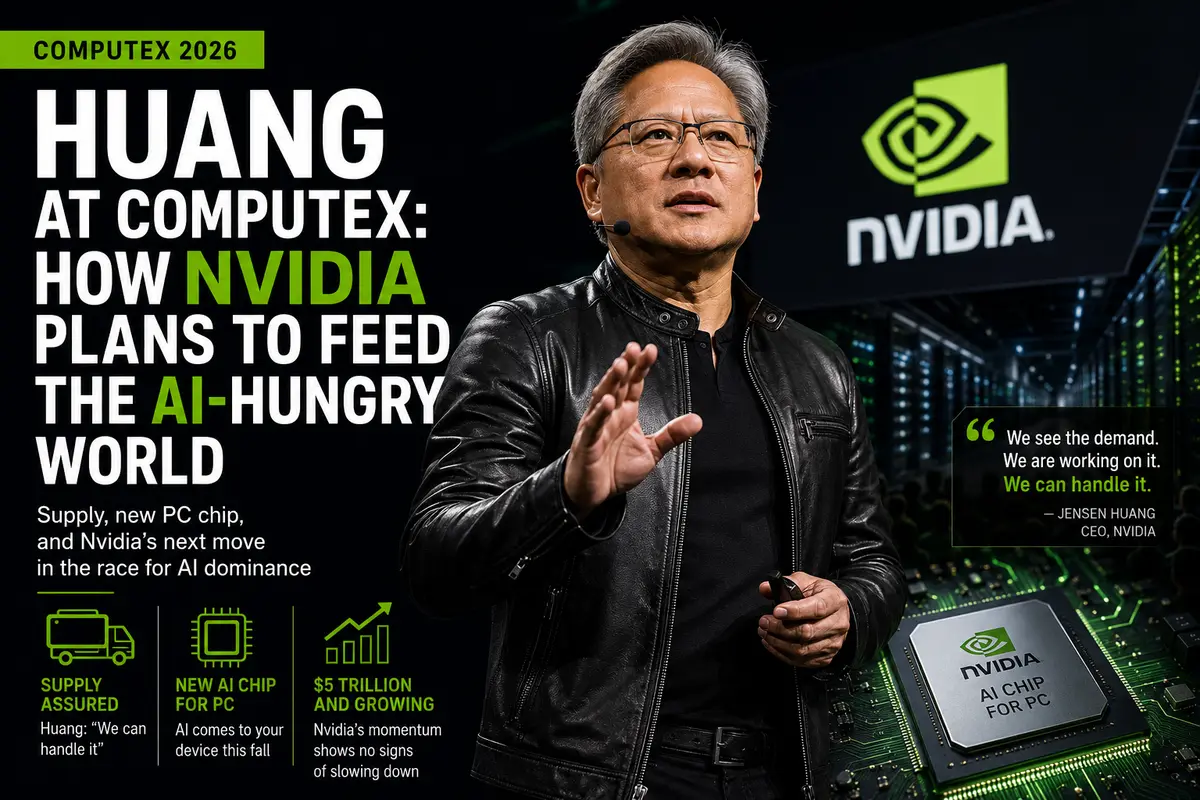
Huang at Computex: How Nvidia Plans to Feed the AI-Hungry World

Huang at Computex: How Nvidia Plans to Feed the AI-Hungry World

Taipei, Computex 2026. The hall is packed to capacity as journalists and analysts from around the world hang on every word of a man who, over the past few years, has transformed from the head of a gaming graphics card manufacturer into one of the most influential figures on the planet. Jensen Huang, Nvidia’s founder and longtime CEO, steps up to the microphone. He is wearing his trademark leather jacket—a signature look that has become as recognizable as Steve Jobs’ black turtleneck. But today, he is not talking about new products; he covered those the day before. Today, he is addressing what concerns markets most: supply. Specifically, whether Nvidia can physically manufacture enough chips to satisfy a world obsessed with artificial intelligence.

“We Can Handle It”: Three Words the Market Was Waiting to Hear

Huang did not mince words. He acknowledged what the market has been whispering about for months: supply constraints remain a real issue. Nvidia, the company powering data centers around the globe with its semiconductor technology, is facing an enormous imbalance between supply and demand. Every new data center, every new large language model, and every AI startup wants Nvidia accelerators. Demand is growing exponentially, outpacing the production capacity of even a giant like Nvidia.

Yet Huang stated that the company has secured sufficient supply to support continued production growth. This was more than just an optimistic remark. It was a signal to investors who had become increasingly anxious about reports of chip shortages and shipment delays. Nvidia’s CEO was effectively saying: we see the problem, we are working on it, and we have addressed it to the extent necessary to keep growing.

Behind those words lies an immense effort. Nvidia does not manufacture chips itself—it designs them and relies on Taiwan’s TSMC and, to a lesser...

Continue reading...
0
0
Tom Maffin

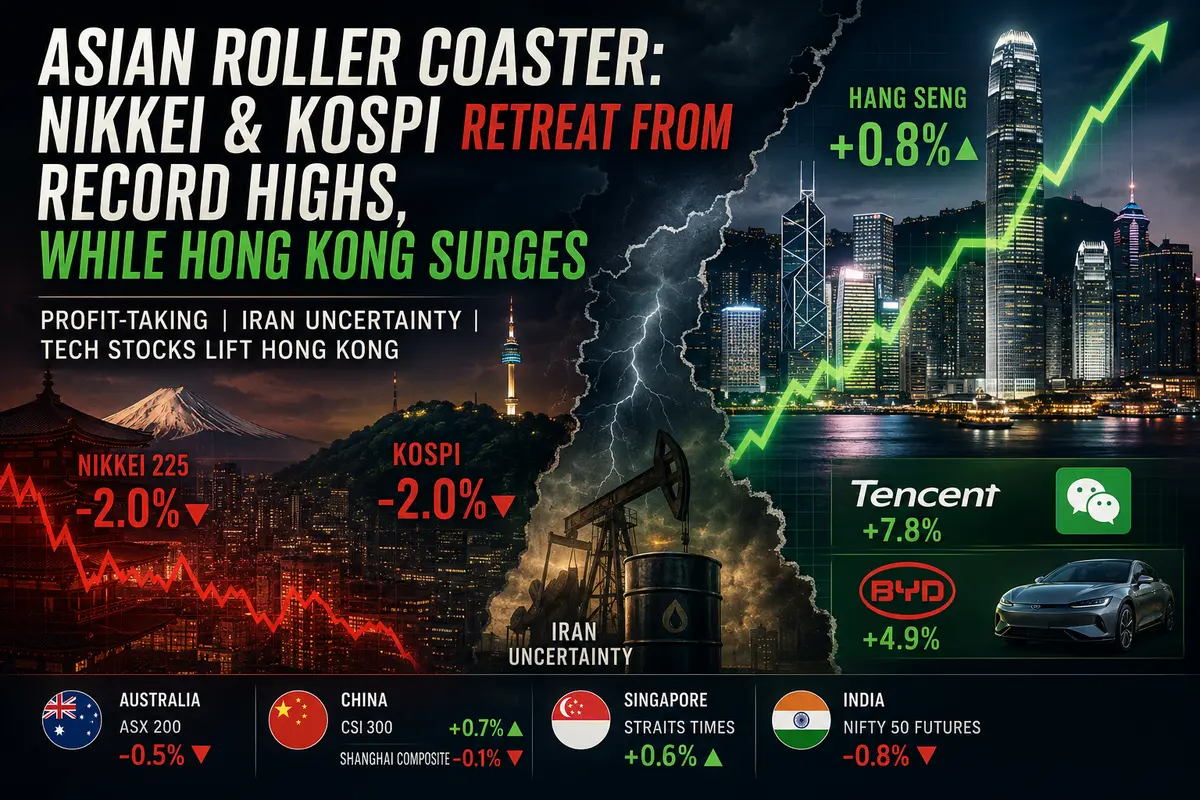
Asian Roller Coaster: Nikkei and KOSPI Retreat from Record Highs While Hong Kong Surges

Asian Roller Coaster: Nikkei and KOSPI Retreat from Record Highs While Hong Kong Surges

Asian markets on Tuesday resembled a patchwork quilt stitched together from conflicting signals. Japan’s Nikkei 225 and South Korea’s KOSPI, which had been celebrating record highs just a day earlier, pulled back by roughly 2%. Hong Kong’s Hang Seng, by contrast, gained 0.8%, lifted by heavyweight technology stocks. Chinese indexes moved in opposite directions, Australia’s market fell following hawkish comments from the central bank, and Indian futures pointed to further losses. All of this unfolded against a backdrop of uncertainty surrounding Iran and profit-taking in the semiconductor sector. Tuesday was a reminder that markets cannot rise forever.

Nikkei and KOSPI: Profit-Taking After the May Rally

Japanese and South Korean equities were among Tuesday’s biggest casualties. Both indexes retreated about 2% from the record levels reached in previous sessions. The reason was as old as the market itself: profit-taking. After an impressive May rally fueled by optimism around artificial intelligence, investors decided it was time to lock in gains.

May was a triumphant month for Asian chipmakers. SK Hynix joined the ranks of trillion-won companies, Samsung reached fresh all-time highs after resolving a labor dispute, while Renesas and Rohm posted double-digit gains. Nvidia added fuel to the rally on Monday by unveiling new AI-related products. But every rally, no matter how powerful, eventually runs out of steam. Tuesday was the day the bulls took a breather.

The decline in South Korea was particularly notable because it coincided with disappointing macroeconomic news. Consumer inflation in May reached a 26-month high, exceeding expectations. This immediately strengthened expectations that the Bank of Korea could raise interest rates again before year-end. Higher rates are generally unfavorable for equities, especially technology stocks, which are highly sensitive to borrowing costs. Korean investors responded to the inflation data by selling.

The Iran Factor: Tehran Suspends Communication Through Intermediaries

...

Continue reading...
0
0

Quiet Revolution: How Overseas Deliveries Saved BYD from a Prolonged Slump

Quiet Revolution: How Overseas Deliveries Saved BYD from a Prolonged Slump

The Hong Kong stock market witnessed an event on Tuesday that BYD shareholders had been waiting eight long months for. Shares of China’s largest electric vehicle manufacturer surged 4.4% to HK$94.75, marking their best single-day gain since late April. The catalyst was the company’s May sales report. BYD finally broke the longest streak of declining sales in its history. Sales increased by 0.3% year-over-year to 383,453 vehicles. The growth was modest—almost within the margin of statistical error. But for a market accustomed to continuous deterioration, it felt like a breath of fresh air.

Eight Months of Decline: Anatomy of a Crisis

To understand why a modest 0.3% increase triggered such a strong market reaction, it is important to recall what BYD has endured over the past several months. A company that was once a symbol of China’s dominance in the electric vehicle industry found itself facing a harsh reality: the domestic market had become saturated, competition had intensified to unprecedented levels, and a fierce price war was squeezing profit margins.

Sales declined for eight consecutive months. This was more than just a statistical trend—it was an indictment of a business model that had become too dependent on a single market. Chinese consumers, who only recently lined up to buy BYD vehicles, now have dozens of brands to choose from, each offering subsidies, discounts, and promotional incentives. BYD found itself caught between the hammer of domestic competition and the anvil of a slowing economy.

Then May brought an unexpected turnaround. And that turnaround happened not in China, but beyond its borders.

Overseas Deliveries as a Lifeline

The primary driver of May’s growth was international sales. BYD has been aggressively expanding its presence outside China, and that strategy is finally beginning to pay off. The company now sells vehicles across Europe, Southeast...

Continue reading...
0
0

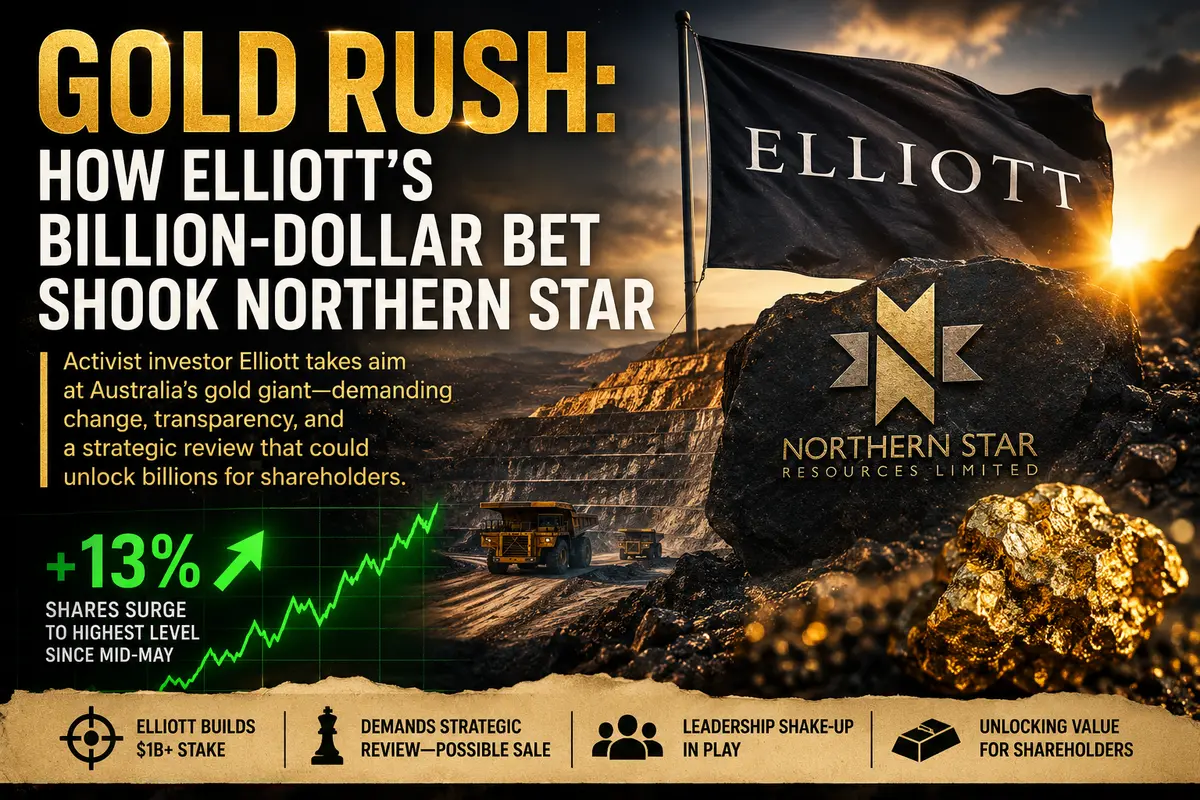
Gold Rush: How Elliott’s Billion-Dollar Bet Shook Northern Star

Gold Rush: How Elliott’s Billion-Dollar Bet Shook Northern Star

There are certain types of news in financial markets that hit like an electric shock. When Elliott Investment Management, one of the world’s most prominent and aggressive activist hedge funds, reveals a major stake in a company, it is never accidental. There is always a strategy, a plan, and a willingness to fight behind the move. On Tuesday, Elliott disclosed a stake worth more than A$1 billion in Northern Star Resources, the Australian gold miner. The company’s shares immediately surged more than 13%, reaching their highest level since mid-May.

This is a classic market reaction to the arrival of an activist investor: everyone knows Elliott will not sit quietly on the sidelines. It will push for change. And those changes typically lead to higher shareholder value.

Elliott Isn’t Just Visiting: What’s Behind the Stake Disclosure

Elliott Investment Management is not a passive fund that buys shares and waits quietly for dividends. It is an activist investor with a long history of successful campaigns against companies it believes are undervalued due to poor management. When Elliott takes a position, it usually means significant changes are coming—either voluntarily or under pressure.

In Northern Star’s case, Elliott wasted no time getting to the point. The fund stated that the gold miner should undertake a strategic review that could include a sale of the company. This is not merely a suggestion—it is effectively an ultimatum. Elliott believes Northern Star is undervalued and argues that the problem lies not in market conditions but in management execution.

The fund accused the company of “operational missteps” and “insufficient disclosure” compared with its peers. Put simply, other gold miners are operating more effectively and communicating more transparently, while Northern Star has, in Elliott’s view, obscured problems behind limited reporting.

The market clearly agreed. Shares jumped...

Continue reading...
0
0
Lin Brings

Oil Between Peace and War: WTI Stalls as the Market Awaits the Outcome of the Iranian Drama

Oil Between Peace and War: WTI Stalls as the Market Awaits the Outcome of the Iranian Drama

Tuesday’s Asian trading session brought another pause to the oil market. July WTI crude futures slipped by a modest 0.5% to $91.65 per barrel. Brent followed its American counterpart, falling 0.47% to $94.53 per barrel. The moves were minimal—almost statistical noise. Yet beneath this apparent calm lies a market holding its breath. Too many unresolved questions remain in the air. Too much depends on what happens in the coming days. And traders, having learned hard lessons over recent months, are reluctant to make any aggressive moves.

Between Support and Resistance: Oil Searches for Equilibrium

The technical picture for WTI resembles a classic trading range. Support at $86.35 has proven resilient during recent declines. Each time prices approached this level, buyers stepped in, preventing bears from pushing the market lower. This suggests that the underlying supply deficit in the oil market remains intact. The Strait of Hormuz is still operating under restrictions, supply chains remain disrupted, and prices have been unable to fall significantly.

Resistance at $94.74 has become the ceiling that recent rallies have failed to break. Every attempt to move higher has been met with heavy selling pressure. This indicates that the market does not believe in an unchecked upward move. Hopes for a ceasefire with Iran, however fragile, continue to cap prices from above. Few traders want to be caught in long positions if a ceasefire is announced tomorrow and the Strait reopens.

As a result, oil remains trapped in a corridor between roughly $86 and $95 per barrel for WTI. It has traded within this range for several weeks, and neither bulls nor bears have been able to force a breakout.

Brent-WTI Spread: Three Dollars of Geopolitical Premium

The price difference between Brent and WTI currently stands at $2.88 per barrel. This moderate spread reflects the remaining...

Continue reading...
0
0
Tom Maffin

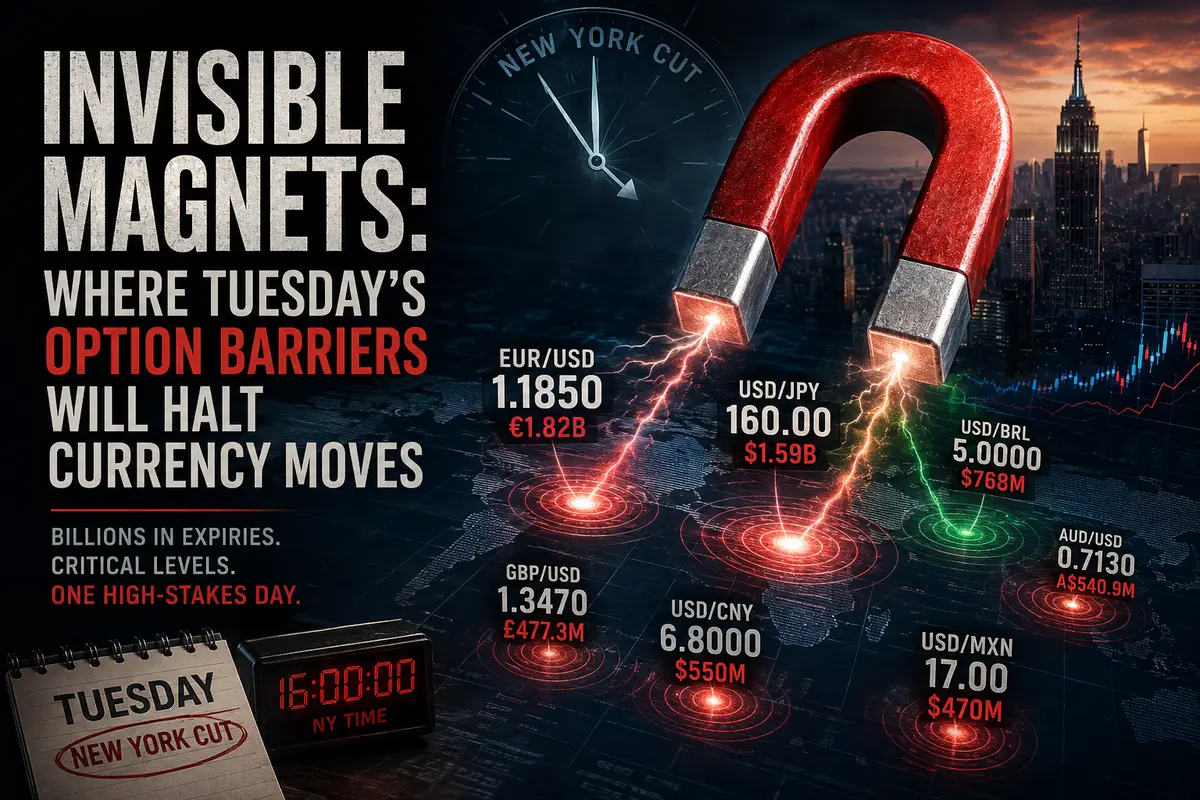
Invisible Magnets: Where Tuesday’s Option Barriers Could Halt Currency Moves

Invisible Magnets: Where Tuesday’s Option Barriers Could Halt Currency Moves

Tuesday’s New York cut. For most people, it’s simply the close of the U.S. trading session. For FX traders, it’s a moment of truth. Options contracts worth billions of dollars are set to expire, and these expiries often exert an almost gravitational pull on spot exchange rates, drawing them toward specific levels. Market makers hedging their positions will do everything possible to keep prices near major strikes. Once the options expire, however, those anchors disappear—and the market may make a sharp move. Let’s look at the key currency pairs and where the traps are set today.

EUR/USD: Nearly €2 Billion at 1.1850

The main magnet for the euro today sits at 1.1850, where options totaling €1.82 billion are due to expire. This is not just a large expiry—it is a gravitational anomaly. The spot rate could be pulled toward this level during the final hours before the New York cut.

Additional anchors include €1.51 billion at 1.1750 and €1.27 billion at 1.1700. Together, these levels create a web of attraction within which the pair may fluctuate. Market makers will actively manage their positions to minimize payouts on expiring contracts. If EUR/USD trades below 1.1850, they may buy euros and push the price higher; if it trades above, they may sell and pull it back toward the strike. This is classic options-related gravity, making sharp moves before expiry less likely.

Notably, an even larger expiry is scheduled for Wednesday: €2.47 billion at 1.1710. This suggests that even after Tuesday’s cut, the market will not gain complete freedom—the next anchor is already waiting.

USD/JPY: 160.00 Is the Red Line

For dollar-yen, the primary magnet is 160.00, where $1.59 billion in options expire. The 160 level is the same red line that triggered large-scale foreign exchange intervention by the...

Continue reading...
0
0

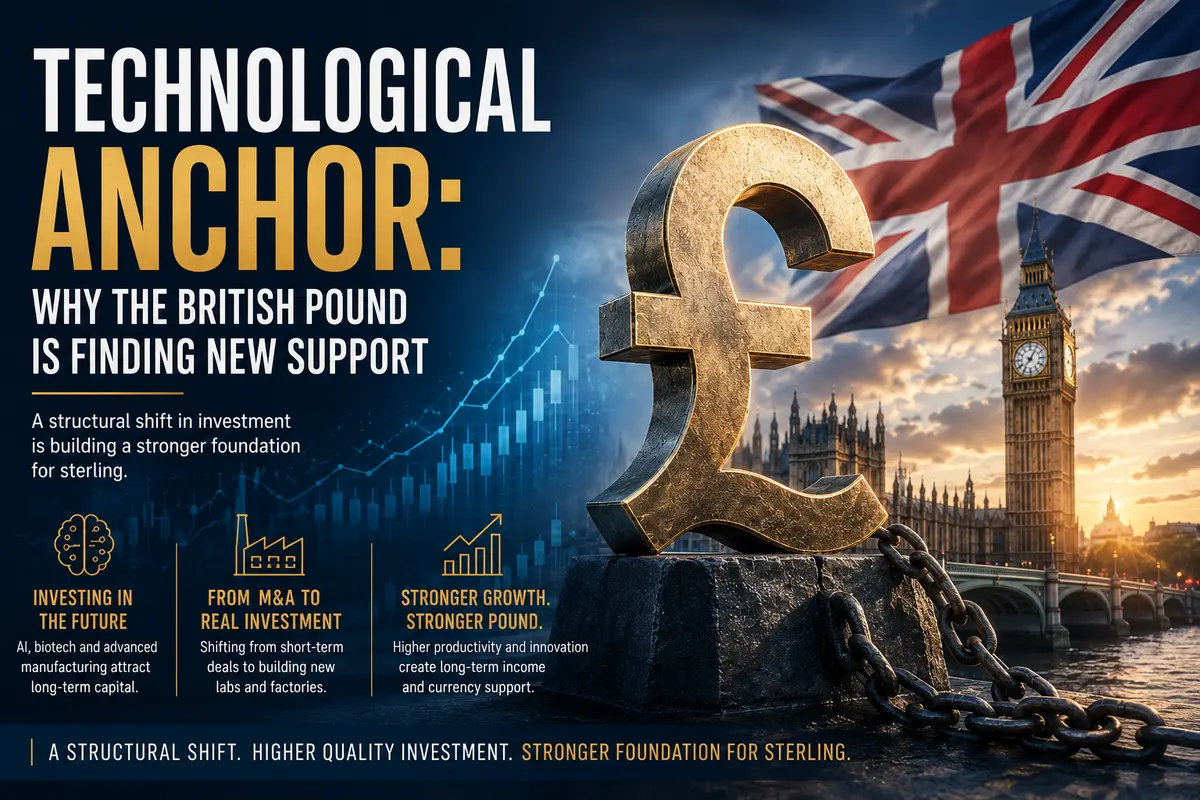
Technological Anchor: Why the British Pound Is Finding New Support

Technological Anchor: Why the British Pound Is Finding New Support

In recent years, the British pound has often looked like a currency adrift. Brexit, political turmoil, scandals involving prime ministers, inflation shocks, and the Iran crisis have all weighed on sterling from different directions. Yet beneath the surface of this turbulence, largely unnoticed by newspaper headlines, a structural shift has been taking place. According to Bank of America strategist Kamal Sharma, this shift could become a long-term pillar of support for the pound. The shift has a name: a transformation in the quality of foreign direct investment (FDI).

From Mergers and Acquisitions to Laboratories and Factories

For decades, sterling was highly sensitive to global mergers and acquisitions (M&A) cycles. When international corporations acquired British companies, billions of dollars flowed into the country, strengthening the pound. When M&A activity slowed, the currency weakened. This created a chronic dependence on short-term, volatile capital flows. A deal closed, money arrived. No deals, no money. The pound effectively danced to the tune of Wall Street investment bankers.

Now, according to EY data cited by Bank of America, the nature of investment flows is changing. The UK is gradually moving away from its dependence on mergers and acquisitions. Instead, it is attracting investment into new production facilities and research and development (R&D). Capital is no longer being used primarily to purchase existing assets but to create new ones. This represents a fundamentally different quality of investment.

Sharma points to specific sectors: artificial intelligence, biotechnology, and advanced manufacturing. These are knowledge-intensive industries that create high-paying jobs, generate intellectual property, and improve economic productivity. When Google or Microsoft opens a research center in Cambridge, when a pharmaceutical giant builds a laboratory in Oxford, or when a semiconductor manufacturer establishes a plant in Scotland, it is not merely a one-off capital inflow. It is the creation of long-term...

Continue reading...
0
0
NorthRay

Indices: How I Bought 500 Companies with One Click (and Why I Liked It)

Indices: How I Bought 500 Companies with One Click (and Why I Liked It)

Hi, this is NorthRay.🆕

Remember when I told you I wanted to buy Apple but couldn't because the market was closed?

Then I opened a trade on the SPX (the S&P 500 index). It closed with a small profit.

And that got me hooked.

Because there's something almost magical about indices. You buy one thing—and instantly get exposure to hundreds of companies. You don't have to guess whether Apple will soar or Tesla will fall. You're simply betting on the entire U.S. economy.

Spoiler: I liked it.

Today I'll explain what indices are, how they work, and why I now watch them almost as often as EUR/USD.

What Is an Index? (The Simple Explanation)

An index is a basket of stocks.

Instead of buying 500 individual stocks, you buy one instrument—the index—and it moves according to the average performance of the companies inside it.

Here's a simple analogy:

Imagine you're a teacher. You don't need to know how every student performed on an exam. You only need to know the class average.

If the average score is high, the class did well. If it's low, the class struggled.

An index is basically the average score of a group of companies.

Some companies inside the index may be rising while others are falling. The index shows the overall result.📉

The Most Important Indices in the World

There aren't that many. I learned five of them, and that's enough to get started.

Why Indices Are More Convenient Than Individual Stocks

I've traded both individual stocks (Apple) and indices (S&P 500). Here's what I've learned.

1. Less Stress

A single company can drop 10–20% because of one bad news story: a management scandal, a failed product launch, or a lawsuit.

An index made up of 500 companies is less likely to suffer such...

Continue reading...
0
0
Navigation menu
instaforex banner