
Bar Pipa
We pay for a post of 10$

Bitcoin

Tom Maffin

Bitcoin: What the Capitulation of the Coin’s Top Holders Is Telling Us

Bitcoin: What the Capitulation of the Coin’s Top Holders Is Telling Us
The Strongest Hands Have Finally Given Up

The world of Bitcoin has its own hierarchy of resilience. Newcomers buy at the top and sell at the bottom. Experienced traders try to time the market but often get it wrong. And then there is a special class of investors: long-term holders. These are the people who buy coins and leave them untouched in their wallets for months or years. They do not react to the news. They do not stare at charts every hour. They simply believe.

They believe that Bitcoin is the future of money, that the current price is irrelevant, and that sooner or later everything will pay off.

These people form the backbone of the Bitcoin community. They are often called “diamond hands.” As long as they hold, the market has a floor. As long as they are not selling, a decline does not turn into a collapse.

But in recent weeks, something has broken. Long-term holders—those who have held their coins for at least 155 days—have become sellers. And they are selling a lot. A very large amount.

According to analysts at Compass Point, they sold roughly $2.4 billion worth of Bitcoin over the past two days. Two and a half billion dollars in just 48 hours. This is not profit-taking. This is an exodus. This is capitulation.

Ed Engel, a Compass Point analyst who tracks long-term holder behavior, notes that these investors were largely inactive from February through April. They sat on their coins, watched Bitcoin fall from its October highs above $126,000, and did not budge. They endured. They hoped for a reversal.

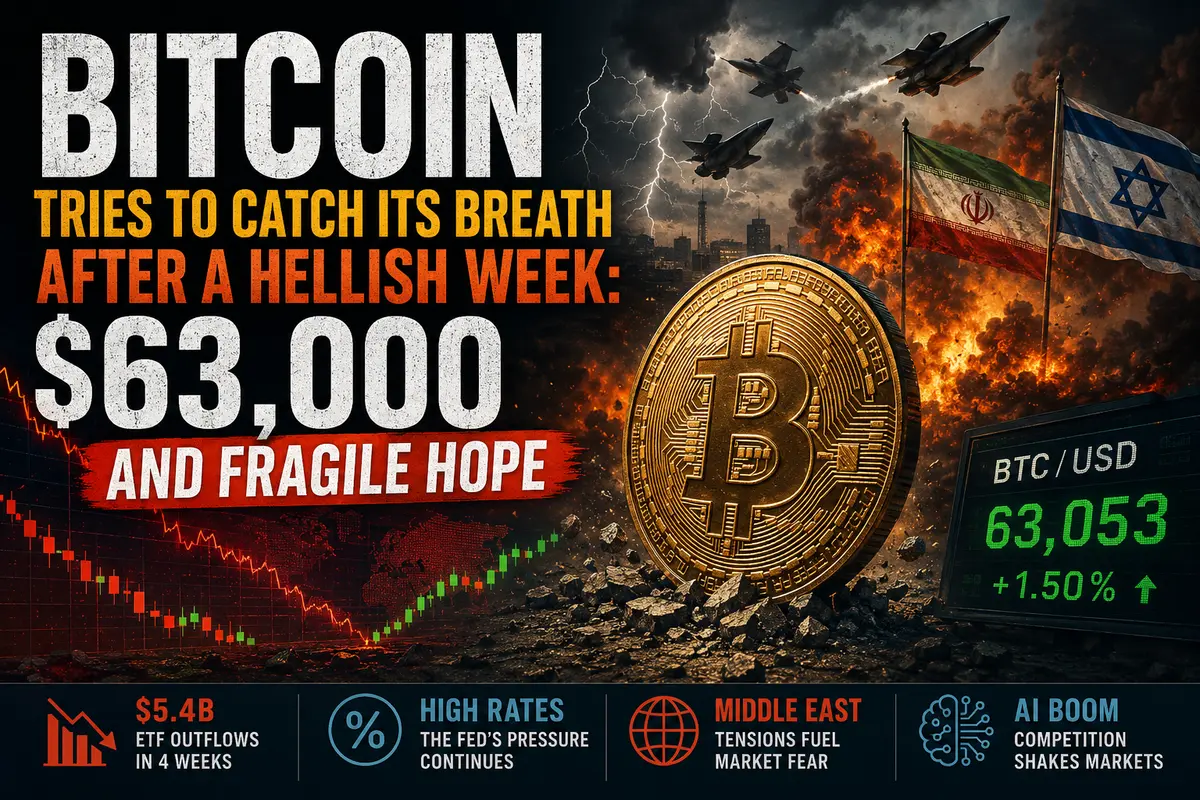
But hope has faded. The price has fallen below $64,000. The conflict in the Middle East is not ending—it is escalating. Institutional investors have withdrawn money from Bitcoin ETFs for twelve consecutive...

Continue reading...
0
0
John Madnes

Cardano Cryptocurrency Plunges 10% in a Bearish Market Pullback

Cardano Cryptocurrency Plunges 10% in a Bearish Market Pullback
Friday the 13th for ADA Holders

Friday turned into a bloodbath for Cardano supporters. Cardano, once among the world's top three cryptocurrencies and a contender for the throne, fell 10.17% in a single day. The price dropped to $0.1728, marking its sharpest decline since June 4 and coming at a time when the broader market was already on edge.

The numbers confronting ADA holders are enough to break the heart of even the most resilient crypto enthusiast. Cardano’s market capitalization shrank to $6.28 billion. That sounds enormous until you remember that at its peak in 2021, Cardano was worth nearly $95 billion. Since then, its value has evaporated like morning mist. The token has lost 94% of its value from its all-time high of $3.10 reached on September 2, 2021.

Over the past week, Cardano has fallen 26%. Twenty-six percent in seven days is not a correction—it is a collapse. Trading volume over the last 24 hours reached nearly $937 million, accounting for 0.69% of the entire cryptocurrency market's turnover. People are selling in panic. Some are cutting their losses; others are simply leaving and may never return to the asset.

At the time of writing, Cardano ranks 15th among all cryptocurrencies by market capitalization. It was once third. That decline in ranking is perhaps the clearest indication of how much has gone wrong.

But the most frightening aspect for holders is not the numbers themselves. It is the news accompanying them. Project founder and spiritual leader Charles Hoskinson announced that he is taking a “creative break.” Just four words posted on X: “I'm taking a break. TTYL.” The market heard those words—and collapsed.

Four Words That Wiped Out Billions

It is difficult to overstate Hoskinson’s influence on Cardano. He is not merely the founder; he is the face, voice,...

Continue reading...
0
0

Strategy Shares Fall After First Bitcoin Sale Since 2022

Strategy Shares Fall After First Bitcoin Sale Since 2022
From an ironclad “never” to the first step back

The cryptocurrency market is used to surprises, but the news that emerged this past Monday caught even the most seasoned Bitcoin enthusiasts off guard. Strategy Inc. — a company that for years has served as a living symbol of unwavering faith in Bitcoin — has sold part of its Bitcoin holdings. For the first time since 2022. The amount was modest, around $2.5 million. Yet the mere fact of the sale sent the company’s stock down nearly 5% in premarket trading.

For those who have followed the story of Strategy (formerly known as MicroStrategy), this move looks like a crack in the foundation. Michael Saylor, the company’s co-founder and chief evangelist, spent years repeating the same mantra: “We do not sell Bitcoin. Ever.” His strategy was brilliantly simple — borrow money, issue bonds, raise capital by any available means, and convert it into Bitcoin. Accumulate at all costs. Hold indefinitely. And now, that narrative has begun to soften.

What Happened

Investors and analysts immediately turned to the regulatory filings submitted after the transaction. What they found was intriguing: the sale was not a panic move or a forced liquidation during a market downturn. Strategy remains the world’s largest corporate holder of Bitcoin, with approximately $61 billion worth of the cryptocurrency still on its balance sheet. The sale was largely symbolic and does not alter the broader picture.

But this is not really about the money. It is about the signal.

When someone who has spent years pledging eternal commitment suddenly takes a step back, the market starts asking questions. The stock did not fall because the company lost $2.5 million. It fell because traders realized that the principle of “buy only, never sell” is no longer absolute.

Saylor himself hinted at...

Continue reading...
0
0

Bitcoin Under Fire: How Iranian Bombs and ETF Flight Crushed Crypto

Bitcoin Under Fire: How Iranian Bombs and ETF Flight Crushed Crypto

Wednesday became the kind of day Bitcoin investors would rather forget as quickly as possible. The world’s leading cryptocurrency plunged below seventy-six thousand dollars, touching 75,820 dollars and losing one point seven percent during the session. But the percentages are not even the main story. The real issue is the context.

While tech stocks on Wall Street and across Asia were climbing to fresh highs, Bitcoin moved sharply in the opposite direction. This divergence — with the NASDAQ and S&P 500 hitting record levels while crypto trades in the red — suggests something specific is happening inside the crypto market, unrelated to the broader appetite for risk. And the name of that “something” is a combination of geopolitical fear and institutional flight.

The Iranian Front: Bombs That Hit Bitcoin

New U.S. strikes on Iranian targets earlier this week continue to poison sentiment across the crypto market. Iran called the attacks a violation of the ceasefire agreement. U.S. officials responded by describing the strikes as defensive in nature. But for traders, the legal wording means little. What matters is that the conflict is not cooling down — it is escalating again.

Moreover, the geopolitical fire has begun spreading beyond the direct U.S.-Iran confrontation. Reports emerged of Israeli strikes in southern Lebanon. This is no longer merely a bilateral conflict; it is beginning to resemble the expansion of a regional war. And for cryptocurrencies, which are still widely viewed as risk assets, such escalation is a direct hit.

The logic here, however, is more complicated than it first appears. Normally, periods of geopolitical tension should support Bitcoin as a defensive asset — digital gold. But what we are witnessing is the opposite. Why? Because the current conflict hurts Bitcoin indirectly through the monetary channel.

War drives oil prices higher. Higher oil prices...

Continue reading...
0
0

Silence on the Airwaves: Why Bitcoin Fell Asleep While the AI Sector Went Crazy

Silence on the Airwaves: Why Bitcoin Fell Asleep While the AI Sector Went Crazy

Nine months. That’s how long it has been since Bitcoin was last this boring. The Bitcoin Volmex implied volatility index — the market’s thermometer of excitement — has dropped to 36.11, its lowest level since last September. The price is stuck around seventy-seven thousand dollars, nearly forty percent below the all-time high above one hundred twenty-six thousand reached in October. And while traders in the worlds of equities and semiconductors are losing their minds over massive rallies, the crypto market has sunk into a lethargic sleep. This is not a crash, not a collapse, not capitulation. It is something more insidious — a slow fading of interest.

Hot Money Moved Into AI

To understand where the speculative capital went, you only need to look at the headlines of recent weeks. South Korea’s KOSPI is hitting record highs. Japan’s Nikkei is storming historical peaks. SK Hynix has just entered the trillion-dollar company club. Samsung is celebrating the resolution of its labor dispute and climbing higher as well. This entire fireworks show is happening in one sector — manufacturers of memory chips, AI accelerators, and related hardware. That is where the “hot money” has gone: into AI and semiconductor stocks, absorbing the same speculative capital that once fueled crypto rallies.

Orbit Markets co-founder Caroline Mauron puts it with brutal clarity: “Retail interest is flowing into other sectors in search of new trading opportunities, as confirmed by ETF outflows.” And the numbers do not lie. In May, around one billion dollars was withdrawn from U.S. spot Bitcoin ETFs, breaking a two-month streak of inflows. Institutional investors who had enthusiastically entered crypto through regulated products are now taking profits or cutting positions.

The logic behind this exodus is simple and ruthless. Bitcoin is trapped in a range. It cannot break resistance and move to...

Continue reading...
0
0

Bitcoin on a Rollercoaster: How Hopes for Peace and Nasdaq Options Brought Crypto Back to Life

Bitcoin on a Rollercoaster: How Hopes for Peace and Nasdaq Options Brought Crypto Back to Life

Monday began with a number that still seemed lost on Saturday: seventy-seven thousand dollars. A round, psychologically important level from which the world’s leading cryptocurrency bounced back after falling to seventy-four thousand three hundred over the weekend. A market that was licking its wounds yesterday is once again looking upward today. And there are at least two reasons for it: one rooted in geopolitics, the other in institutional finance. Together, they created the perfect cocktail that pulled Bitcoin out of the pit and forced traders to rethink the near-term outlook.

Iranian Optimism: How Peace Talks Are Moving Crypto

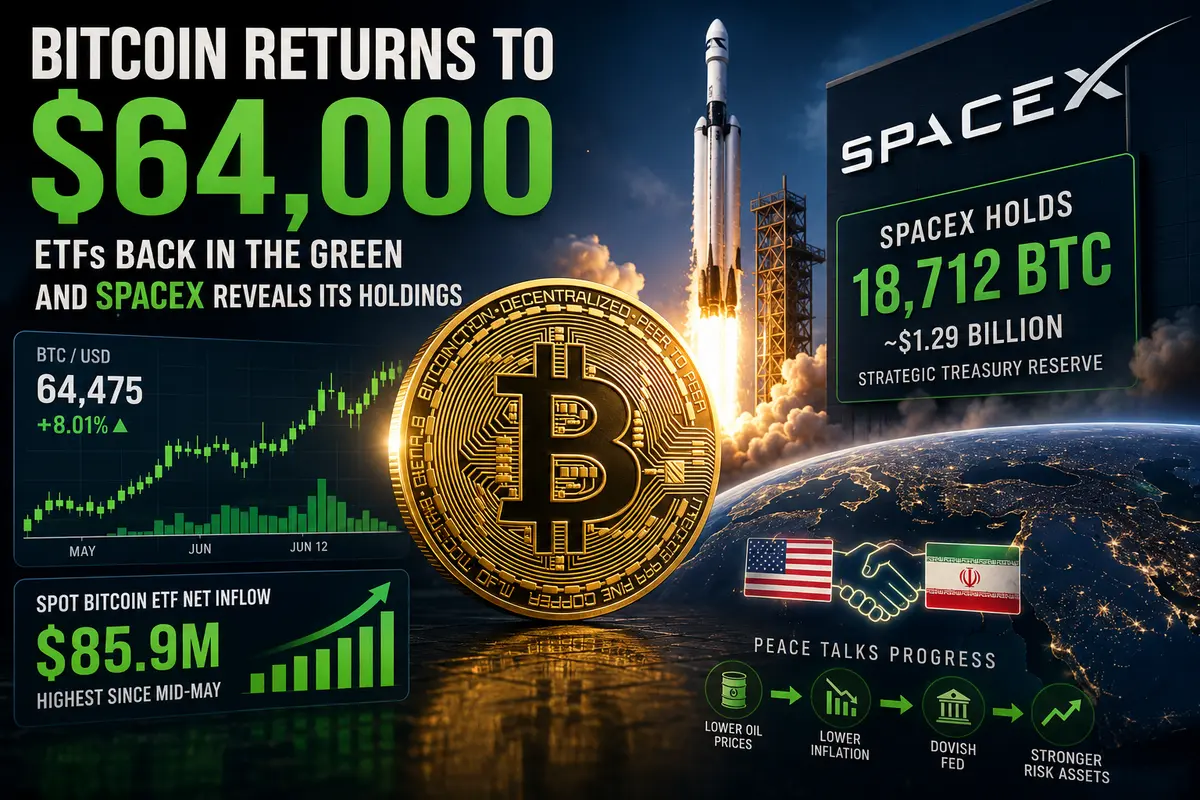
The connection between Bitcoin and negotiations in Doha is not obvious at first glance. But dig deeper, and the logic becomes clear. Hopes for a peace agreement between the United States and Iran, which emerged over the weekend, imply the potential reopening of the Strait of Hormuz. Reopening the strait means restoring oil supplies. Restored supplies mean lower energy prices. Lower energy prices mean weaker inflationary pressure. And weaker inflation means the Federal Reserve may not need to tighten policy further or raise rates.

For Bitcoin, which has spent recent months suffocating under fears of persistently high interest rates, this chain reaction is like a breath of fresh air. High rates crush appetite for risk assets. Investors move into bonds, the dollar, and anything offering guaranteed yield. Cryptocurrency, which generates no cash flow, suffers first in such an environment. But the moment there is hope for easier monetary policy, capital starts flowing back in.

Of course, geopolitical optimism is fragile. We have seen how quickly it can evaporate. One strike on Iranian facilities, one harsh statement from Tehran, one Trump tweet — and Bitcoin could tumble again. But on Monday, the market chose to focus on the bright side. Talks are ongoing,...

Continue reading...
0
0

Digital Lari: How Tether and Georgia Are Rewriting the Rules of the Game in the Post-Soviet Space

Digital Lari: How Tether and Georgia Are Rewriting the Rules of the Game in the Post-Soviet Space

Tbilisi rarely makes headlines in global financial news. Mountain landscapes, ancient wineries, khachapuri, and hospitality — those are usually the first things that come to mind when people think of Georgia. But today, this small country at the crossroads of Europe and Asia has taken a step that could turn it into one of the world’s most intriguing testing grounds for digital currency experiments.

Tether, the issuer of the world’s largest dollar-backed stablecoin, USDT, with a market capitalization of $189 billion, has announced the launch of GEL₮ — a stablecoin pegged to the Georgian lari. And this is not a private initiative carried out around the authorities. The project is being implemented with the direct support of the Georgian government. The world has never seen an alliance between a state and the crypto industry quite like this.

What Is GEL₮ and Why Does It Matter?

GEL₮ is a digital token whose value is tied to the Georgian lari. One token equals one lari. Unlike volatile cryptocurrencies such as Bitcoin, a stablecoin does not swing wildly in price. It performs the same function as ordinary money, but within a digital environment.

Transfers, payments, and transaction settlements can all be carried out using GEL₮ faster, cheaper, and more transparently than through the traditional banking system.

Tether describes the advantages in the same language tech companies use to market their products: lower transaction costs, near-instant settlements, programmable payments, and efficient movement of funds within digital financial infrastructure. Behind these technical terms lies a simple reality: GEL₮ could become the bridge connecting Georgia’s traditional economy with the world of decentralized finance.

A Georgian farmer selling wine to Europe could receive payment instantly in stablecoins, without waiting weeks for an international bank transfer and without losing margins to fees. A Georgian freelancer working for overseas...

Continue reading...
0
0

Bitcoin Over the Abyss: An Oil Truce Beckons, but Bond Yields Keep a Stranglehold

Bitcoin Over the Abyss: An Oil Truce Beckons, but Bond Yields Keep a Stranglehold

Seventy-seven thousand one hundred twenty-seven dollars. On Wednesday evening, Bitcoin hovered at that mark, gaining a symbolic four-tenths of a percent for the session. A move that, in normal times, wouldn’t even make the news feed now tells an entire story. A story about how the world’s leading cryptocurrency is trying to find solid ground after being rejected from the coveted eighty-two-thousand-dollar level and thrown back into the abyss of uncertainty. And that abyss is lined not with technical failures or regulatory fears, but with old-fashioned macroeconomic forces — Treasury yields, oil prices, and geopolitical swings orchestrated personally by Donald Trump.

The Iranian Pendulum: From Bombs to Negotiations in Sixty Minutes

Trumpian diplomacy is always theater, and the current Iranian drama is no exception. On Tuesday, the U.S. president made a statement that left traders breathless. He admitted he was “an hour away” from authorizing another military strike against Iran. One hour. Sixty minutes separated the world from another escalation in the Persian Gulf, another spike in oil prices, another wave of inflation, and, as a consequence, another collapse in risk assets, including cryptocurrencies. But the strike was postponed. Trump decided to give diplomacy one more chance.

The admission was a masterful rhetorical maneuver. At the same time, Trump portrayed himself as both a decisive leader ready to press the button and a prudent peacemaker who prefers negotiations over war. For markets, this creates an explosive mixture of hope and fear. Hope that the conflict may genuinely be moving toward resolution. Fear that the entire structure could collapse at any moment. Vice President J.D. Vance added fuel to the fire by declaring that the United States would remain “ready for combat” if negotiations fail. A double signal: we believe in peace, but our hand remains on the trigger.

For Bitcoin,...

Continue reading...
0
0
Lin Brings

Millions Spent on Bodyguards: How the Crypto Industry Is Becoming a Fortress Under Siege

Millions Spent on Bodyguards: How the Crypto Industry Is Becoming a Fortress Under Siege

Las Vegas, May 2026. At first glance, the Bitcoin 2026 conference looks little different from any other tech expo: the same brightly lit booths, the same panel discussions, the same constant hum of networking in the hallways. But it only takes a closer look at how the speakers move around to realize that something unusual is happening here. Top executives are surrounded by men with military posture, dressed in tailored suits and wearing discreet earpieces. These are not assistants. They are professional bodyguards — former special forces operatives hired to protect against a threat that would have seemed unimaginable just a few years ago.

The crypto industry, born from idealistic dreams of freedom from intermediaries, has found itself cornered by brutal physical reality. And that reality is armed with a crowbar.

The Wrench as a Hacking Tool

In the professional jargon of security specialists, it’s called a “wrench attack.” The scheme is brutally simple: criminals identify the owner of a large crypto wallet, break into their home, beat them or threaten their family until they transfer the funds. No sophisticated code. No exploits. No phishing. Just brute force and human fear. And statistics show the method works with alarming efficiency.

The database maintained by Casa, a company specializing in custody solutions, records a threefold increase in such attacks since 2023. CertiK, one of the leading blockchain security auditing firms, reports even more disturbing numbers: in 2025, confirmed physical incidents rose by seventy-five percent. Seventy-two documented cases. Forty-one million dollars in direct losses. And those are only the incidents that made it into official reports. Many victims stay silent, fearing repeat attacks or unwilling to reveal the scale of their losses.

The wording used by CertiK sounds almost like a verdict: “2025 became the turning point. Physical violence is now the...

Continue reading...
0
0

Millions Spent on Bodyguards: How the Crypto Industry Is Defending Itself Against Kidnappings

Millions Spent on Bodyguards: How the Crypto Industry Is Defending Itself Against Kidnappings

Las Vegas, Bitcoin 2026 conference. On the surface, everything looks familiar: booths packed with mining hardware, Bitcoin-logo T-shirts, endless networking parties. But it only takes a closer look at how top crypto executives move through the venue to realize something has changed. They are surrounded by people in tailored suits wearing the unmistakable transparent coiled earpieces. These are not assistants or colleagues. They are professional bodyguards — former military personnel and private security contractors.

Step into one of the overcrowded seminars, and you may hear a topic that would have sounded exotic just a few years ago: how to protect your assets during a physical home invasion. The crypto industry, built on ideals of anonymity and decentralization, has run into the most primitive and terrifying threat imaginable — physical violence.

A Wrench Versus a Private Key

The threat known in security circles as a “wrench attack” — when a victim is beaten until they surrender a password — is no longer a dark joke shared among cybersecurity professionals. It has become the industry’s reality.

A database maintained by custody solutions provider Casa shows that such attacks have tripled since 2023. CertiK’s statistics are even more alarming: in 2025, the number of confirmed physical incidents rose by seventy-five percent. Seventy-two documented cases. Forty-one million dollars in losses. And those are only the incidents that became public. CertiK analysts are blunt in their assessment: 2025 marked a turning point, when physical violence became a primary threat vector for crypto holders.

The criminals’ logic is simple and ruthless. Cryptocurrency was designed to eliminate intermediaries. There is no bank that can freeze a transfer, no regulator that can lock an account. The private key is the only thing separating an owner from their fortune. And that also makes it the perfect target.

Steal the...

Continue reading...
0
0
Navigation menu