
Oil Between Peace and War: WTI Stalls as the Market Awaits the Outcome of the Iranian Drama
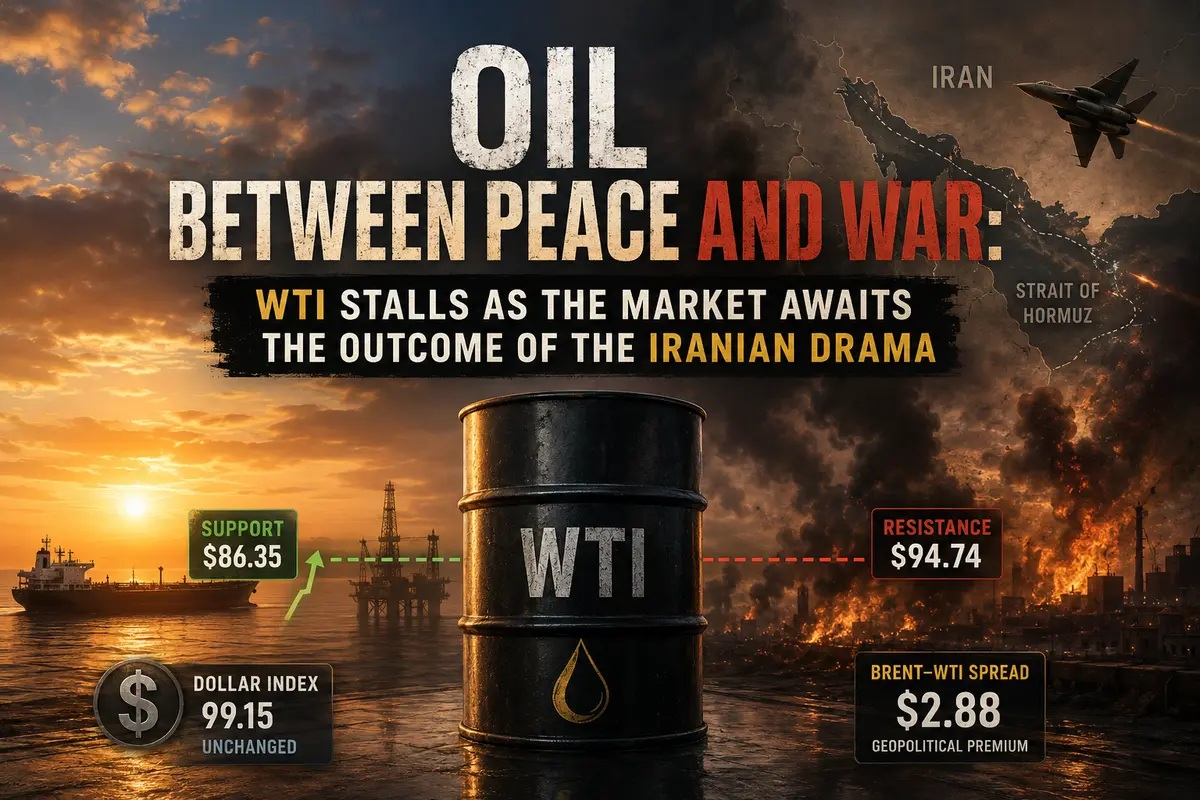
Tuesday’s Asian trading session brought another pause to the oil market. July WTI crude futures slipped by a modest 0.5% to $91.65 per barrel. Brent followed its American counterpart, falling 0.47% to $94.53 per barrel. The moves were minimal—almost statistical noise. Yet beneath this apparent calm lies a market holding its breath. Too many unresolved questions remain in the air. Too much depends on what happens in the coming days. And traders, having learned hard lessons over recent months, are reluctant to make any aggressive moves.
Between Support and Resistance: Oil Searches for Equilibrium
The technical picture for WTI resembles a classic trading range. Support at $86.35 has proven resilient during recent declines. Each time prices approached this level, buyers stepped in, preventing bears from pushing the market lower. This suggests that the underlying supply deficit in the oil market remains intact. The Strait of Hormuz is still operating under restrictions, supply chains remain disrupted, and prices have been unable to fall significantly.
Resistance at $94.74 has become the ceiling that recent rallies have failed to break. Every attempt to move higher has been met with heavy selling pressure. This indicates that the market does not believe in an unchecked upward move. Hopes for a ceasefire with Iran, however fragile, continue to cap prices from above. Few traders want to be caught in long positions if a ceasefire is announced tomorrow and the Strait reopens.
As a result, oil remains trapped in a corridor between roughly $86 and $95 per barrel for WTI. It has traded within this range for several weeks, and neither bulls nor bears have been able to force a breakout.
Brent-WTI Spread: Three Dollars of Geopolitical Premium
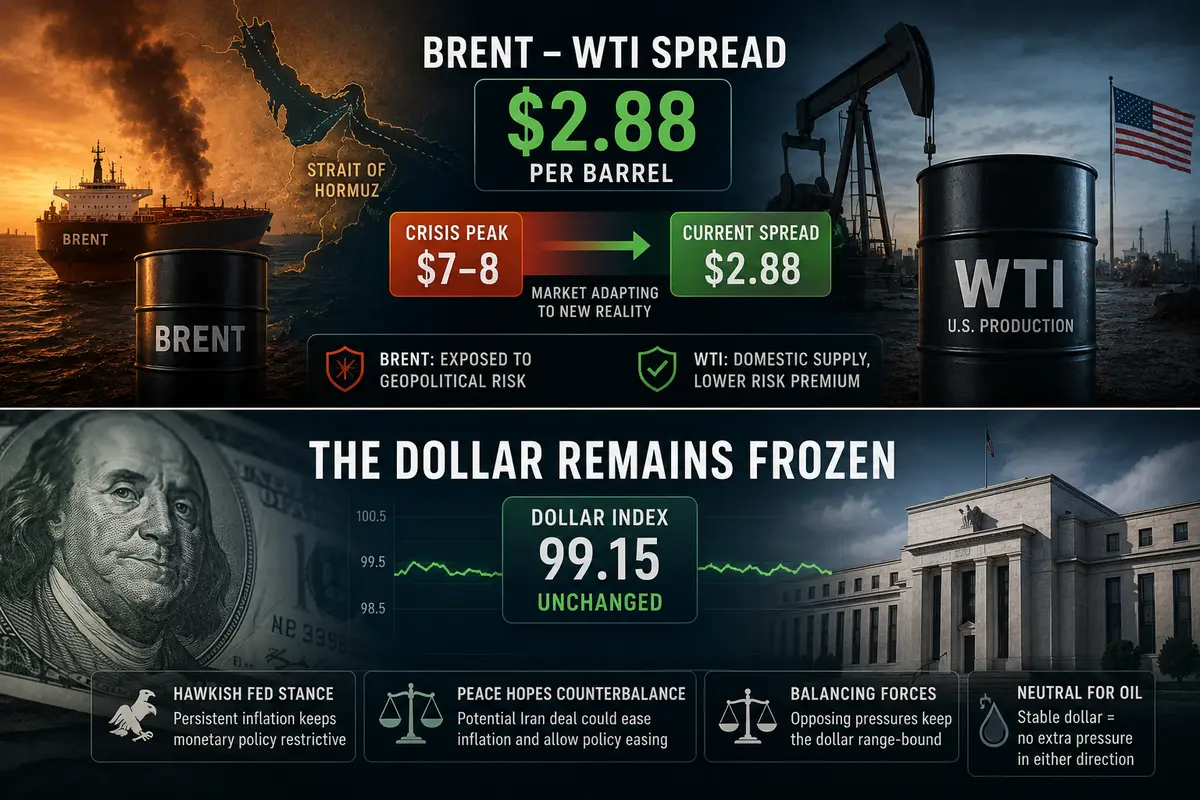
The price difference between Brent and WTI currently stands at $2.88 per barrel. This moderate spread reflects the remaining geopolitical premium embedded in the global benchmark. For comparison, at the height of the crisis—when the Strait of Hormuz was initially closed—the spread widened to $7–8 per barrel. Its subsequent narrowing suggests that the market has partially adapted to the new reality.
Yet a three-dollar spread is far from zero. The market continues to price additional risk into Brent due to its greater exposure to the conflict zone. U.S.-produced WTI, sourced domestically and less dependent on shipping routes through high-risk areas, continues to trade at a discount. Until the Strait fully reopens, that discount is likely to remain. A three-dollar spread is the market’s way of saying: we are no longer panicking, but we are still concerned.
The Dollar Remains Frozen: Index Unchanged
The U.S. Dollar Index was virtually unchanged on Tuesday, holding steady at 99.15. The stability of the dollar reflects the broader uncertainty across financial markets.
The greenback continues to be supported by the Federal Reserve’s hawkish stance, as policymakers remain reluctant to ease monetary policy while inflation stays persistent. At the same time, expectations of a potential peace agreement with Iran act as a counterweight. If a ceasefire materializes and oil prices decline, inflationary pressures could ease, allowing the Fed to adopt a less restrictive approach. These opposing forces are currently balancing each other out, preventing the dollar from making a decisive move in either direction.
For the oil market, a stable dollar is largely a neutral factor. There is neither additional pressure from a strengthening currency nor support from a weakening one. As a result, oil is left to trade on its own fundamentals.
The Iranian Factor: Ceasefire on a Knife’s Edge
The primary reason oil remains directionless is Iran. Ceasefire negotiations are ongoing, but progress remains fragile. Last week, reports emerged suggesting that the United States and Iran were close to extending a ceasefire for sixty days and reopening the Strait of Hormuz. The market responded by pushing oil prices lower.
However, fresh military actions soon followed. U.S. forces reportedly struck Iranian air-defense positions and drone infrastructure. Iran responded with an attack on a U.S. airbase. Israel moved troops deeper into southern Lebanon. The conflict is not merely continuing—it is spreading across the region. Every new escalation adds a renewed military risk premium to each barrel of oil.
The market now finds itself suspended in uncertainty. No one knows what tomorrow will bring. Will a ceasefire be signed? Will Trump endorse it? Will Iran accept the proposed terms? Will the Strait of Hormuz reopen?
The answers to these questions will determine the direction of oil prices over the coming weeks. Until clarity emerges, traders prefer to remain on the sidelines rather than commit to large positions in either direction.
The Weekend Factor: Fear of Geopolitical Surprises
It may only be Tuesday, but concerns about potential weekend developments are already influencing trader behavior. Every weekend carries the risk that the situation in the Middle East could shift dramatically. New strikes, new statements, or failed negotiations can occur while markets are closed.
Experienced traders remember numerous Mondays when they arrived at their desks to find oil prices up or down several percentage points due to events that unfolded over the weekend. As a result, many prefer to reduce exposure ahead of time rather than wait until Friday. This tendency creates additional pressure on prices and limits volatility during the trading week.
What Comes Next: Scenarios for Oil
The oil market currently stands at a crossroads.
Scenario One: The Bullish Peace Outcome.
A ceasefire agreement with Iran is finalized, the Strait of Hormuz reopens, and disrupted supplies begin to normalize. In this case, WTI could break below support at $86.35 and move toward pre-crisis levels. Brent would likely lose much of its geopolitical premium, causing the Brent-WTI spread to narrow further.
Scenario Two: Escalation and Conflict Expansion.
Negotiations collapse, military strikes continue, and the conflict broadens across the region. Under this scenario, oil could break above resistance at $94.74 and potentially move into triple-digit territory. The geopolitical risk premium would return in full force.
Until one of these scenarios becomes reality, oil is likely to remain range-bound. Tuesday’s Asian session reinforced this view. A half-percent decline is not a meaningful move—it is merely treading water.
The market is waiting.
Waiting for news from Doha, where negotiations continue. Waiting for statements from Trump. Waiting for the fog of uncertainty to lift.
And until it does, oil will continue to move in circles, trapped between support and resistance, between hopes for peace and fears of war.
Comments
No comments yet. Be the first to share your thoughts!
Comments only for logged-in users.