Bar Pipa
We pay for a post of 10$

Metals

US MARKETS WEEKLY · 16–20 JUNE 2026 The New Fed Chair Inherits the Hottest Inflation in Two Years — and Markets Are Holding Their Breath

US MARKETS WEEKLY · 16–20 JUNE 2026 The New Fed Chair Inherits the Hottest Inflation in Two Years — and Markets Are Holding Their Breath

Gold just broke below a level it hasn't seen since 2023. Bitcoin hasn't moved in weeks. And a man who has never run a Fed meeting is about to chair the most consequential FOMC of the year — days after inflation printed at its highest since April 2023.


Capital Street FX Research Desk  ·  13 June 2026


What does a brand-new Fed Chair do when the first inflation data he inherits comes in at 4.2% — the hottest since April 2023 — and his predecessor's policy is already being questioned? Does he hold and signal patience, hoping the market reads it as steady-handed? Does he hold but warn that the door is open to something more? Or does he do what no Fed Chair has done since 2023 and actually hike? Wednesday's FOMC is not a routine meeting. It is Kevin Warsh's credibility test — and every major asset in this weekly is positioned around which version of him shows up. Gold is already below its 200-day moving average for the first time since October 2023. Bitcoin hasn't moved meaningfully in weeks. Treasury yields are within 12 basis points of a 52-week high. The market has made its bet. Now it waits to find out if it was right.

How We Got Here

The story of this week begins on June 10, when the Bureau of Labor Statistics confirmed what traders had been dreading: May CPI came in at 4.2% year-on-year, the hottest reading since April 2023. A few days earlier, May PPI had printed at +6.5% year-on-year — the highest since November 2022. Both prints reflect the same underlying source: the energy shock flowing from Middle East disruption to the Strait of Hormuz, which has been embedding itself into the price level month by month since the...

Continue reading...
0
0

EUROPEAN MARKETS WEEKLY REPORT · WEEK OF 16–20 JUNE 2026 The ECB Just Ended Three Years of Silence — And Silver Paid the Price

EUROPEAN MARKETS WEEKLY REPORT · WEEK OF 16–20 JUNE 2026 The ECB Just Ended Three Years of Silence — And Silver Paid the Price

European Markets Weekly — 16–20 June 2026. One week. A historic ECB rate hike. An Iran peace deal that wiped 4% off silver in a single session. A FTSE 100 closing in on its all-time record. And GBP/USD quietly setting up for what could be its most important move of 2026.


Capital Street FX Research Desk  ·  13 June 2026


What happens when the world's most cautious central bank finally blinks — and does it on the same afternoon a president cancels airstrikes and hints at a peace deal? What does that do to silver, which had been riding three months of war premium straight to the moon? And if the ECB is now hiking while the Bank of England is frozen in place, what exactly is holding up the British pound right now? These are not hypothetical questions. They are the exact trades that played out last week — violently, in real time — and they are the reason GBP/USD looks vulnerable toward 1.36, why Bund yields are building toward 3.20%, why silver’s next level down is $61.50, and why the FTSE 100 — sitting just 4% below its all-time record — may finally have the catalyst it has been waiting for.

Thursday Changed Everything

Let's set the scene. It is Thursday, June 11. The ECB — which has not raised interest rates since 2023 — delivers a 25 basis-point hike to 2.25%. The room expected the hike. What they did not expect was Christine Lagarde keeping the door open for September. She upgraded the ECB's inflation forecast to 3.0% for 2026. She talked about energy. She left every option on the table. German Bund yields shot toward 3.07%. The euro held firm.

Four hours later, Donald Trump posted on social media that he had called off...

Continue reading...
0
0

USD/JPY Returns to 160.20, Copper Surges to $6.53 & Hang Seng Retraces to 24,613

USD/JPY Returns to 160.20, Copper Surges to $6.53 & Hang Seng Retraces to 24,613

Saturday, 13 June 2026  ·  Capital Street FX Research Desk

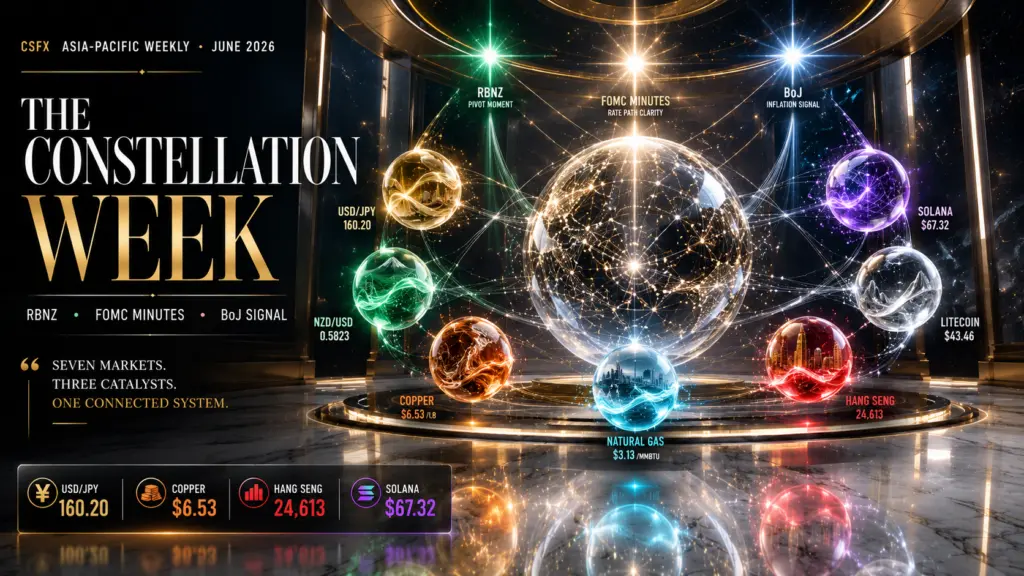
USD/JPY 160.20  ·  NZD/USD 0.5823  ·  Copper $6.53  ·  Nat Gas $3.13  ·  Hang Seng 24,613.3  ·  SOL $67.32  ·  LTC $43.46

Past Week in Review — 9–13 June 2026

The week of 9–13 June 2026 pivoted dramatically on geopolitics. President Trump's remarks on Thursday that a US-Iran peace deal could be signed as soon as this weekend in Europe triggered an aggressive risk-on move across all Asia-Pacific assets. The Hang Seng's 1,946-point weekly surge — from a four-session losing streak low to a 26,626 high — was the most decisive single-week move since March 2025, led by SMIC up 8.4% and Tencent up 4.2%. USD/JPY touched a fresh multi-year high of 160.57 on Thursday — its weakest level since July 2024 — before retreating to 160.20 as the yen climbed 0.6% on the ceasefire remarks. Natural gas shed its Middle East supply risk premium, falling 4.35% on the week as LNG cargo competition eased. Copper recovered sharply to $6.53, well above the $6.20 support, as Jefferies' structural upgrade — forecasting an average 491,000-ton annual supply deficit through 2030 — attracted dip-buying. Solana recovered 11.73% from the $58 structural support zone driven by the Alpenglow consensus protocol upgrade and $15.6 million in spot ETF inflows. Litecoin stabilised within the $40 to $44 demand zone with initial bottom-building capital inflows.


This Week at a Glance — 16–20 June 2026

The week of 16–20 June 2026 is defined by a sequential central bank event structure with direct implications for every instrument in CSFX's Asia coverage. The RBNZ's hawkish pivot last week — signalling rates could rise earlier and by a larger-than-expected margin — has created a structural NZD floor at 0.5800. Wednesday's FOMC minutes are the primary USD direction setter: hawkish...

Continue reading...
0
0

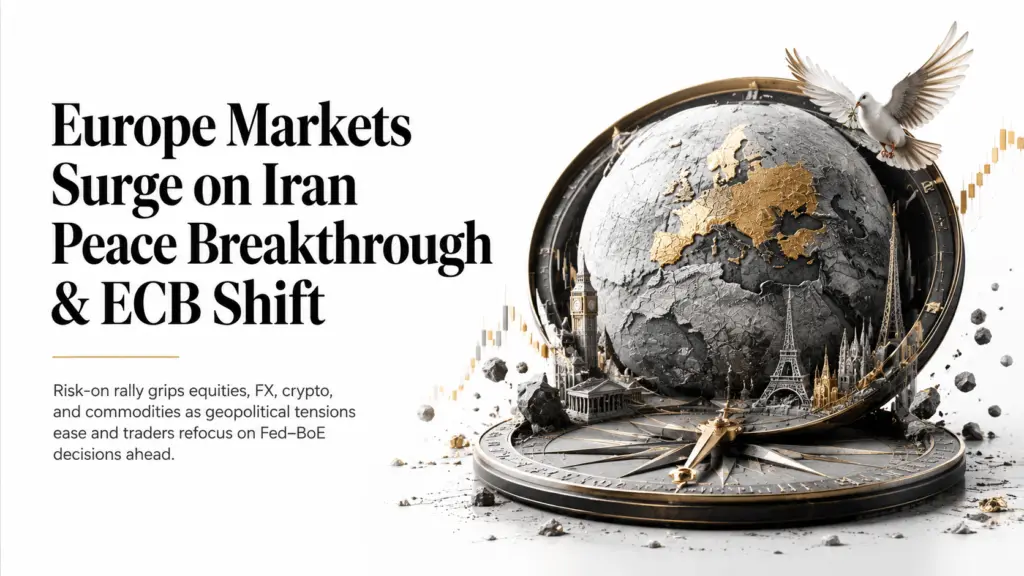
Iran Peace Breakthrough Sparks a Risk-On Rally as ECB & CPI Clear

Iran Peace Breakthrough Sparks a Risk-On Rally as ECB & CPI Clear

Friday, 12 June 2026  ·  Capital Street FX Research Desk

EUR/USD 1.1579  ·  GBP/USD 1.3415  ·  DAX 24,668  ·  Silver $67.02  ·  Nat Gas $3.05  ·  BP 545p  ·  Bund 20Y 3.42%  ·  ETH $1,674  ·  LINK $7.89  ·  BTC $63,577

Session Overview

Europe opens Friday in full relief mode. Overnight President Trump called off fresh strikes on Iran and pointed to a breakthrough in talks to end the war — the firmest de-escalation signal in months — and with this week's two macro hurdles now cleared (the hot-but-soft-core US May CPI and the ECB's 25 basis-point hike to 2.25%), the continent is trading a clean risk-on rotation rather than a war-and-policy binary.

The pivot is sharp and broad. The Stoxx 600 is up about 1.7%, led by the most war-sensitive corners of the market: travel and leisure surged more than 4.9% — TUI +8.5%, Ryanair +7.5%, Lufthansa +6.9% — while European banks added 3.7% as the curve and the rate outlook firmed. The mirror image is energy: with crude sliding on the peace signal, oil majors and the wider energy complex are the session's clear laggards, dragging on the FTSE 100 and on names like BP even as the broad tape rips higher.

The ECB hiked to 2.25% on Thursday — its first move since 2023 — and turned hawkish, lifting 2026 headline inflation forecasts to 3.0% and pricing roughly a 50% chance of a follow-up in September, even as it trimmed growth to 0.8%. The euro sold the fact, with EUR/USD slipping toward 1.1579 near its lowest since early April, as a firm dollar and a draining haven bid outweighed the rate-gap story. Attention now jumps to next week's back-to-back central-bank events: the Fed on June 17 — Kevin Warsh's debut meeting as Chair, expected to hold at...

Continue reading...
0
0

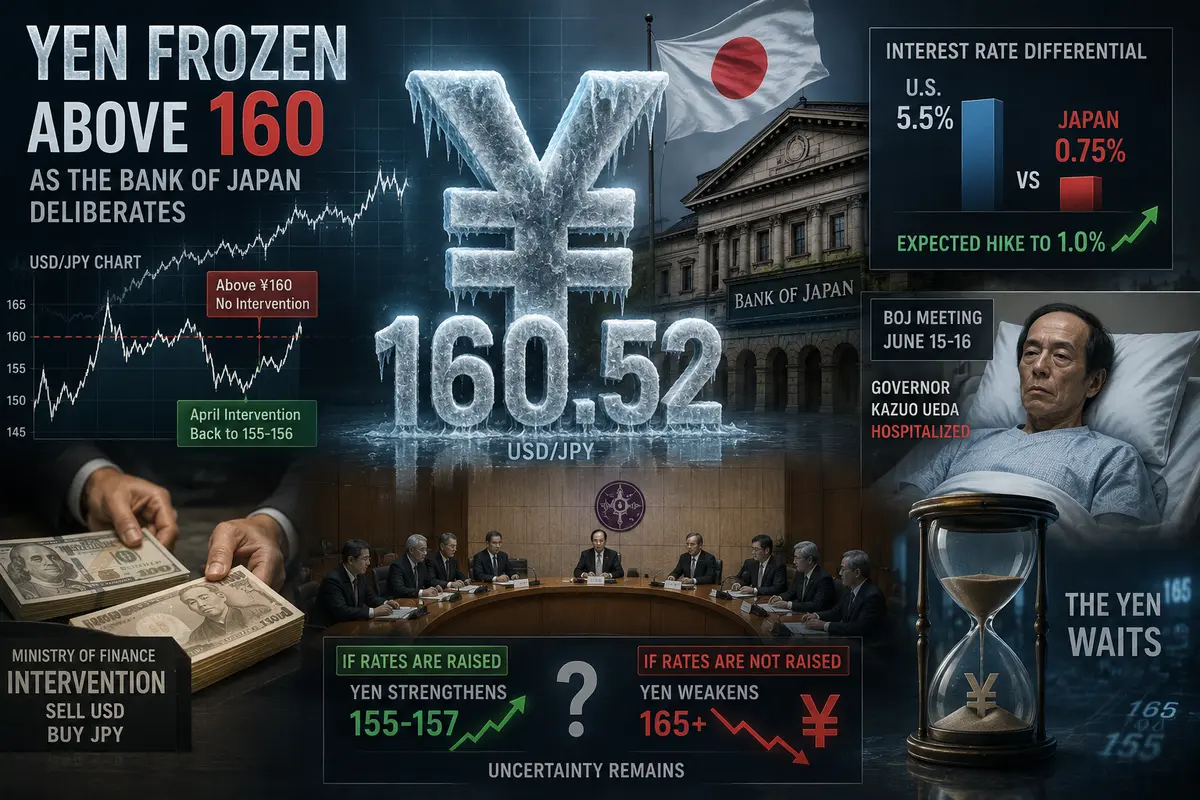
Iran Peace Deal ‘Largely Negotiated’ Sends Oil Crashing & Risk Soaring as BoJ Hike Week Begins

Iran Peace Deal ‘Largely Negotiated’ Sends Oil Crashing & Risk Soaring as BoJ Hike Week Begins

Friday, 12 June 2026  ·  Capital Street FX Research Desk

USD/JPY 160.29  ·  AUD/USD 0.7031  ·  Hang Seng 24,702.6  ·  Copper $6.40  ·  WTI $86.30  ·  BTC $63,427.90  ·  DOGE $0.0860  ·  LTC $42.00  ·  Gold $4,205

Session Overview

Asia wakes up to the sharpest sentiment reversal of the month. Late Thursday, President Trump posted that a peace agreement with Iran — one that would reopen the Strait of Hormuz and end the three-month conflict — is largely negotiated and will be announced shortly, with a memorandum of understanding awaiting final sign-off from Washington and Tehran. The market reaction was immediate and violent: crude oil cratered roughly 4% to its lowest level since mid-May near $86.30, ripping the geopolitical war premium out of the energy complex overnight and triggering a broad risk-on rotation into equities, industrial metals, and crypto just as the region heads into the year's most consequential central-bank week.

The reaction across the region is a clean, one-directional risk rally — almost the mirror image of the past month's war-driven defensiveness. Hong Kong's Hang Seng is firmer near 24,702.6 as oil-import-sensitive Asian equities cheer the prospect of a durable de-escalation, while Japan's Nikkei extends its advance with exporters tracking a still-weak yen. USD/JPY is pinned at 160.29, effectively glued to the intervention line even as the broader risk tape turns constructive — the Iran de-escalation removes one inflationary leg (energy) just days before a Bank of Japan that was already leaning hawkish on a separate leg (wholesale prices at 6.3%). Copper has rebounded sharply off three-week lows toward $6.40 per pound as the growth-friendly headline outweighs the loss of its modest oil-linked cost-push support, while gold holds a haven bid near $4,205 — a sign the de-escalation is being read as real but not yet done.

The crypto...

Continue reading...
0
0
BCR

Daily Analysis 12 June 2026 | Dollar Holds Firm Near 100 While Oil and Gold React to Middle East Tensions

Daily Analysis 12 June 2026 | Dollar Holds Firm Near 100 While Oil and Gold React to Middle East Tensions

Currency and Commodity Analysis:


US Dollar Index


The US dollar index closed up 0.09% at 100.04 on Wednesday, having fallen as low as 99.71 during the session. This was due to the US May Consumer Price Index (CPI) rising 4.2% year-on-year, the largest increase in three years, but in line with market expectations and not significantly increasing the likelihood of a Fed rate hike this year. It fell to around 99.65 on Thursday. The lack of a widely feared acceleration in core inflation indicates that soaring energy prices have not yet transmitted to the Fed's key indicators. Short-term US Treasury traders have reduced their bets on a September rate hike but remain confident that a rate hike before the end of October is inevitable. The situation in the Middle East deteriorated further on Wednesday, with the conflict spreading outwards from the Persian Gulf region. As a result, risk aversion spread rapidly, with funds accelerating their inflow into traditional safe-haven assets such as the US dollar, providing strong support for the US dollar index near the 100 level. If the conflict escalates further, the demand for the US dollar as a safe haven may continue to strengthen.


The US dollar index has recently shown a fluctuating upward trend on the daily chart, with prices recovering steadily from a recent low of 97.62 and currently trading around 99.90, approaching the previous high of 100.64. In terms of moving averages, the price has stabilized above the 20-day and 50-day moving averages, as well as the medium- and long-term moving averages, which are in a bullish alignment, providing support and maintaining the medium-term upward trend. Regarding indicators, the MACD DIFF line continues to run above the DEA line, with the red bars expanding, indicating continued bullish momentum; the RSI indicator has...

Continue reading...
0
0

Oil Plunges 2%: An Illusion of Peace or a Real Calm?

Oil Plunges 2%: An Illusion of Peace or a Real Calm?
Thursday: The Silence That Hurts Your Wallet

You wake up on Thursday, open your trading terminal, and can hardly believe your eyes. WTI crude oil, which was trading near $94 just yesterday, is now changing hands at $91.88. A drop of 2.05% in just a few hours. The $88 support level that held earlier this week failed to provide a floor. Oil broke lower and continues to slide.

What happened? Did the war in the Middle East suddenly end? No. Iran and Israel exchanged strikes. The United States launched new attacks on Iranian targets. Iran threatened to block the Strait of Hormuz. All of this happened within the last 24 hours. Oil should have been rising, yet it is falling.

A paradox? Only at first glance.

The oil market today is not a mirror of geopolitics. It is a mirror of expectations. And expectations change faster than missile trajectories.

Let's take a closer look.

On Thursday morning, WTI found support at $85.95, the low of today's session. Resistance stands at $95.47. That's an unusually wide range of nearly $10, signaling extreme volatility.

Brent crude is also declining, though slightly less sharply—down 1.75% to $94.73 per barrel. The spread between the two benchmarks is $2.85 in favor of Brent. That's a fairly normal level for a market that is not expecting immediate disruptions to Persian Gulf supply.

The U.S. dollar, which typically strengthens during periods of panic, weakened slightly today. The DXY Dollar Index slipped 0.03% to 99.96. A symbolic move, perhaps, but an important one: the dollar is no longer acting as an unquestioned safe haven. Or rather, investors are no longer convinced that the conflict will escalate into a catastrophe.

But let's dig deeper.

Why Is Oil Falling?

There are three main reasons, and all of them point to...

Continue reading...
0
0

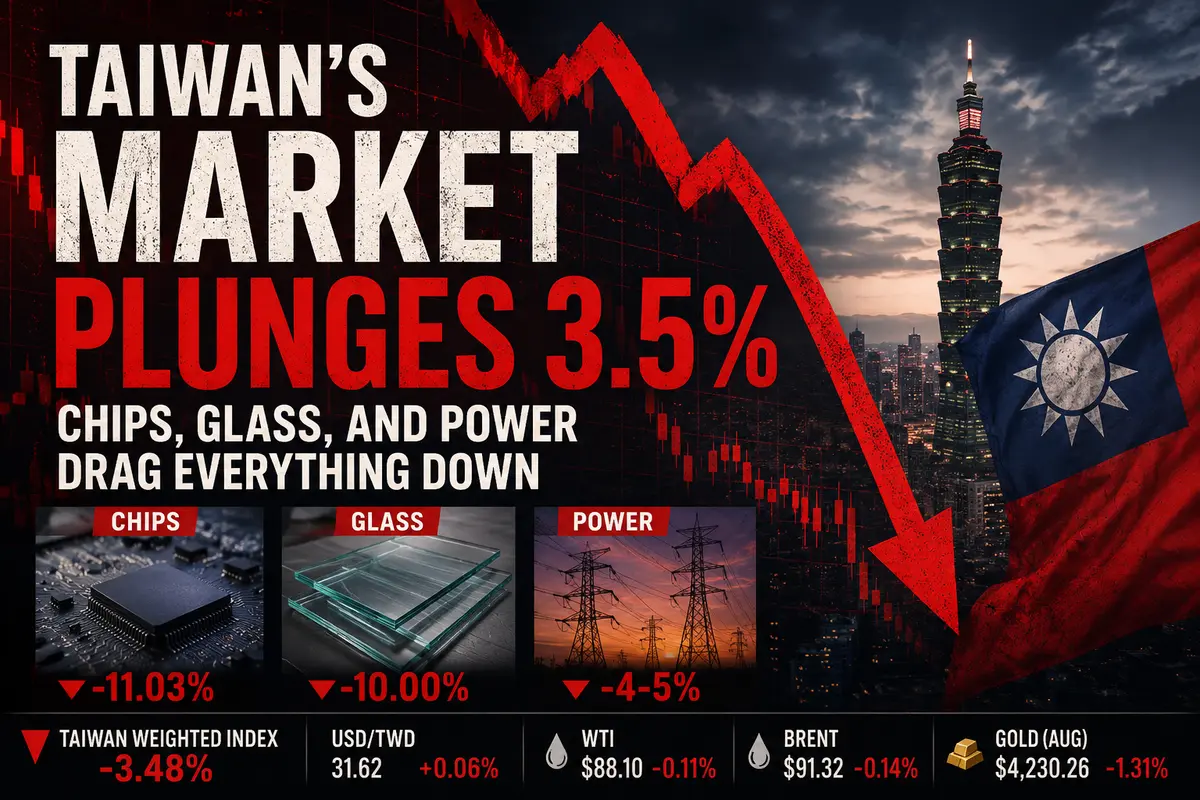
Taiwan’s Market Plunges 3.5%: Chips, Glass, and Power Drag Everything Down

Taiwan’s Market Plunges 3.5%: Chips, Glass, and Power Drag Everything Down
A Wednesday That Brought Nothing Good

When you wake up in Taipei and open your brokerage app, you expect to see green numbers. Or at least yellow ones. But not red. On the morning of June 10, 2026, everything was red. Not just red—blood red. Taiwan’s benchmark stock index, the Taiwan Weighted Index, the island’s main economic barometer, plunged 3.48% in a single day. Without any obvious domestic trigger. Simply because the world around it seemed to be falling apart.

This was not just a decline. It was a stampede for the exits. Investors sold everything they could. Technology stocks—especially semiconductor companies—were hit first. Glass manufacturers were dumped as well. Energy companies were not spared. Three sectors that form the backbone of Taiwan’s economy came under pressure simultaneously.

Who was to blame? External factors, as is often the case. The conflict in the Middle East, driving up oil prices and fueling panic. Expectations of prolonged high interest rates from the Federal Reserve, which continue to suppress demand for risk assets. An overheating artificial intelligence sector that, after months of relentless gains, has finally entered a correction. And, of course, the ever-present geopolitical tensions surrounding Taiwan itself.

But let’s take it step by step.

Technology Sector: The Main Casualty

Taiwan is semiconductors. Semiconductors are Taiwan. The island produces more than 60% of the world’s chips and over 90% of the most advanced ones. TSMC, UMC, MediaTek, ASE Group—names familiar to every investor on the planet. And when those names fall, the entire market follows.

On Wednesday, Taiwan’s technology sector suffered the steepest losses. Shares of WT Microelectronics, one of Asia’s largest distributors of electronic components, plunged 11.03%. A loss of NT$31 per share in a single session is enormous. Investors fled a company widely viewed as a barometer of electronics demand...

Continue reading...
0
0
BCR

Daily Analysis 11 June 2026 | Oil Surges, Gold Weakens and Dollar Holds Ground Amid Global Uncertainty

Daily Analysis 11 June 2026 | Oil Surges, Gold Weakens and Dollar Holds Ground Amid Global Uncertainty

Currency and Commodity Analysis:


US Dollar Index


The US dollar index hovered around 100 on Wednesday, after a sharp intraday rebound in the previous session, as renewed hostilities in the Middle East clouded the prospects for a fragile ceasefire and a long-term peace agreement. The US launched a "self-defense strike" against Iran in response to the downing of a US helicopter, while Iranian Foreign Minister Abbas Araqchi warned that the Iranian armed forces would respond to any attack or threat. Markets expressed concerns about inflation and the possibility of central bank interest rate hikes as regional conflict drove up energy prices. Investors are also awaiting the latest US inflation data for new signals on the Federal Reserve's policy outlook, after stronger-than-expected jobs data last week strengthened expectations of a rate hike this year. Furthermore, the market widely expects the European Central Bank and the Bank of Japan to raise interest rates later this month.


The US dollar index is currently in a strong upward channel on the daily chart, having rebounded steadily from its May low of 97.62, recently rising to near the 100 mark and approaching the previous high of 100.64, indicating a clear bullish trend. The moving average system is in a bullish alignment, with the price above the 20-day, 50-day, 100-day, and 200-day moving averages. Support levels are at 99.59 (the 9-day moving average) and 99.00 (a psychological level), indicating solid support. Key resistance levels are at 100.21 (this week's high) and 100.64 (the high of March 31st). A break above these levels could open up further upside potential to the 101 level. In terms of indicators, the MACD DIFF line is above the DEA line, and the red bars are continuing to expand, indicating strengthening bullish momentum. The RSI is at 62.89, in...

Continue reading...
0
0

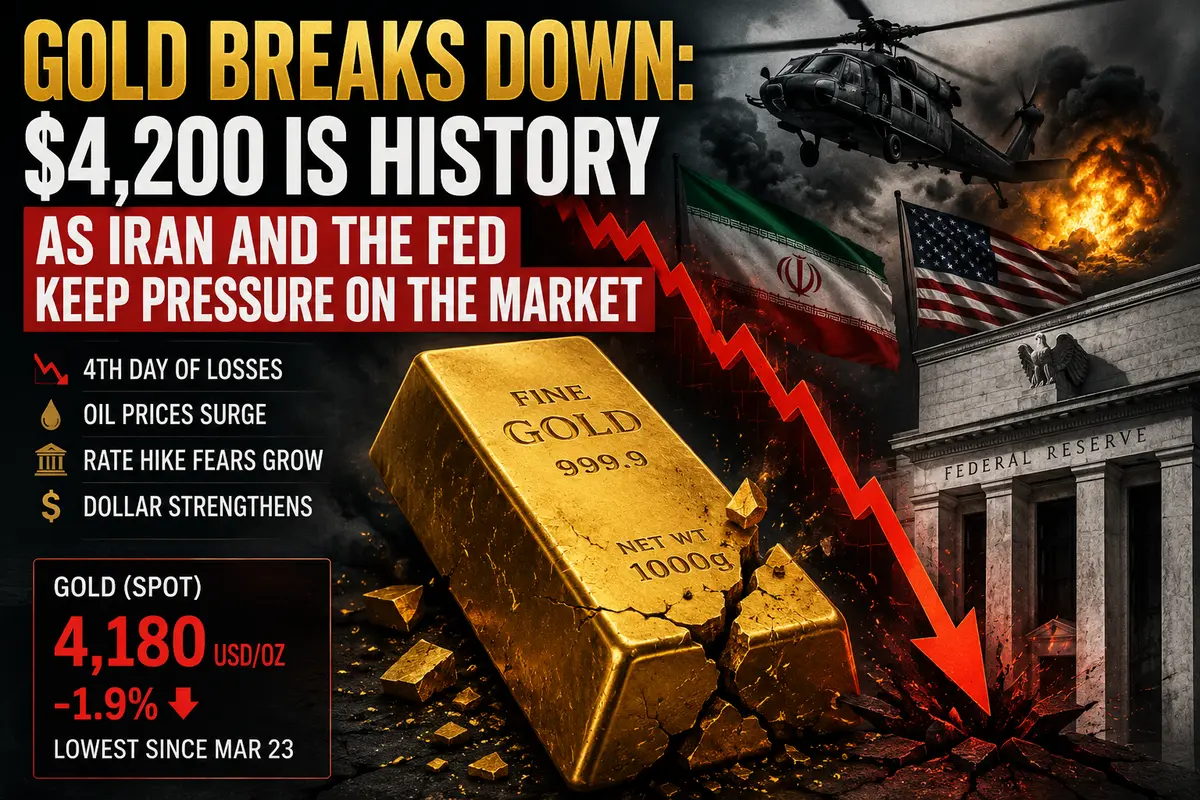
Gold Breaks Down: $4,200 Is History as Iran and the Fed Keep Pressure on the Market

Gold Breaks Down: $4,200 Is History as Iran and the Fed Keep Pressure on the Market
The fourth day of pain: not even a helicopter incident could save the yellow metal

Wednesday morning. You open the gold chart and can hardly believe what you see. Spot gold is trading at $4,180 per ounce, down 1.9% overnight. Four consecutive trading sessions in the red. Four. The last time that happened was last year, when the Federal Reserve was just beginning its aggressive rate-hiking cycle.

Gold has broken below the psychological $4,200 level and never looked back. It keeps falling, and nobody knows where the bottom is. U.S. gold futures are at $4,204.75, also down 1.9%, their lowest level since March 23. Three months ago, the world looked very different: the Middle East ceasefire was still holding, U.S. inflation was easing, and the Fed was signaling rate cuts. Those promises have now all but disappeared.

What Happened?

The same story that has plagued gold for weeks continues. The dollar is strong. Interest rates remain high. Inflation refuses to retreat. And the Middle East—which would normally support gold prices—has instead become another source of pressure.

Now a new and dangerous twist has emerged. On Tuesday, Washington reportedly launched fresh strikes against Iranian targets following the downing of a U.S. military helicopter near the Strait of Hormuz.

Think about what that means. The United States and Iran are no longer exchanging blows through intermediaries or proxy forces in Lebanon or Yemen. These are direct strikes. A helicopter has been shot down. Airstrikes are underway. The Strait of Hormuz—the artery through which roughly one-fifth of the world's oil flows—is increasingly becoming a conflict zone.

And do you know how gold is reacting?

It’s falling.

Not rising—falling.

Because markets are looking three steps ahead. Strikes on Iran lead to higher oil prices (which rose another 1% on Wednesday),...

Continue reading...
0
0
Navigation menu
instaforex banner