Bar Pipa
We pay for a post of 10$

Nvidia

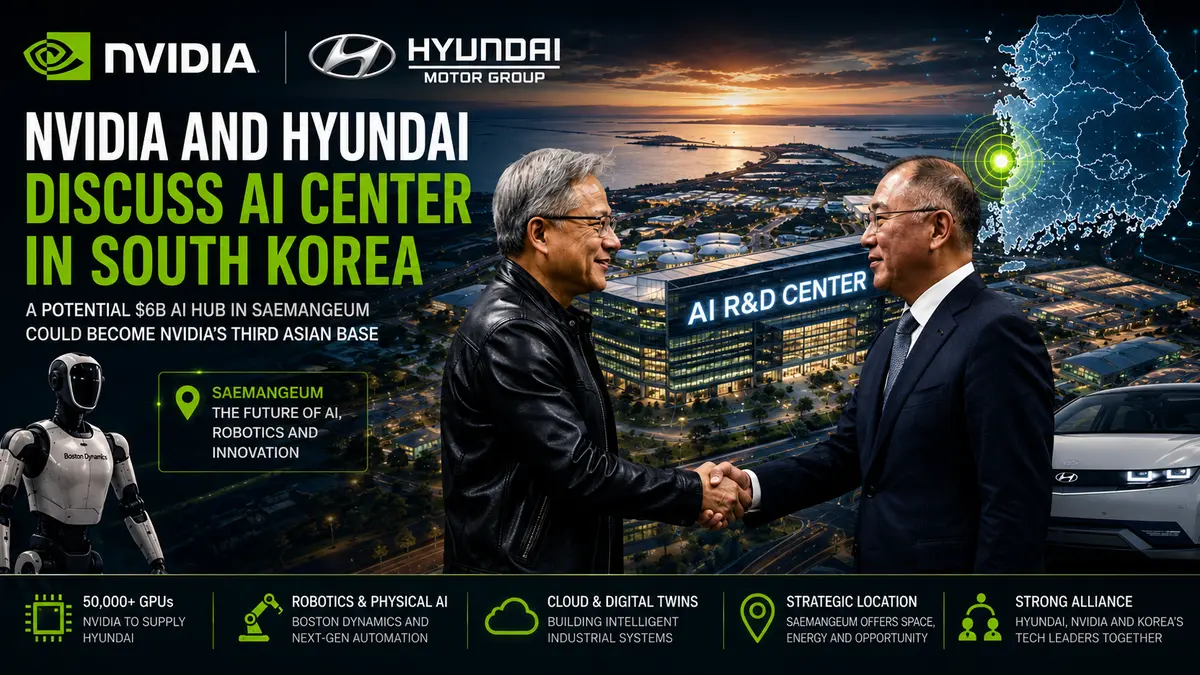
Nvidia and Hyundai Discuss an AI Center in South Korea

Nvidia and Hyundai Discuss an AI Center in South Korea
When Two Giants Sit Down at the Same Table

In the world of high technology, some developments make markets pause and watch closely. The ongoing talks between Nvidia and Hyundai Motor Group are one of those moments. Not because the two companies have never worked together before—they have, and quite extensively. Rather, it is because the scale of what is now being discussed goes far beyond a standard business partnership.

At the center of the discussions is the creation of an artificial intelligence technology hub in South Korea. Not merely an office or a university-affiliated research lab, but a full-scale R&D center that could become Nvidia’s third major base in Asia, alongside its existing hubs in Singapore and Taiwan.

Reports that negotiations have entered their final stage emerged Thursday in The Korea Economic Daily, citing government and industry officials. There has been no official confirmation yet. A Hyundai Motor Group spokesperson stated that no final decisions have been made regarding the project, its timeline, or its location. However, the fact that details surfaced just before Nvidia CEO Jensen Huang’s visit to Seoul is telling.

The timing is significant. In October 2025, Hyundai, Nvidia, and South Korea’s Ministry of Science and ICT signed a memorandum of understanding. Nvidia committed to supplying GPUs to Hyundai and jointly developing AI facilities in the country. Six months later, the partnership appears to be moving from broad commitments to concrete implementation.

Now attention has shifted to the final details: site selection, project structure, and strategic alignment. Huang is expected to arrive in Seoul on Friday and meet Hyundai Motor Group Executive Chair Euisun Chung. According to reports, an informal dinner is planned in Seoul’s Seongsu-dong district, with executives from SK Group, LG Group, and Naver also expected to attend.

The rumored menu? Korean pork belly...

Continue reading...
0
0

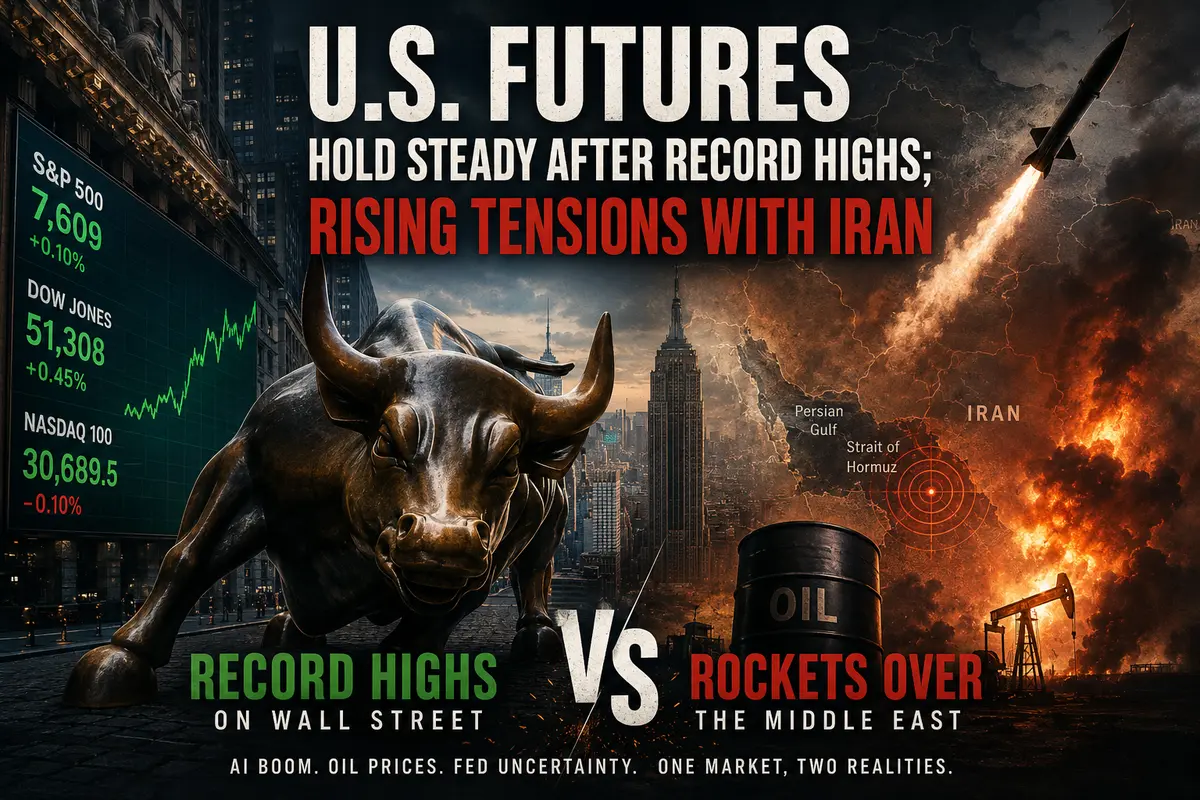
U.S. Futures Hold Steady After Record Highs Amid Rising Tensions With Iran

U.S. Futures Hold Steady After Record Highs Amid Rising Tensions With Iran
When Records Meet Rockets

Tuesday evening brought a nervous mood to the U.S. market. Not because investors were panicking. Quite the opposite — everyone seemed frozen in place. Futures on the major Wall Street indexes settled into a strange state of calm: the S&P 500 was virtually unchanged, the Dow Jones Industrial Average stood still, and the Nasdaq 100 edged slightly lower, slipping by just one-tenth of a percent. At 30,689.5 points, Nasdaq futures looked impressive on paper — but the number carried an undertone of unease.

That unease has a name: Iran.

A country that has dominated global headlines in recent weeks once again commanded attention — not through words, but through actions. New airstrikes against neighboring targets marked the third such incident in a week. The United States responded, and now the financial world is holding its breath, watching the Middle East and asking a crucial question: is this merely another chapter in a long-running confrontation, or the beginning of something far larger and more dangerous?

The paradox of the day is that only hours before these developments, Wall Street was celebrating. Major indexes had reached fresh all-time highs. The S&P 500 climbed to 7,609 points. The Dow Jones crossed the 51,000 mark. The Nasdaq advanced as well. Technology stocks — especially semiconductor manufacturers — staged a remarkable rally. Against that backdrop of optimism came news of missile strikes and stalled negotiations.

The market suddenly found itself caught between two powerful forces. On one side stood enthusiasm for artificial intelligence, record profits from technology giants, and the belief that a prosperous future has already arrived. On the other stood geopolitical turmoil, the threat of disruptions in the Strait of Hormuz, rising oil prices, and the prospect of renewed inflation that few had anticipated.

In the face of these...

Continue reading...
0
0

Huang at Computex: How Nvidia Plans to Feed the AI-Hungry World

Huang at Computex: How Nvidia Plans to Feed the AI-Hungry World

Taipei, Computex 2026. The hall is packed to capacity as journalists and analysts from around the world hang on every word of a man who, over the past few years, has transformed from the head of a gaming graphics card manufacturer into one of the most influential figures on the planet. Jensen Huang, Nvidia’s founder and longtime CEO, steps up to the microphone. He is wearing his trademark leather jacket—a signature look that has become as recognizable as Steve Jobs’ black turtleneck. But today, he is not talking about new products; he covered those the day before. Today, he is addressing what concerns markets most: supply. Specifically, whether Nvidia can physically manufacture enough chips to satisfy a world obsessed with artificial intelligence.

“We Can Handle It”: Three Words the Market Was Waiting to Hear

Huang did not mince words. He acknowledged what the market has been whispering about for months: supply constraints remain a real issue. Nvidia, the company powering data centers around the globe with its semiconductor technology, is facing an enormous imbalance between supply and demand. Every new data center, every new large language model, and every AI startup wants Nvidia accelerators. Demand is growing exponentially, outpacing the production capacity of even a giant like Nvidia.

Yet Huang stated that the company has secured sufficient supply to support continued production growth. This was more than just an optimistic remark. It was a signal to investors who had become increasingly anxious about reports of chip shortages and shipment delays. Nvidia’s CEO was effectively saying: we see the problem, we are working on it, and we have addressed it to the extent necessary to keep growing.

Behind those words lies an immense effort. Nvidia does not manufacture chips itself—it designs them and relies on Taiwan’s TSMC and, to a lesser...

Continue reading...
0
0

Server Fever: How Dell Transformed from a PC Maker into an Artificial Intelligence King

Server Fever: How Dell Transformed from a PC Maker into an Artificial Intelligence King

There are moments in corporate history when a company stops being what it has been for decades and becomes something entirely different. For Dell Technologies, that moment has arrived. The stock rose 3.2% in pre-market trading, extending a rally that began after the company released its quarterly earnings. Dell, a company millions of people know as a manufacturer of laptops and desktop computers, has suddenly found itself at the center of the hottest theme in global equity markets—artificial intelligence. And the numbers it reported force investors to rethink everything they thought they knew about the business.

A Quarter That Will Be Studied in Business Schools

Dell’s financial results for the first quarter of fiscal 2027 look almost too good to be true. Revenue reached $43.8 billion, up 88% year-over-year—the fastest quarterly growth rate since the company returned to the public markets in 2018. GAAP diluted earnings per share came in at $5.24, a 282% increase. Non-GAAP earnings per share reached $4.86, up 214%.

But the most astonishing figure was the magnitude of the earnings beat. Analysts had expected non-GAAP EPS of $2.93. Dell delivered $4.86—nearly 66% above consensus expectations. In a market where companies typically beat estimates by a few cents, such a deviation is extraordinary.

The primary driver of this explosive growth was Dell’s Infrastructure Solutions Group (ISG). Revenue from AI-optimized servers reached $16.1 billion, soaring 757% year-over-year. Yes, 757%. ISG as a whole generated $29 billion in revenue, representing 181% growth.

$24 Billion in Orders: AI Demand Shows No Signs of Slowing

Dell COO Jeff Clarke summarized the situation perfectly:

“We received $24.4 billion in AI orders and recognized $16.1 billion in AI server revenue. We are raising our fiscal 2027 AI server revenue outlook to $60 billion, further reinforcing that AI opportunities show no signs of slowing...

Continue reading...
0
0

Silicon Storm: How Japanese and Korean Stocks Are Rewriting History While the World Watches Iran

Silicon Storm: How Japanese and Korean Stocks Are Rewriting History While the World Watches Iran

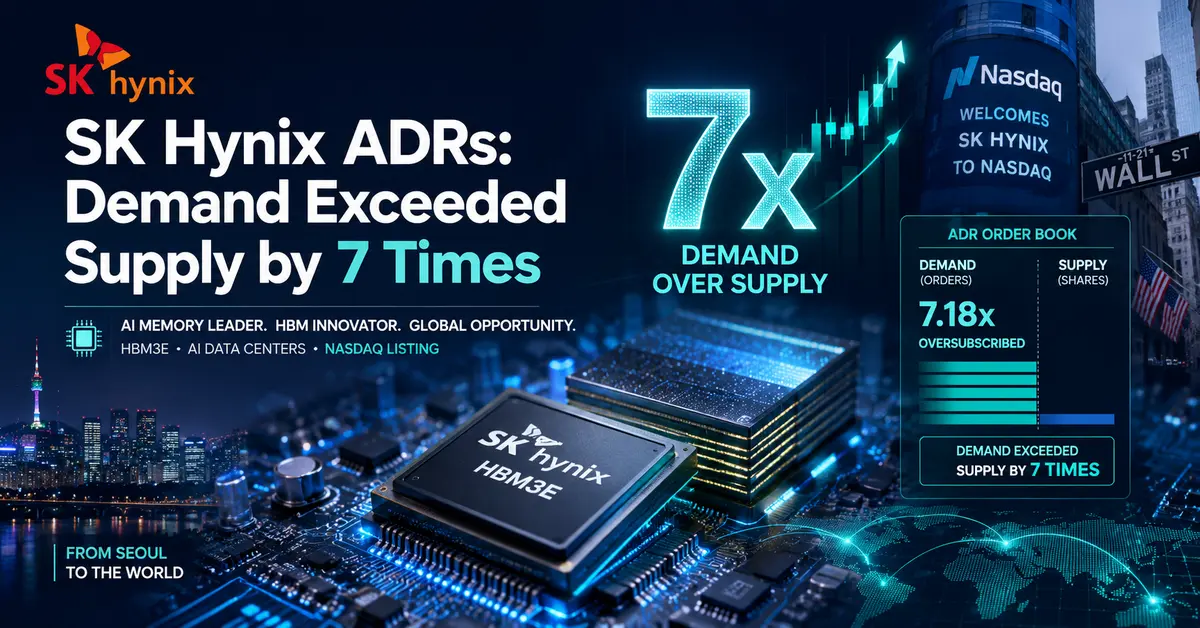
Asian markets on Wednesday looked like two parallel worlds existing within the same universe. In the first world — inhabited by memory chip makers and AI accelerator manufacturers — euphoria reigned. Japan’s Nikkei 225 surged to a new all-time high, climbing above 66,428 points. South Korea’s KOSPI delivered an even more dramatic move, soaring five percent in a single session to reach an unprecedented 8,457 points. Shares of SK Hynix jumped nearly fourteen percent, pushing the company’s market capitalization above one trillion dollars for the first time in history.

In the second world — the world of geopolitics, oil prices, and Middle Eastern negotiations — anxiety dominated. Brent crude hovered around ninety-nine dollars a barrel, Chinese indices declined, and investors nervously scanned the horizon for an answer to a single question: would there be peace with Iran, or more bombing campaigns ahead?

SK Hynix: Crossing the Trillion-Dollar Threshold

There are moments in corporate history that divide eras. For SK Hynix, Wednesday became such a moment. A near fourteen-percent rally in a single session pushed the company’s market capitalization beyond the psychological trillion-dollar mark.

This is more than just a symbolic number. It is an entry ticket into an exclusive club where only two other memory manufacturers reside alongside SK Hynix: Samsung Electronics and Micron Technology. Three companies, three pillars supporting the global memory industry.

The reason behind the rally is both simple and monumental. The world is entering an era in which artificial intelligence requires enormous volumes of high-speed memory. Every new data center, every large language model, every Nvidia accelerator devours gigabytes and terabytes of HBM memory — a segment where SK Hynix holds a leading position.

And as technology giants like Google and Amazon announce fresh investments in AI infrastructure, the Korean memory maker can calmly count its...

Continue reading...
0
0

Tokyo Records and an Oil Pullback: How Asian Markets Are Celebrating Hopes for Peace

Tokyo Records and an Oil Pullback: How Asian Markets Are Celebrating Hopes for Peace

Monday began on Asian stock exchanges in a way not seen for a very long time. Japan’s Nikkei 225 soared to the skies, hitting a fresh all-time high of 65,408 points. The TOPIX followed closely behind, also rewriting the record books. Chinese indexes moved higher. Australia, Singapore, and India all painted their screens green. And all of this unfolded against the backdrop of a U.S. market holiday, with the world’s biggest players absent from their desks. Left to themselves, Asian markets staged a rally driven by the intersection of two powerful forces: renewed optimism surrounding artificial intelligence and hopes for an end to the Iran conflict.

Tokyo Records: When the Nikkei Storms the Heavens

Japan’s stock market traded on Monday as if no global crisis existed. The Nikkei 225 gained more than three percent during the session, reaching a level that would have seemed фантастical just a year ago. TOPIX, the broader gauge of Japan’s economy, climbed to nearly 3,954 points, also setting a historic record. This was not merely growth — it was a display of strength.

The driving force behind Tokyo’s rally was shares of companies tied to semiconductors and artificial intelligence. Renesas Electronics and Rohm both surged by ten percent. This was not abstract optimism but a direct spillover from Wall Street, where U.S. semiconductor companies staged their own rally late last week after upbeat earnings and forecasts. Nvidia set the tone, and now Japanese suppliers and partners have picked up the baton.

Japan, long viewed as a fading economic power trapped in deflation, has suddenly found itself in an ideal position to profit from the AI boom. Japanese firms produce critical components for chips — substrates, chemicals, and precision equipment. No TSMC or Samsung factory can operate without them. And as global demand for computing power...

Continue reading...
0
0
Navigation menu