

Indices: How I Bought 500 Companies with One Click (and Why I Liked It)

Hi, this is NorthRay.🆕
Remember when I told you I wanted to buy Apple but couldn’t because the market was closed?
Then I opened a trade on the SPX (the S&P 500 index). It closed with a small profit.
And that got me hooked.
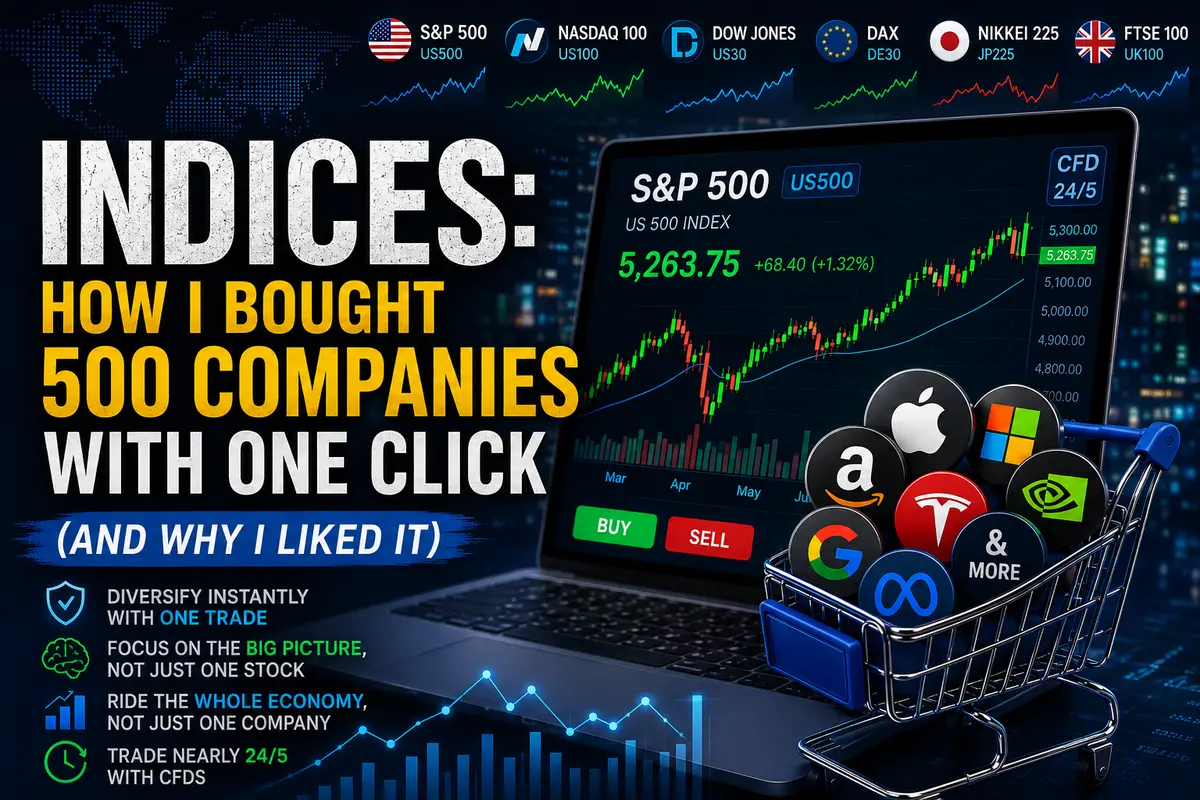
Because there’s something almost magical about indices. You buy one thing—and instantly get exposure to hundreds of companies. You don’t have to guess whether Apple will soar or Tesla will fall. You’re simply betting on the entire U.S. economy.
Spoiler: I liked it.
Today I’ll explain what indices are, how they work, and why I now watch them almost as often as EUR/USD.
What Is an Index? (The Simple Explanation)
An index is a basket of stocks.
Instead of buying 500 individual stocks, you buy one instrument—the index—and it moves according to the average performance of the companies inside it.
Here’s a simple analogy:
Imagine you’re a teacher. You don’t need to know how every student performed on an exam. You only need to know the class average.
If the average score is high, the class did well. If it’s low, the class struggled.
An index is basically the average score of a group of companies.
Some companies inside the index may be rising while others are falling. The index shows the overall result.📉
The Most Important Indices in the World
There aren’t that many. I learned five of them, and that’s enough to get started.
Why Indices Are More Convenient Than Individual Stocks
I’ve traded both individual stocks (Apple) and indices (S&P 500). Here’s what I’ve learned.
1. Less Stress
A single company can drop 10–20% because of one bad news story: a management scandal, a failed product launch, or a lawsuit.
An index made up of 500 companies is less likely to suffer such a dramatic decline. If Tesla falls, Apple, Amazon, and Microsoft may offset some of the damage. As a result, indices tend to move more smoothly.
2. You Don’t Have to Pick Winners
Finding one winning stock among thousands is like searching for a needle in a haystack.
I’m not a professional analyst. I don’t know which company will explode higher tomorrow.
With an index, I simply say: “I believe the U.S. economy will grow.”
That’s it.
3. Indices Respond Well to Fundamental Analysis
The Federal Reserve raises interest rates? U.S. indices will likely fall because higher borrowing costs hurt businesses.
The economy is growing? Indices tend to rise.
Forecasting a single stock is difficult. Forecasting an entire economy is difficult too—but at least there’s more information available.
4. Many Brokers Offer Nearly 24/5 Access
Unlike stocks, which only trade during exchange hours, index CFDs are often available almost around the clock.
With my broker, I can open an SPX position at 10 a.m., 3 p.m., or in the evening.
How I Trade Indices (My Approach)
I don’t have a sophisticated strategy yet.
But I do have a basic approach that seems to be working—for now.💪
What I Do
-
Check the overall market sentiment. If economic news is positive (growth, lower rates), I lean toward Buy positions. If it’s negative, I lean toward Sell positions.
-
Use technical analysis: support and resistance levels, plus the Stochastic oscillator for confirmation.
-
Open trades with small position sizes. Indices can be more volatile than currencies. For me, 0.10 lots is a comfortable starting point.
-
Always use stop-loss and take-profit orders. I never open a trade without them.
A Real Example
Last week I opened a Sell position on SPX because:
-
U.S. inflation came in higher than expected (meaning rate cuts were less likely—bad for stocks).
-
Price reached a strong resistance level and failed to break through.
-
The Stochastic indicator showed overbought conditions.
The trade closed with a small profit.
Nothing spectacular—but consistent.✍️
How Indices Differ from Currency Pairs
When I switched from EUR/USD to SPX, I noticed several differences.
My Mistakes Trading Indices
Mistake #1: Opening a Trade 10 Minutes Before the U.S. Market Open
I assumed that because my broker offered the index 24/5, I could trade it anytime.
The price barely moved for an hour.
Then, five minutes before the opening bell, things became extremely choppy. I closed the trade at a loss.
The market opened—and immediately moved in my original direction.
Painful.
Lesson: The main action in U.S. indices happens during regular U.S. market hours. Avoid opening new positions right before the open unless you know exactly what you’re doing.
Mistake #2: Ignoring Futures and CFD Differences
It turns out that what I trade is a CFD on the index—not the actual index itself.
The price can differ slightly from the underlying market.
Lesson: Accept that small differences exist. Usually they’re not significant.
Mistake #3: Trading During Major News Releases
Indices are highly sensitive to news.
Especially:
-
Inflation data
-
Federal Reserve decisions
-
Earnings reports from major companies
Lesson: Before major announcements, either close positions or reduce position size significantly.
Which Indices I’m Trading Right Now
I’ve decided not to spread myself too thin.🧠
My core watchlist:
1. S&P 500 (US500)
My main instrument.
The easiest to understand and, in my experience, the most predictable.
2. NASDAQ (US100)
Occasionally, when I want more volatility.
Technology stocks tend to move more aggressively.
For now, I’m staying away from Europe and Asia.
First, I want to become comfortable with the American markets.
What I Learned Today
First: Indices are an excellent instrument for beginners. Less stressful than trading individual stocks and easier to understand than cryptocurrencies.
Second: Major U.S. indices reflect the broader American economy. If I understand what’s happening in the economy, I have a rough idea of where the index may be headed.
Third: Indices love news. Fundamental analysis is arguably even more important than technical analysis.
Fourth: It’s best to trade indices during active market hours.🤝
My Plan for Trading Indices
-
Continue trading the S&P 500 and collecting statistics.
-
Add more NASDAQ trades when I want greater volatility.
-
Follow the economic calendar, especially U.S. releases.
-
Keep a separate trading journal for indices and compare the results with my currency trades.
-
Once I gain more experience, I may add European indices such as DAX and CAC 40.
What’s Next?
-
I’ll continue trading indices on a demo account.
-
Soon I’ll compare which instruments are more profitable for me (at least on demo): EUR/USD or SPX.
-
If there’s interest, I’ll write a separate post about trading index-related news events.🥇
If you’ve only traded currency pairs so far, try opening an S&P 500 chart.
Just watch how it moves.
You might end up liking it as much as I do.
Indices aren’t scary.
They’re simply baskets of stocks.
And sometimes buying the whole basket is smarter than trying to guess which single berry will turn out to be the sweetest.
Your NorthRay😎
(with an open S&P 500 chart, a small US500 position, and the thought: “I wonder what’s happening with NASDAQ today… No, I won’t get distracted. First I’ll learn to understand one market properly.”)

Comments
No comments yet. Be the first to share your thoughts!
Authentication Required
You must be logged in to post a comment.