Bar Pipa
We pay for a post of 10$

Shares

X Energy’s Nuclear Renaissance: How the Trump Administration and the AI Revolution Woke Investors Up
X Energy’s Nuclear Renaissance: How the Trump Administration and the AI Revolution Woke Investors Up

After-Hours Momentum: A 4.8% Gain in Just a Few Hours of Trading

When the closing bell rang on Wall Street on Tuesday evening, most investors had already turned their attention to the next day’s coffee and market charts. For X Energy shareholders, however, the evening marked the beginning of a genuine celebration. The company’s shares surged 4.8% in after-hours trading, and the move was far from a random spike. It was driven by news that could reshape the future not only of the company itself but of the entire US energy industry.

Citing people familiar with the matter, Bloomberg reported that X Energy had become part of a major $200 million federal initiative personally backed by the Trump administration. The program, which the US Department of Energy was preparing to officially unveil, is designed to dramatically accelerate the development of next-generation nuclear reactors.

The purpose of this race is not simply to produce environmentally friendly electricity and satisfy green-energy targets. The reality is both more practical and more ambitious: nuclear reactors are needed to power artificial intelligence data centers, which consume electricity like hungry monsters.

The development came as a complete surprise to many analysts. Although X Energy had long appeared on lists of promising developers of small modular reactors, its shares had not recorded significant growth in recent months. Now, however, the situation has changed dramatically. The government is extending a helping hand, while Microsoft and Nvidia are reportedly among the initiative’s participants.

X Energy is no longer merely an ambitious technology startup. It is becoming a key component of the United States’ national strategy for artificial intelligence and energy security.

Why Artificial Intelligence Needs Nuclear Energy More Than Ever

To understand why the news generated so much excitement, it is necessary to look at the heart of the...


Continue reading...
0
0

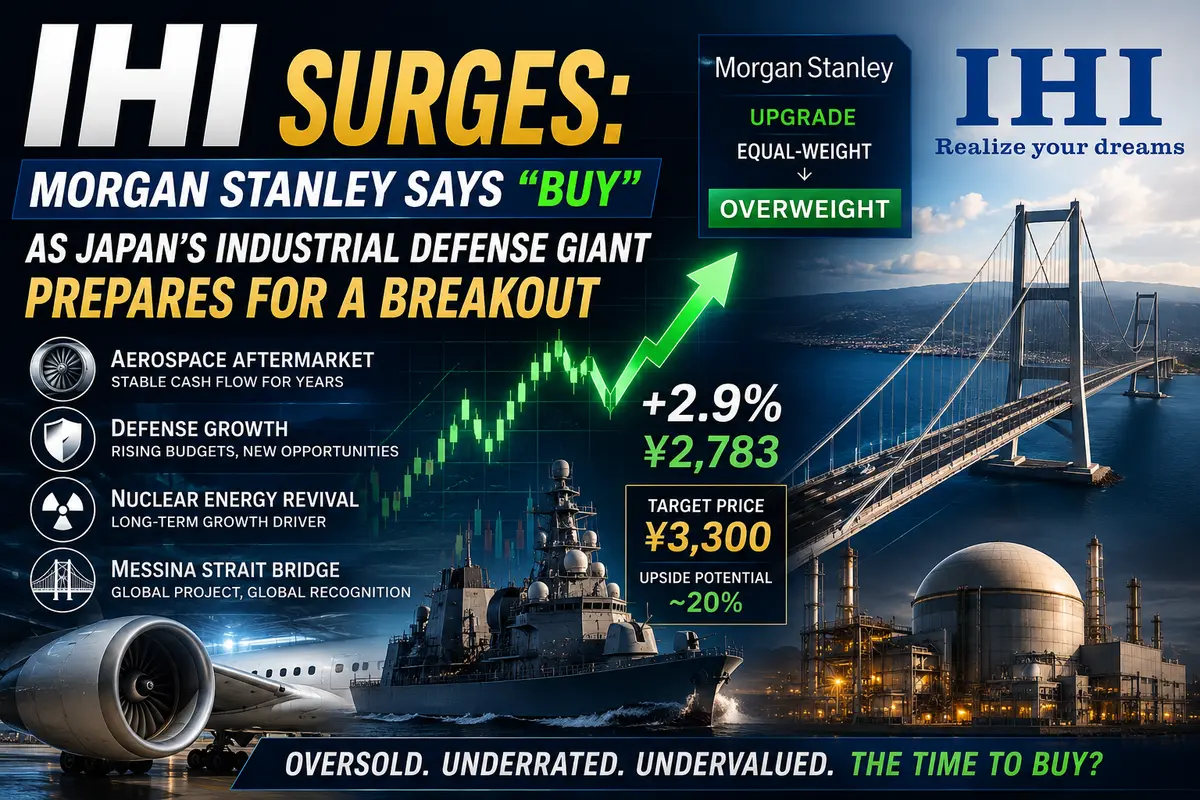
IHI Surges: Morgan Stanley Says “Buy” as Japan’s Industrial Defense Giant Prepares for a Breakout

IHI Surges: Morgan Stanley Says “Buy” as Japan’s Industrial Defense Giant Prepares for a Breakout

Tuesday: The Day an Old Industrial Conglomerate Suddenly Became Interesting

On Tuesday morning, while the Japanese market was digesting the Bank of Japan’s rate decision and preparing for the upcoming Federal Reserve meeting, one stock stood out from the crowd. Shares of IHI Corporation jumped 2.9% to ¥2,783.

Does that sound modest? Perhaps. But for a company that has lost more than 40% of its value over the past 52 weeks—from a high of ¥4,698 to a low of ¥2,069—even a 2.9% gain is noteworthy.

What happened?

Morgan Stanley, one of the world’s most influential investment banks, upgraded IHI from “Equal-weight” to “Overweight” and raised its price target to ¥3,300 from ¥3,150.

In simple terms, Morgan Stanley believes IHI shares have been heavily oversold, that the recent decline was driven by external factors—particularly tensions in the Middle East—rather than company-specific problems, and that now presents an attractive buying opportunity.

The bank described its investment thesis as “growth at a discount.” In other words, IHI offers solid growth prospects, but its shares are trading at depressed valuations due to temporary concerns.

What are those growth prospects? Three major themes:

  • Civil aerospace aftermarket services

  • Defense

  • Nuclear energy

The civil aerospace aftermarket business provides recurring revenue for years as aircraft engines require ongoing maintenance, repairs, and replacement parts. Defense spending is rising in Japan and globally. Nuclear energy is experiencing a resurgence as countries seek reliable, low-carbon power sources.

There is also a political catalyst.

Japanese Prime Minister Sanae Takaichi has publicly supported the Strait of Messina Bridge project. IHI is involved in the consortium alongside Italy’s Webuild and Spain’s Sacyr. The project is more than infrastructure—it represents international recognition of Japanese engineering expertise.

So the key questions are: Who is IHI, why has Morgan Stanley become interested now, and does the stock...

Continue reading...
0
0
Rose Gramit

Strategy Shares Fall After First Bitcoin Sale Since 2022

Strategy Shares Fall After First Bitcoin Sale Since 2022

From an ironclad “never” to the first step back

The cryptocurrency market is used to surprises, but the news that emerged this past Monday caught even the most seasoned Bitcoin enthusiasts off guard. Strategy Inc. — a company that for years has served as a living symbol of unwavering faith in Bitcoin — has sold part of its Bitcoin holdings. For the first time since 2022. The amount was modest, around $2.5 million. Yet the mere fact of the sale sent the company’s stock down nearly 5% in premarket trading.

For those who have followed the story of Strategy (formerly known as MicroStrategy), this move looks like a crack in the foundation. Michael Saylor, the company’s co-founder and chief evangelist, spent years repeating the same mantra: “We do not sell Bitcoin. Ever.” His strategy was brilliantly simple — borrow money, issue bonds, raise capital by any available means, and convert it into Bitcoin. Accumulate at all costs. Hold indefinitely. And now, that narrative has begun to soften.

What Happened

Investors and analysts immediately turned to the regulatory filings submitted after the transaction. What they found was intriguing: the sale was not a panic move or a forced liquidation during a market downturn. Strategy remains the world’s largest corporate holder of Bitcoin, with approximately $61 billion worth of the cryptocurrency still on its balance sheet. The sale was largely symbolic and does not alter the broader picture.

But this is not really about the money. It is about the signal.

When someone who has spent years pledging eternal commitment suddenly takes a step back, the market starts asking questions. The stock did not fall because the company lost $2.5 million. It fell because traders realized that the principle of “buy only, never sell” is no longer absolute.

Saylor himself hinted at...

Continue reading...
0
0
Navigation menu
instaforex banner