

Huang at Computex: How Nvidia Plans to Feed the AI-Hungry World
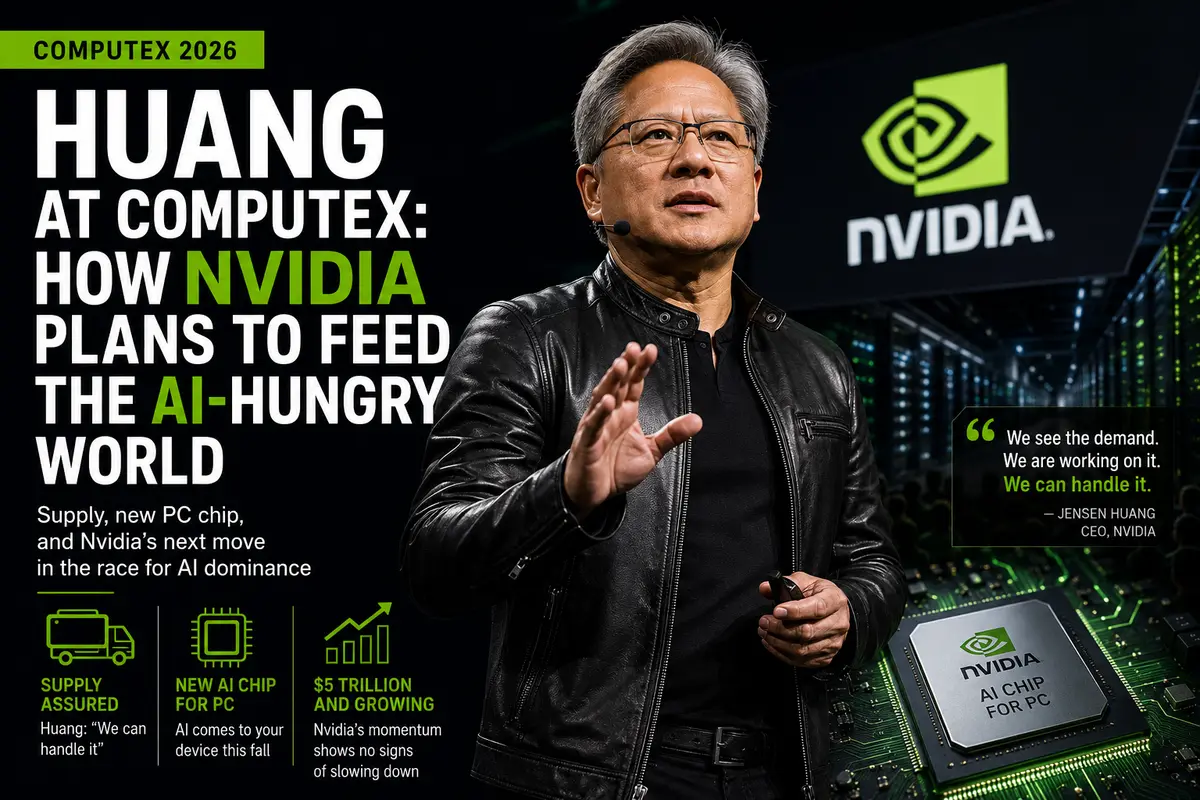
Taipei, Computex 2026. The hall is packed to capacity as journalists and analysts from around the world hang on every word of a man who, over the past few years, has transformed from the head of a gaming graphics card manufacturer into one of the most influential figures on the planet. Jensen Huang, Nvidia’s founder and longtime CEO, steps up to the microphone. He is wearing his trademark leather jacket—a signature look that has become as recognizable as Steve Jobs’ black turtleneck. But today, he is not talking about new products; he covered those the day before. Today, he is addressing what concerns markets most: supply. Specifically, whether Nvidia can physically manufacture enough chips to satisfy a world obsessed with artificial intelligence.
“We Can Handle It”: Three Words the Market Was Waiting to Hear
Huang did not mince words. He acknowledged what the market has been whispering about for months: supply constraints remain a real issue. Nvidia, the company powering data centers around the globe with its semiconductor technology, is facing an enormous imbalance between supply and demand. Every new data center, every new large language model, and every AI startup wants Nvidia accelerators. Demand is growing exponentially, outpacing the production capacity of even a giant like Nvidia.
Yet Huang stated that the company has secured sufficient supply to support continued production growth. This was more than just an optimistic remark. It was a signal to investors who had become increasingly anxious about reports of chip shortages and shipment delays. Nvidia’s CEO was effectively saying: we see the problem, we are working on it, and we have addressed it to the extent necessary to keep growing.
Behind those words lies an immense effort. Nvidia does not manufacture chips itself—it designs them and relies on Taiwan’s TSMC and, to a lesser extent, Samsung in South Korea for production. Securing supply means negotiating manufacturing capacity with these industry giants and building logistics networks capable of delivering chips to customers on time. In a world where semiconductor fabs are operating at full capacity and production slots are booked months in advance, that is no small feat.
A New PC Chip: Nvidia Moves Into Intel and Apple’s Territory
A day earlier, at Computex’s opening keynote, Nvidia unveiled a new chip designed to bring artificial intelligence capabilities directly to personal computers. This is not just another addition to the product lineup—it represents a strategic shift that could reshape the PC market.
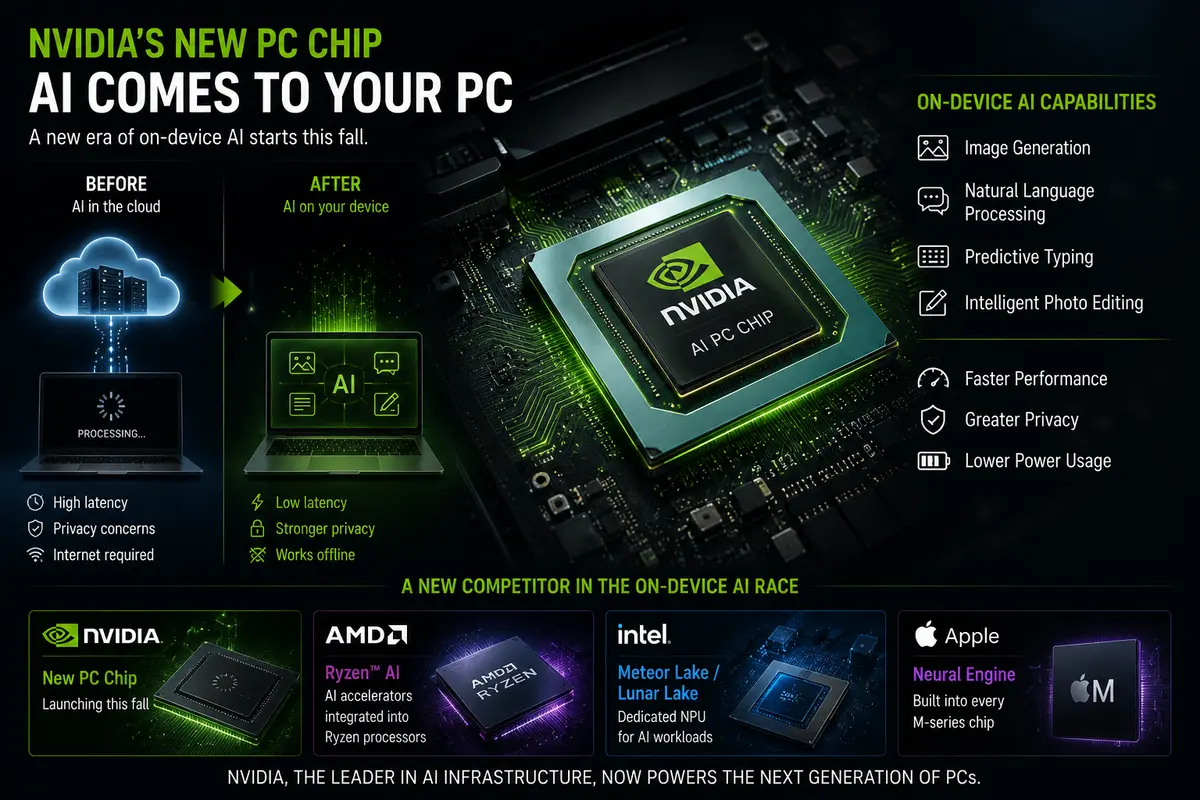
Until now, Nvidia’s AI accelerators have primarily lived inside data centers. They powered ChatGPT queries, trained neural networks, generated images and videos, and handled massive AI workloads. Users interacted with AI through the cloud, while their laptops and desktops served mainly as terminals connecting to remote servers.
The new chip changes that paradigm. It brings AI directly onto users’ devices. That means features such as image generation, natural-language processing, predictive typing, and intelligent photo editing can run locally, without the delays associated with sending data to the cloud and back. The result is faster performance, greater privacy, and less dependence on a constant internet connection.
The chip is scheduled to launch this fall and will compete directly with offerings from AMD, Intel, and Apple. All three companies are already developing their own on-device AI solutions. AMD is integrating AI accelerators into its Ryzen processors. Intel is betting on Meteor Lake and Lunar Lake with dedicated neural processing units. Apple continues to expand the Neural Engine embedded in every M-series chip. Nvidia, long associated with discrete graphics cards, is now entering this race as a full-fledged contender.
Computex as a Showcase of Ambition
Computex in Taipei has long since outgrown its roots as a niche event for PC builders. Today, it is one of the world’s premier stages for showcasing advances in semiconductors and artificial intelligence. Nvidia’s decision to unveil its new chip there was no coincidence. Taiwan is the heart of the global semiconductor industry, home to TSMC’s fabrication plants that manufacture chips for Nvidia, Apple, AMD, and dozens of other companies.
Huang’s presence at Computex and his comments on supply are also a message to partners. TSMC, Taiwanese equipment suppliers, chassis manufacturers, and cooling-system makers all view Nvidia as one of the most important customers of the future. Confirmation that Nvidia intends to continue expanding production translates into stable orders and confidence across the supply chain.
The AI Chip Battle Is Just Beginning
Today’s AI chip market resembles a modern-day gold rush. Nvidia holds a dominant position, controlling an estimated 80–90% of the data-center accelerator market. But competitors are closing in.
AMD is trying to gain ground with its Instinct lineup, emphasizing open software ecosystems and competitive pricing. Intel is developing its Gaudi products and planning future platforms such as Falcon Shores. Google designs its own TPUs for internal use. Amazon has developed Trainium and Inferentia. Microsoft is reportedly working on an in-house AI accelerator. Even Meta is said to be experimenting with custom silicon.
Meanwhile, startups such as Cerebras, Groq, and Graphcore are pursuing alternative architectures that aim to challenge Nvidia through innovation rather than scale. None currently poses a serious threat to Nvidia’s dominance, but their emergence demonstrates that the industry sees room for competition.
Nvidia’s move into client-side AI chips is also a way to diversify its business and reduce reliance on data centers. If its new PC chip succeeds, the company will be able to generate revenue not only from cloud giants but also from hundreds of millions of laptop and desktop users worldwide.
Five Trillion Dollars and No Signs of Slowing Down
Nvidia’s market capitalization now stands at roughly $5 trillion. The company is worth more than the entire German economy. More than Amazon and Tesla combined. And despite its enormous size, it continues to grow at a pace that seems almost unimaginable for a business of this scale.
At Computex, Huang made it clear that he believes this is only the beginning. Artificial intelligence is spreading into every corner of society—from healthcare to agriculture, from education to defense. Every new application requires computing power. Nvidia chips.
A company that once began by accelerating graphics for computer games now sits at the center of the most significant technological transformation since the birth of the internet.
Huang’s comments on supply were more than a technical update. They were a declaration of leadership. Nvidia sees the enormous demand ahead and is not intimidated by it. The company is prepared to meet it. And if Huang is right, the world may be on the verge of an era in which AI becomes as ubiquitous as electricity or the internet—and Nvidia remains the primary supplier of the infrastructure powering that new age.

Comments
No comments yet. Be the first to share your thoughts!
Authentication Required
You must be logged in to post a comment.