Bar Pipa
We pay for a post of 10$

Technical Analysis

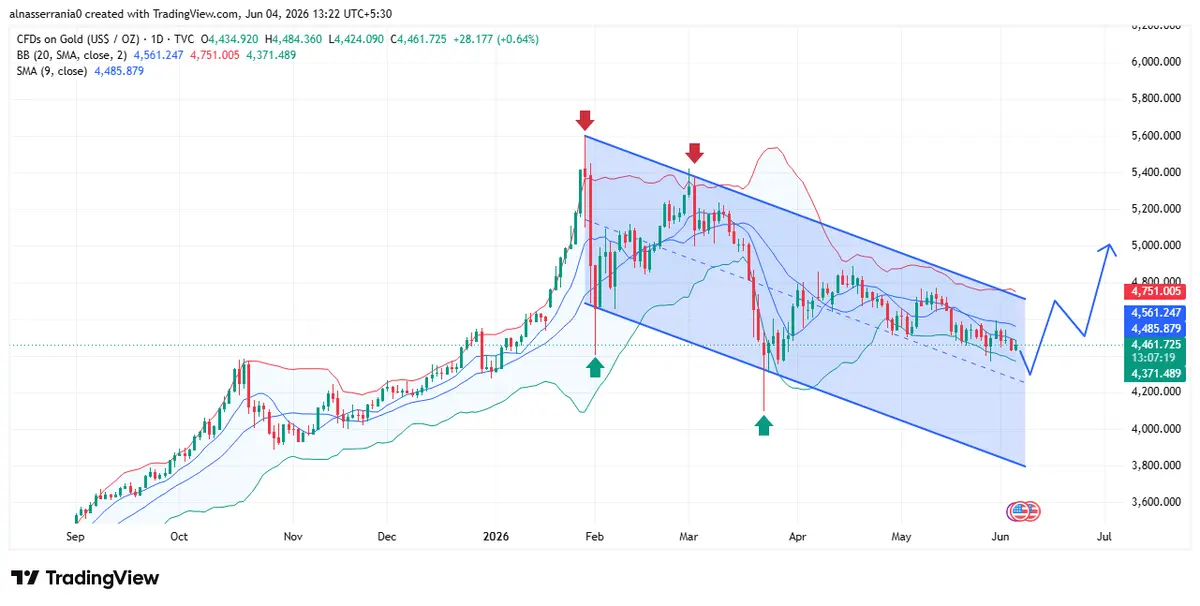
XAUUSD Technical Outlook – 4 June 2026

XAUUSD Technical Outlook – 4 June 2026


Descending channel, the dominant structure since February peak

Gold peaked sharply near $5,500+ in early February 2026 and has been carving a clear descending channel (drawn in blue on the chart) ever since. Both the upper and lower channel lines are well-respected, price has tested both boundaries multiple times. The channel is sloping down from top-right to bottom-left, which tells you the sellers have been in control for 4+ months

Price is sandwiched, squeezed between channel support and SMA9

At $4,461, price is sitting right at the lower boundary of the descending channel a historically significant bounce zone. Both prior green arrows on the chart (February and March) marked rebounds from this exact region. The SMA9 ($4,485) is overhead acting as immediate dynamic resistance. Price needs to close above SMA9 on a daily basis to even hint at recovery. Until that happens, this is a range-bound squeeze with downside risk still alive.

Key Levels to watch

Channel top / BB upper - $4,751 Major resistance — unlikely near-term

SMA20 midline - $4,561 Bears defend this level

SMA9 dynamic resistance - $4,485 Immediate ceiling today

Current price - $4,461 At channel lower support

BB lower / channel floor - $4,371 Critical support — bounce or break

Breakdown target - $3,800 If $4,371 fails decisively

Continue reading...
0
0

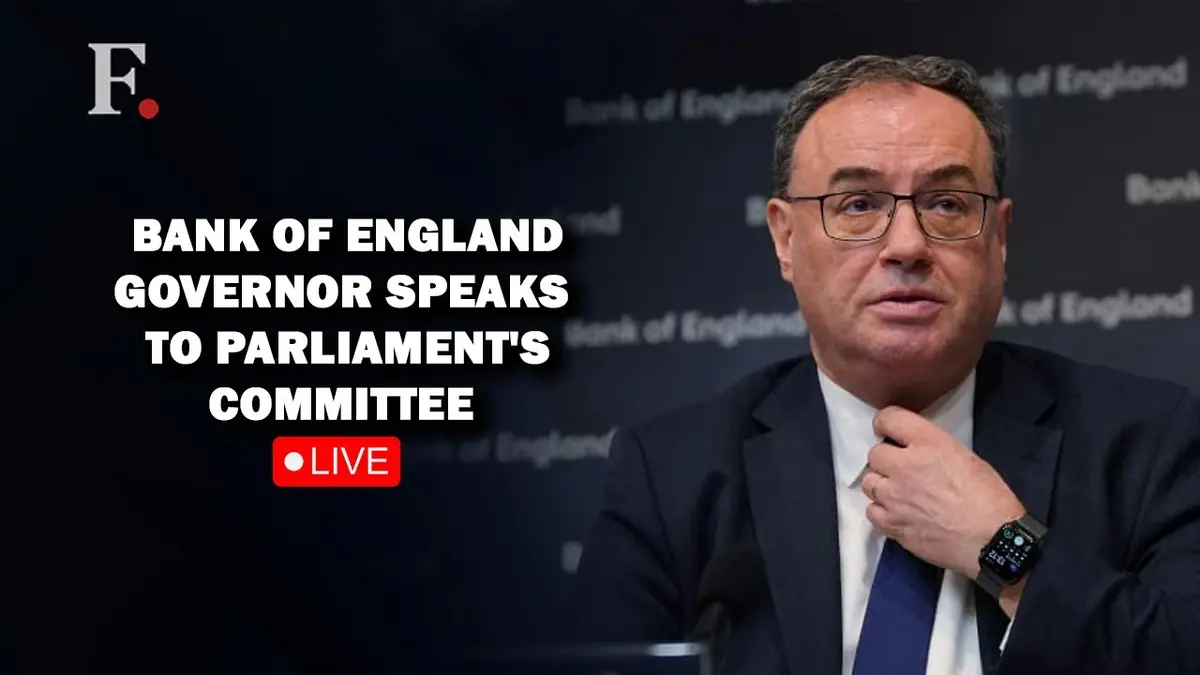
Double Trouble Today: BOE’s Bailey Speaks & JOLTS Job Openings! (+ Gold Strategy)

Double Trouble Today: BOE’s Bailey Speaks & JOLTS Job Openings! (+ Gold Strategy)

Hey Traders,

Today is packing some serious macroeconomic heat. If you're trading the Pound, the Dollar, or Gold, you need to have your alerts set and your risk management dialed in. Here is the no-nonsense breakdown of what to expect today and how to position yourself.

🇬🇧 BOE Gov Bailey Speaks: Is the Pound Losing its Edge?

The Context: Governor Andrew Bailey has recently shifted to a surprisingly dovish stance. He explicitly noted that the Bank of England (BoE) might tolerate inflation staying above their 2% target temporarily to support the weak real economy, especially given the ongoing uncertainties and supply shocks from the conflict in the Middle East.

What to Watch: He is in the spotlight again today. If he doubles down on this dovish rhetoric and signals that the BoE is in "no rush" to tighten policy or hike rates despite sticky prices, expect the Pound to face selling pressure.

Key Pairs: Watch $GBPUSD and $EURGBP. If Bailey sounds cautious about UK growth and confirms that summer rate hikes are effectively off the table, $GBPUSD could aggressively test immediate support levels.

🇺🇸 USD JOLTS Job Openings: The Prelude to NFP

The Numbers: Dropping exactly at 10:00 AM ET / 14:00 GMT. The forecast is sitting around 6.82M to 6.87M openings, which is slightly below or roughly in line with March's print of 6.866M.

Why it Matters: The Federal Reserve is laser-focused on the labor market right now to determine its next monetary policy move. This report is our first major clue of the week, setting the stage before Friday’s massive Nonfarm Payrolls (NFP) release.

The Play:

Hot Print (>6.87M): A higher-than-expected number means the labor market is still too tight, reinforcing the "higher for longer" interest rate narrative. This is bullish for the USD.

Cold Print...

Continue reading...
0
0
NorthRay

Fundamental Analysis: Why I Stopped Looking Only at Charts and Started Reading News About Farmers and Interest Rates

Fundamental Analysis: Why I Stopped Looking Only at Charts and Started Reading News About Farmers and Interest Rates

Hi, this is NorthRay.💥

For a long time, I thought: “Technical analysis is enough. The chart reflects everything. Why should I bother with reports, GDP figures, and interest rates?”

I drew support and resistance levels, watched the stochastic oscillator, and opened trades.

And often, technical analysis would tell me “buy.” The price would move up at first, then suddenly reverse and crash lower. No apparent reason. No warning.

I’d sit there thinking:

“What went wrong? The level was solid...”

Then I started reading the news.

It turned out that inflation data had been released in the U.S. that day. Or the Federal Reserve Chair had made comments about interest rates. Or Europe was dealing with a crisis.

My technical analysis wasn’t wrong. It simply didn’t know what the market already knew.

That’s when I realized: the chart is the result. The cause lies in fundamentals.

So I started studying fundamental analysis.💬

What Is Fundamental Analysis? (In Simple Terms)

If technical analysis focuses on the chart itself (candlesticks, levels, indicators), fundamental analysis focuses on what’s behind the chart.

A country's economy. Central bank actions. Politics. Natural disasters. Wars. Elections.

Everything that can affect the supply and demand of currencies, stocks, or commodities.

A simple example:

Imagine you want to buy an apartment in a city.

Technical analysis looks at housing prices over the past year and says:

"Prices usually rise in spring and fall in autumn. It's spring now, so prices will probably go up."

Fundamental analysis looks at the city itself:

Is a new factory being built? (More people move in → prices rise.)

Is a major employer shutting down? (People move away → prices fall.)

Are mortgage rates being lowered? (Housing becomes more affordable → prices rise.)

Technical analysis is about history and recurring patterns.

Fundamental analysis is about...

Continue reading...
0
0
NorthRay

I Started Learning Technical Analysis. The Chart Stopped Being Just a Picture.

I Started Learning Technical Analysis. The Chart Stopped Being Just a Picture.

Hi, this is NorthRay.😎

For a long time, I looked at charts like abstract art.

Red candles, green candles, lines crawling somewhere across the screen. I understood where the price moved, but I didn’t understand WHY it moved there or WHERE it might go next.

I traded randomly. I clicked Buy because “I feel like it’ll go up.” I clicked Sell because “it seems too high.”

That worked about half the time. Because honestly, both I and my cat could flip a coin.

And then I told myself: “Enough guessing. Time to understand.”

That’s when I started learning technical analysis.

What I Used to Think About Technical Analysis (and How Wrong I Was)

Honestly? I thought it was something complicated and unnecessary.

“Why do I need all these lines and patterns? The market is chaotic. News and crowd emotions decide everything.”

I was wrong.

Yes, news matters. Yes, emotions drive the crowd. But all of that is REFLECTED on the chart. Price doesn’t come out of nowhere. It’s created by the actions of thousands of traders.

And those actions have patterns.

Technical analysis isn’t magic. It’s simply an attempt to find repeating patterns on a chart and use them to make forecasts.

In simple terms:

If every time the price touches a certain level it bounces upward, that’s not a coincidence. It means buy orders are sitting there.

Technical analysis helps identify those levels.🔥

Where I Started (Slowly, Without Overdoing It)

I didn’t try to learn everything at once. I have no goal of becoming a professor.

I decided to master three basic things that, according to experienced traders, cover 80% of a beginner’s needs.

My minimum program:

Support and resistance levels

Trend lines

One confirmation indicator (for me it’s the Stochastic oscillator, which I already wrote about)

That’s it....

Continue reading...
0
0

Bitcoin on a Rollercoaster: How Hopes for Peace and Nasdaq Options Brought Crypto Back to Life

Bitcoin on a Rollercoaster: How Hopes for Peace and Nasdaq Options Brought Crypto Back to Life

Monday began with a number that still seemed lost on Saturday: seventy-seven thousand dollars. A round, psychologically important level from which the world’s leading cryptocurrency bounced back after falling to seventy-four thousand three hundred over the weekend. A market that was licking its wounds yesterday is once again looking upward today. And there are at least two reasons for it: one rooted in geopolitics, the other in institutional finance. Together, they created the perfect cocktail that pulled Bitcoin out of the pit and forced traders to rethink the near-term outlook.

Iranian Optimism: How Peace Talks Are Moving Crypto

The connection between Bitcoin and negotiations in Doha is not obvious at first glance. But dig deeper, and the logic becomes clear. Hopes for a peace agreement between the United States and Iran, which emerged over the weekend, imply the potential reopening of the Strait of Hormuz. Reopening the strait means restoring oil supplies. Restored supplies mean lower energy prices. Lower energy prices mean weaker inflationary pressure. And weaker inflation means the Federal Reserve may not need to tighten policy further or raise rates.

For Bitcoin, which has spent recent months suffocating under fears of persistently high interest rates, this chain reaction is like a breath of fresh air. High rates crush appetite for risk assets. Investors move into bonds, the dollar, and anything offering guaranteed yield. Cryptocurrency, which generates no cash flow, suffers first in such an environment. But the moment there is hope for easier monetary policy, capital starts flowing back in.

Of course, geopolitical optimism is fragile. We have seen how quickly it can evaporate. One strike on Iranian facilities, one harsh statement from Tehran, one Trump tweet — and Bitcoin could tumble again. But on Monday, the market chose to focus on the bright side. Talks are ongoing,...

Continue reading...
0
0
Navigation menu