

Quiet Revolution: How Overseas Deliveries Saved BYD from a Prolonged Slump

The Hong Kong stock market witnessed an event on Tuesday that BYD shareholders had been waiting eight long months for. Shares of China’s largest electric vehicle manufacturer surged 4.4% to HK$94.75, marking their best single-day gain since late April. The catalyst was the company’s May sales report. BYD finally broke the longest streak of declining sales in its history. Sales increased by 0.3% year-over-year to 383,453 vehicles. The growth was modest—almost within the margin of statistical error. But for a market accustomed to continuous deterioration, it felt like a breath of fresh air.
Eight Months of Decline: Anatomy of a Crisis
To understand why a modest 0.3% increase triggered such a strong market reaction, it is important to recall what BYD has endured over the past several months. A company that was once a symbol of China’s dominance in the electric vehicle industry found itself facing a harsh reality: the domestic market had become saturated, competition had intensified to unprecedented levels, and a fierce price war was squeezing profit margins.
Sales declined for eight consecutive months. This was more than just a statistical trend—it was an indictment of a business model that had become too dependent on a single market. Chinese consumers, who only recently lined up to buy BYD vehicles, now have dozens of brands to choose from, each offering subsidies, discounts, and promotional incentives. BYD found itself caught between the hammer of domestic competition and the anvil of a slowing economy.
Then May brought an unexpected turnaround. And that turnaround happened not in China, but beyond its borders.
Overseas Deliveries as a Lifeline
The primary driver of May’s growth was international sales. BYD has been aggressively expanding its presence outside China, and that strategy is finally beginning to pay off. The company now sells vehicles across Europe, Southeast Asia, Latin America, and the Middle East—regions where Chinese-made EVs are gaining traction thanks to their combination of affordability, quality, and advanced technology.
Overseas markets are attractive to BYD for several reasons. First, competition is not nearly as intense as it is in China. Tesla, Volkswagen, and Hyundai are certainly present, but BYD still enjoys a price advantage that many Western competitors have yet to match. Second, governments in many countries are encouraging EV adoption through subsidies and tax incentives, expanding the addressable market. Third, BYD is building manufacturing facilities abroad, allowing it to bypass trade barriers and gain access to local supply chains.
The May figures suggest that the globalization strategy is working. Overseas sales offset the continued decline in the domestic market. It is a classic example of diversification: when one market struggles, another provides support.
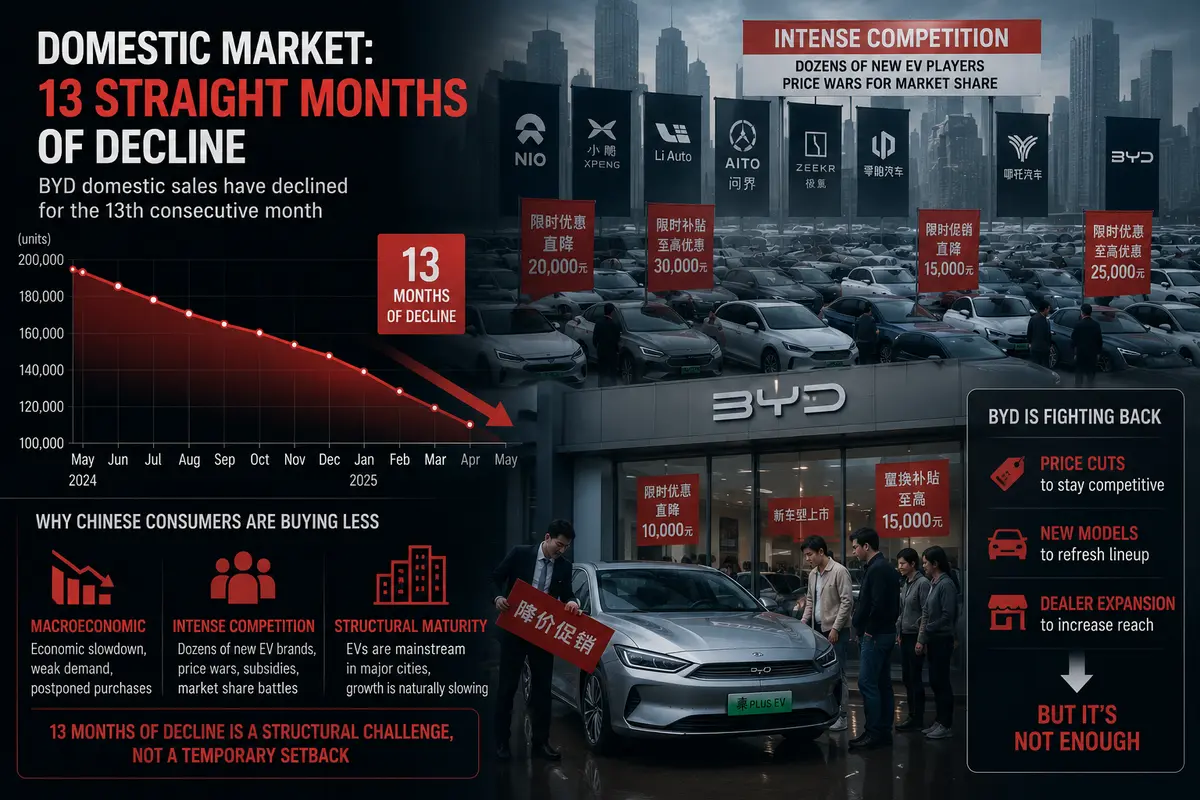
Domestic Market: Thirteen Straight Months of Decline
However, the excitement surrounding overall sales growth should not overshadow a troubling reality: BYD’s domestic sales declined for the thirteenth consecutive month. The Chinese market, once the company’s growth engine, has become a drag on performance.
Why are Chinese consumers buying fewer BYD vehicles? There are several reasons. The first is macroeconomic. China’s economy is slowing, consumer demand remains weak, and households are postponing major purchases. The second is competitive. Dozens of new EV manufacturers have entered the market, many backed by local governments and willing to engage in aggressive price-cutting to gain market share. The third is structural. In China’s largest cities, EVs have already become mainstream, and growth rates are naturally slowing as the market approaches saturation.
BYD is fighting back by cutting prices, launching new models, and expanding its dealer network. Yet these efforts have not been enough. Thirteen months of decline is not a temporary setback—it is a structural challenge. China can no longer serve as the company’s sole growth engine. That is why international expansion is becoming not just an opportunity, but a necessity for survival.
The Price War and Margins: The Hidden Threat
Behind the sales figures lies another issue that markets sometimes overlook in their enthusiasm for growth headlines: profitability. BYD is deeply involved in the ongoing price war, cutting vehicle prices to defend market share. While this strategy helps boost sales volumes, it comes at the expense of margins.
The company has not yet released its latest quarterly financial results, but analysts expect margins to continue shrinking. Selling more vehicles while earning less from each one is not a strategy that long-term investors typically favor. For now, the market may be willing to overlook profitability concerns in celebration of renewed sales growth. But eventually, attention will return to a critical question: how much profit does BYD generate from each vehicle sold?
Here, international sales may once again provide relief. Prices are generally higher in overseas markets, competition is less intense, and margins should therefore be stronger. If BYD can continue increasing the share of exports in its total sales mix, it could support not only revenue growth but also profitability.
Context: The Global EV Market at a Crossroads
BYD is not operating in a vacuum. The global electric vehicle market is going through a transitional phase. On one hand, demand continues to grow, fueled by climate policies and technological advancements. On the other hand, growth rates are slowing. Early adopters have already purchased their EVs. Manufacturers must now convince mainstream consumers, who tend to be more price-sensitive and less willing to experiment.
Geopolitical factors are also shaping the market. Trade tensions among the United States, China, and Europe continue to create uncertainty. Tariffs on Chinese EVs in Europe and North America could slow BYD’s international expansion. The company is attempting to mitigate these risks by building factories in other countries, but doing so requires significant time and capital investment.
What Comes Next: Scenarios for BYD
May’s sales growth is an important signal, but it is not a definitive victory. BYD still faces several major challenges. The first is sustaining international growth. The second is halting the decline in its domestic market. The third is maintaining profitability amid an ongoing price war.
If the company can continue expanding globally, if its new overseas factories reach full production capacity, and if the domestic market at least stabilizes, BYD’s stock could continue to rise. Tuesday’s 4.4% gain may be only the beginning if the company proves that May’s turnaround was not a one-off event but the start of a new trend.
However, if overseas sales prove to be a temporary surge, if domestic demand continues to weaken, and if the price war consumes profitability, the recent rebound could quickly reverse. BYD is walking a tightrope. The May report has given shareholders hope that the company can pull out of its prolonged downturn. Yet confirming that hope will require months—if not years—of sustained growth.
For now, the market is celebrating its first piece of genuinely positive news in eight months. And that celebration is well deserved.

Comments
No comments yet. Be the first to share your thoughts!
Authentication Required
You must be logged in to post a comment.