Bar Pipa
We pay for a post of 10$

AUD/USD

The Australian Market Stalls Just Above Zero: A Day That Changed Nothing

The Australian Market Stalls Just Above Zero: A Day That Changed Nothing

Monday on the ASX: A Decline of Mere Hundredths of a Percent

The Australian stock market ended the first trading day of the week with an almost imperceptible move lower. The S&P/ASX 200 Index lost just 0.06%—such an insignificant amount that it could easily be dismissed as statistical noise. Yet behind this microscopic decline was a day full of contrasts: some companies surged, others fell to record lows, while the overall result remained virtually unchanged.

Trading on the Sydney Stock Exchange was marked by a tug-of-war. The information technology, utilities, and healthcare sectors pushed the index lower, while other industries attempted to keep it afloat. In the end, the battle finished in a draw—but the apparent calm was deceptive. Within the market, a genuine drama was unfolding, with winners and losers changing places at a dizzying pace.

The final tally showed 583 declining stocks compared with 485 advancing stocks, while 389 shares remained virtually unchanged. This suggests that sellers outnumbered buyers, but the overall decline remained minimal because the day’s strongest performers delivered impressive gains.

The Top Three Performers: Who Pulled Ahead?

Against a backdrop of general stagnation, three companies posted impressive gains of more than 4%.

Yancoal Australia, a coal-mining company, took first place, rising 6.16% to AUD 5.69. The strength of the coal sector was no coincidence. Energy prices surged amid the escalation of the conflict in the Middle East, making coal increasingly attractive as an alternative source of energy. Investors concerned about potential disruptions to oil supplies have been shifting toward coal-related assets, placing Yancoal at the centre of this trend.

Contact Energy, a New Zealand energy company, ranked second after gaining 4.56% to AUD 7.80. Interestingly, Contact Energy is traded on the Australian exchange, although its core business is concentrated in New Zealand. The rise in...


Continue reading...
0
0
Lin Brings

Asia freezes ahead of the Fed: everyone awaits a signal from Kevin Warsh

Asia freezes ahead of the Fed: everyone awaits a signal from Kevin Warsh

Wednesday in Asian currency markets began with an oppressive calm. Asian currencies did not move. The dollar did not move. The dollar index (DXY) remained frozen after four days of decline. Everyone stood still. Like rabbits before a predator. Or like traders ahead of the most important event of the week — the meeting of the U.S. Federal Reserve, the first under new Chairman Kevin Warsh.

USD/JPY — the Japanese yen — fell by 0.1% to 160.30. It was a symbolic move. Even after the Bank of Japan raised its rate to 1.0% the previous day — the highest in 31 years — the yen did not strengthen. Because everyone is waiting for the Fed.

USD/CNY — the Chinese yuan — was unchanged. USD/SGD — the Singapore dollar — was unchanged. USD/INR — the Indian rupee — fell by 0.3%, but this was a local move. AUD/USD — the Australian dollar — was unchanged after the RBA kept rates steady.

Only USD/KRW — the South Korean won — rose by 0.4%, breaking away from the general trend. But even this was likely linked to a tech rally in Samsung and SK Hynix shares rather than currency policy.

The reason for the calm is anticipation. Traders do not want to open new positions ahead of the Fed meeting. Uncertainty is too high. The risks are too large.

There is also the peace agreement between the U.S. and Iran. Details are becoming clearer. On Tuesday, the first concrete terms emerged. The agreement provides for the immediate resumption of Iranian oil exports. Iran agrees not to develop nuclear weapons and freezes its nuclear program for 60 days for negotiations.

This is positive for markets. But traders want to see a signed document, not just words. So they wait.

So what is happening in...

Continue reading...
0
0

Currency options on the FX market expire on Wednesday

Currency options on the FX market expire on Wednesday

On Wednesday, June 16, 2026, an event is taking place in the foreign exchange market that most ordinary people will not even notice. But those who trade currencies know: today, large FX options are expiring. Billions of dollars, euros, yen, pesos, yuan, and reais may be exercised, not exercised, or rolled over. And depending on what happens, exchange rates could shift by tenths of a percent—or more.

This is not just a technical detail. It is a key market moment. Because options are both insurance and speculation at the same time. When they expire, the market loses support or resistance levels. Prices can move sharply. Traders holding positions may be forced to close them.

And today, on Wednesday, large options expire across several currency pairs. Let’s start with USD/JPY. The largest option is worth $1.09 billion with a strike at 158.00. Almost a billion dollars! What does this mean? The trader who bought this option has the right to buy or sell dollars at 158 yen per dollar. If the market is above 158, the option is in the money. If below, it is worthless.

In addition, options expire for $749.6 million at 157.25 and $691.1 million at 158.50. There are also USD/CNY options worth $1.8 billion at a strike of 6.7928. USD/BRL options worth $767.5 million at 5.1100. EUR/USD options worth nearly 1 billion euros at 1.1450. AUD/USD options worth 933.3 million AUD at 0.6650. USD/MXN options worth $629.5 million at 17.24.

All of these expire today. And they may affect markets.

But that’s only today. On June 18 (tomorrow), even larger options expire: EUR/USD options worth 8.73 billion euros at 1.1500! Yes, nearly 9 billion euros. No joke. And USD/JPY options worth $1.79 billion at 155.00. And USD/CAD options worth $884 million at 1.3735.

These are truly large...

Continue reading...
0
0

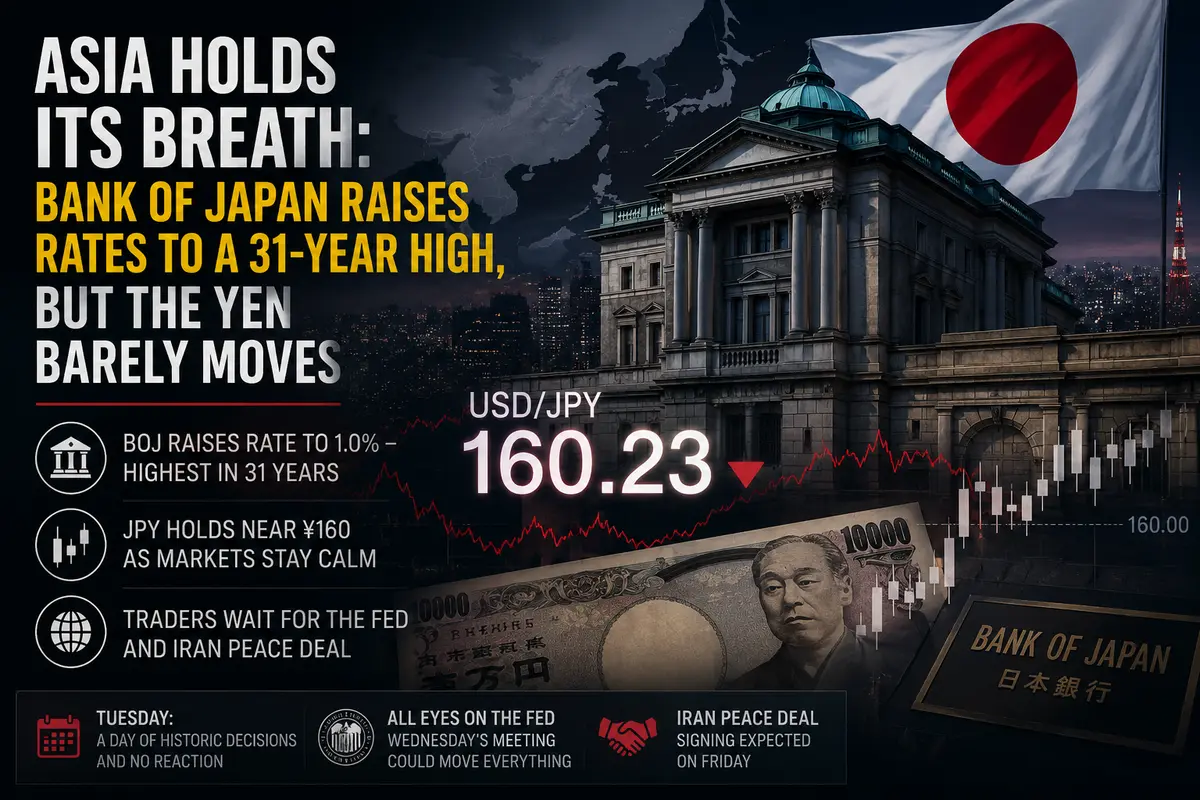
Asia Holds Its Breath: Bank of Japan Raises Rates to a 31-Year High, but the Yen Barely Moves

Asia Holds Its Breath: Bank of Japan Raises Rates to a 31-Year High, but the Yen Barely Moves

Tuesday: A Day of Historic Decisions and No Market Reaction

Tuesday began with an event that, under normal circumstances, would have shaken currency markets to their core. The Bank of Japan raised its short-term policy rate by 25 basis points to 1.0% — the highest level in 31 years. The last time Japanese interest rates stood at this level was in 1995, when the internet was still in its infancy and many of today's traders had not even been born.

The decision passed by a 7–1 vote. Governor Kazuo Ueda did not attend the meeting as he is currently undergoing medical treatment in the hospital. The meeting was chaired by Deputy Governor Shinichi Uchida instead. It is an unusual situation: the head of the central bank was absent during a historic policy decision.

And what happened?

Virtually nothing.

USD/JPY barely moved. The yen remained around ¥160.23 per dollar, only slightly different from levels seen before the announcement. Traders who expected a rate hike to strengthen the yen were left disappointed.

Why?

Because markets had already priced in the move over recent weeks. The real surprise would have been if the Bank of Japan had not raised rates. Since the hike was widely expected, the market reaction was essentially zero.

The yen continues to trade near the psychologically important ¥160-per-dollar level. Back in April, when the dollar first broke above ¥160, Japanese authorities intervened in the currency market. This time, they have remained on the sidelines, apparently viewing ¥160 as an acceptable exchange rate with policy rates at 1.0%.

But let's take a closer look at what is actually happening across Asian currency markets on Tuesday, why most currencies appear frozen in place, and what traders are waiting for from other central banks.

Bank of Japan: A Historic Move Without the...

Continue reading...
0
0
Tom Maffin

Invisible Magnets: Where Tuesday’s Option Barriers Could Halt Currency Moves

Invisible Magnets: Where Tuesday’s Option Barriers Could Halt Currency Moves

Tuesday’s New York cut. For most people, it’s simply the close of the U.S. trading session. For FX traders, it’s a moment of truth. Options contracts worth billions of dollars are set to expire, and these expiries often exert an almost gravitational pull on spot exchange rates, drawing them toward specific levels. Market makers hedging their positions will do everything possible to keep prices near major strikes. Once the options expire, however, those anchors disappear—and the market may make a sharp move. Let’s look at the key currency pairs and where the traps are set today.

EUR/USD: Nearly €2 Billion at 1.1850

The main magnet for the euro today sits at 1.1850, where options totaling €1.82 billion are due to expire. This is not just a large expiry—it is a gravitational anomaly. The spot rate could be pulled toward this level during the final hours before the New York cut.

Additional anchors include €1.51 billion at 1.1750 and €1.27 billion at 1.1700. Together, these levels create a web of attraction within which the pair may fluctuate. Market makers will actively manage their positions to minimize payouts on expiring contracts. If EUR/USD trades below 1.1850, they may buy euros and push the price higher; if it trades above, they may sell and pull it back toward the strike. This is classic options-related gravity, making sharp moves before expiry less likely.

Notably, an even larger expiry is scheduled for Wednesday: €2.47 billion at 1.1710. This suggests that even after Tuesday’s cut, the market will not gain complete freedom—the next anchor is already waiting.

USD/JPY: 160.00 Is the Red Line

For dollar-yen, the primary magnet is 160.00, where $1.59 billion in options expire. The 160 level is the same red line that triggered large-scale foreign exchange intervention by the...

Continue reading...
0
0
John Madnes

A Magnet for Exchange Rates: Where the Option Traps Are Set This Wednesday

A Magnet for Exchange Rates: Where the Option Traps Are Set This Wednesday

Wednesday, 6 PM. For most people, it’s the hour when attention shifts from work to evening plans. But for currency traders, this moment becomes a point of maximum gravity. Options contracts worth billions of dollars are expiring, and these expiries can pull spot exchange rates toward specific levels with a force that cannot be ignored. Let’s walk through the key currency pairs and see where the traps are set today.

EUR/USD: Nearly €1 Billion at 1.1650

The main magnet for the euro today sits at 1.1650. Options worth a massive €868 million expire at this strike. The spot rate is currently 1.1645 — just five pips away. This means that in the remaining hours before expiry, market makers will do everything possible to keep the pair near this level.

The mechanics are simple: when price approaches a large strike, option holders aggressively hedge their positions, creating artificial gravity. The pair may fluctuate within a narrow range of a few pips around 1.1650, but sharp moves are unlikely.

An additional anchor lies at 1.1640, where €138 million in options expire. This is closer to the current spot price but smaller in size. Most likely, these options will expire without major market impact, though they create extra support just below current levels. If price unexpectedly drops toward 1.1640, buyers may step in and push it back toward the primary magnet zone.

USD/CAD: $328 Million at 1.3805

The largest single options pool today expires in USD/CAD. At the 1.3805 strike, $328 million is concentrated. This is not just a large expiry — it’s a true gravitational anomaly.

The spot rate is 1.3834, slightly above the strike. That suggests the pair could be pulled lower toward 1.3805, as market makers sell USD against CAD to minimize payouts.

Another level sits at 1.4095 with $128...

Continue reading...
0
0
Tim Drening

Price Magnet: How Tuesday’s Option Expiries Could Pull Currency Rates

Price Magnet: How Tuesday’s Option Expiries Could Pull Currency Rates

Tuesday, 6:00 PM Moscow time. For most people, it’s just another hour when the workday winds down and thoughts shift toward home. But for FX traders, this moment marks a point of maximum tension. At the New York cut, option contracts worth billions of dollars across major currency pairs will expire. And these expiries are not just accounting entries. They are a force capable of pulling spot exchange rates toward specific levels in the final hours before expiration — like a magnet drawing in iron filings. Let’s go through the major pairs and see where the traps are set.

EUR/USD: A Narrow Corridor Around 1.16

Two significant option clusters are expiring in euro-dollar. The first is €140 million at the 1.1640 strike. The second is €122 million at 1.1625. At the time the data was recorded, the spot rate stood at 1.1628 — right between the two expiry levels.

This is no coincidence. It’s a classic situation where option barriers create an invisible corridor in which price can remain trapped until the cut.

The mechanics are straightforward. Large option holders — banks and market makers — hedge their exposure. If they sold options at 1.1640, then as price approaches that level they are likely to sell euros to protect themselves from potential losses. Those flows create artificial resistance. The same mechanism works in reverse at 1.1625: as price falls toward that strike, market makers buy euros, creating artificial support.

As a result, the exchange rate becomes squeezed in a vice, and breaking these levels ahead of expiry becomes extremely difficult unless some overwhelming news shock hits the market.

USD/JPY: A Quarter Billion at 159.5

Dollar-yen looks even more intriguing. Options worth $231 million expire at the 159.50 strike. Another $240 million sits at 159.25. The spot rate is currently 159.26...

Continue reading...
0
0
Navigation menu
instaforex banner