Bar Pipa
We pay for a post of 10$

USD/JPY

Tim Drening

Sterling Gains, but Its Position Looks Fragile

Sterling Gains, but Its Position Looks Fragile
A Small Green Ray Through the Clouds

Thursday brought a modest sense of relief to holders of British pounds and euros. After several days in which the U.S. dollar bulldozed its way through virtually every major currency, the market finally paused. Sterling gained 0.27% against the dollar, reaching 1.3459. The euro performed slightly better, rising 0.35% to 1.1640.

These are modest, almost symbolic moves. Yet after the previous day's decline, even such gains felt like a welcome gift.

Still, don't be fooled by the green numbers on the screen. The pound and the euro remain on extremely shaky ground. They resemble a person walking across thin ice—every next step could be the last. The fundamental drivers behind these currencies have not changed. The dollar remains strong. Geopolitical risks remain severe. And economic data from Europe and the UK continue to disappoint.

On Thursday, the dollar merely took a breather. Investors paused ahead of Friday's key event—the U.S. nonfarm payrolls report. This release could either reinforce the dollar's recent momentum or call it into question. Few traders are willing to establish major positions ahead of such uncertainty. As a result, the dollar stood still while the pound and euro managed a modest rebound.

But let's take a closer look. Why does sterling remain so vulnerable? Why is the euro struggling to strengthen despite its gains? And what lies ahead for these currencies after the U.S. employment data is released?

Sterling: Recovering After a Blow

Let's begin with the pound. Thursday's modest rise followed a sharp decline the previous day.

On Wednesday, sterling fell heavily after disappointing UK services-sector PMI data.

The figures were alarming. For the first time in more than a year, the index dropped below the psychologically important 50-point threshold. A reading above 50 signals expansion; below 50 indicates...

Continue reading...
0
0
Tom Maffin

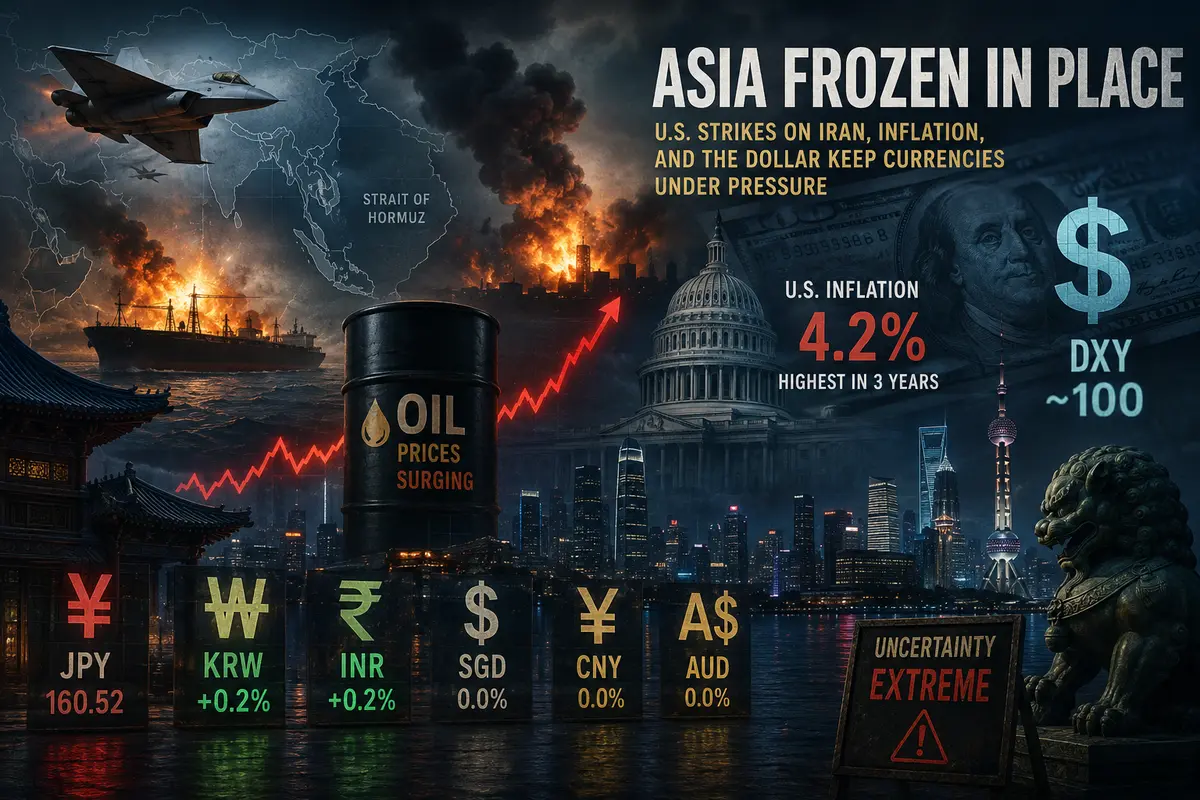
Asia Defends Its Currencies Amid a Strong Dollar and Expensive Oil

Asia Defends Its Currencies Amid a Strong Dollar and Expensive Oil
A Storm That Won’t Let Up

Asia wakes up on Thursday, and the first thing traders see on their screens is red once again. Regional currencies have fallen for a fourth consecutive day. Bloomberg’s Asian currency index—a barometer of the financial health of hundreds of millions of people across the region—continues its relentless slide. The biggest losers are the South Korean won and the Indonesian rupiah, but few others are faring much better.

Behind these numbers lies a simple and uncomfortable story. The dollar is strong. Oil is expensive. Capital is flowing out of Asia and into the United States. Meanwhile, local central banks are trying to preserve what they can. Interventions, warnings, interest-rate hikes—every tool is being deployed. So far, however, the results have been limited.

Asian countries have found themselves in a perfect storm. Two powerful forces are putting simultaneous pressure on their currencies. The first is the policy stance of the U.S. Federal Reserve. The American economy has remained stronger than expected, inflation remains stubborn, and the Fed is not only delaying rate cuts but is even considering further hikes. The second factor is the Middle East. Rising tensions between the United States and Iran are pushing oil prices higher. For Asia, which imports most of the oil it consumes, expensive oil delivers a triple blow: higher inflation, worsening trade balances, and weaker currencies.

Regional authorities are fighting back. Some are intervening directly, selling dollars from their reserves and buying local currencies. Others are raising interest rates to make their currencies more attractive to investors. Some are imposing administrative measures to limit capital outflows. Yet the U.S. dollar remains a formidable opponent. It is difficult to fight when domestic economies are slowing and inflation is rising.

South Korea: Words and Actions

South Korea, Asia’s fourth-largest economy and...

Continue reading...
0
0

Yen Tests the 160-per-Dollar Level Amid Intervention Threats

Yen Tests the 160-per-Dollar Level Amid Intervention Threats
The line that must not be crossed

The silence during Wednesday’s Asian trading session was tense. Not the kind of silence where nothing happens, but the kind where everyone holds their breath and stares at a single number on their screens: 160. Three digits that, for the Japanese yen, matter more than any economic forecast or government report.

The dollar-yen exchange rate hovered around 159.9. It was like standing at the edge of a cliff and looking down. One step forward, and you're at 160 — precisely the level Japanese authorities deemed unacceptable back in April.

Four months ago, Japan’s Ministry of Finance woke up to a yen trading at 160 and launched a currency intervention on a scale the country had not seen in decades. Officials spent a record ¥11.5 trillion — nearly $73 billion — defending the currency. It was the largest single-round intervention in modern Japanese history.

But markets are notoriously stubborn. The impact proved short-lived. As soon as Japanese officials breathed a sigh of relief and congratulated themselves, the dollar resumed its slow, relentless advance. And today, the 160 level was briefly touched again. Only for a few minutes — but those few minutes were enough to make thousands of traders around the world forget about their coffee and everything else.

Why the Yen Is Falling Again: Three Pillars of Weakness

There are several explanations, rooted not in emotion but in the hard realities of global finance.

1. U.S. Interest Rates

The most obvious factor is U.S. monetary policy. The Federal Reserve has made it clear that it is in no rush to cut interest rates. Contrary to gloomy predictions, the U.S. economy continues to show remarkable resilience.

Labor market data surprised analysts with stronger-than-expected job openings, while consumer spending has softened only modestly...

Continue reading...
0
0

Invisible Magnets: Where Tuesday’s Option Barriers Could Halt Currency Moves

Invisible Magnets: Where Tuesday’s Option Barriers Could Halt Currency Moves

Tuesday’s New York cut. For most people, it’s simply the close of the U.S. trading session. For FX traders, it’s a moment of truth. Options contracts worth billions of dollars are set to expire, and these expiries often exert an almost gravitational pull on spot exchange rates, drawing them toward specific levels. Market makers hedging their positions will do everything possible to keep prices near major strikes. Once the options expire, however, those anchors disappear—and the market may make a sharp move. Let’s look at the key currency pairs and where the traps are set today.

EUR/USD: Nearly €2 Billion at 1.1850

The main magnet for the euro today sits at 1.1850, where options totaling €1.82 billion are due to expire. This is not just a large expiry—it is a gravitational anomaly. The spot rate could be pulled toward this level during the final hours before the New York cut.

Additional anchors include €1.51 billion at 1.1750 and €1.27 billion at 1.1700. Together, these levels create a web of attraction within which the pair may fluctuate. Market makers will actively manage their positions to minimize payouts on expiring contracts. If EUR/USD trades below 1.1850, they may buy euros and push the price higher; if it trades above, they may sell and pull it back toward the strike. This is classic options-related gravity, making sharp moves before expiry less likely.

Notably, an even larger expiry is scheduled for Wednesday: €2.47 billion at 1.1710. This suggests that even after Tuesday’s cut, the market will not gain complete freedom—the next anchor is already waiting.

USD/JPY: 160.00 Is the Red Line

For dollar-yen, the primary magnet is 160.00, where $1.59 billion in options expire. The 160 level is the same red line that triggered large-scale foreign exchange intervention by the...

Continue reading...
0
0

A Magnet for Exchange Rates: Where the Option Traps Are Set This Wednesday

A Magnet for Exchange Rates: Where the Option Traps Are Set This Wednesday

Wednesday, 6 PM. For most people, it’s the hour when attention shifts from work to evening plans. But for currency traders, this moment becomes a point of maximum gravity. Options contracts worth billions of dollars are expiring, and these expiries can pull spot exchange rates toward specific levels with a force that cannot be ignored. Let’s walk through the key currency pairs and see where the traps are set today.

EUR/USD: Nearly €1 Billion at 1.1650

The main magnet for the euro today sits at 1.1650. Options worth a massive €868 million expire at this strike. The spot rate is currently 1.1645 — just five pips away. This means that in the remaining hours before expiry, market makers will do everything possible to keep the pair near this level.

The mechanics are simple: when price approaches a large strike, option holders aggressively hedge their positions, creating artificial gravity. The pair may fluctuate within a narrow range of a few pips around 1.1650, but sharp moves are unlikely.

An additional anchor lies at 1.1640, where €138 million in options expire. This is closer to the current spot price but smaller in size. Most likely, these options will expire without major market impact, though they create extra support just below current levels. If price unexpectedly drops toward 1.1640, buyers may step in and push it back toward the primary magnet zone.

USD/CAD: $328 Million at 1.3805

The largest single options pool today expires in USD/CAD. At the 1.3805 strike, $328 million is concentrated. This is not just a large expiry — it’s a true gravitational anomaly.

The spot rate is 1.3834, slightly above the strike. That suggests the pair could be pulled lower toward 1.3805, as market makers sell USD against CAD to minimize payouts.

Another level sits at 1.4095 with $128...

Continue reading...
0
0
Lin Brings

Peace as a Currency Driver: Why a Single Word from Trump Turned Asian Markets Upside Down

Peace as a Currency Driver: Why a Single Word from Trump Turned Asian Markets Upside Down

Monday on Asian currency markets began with a sight rarely seen in recent weeks — the dollar was retreating while currencies from Tokyo to Mumbai moved higher in unison. The U.S. dollar index slipped by two-tenths of a percent, and futures on the index fell by roughly the same amount. The move was modest, barely noticeable on the charts, but behind it stood a tectonic shift in sentiment. The reason was a few words spoken by Donald Trump over the weekend. Words that may have marked the beginning of the end of this year’s most destructive geopolitical crisis. And Asian currencies, being among the most sensitive barometers of global risk appetite, reacted instantly.

Trump the Peacemaker: “Largely Agreed”

Over the weekend, the U.S. president made a statement markets had been waiting months to hear. The United States and Iran had “largely agreed” on a framework deal to resolve the conflict. The key point was the resumption of shipping through the Strait of Hormuz — the very artery whose blockade had sent oil prices soaring and triggered a global chain reaction of inflation. Separate sources added further detail: Iranian and Pakistani mediators also reported progress. The picture looked almost idyllic.

But Trump would not be Trump without adding a note of uncertainty to the optimism. Almost immediately after the encouraging statement, he clarified that he was in no hurry to finalize a deal. Iran, for its part, largely rejected U.S. demands regarding the transfer of enriched uranium stockpiles — one of the most contentious points in the negotiations. Contradictory signals, mixed messages, swings between hope and skepticism. Classic Trump diplomacy, in which no one knows until the very last moment whether an agreement will be signed or another escalation will follow.

Still, markets exhausted by months of uncertainty chose to focus...

Continue reading...
0
0

The Silent Battle for the Yen

The Silent Battle for the Yen

Japan is once again fighting for its currency. This time quietly — without loud ministerial statements or dramatic press conferences. But the numbers emerging from banking analytics speak for themselves. According to estimates by Citi, the Japanese government has already spent around 10 trillion yen over the past few weeks buying its national currency. In dollar terms, that is roughly $63 billion. Sixty-three billion dollars disappearing into the foreign exchange market within days — a scale that is hard to comprehend, yet that is the price Tokyo is paying to convince the world that the yen should not be cheap.

The data on current deposits at the Bank of Japan are the breadcrumbs analysts use to trace invisible interventions. The central bank does not loudly announce its actions, but statistics do not lie. On April 30, about 5 trillion yen disappeared from deposits, and between May 1 and May 6 another 5 trillion vanished. Ten trillion in two weeks. These are not random liquidity fluctuations — they are the footprints of the currency regulator’s heavy boots on the sands of the money market.

Why now: the specter of 160 yen per dollar

The trigger for the intervention, as in previous episodes, was the psychological level of 160 yen per dollar. This appears to be the red line Japanese financial authorities cannot tolerate. Once USD/JPY crosses it, alarm bells go off in Tokyo and the intervention machinery swings into action.

After the intervention, the pair obediently fell toward 155 yen. A temporary reprieve bought with billions of dollars. But by the beginning of the current week, the exchange rate had sharply rebounded and climbed back toward 158 yen per dollar. The market, like a stubborn beast, lay down for a moment, caught its breath, and began rising again. This is the...

Continue reading...
0
0
Navigation menu