Bar Pipa
We pay for a post of 10$

Copy Trading

pixel

Slippage Explained: Why Your Crypto Trade Almost Never Fills at the Exact Price You Saw
Slippage Explained: Why Your Crypto Trade Almost Never Fills at the Exact Price You Saw

You tap "swap" on your favorite DEX. The screen says you'll get 1,000 USDC for your ETH. You confirm. Ten seconds later, the transaction lands — and you actually got 994 USDC. Nobody stole from you. No hack. No bug.

You just met slippage, one of the most misunderstood concepts in crypto trading. Whether you're swapping on Uniswap, filling an order on a centralized exchange, or aping into a fresh memecoin, slippage is quietly shaping every price you touch. Understanding it is the difference between a trader who feels ripped off and one who knows exactly what happened.

What Slippage Actually Is

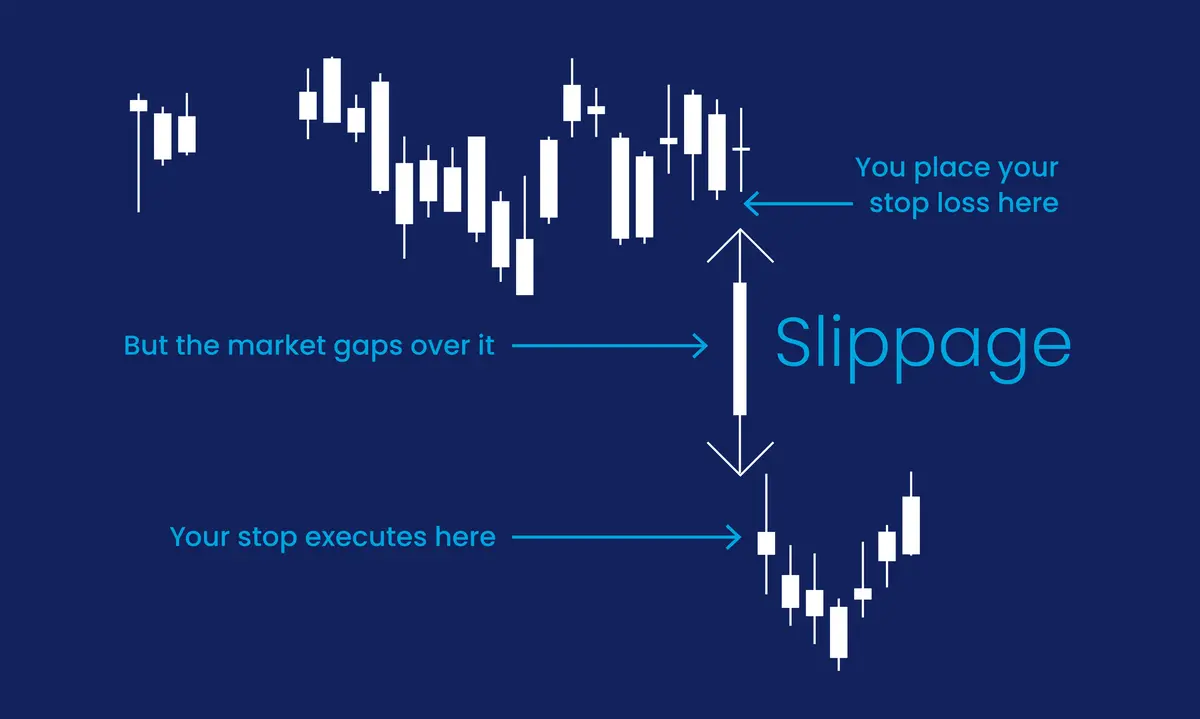
Slippage is the difference between the price you expected to get and the price you actually got.

If you expected to buy ETH at $3,000 and you paid $3,015, that's $15 of slippage — half a percent. If you expected to sell 1 SOL for $150 and you received $148.50, that's $1.50 of slippage — one percent.

Slippage can be positive too. Sometimes you get a slightly better price than expected. But in practice, especially when you're the one initiating a trade, slippage almost always works against you. There's a structural reason for that, and we'll get to it.

The key insight: slippage is not a fee. Nobody charges it. It's not a hidden tax collected by the exchange. It's simply a consequence of how markets — and especially blockchain markets — actually work.

Why Slippage Exists

Imagine a farmer's market with one apple seller. She has ten apples at $1 each. You buy two — easy, $2 total. Now imagine you want fifteen apples. You buy all ten at $1, then have to find another seller who might charge $1.50 for the extra five. That $0.50 premium is your slippage.

Every market works this way. There's...

Continue reading...
0
0
pixel

The Blueprint to Consistent Capital Growth: Mastering Simplicity and Trading Psychology

The Blueprint to Consistent Capital Growth: Mastering Simplicity and Trading Psychology

Trading is often misconstrued as a game of highly complex algorithms and predictive superpowers. However, when you observe professional traders pulling apart the strategies of developing traders, a glaring truth emerges: beginners overcomplicate their charts, while professionals ruthlessly simplify theirs.

If your goal is to systematically grow your capital over a standard 20-day trading cycle, the secret does not lie in adding more indicators to your MetaTrader 5 interface. It lies in refining your trading psychology, aligning yourself with the higher timeframes, and executing a singular, masterfully understood edge. Here is the professional blueprint for tearing down a flawed trading model and rebuilding it for consistent profitability.

The Trap of Over-Complication

The most common hurdle for traders who understand the mechanics of the market but struggle to build their account balance is over-complication. More data does not equal more profit; it often results in analysis paralysis.

Confluences as a Coping Mechanism

Many developing traders stack confluences on top of each other — waiting for a liquidity sweep, an internal market structure shift, a 79% Fibonacci retracement, and a fair value gap all to align perfectly on the 1-minute chart. While this sounds incredibly precise, professionals recognize this behavior as a psychological coping mechanism.

By demanding a flawless setup, you are inadvertently protecting yourself from taking the trade and facing a potential loss. This extreme strictness drops your trade frequency to near zero. You end up missing the most explosive, high-probability moves because price simply tapped a 15-minute gap and ran without giving you that deep 79% pullback. Trading is an exercise in managing probabilities, not demanding perfection.

The Strategy Hopping Syndrome

Running two entirely different strategies concurrently — such as an EMA crossover model alongside a Smart Money Concepts (SMC) liquidity model — guarantees that you master neither. Conflicting signals...

Continue reading...
0
0
NorthRay

I Wanted a Robot to Trade for Me. I Almost Bought the “Magic Button.” Good Thing I Stopped in Time.

I Wanted a Robot to Trade for Me. I Almost Bought the “Magic Button.” Good Thing I Stopped in Time.

Hi, this is NorthRay.💪

Do you know what I was looking for in my first days of trading?

Not a strategy. Not knowledge. Not discipline.

I was looking for a magic button.

A button that would open trades for me. One that never sleeps, never gets scared, and never makes stupid mistakes. One that makes money while I drink coffee or sleep.

And I found one. Or rather, someone offered it to me.

  • “Trading robot with a 95% win rate.”

  • “Copy trading — copy professional traders and earn money.”

  • “Passive income of 30% per month.”

I almost fell for it because it sounded perfect.

But then I asked myself one question:

“If it’s really that simple and profitable, why isn’t every trader already a millionaire?”

So I started digging. And here’s what I learned.

What Are Trading Robots (Expert Advisors)?

A trading robot (or Expert Advisor) is a program that automatically opens and closes trades according to a predefined algorithm.

You install it in MetaTrader 4, turn it on, and the robot analyzes the chart, presses Buy and Sell, and sets stop-losses by itself.

No involvement from you. 24/5. No emotions. No fear. No greed.

Sounds like a beginner’s dream, right?

I downloaded a free robot, installed it on a demo account, and turned it on.

It opened a trade. Then another. Then another.

An hour later, I checked the results: three losing trades and one winning trade. Overall result: negative.

I thought:

“Maybe I downloaded a bad robot. Maybe I should buy a paid one?”

That’s when I started doing real research.

How I Almost Bought a Robot (And Why I’m Glad I Didn’t)

I visited a website selling a “super robot with 90% accuracy.”

Beautiful website. Equity growth charts. Reviews (probably fake). A 70% discount “today only.”

Price:...

Continue reading...
0
0
Navigation menu
instaforex banner