Bar Pipa
We pay for a post of 10$

Brokers

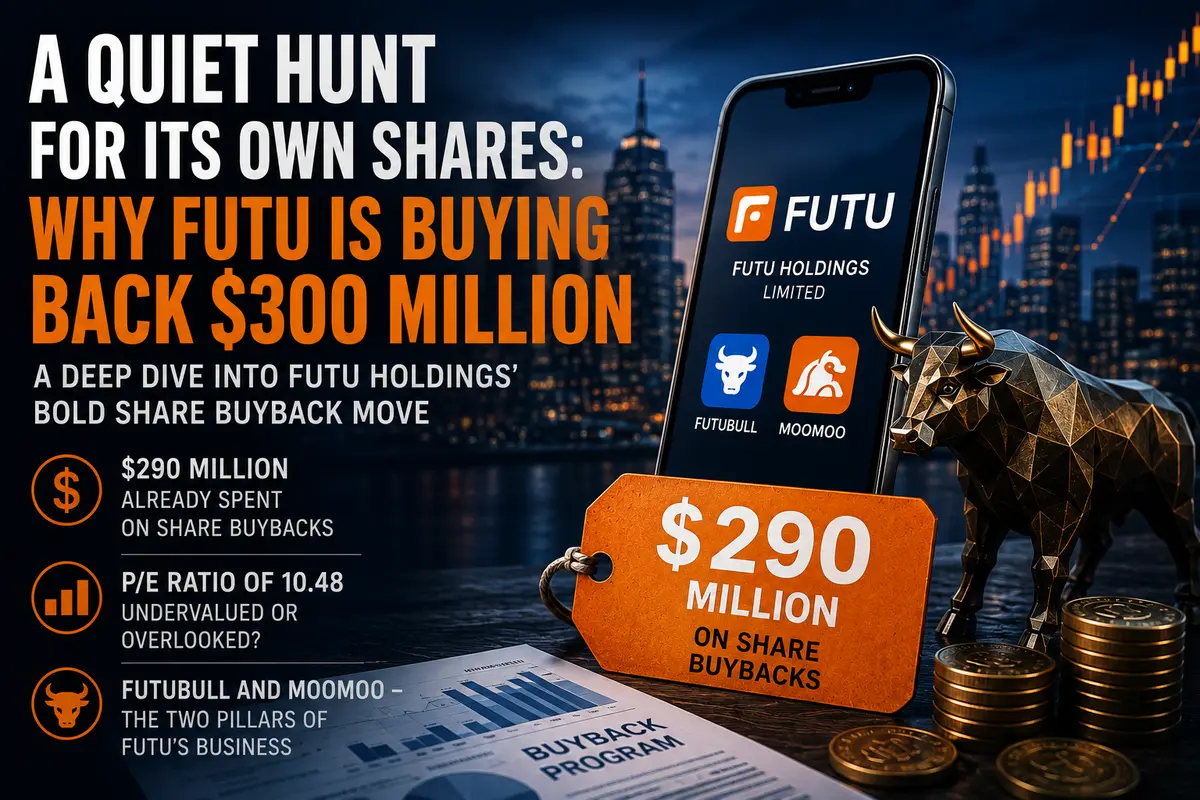
A Quiet Hunt for Its Own Shares: Why Futu Is Buying Back $300 Million Worth of Stock

A Quiet Hunt for Its Own Shares: Why Futu Is Buying Back $300 Million Worth of Stock

There is a gesture in corporate finance that says more about management sentiment than any press release ever could. That gesture is a share buyback. When a company spends real cash to repurchase its own stock, it is not merely returning capital to shareholders. It is telling the market: we believe our shares are undervalued. And when a company like Futu Holdings puts $290 million on the table, it deserves attention.

$290 Million as a Statement of Intent

The figure is impressive, though not record-breaking. $290 million represents roughly 2% of Futu’s current market capitalization, which stands at more than $15 billion. At first glance, 2% may not sound like much. But in the context of the buyback program announced last November, it is already a substantial tranche. The total authorization amounts to $800 million through the end of 2027. Futu has already used more than one-third of that allocation in the first year alone. The pace signals determination.

Management is not merely making declarations. It is acting. The company’s press release is dry and restrained, yet between the lines one can sense confidence: the company “may continue repurchases depending on market conditions.” No promises, no guarantees. But the mere fact that the company has already spent nearly $300 million speaks louder than words. Internally, management’s valuation of its own stock is clearly higher than the market’s.

A P/E Ratio of 10.48: Undervalued or Hiding Problems?

Futu trades at a price-to-earnings ratio of 10.48. For a technology-driven financial services company, that is a modest valuation. By comparison, American brokerage platforms such as Charles Schwab or Interactive Brokers often trade at multiples in the high teens or above twenty. Chinese technology companies have historically traded at P/E ratios of thirty or even forty. Yet here we have a multiple of barely...

Continue reading...
0
0
Tom Maffin

Money That Feeds: How the Card Works

Money That Feeds: How the Card Works

The nonprofit organization WYDE, which has already attracted attention with its Impact Exchange concept, is preparing to launch a new financial tool. In partnership with the fintech platform Crowded, it is introducing a debit card called EAT that runs on the Visa infrastructure. At first glance, it sounds like a standard business card, but embedded within it is a mechanism that could reshape how businesses participate in charitable giving.

The concept is simple and elegant. Every time a cardholder — whether an entrepreneur, company, or organization — makes a purchase, a small portion of the transaction is automatically directed to hunger-relief organizations. No separate donations, no additional actions, no checkboxes or “donate” buttons. The money goes to charity automatically, simply because the business continues operating and spending on its everyday needs.

That is the core innovation. Charity stops being a separate act that requires a conscious decision and instead becomes integrated into daily financial activity. A company buys office supplies, pays for lunch with clients, or covers software subscriptions — and with each transaction, a few cents or dollars are sent to those fighting hunger. Over the course of a year, those contributions can add up to thousands of meals.

Crowded: Fintech Infrastructure for Good

WYDE’s partner in launching the card is Crowded — a fintech company specializing in services for nonprofit organizations. This is an important detail because the charitable sector has historically suffered from a lack of modern financial infrastructure. Banks are often reluctant to open accounts for nonprofits, payment systems are rarely tailored to their specific needs, and donation accounting is frequently handled through semi-manual processes.

Crowded manages the entire technical side: payment processing, fraud protection, and integrated card management. This means cardholders receive the same level of convenience and security as with any other Visa business...

Continue reading...
0
0

The Big Twenty-Four: Who Made the List and Why It Matters

The Big Twenty-Four: Who Made the List and Why It Matters

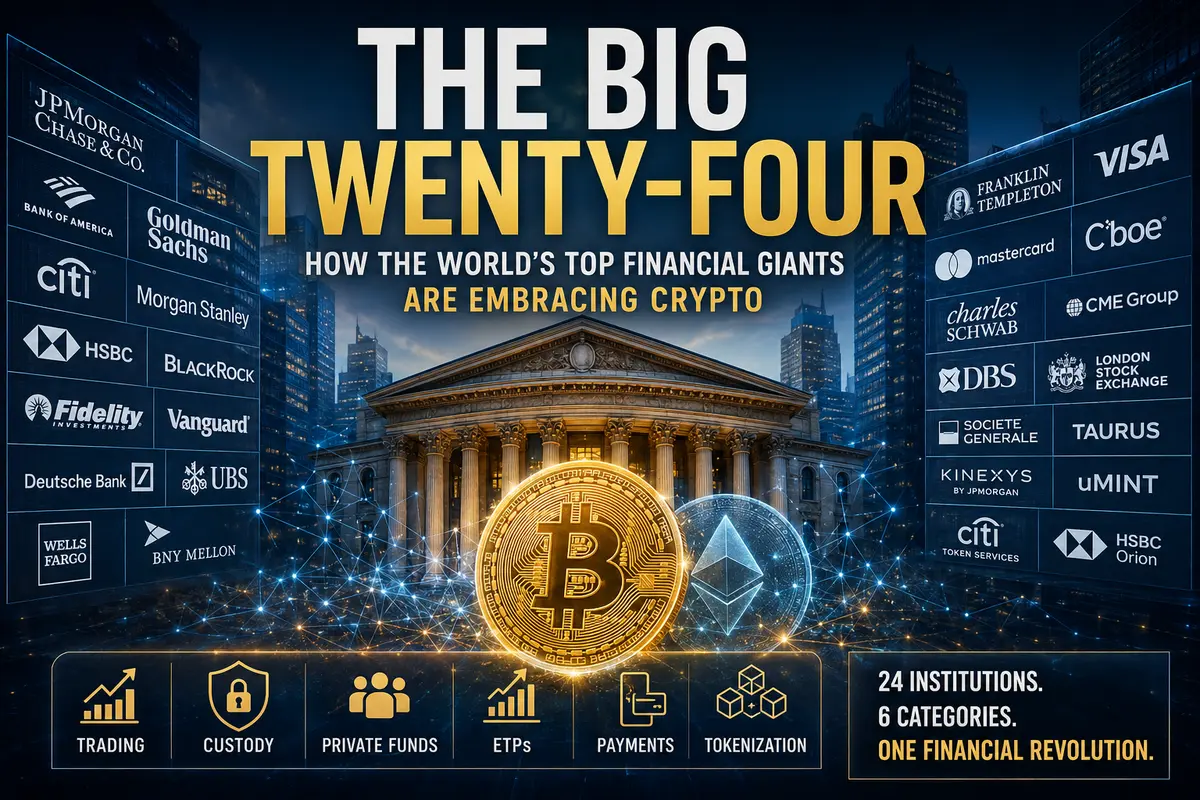
On May 8, asset management company Bitwise — long considered one of the key bridges between cryptocurrencies and traditional finance — published a short but remarkably revealing post on X. Accompanying it was a chart listing the world’s 24 largest financial institutions, each already involved with cryptocurrencies in one way or another. The post read: “Banks and crypto: better together.” Behind that simple phrase may lie the most important institutional story of 2026.

The list spans nearly every imaginable area of crypto activity. Trading, custody, private funds, exchange-traded products, payments, and tokenization — six columns populated by heavyweight names. Bank of America, Goldman Sachs, JPMorgan Chase, BlackRock, Fidelity Investments, HSBC, Deutsche Bank, Citigroup, Visa, and Mastercard — the list reads like the table of contents of a handbook on the global financial elite. Most importantly, these firms are no longer merely observing the crypto market or experimenting with pilot programs. They are integrating crypto infrastructure directly into their core business operations, treating it as an essential component alongside equities trading or bond custody.

Exchange-Traded Products as the Main Gateway

The broadest entry point for institutional investors has become crypto exchange-traded products — the very ETPs that regulators viewed as dangerous and exotic only a few years ago. Today, they are the main highway through which pension funds, insurance companies, wealth managers, and private banks enter the crypto market.

Bank of America now provides clients of Merrill Lynch, its wealth management division, access to spot Bitcoin ETPs. This marks a dramatic shift considering the bank’s previously skeptical stance toward cryptocurrencies. Vanguard, which once famously blocked Bitcoin ETFs and faced a wave of criticism from its own clients, now allows brokerage customers to trade crypto ETPs. It is a silent 180-degree turn driven not by ideology, but by straightforward client demand.

Alongside...

Continue reading...
0
0
NorthRay

I Chose a Broker. And It Was a Whole Story

I Chose a Broker. And It Was a Whole Story

Hey, this is NorthRay.

Remember last time, when I sat there staring blankly at MetaTrader 4, afraid to click anything?

Well, here's the thing: a terminal without an account is like a car without wheels. It looks nice, but it's not going anywhere.

I needed a broker. And that's when the real quest began.🥶

How I Spent Two Evenings with the Internet and a Cup of Coffee

I never thought choosing a broker would be its own special kind of stress for a beginner.

Do you know how many there are? Dozens. Hundreds. Each one with a slick website, green "Become a Trader" buttons, and smiling people in photos who apparently became millionaires in two weeks.

I honestly read reviews. Forums. Telegram channels. Guides on "how to avoid scammers."

My head was spinning.

Some shouted, "Only regulated brokers with top-tier oversight!" Others said, "It doesn't matter, as long as withdrawals work." And others: "They're all the same, just pick the one with the lowest spread."🤔

I ended up more confused than I was with the indicators.

Why I Settled on InstaForex

I could write now that I conducted a complex fundamental analysis and compared every rating in the world. But no.

It happened much more simply—and honestly.

On one trading forum (I won't name it—sometimes they write strange things there), I found a long post from a guy who's been trading for five years. He wrote something along these lines:

"A beginner doesn't need a perfect broker. A beginner needs a broker that has:
— a demo account with no restrictions;
— a clear, understandable client area;
— and a place where they won't be afraid to click something."

And he recommended InstaForex. Just as a practical option to get started.

I went to check it out.

Here's what honestly...

Continue reading...
0
0
Navigation menu
instaforex banner