Bar Pipa
We pay for a post of 10$

Crypto

pixel

Stablecoins Cost Banks Their Deposits: 9 Reasons Banks Are Building Tokenized Deposits
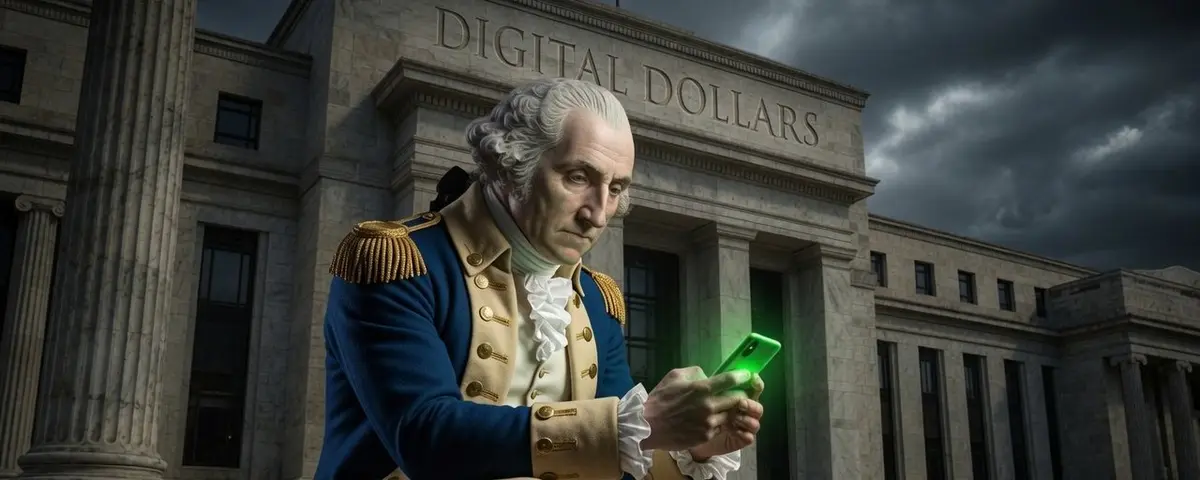
Stablecoins Cost Banks Their Deposits: 9 Reasons Banks Are Building Tokenized Deposits

Stablecoins, tokenized deposits, and deposit tokens are all digital dollars, but they are not the same instrument even though many institutions talk about them like they are.

In April, the FDIC proposed something that received minimal coverage outside of law firm memos and discussion from those in the industry. In short, it said, the underlying technology used to record a liability is irrelevant to deposit insurance. Whether a deposit is tracked on a distributed ledger or within a legacy core banking database, it receives identical treatment as long as it satisfies the statutory definition of a deposit.

Two months later, JPMorgan, Citi, Bank of America, Wells Fargo and a dozen others said they were building a shared tokenized deposit network run by The Clearing House, targeting the first half of 2027. A separate group of regionals (Huntington, First Horizon, KeyCorp, M&T, Old National) is piloting a retail version this quarter.

The question used to be whether any of this was real, but now it's which digital asset instrument, for which client, on which rail. That's a harder question, because the three things people keep lumping together do very different things to your balance sheet.


WHAT BANKS GET FROM STABLECOINS

For permitted issuers, holding the underlying cash and Treasuries represents a sticky, low-risk balance that generates fee income. When building an internal business case, however, it is critical to note that these reserves lack pass-through insurance for token holders, a point explicitly detailed in the FDIC proposal.

Because GENIUS envisions issuance via bank subsidiaries, white-labeling offers an accelerated route for institutions possessing distribution channels but lacking a native product. Capitalizing on fiat conversion and the associated remittance corridors presents clear fee opportunities. Furthermore, a distinct customer segment (including crypto exchanges, crypto treasuries, PSPs, and market makers) already functions using stablecoins and...


Continue reading...
0
0
pixel

The crypto market is increasingly buying the dips

The crypto market is increasingly buying the dips

The crypto market is recovering from its pullback: market capitalization is rebounding, BTC has returned above $65K, and ETH has hit new two-month highs, but risks remain.

Market Overview

The crypto market capitalization has been gradually rising, reaching the $2.24T mark and recouping a significant portion of the losses incurred last Thursday and Friday. The recovery is being driven by a slight de-escalation between the US and Iran, which is fuelling risk appetite and leading to a series of higher local lows. Among the top altcoins over the past seven days, leading coins have shown gains ranging from Uniswap (+13%), Aave (+13.2%), and Aptos (+7.5%) to declines in Zcash (-4.8%), Cosmos (-4.1%), and NEAR Protocol (-2.6%).

Fig. 1. Bitcoin has resumed its upward trend following the sell-off at the end of the week.

On Friday, Bitcoin fell below the uptrend’s support line in place since the start of the month, hitting a local low of $63.6K. This was an attempt by the bears to push the price down towards the 50-day moving average. However, ahead of the start of active trading in Europe on Monday, the price once again exceeded $65K, with attempts to maintain an upward trend while remaining above a significant medium-term trend line.

Ethereum outperformed Bitcoin in the recovery, being the first to hit two-month highs, rising above $1,950 and returning to test key support levels. This outperformance points to growing optimism surrounding cryptocurrencies, suggesting the market is shifting into a ‘buy on the dip’ mode. Although the risk of a further crash cannot be entirely ruled out, it appears that the cryptocurrency market bottomed out in June, a view supported by the shift in sentiment towards Ethereum, which is now in its fifth week of gains.

Fig. 2. Ethereum has resumed its climb to new two-month...

Continue reading...
0
0
pixel

Two Major Crypto Exchanges to Shut Down: What’s Behind It?

Two Major Crypto Exchanges to Shut Down: What’s Behind It?

Two known crypto exchanges said they are shutting down and neither of their official messages gives much detail. BitMEX and BitMart both mentioned that they are doing a review of their business. Independent analysis explains more: BitMEX lost a lot of its derivatives market share over the years. Could not find a buyer while BitMart never fully recovered from a hack in 2021 and was squeezed as liquidity moved to the biggest platforms. Neither has said they are bankrupt and both say you can still withdraw your money.

The timing is surprising. BitMEX said goodbye on July 23 2026. BitMart followed on July 26. It is very rare for two major centralized exchanges to close in the week and the whole industry sees these back-to-back announcements as a sign of how tough the middle of the exchange market is becoming.

Why Is BitMEX Really Closing?

BitMEX told its users it is sharing the news "with a heavy heart." The exchange will stop on September 23, 2026, at 04:00 UTC. The decision came from the board of HDR Global Trading Limited, the company that owns and runs the exchange after a review of the business. New account signups stopped away. From August 26 at 04:00 UTC accounts will be in reduce- mode meaning no new positions can be opened and existing positions can be force-closed to wind things down. Users who leave money behind after the closure will pay a fee of about $50 or 1% per year whichever is higher. The farewell message focused on the past: over 11 years of operation the invention of the 100x swap and no customer funds lost to hacks.

That is the story. Analysis from BeInCrypto points to three issues behind the decision:

Market share dropped. BitMEX was the first to create the swap...

Continue reading...
0
0
Tim Drening

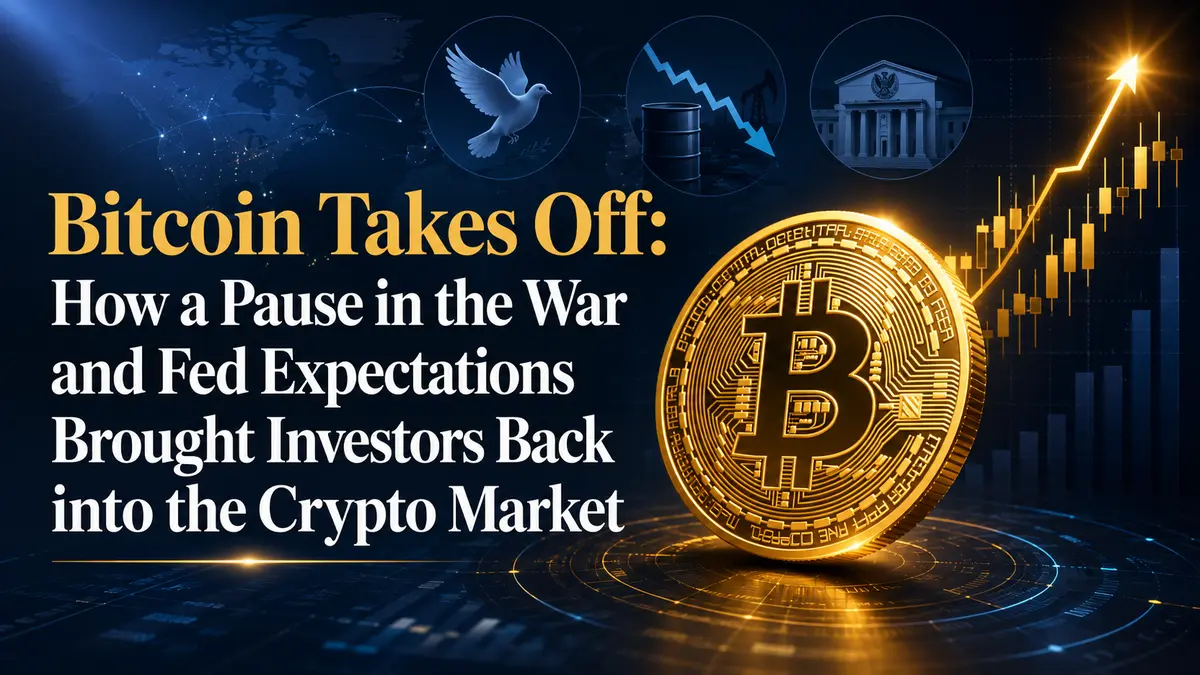
Bitcoin Takes Off: How a Pause in the War and Fed Expectations Brought Investors Back into the Crypto Market

Bitcoin Takes Off: How a Pause in the War and Fed Expectations Brought Investors Back into the Crypto Market

Monday Morning: Digital Gold Shines Again

When investors opened their trading terminals on Monday morning, BTCUSD ... was already reacting strongly to the positive news that emerged over the weekend. The world’s largest cryptocurrency climbed above the $65,000 mark, gaining 1.5% to reach $65,405. This was not merely a technical move—it was a signal that the market was shifting back toward risk assets after weeks of fear and uncertainty. Following a volatile previous week that ended almost unchanged, Bitcoin finally found the strength to make a confident move higher.

What triggered this rally? The answer lies in the events that unfolded in the Middle East over the weekend. The suspension of reciprocal strikes between the United States and Iran after 13 nights of continuous bombardment provided exactly the relief the markets had been waiting for. Although it is still too early to call this peace, even a temporary pause in the conflict sparked a wave of optimism across global financial markets.

However, geopolitics was not the only factor driving Bitcoin higher. The decline in oil prices following the ceasefire also played an important role. Brent crude fell by more than 5%, easing concerns about another surge in inflation. When inflation expectations decline, the dollar tends to weaken, making dollar-denominated assets, including cryptocurrencies, more attractive to international investors.

A Geopolitical Pause: A Fragile Ceasefire and Its Impact on the Markets

Saturday and Sunday brought something many investors had not expected: the United States and Iran, which had spent the previous two weeks exchanging military strikes, suddenly announced a suspension of hostilities. Iran declared that it was prepared to halt retaliatory attacks provided that Washington also refrained from further military action. The United States, in turn, suspended its bombing campaign.

For the markets, this was an extremely powerful signal. A conflict that had...

Continue reading...
0
0
pixel

Week in the Trenches: July 27

Week in the Trenches: July 27

Bitcoin Holds Range as Iran's Ceasefire, Not Crypto News, Dictates the Week

The market did not move this week on crypto headlines. It moved on Iran.

Bitcoin closed the seven-day period near $65,256, up roughly 0.7 percent inside a tight $63,829–$66,803 band. Ethereum finished stronger at approximately $1,951, posting a 3.7 percent weekly gain. SOLUSD ... Solana lagged, slipping 0.8 percent to $76.29 after failing to sustain a push toward $78. The spread between majors remained visible, yet none of them broke structure. Price action stayed contained, leverage stayed measured, and the dominant catalyst came from outside the digital-asset complex.

Geopolitics Sets the Tone

Major News This Week: July 27 - July 31


US–Iran ceasefire talks proved the week’s clearest driver. Mid-week escalation briefly pushed risk assets lower and triggered visible outflows from Bitcoin ETFs. When the ceasefire held, oil prices dropped approximately 5 percent and crypto recovered most of the lost ground. The rebound was orderly rather than euphoric. Sentiment, however, had already shifted before the weekend close. Traders who had been leaning into the prior calm were forced to reassess how quickly external headlines can override on-chain developments.

ETF Flows Rotate, Not Disappear

Spot Bitcoin ETFs entered Thursday with a seven-session inflow streak totaling roughly $1 billion. That streak ended on July 24 with $225 million in net outflows—$202.5 million of it concentrated in BlackRock’s IBIT alone. Iran-related risk-off flows were widely cited as the trigger.

Ethereum ETFs moved in the opposite direction. They extended a five-day inflow streak with an additional $26.3 million on the same day. Demand did not vanish; it simply rotated. The divergence underscores a subtle shift in relative preference rather than a broad retreat from the sector.

Macro Backdrop Remains Tight but Stable

US 10-year yields hovered near 4.69 percent throughout the week. The...

Continue reading...
0
0

GBPUSD learn how to trade GBPUSD

GBPUSD learn how to trade GBPUSD

GBP/USD: The Currency Pair That Has Humbled Many Traders

There was a day I opened my chart and saw GBP/USD had already moved over 100 pips before noon. My first reaction was, "This market is too sweet. Imagine if I caught this move."

Then I asked myself another question.

"If I had entered at the wrong point, would I still be saying the same thing?"

That was when I started respecting this currency pair.

If you spend time around Nigerian forex traders, you will notice something. The moment GBP/USD starts moving, everybody suddenly becomes an analyst. One person says it is buying. Another says selling is the only option. Someone else posts a screenshot claiming they already caught the move from the beginning.

As a beginner, all those opinions can confuse you.

The truth is, GBP/USD does not care what anybody thinks. It will move according to what the market wants to do.

GBP/USD simply compares the British Pound with the US Dollar. If the price is climbing, it means the Pound is becoming stronger than the Dollar. If the chart is falling, then the Dollar is gaining strength.

Simple enough.

But trading it is a different story.

One mistake I see many people make is falling in love with fast-moving candles.

A long green candle appears, and before they even ask why the market is moving, they have already clicked the Buy button.

Sometimes it works.

Many times, it doesn't.

The market has a funny way of teaching expensive lessons to impatient traders.

Have you noticed how a trade always looks obvious after it has already happened?

When you look back at the chart, everything seems clear. You tell yourself, "I would have entered here and closed there."

But when the candles are still forming in real time, things...

Continue reading...
0
0

Let’s learn about EURUSD and understand how to trade them.

Let’s learn about EURUSD and understand how to trade them.

EUR/USD: The One Currency Pair I Wish Someone Told Me to Focus On Earlier

A few weeks after I started learning forex, I made one mistake that almost every beginner makes.

I believed the more currency pairs I watched, the better my chances of making money. My chart was full. GBP/USD was open. USD/JPY was there. Gold was calling my attention. NAS100 was moving. Before long, I had more than ten charts on my screen, yet I wasn't understanding any of them.

Then one experienced trader asked me a simple question.

"Why are you stressing yourself? Have you even taken time to understand EUR/USD?"

That question stayed in my mind.

The following day, I decided not to jump from one chart to another. I left only EUR/USD on my screen. Honestly, it felt strange at first. I thought I would miss plenty of opportunities. Instead, I started noticing things I had never seen before.

If you are new to forex, let me save you from that same mistake.

EUR/USD is simply the Euro against the United States Dollar. Nothing complicated. If you buy the pair, you are expecting the Euro to gain strength against the Dollar. If you sell it, you believe the Dollar will become stronger than the Euro.

The explanation is easy.

Understanding how the pair behaves is the real work.

One thing I like about EUR/USD is that it rarely behaves like it is trying to confuse everybody. Don't get me wrong, it can still surprise you. Every market does. But compared to some other pairs, its movement often makes more sense when you patiently watch it.

Have you noticed something?

Sometimes you mark a support level before going to bed. The next morning, price gets there, pauses for a while, forms a nice rejection candle and...

Continue reading...
0
0

Wait for confirmation, not just movement.

Before i start trading I observe and one thing that comes to my mind is,Have you noticed how, whenever the market starts moving, it suddenly feels as if this is the only opportunity that will ever come?

That feeling has pushed many traders into losses, and if we are being honest, almost all of us have fallen into that trap at one point.

The truth is, many new forex traders don't lose because they cannot read the charts. They lose because they hate waiting. The moment price begins to move, they convince themselves they already know where it is heading. Before the market has even made up its mind, they are already in a trade.

Then a few minutes later, price turns around.

Immediately the questions start. "Why did the market reverse?" "Why does this always happen to me?" In reality, the market did not trick them. They simply acted before the market gave enough information.

That is why confirmation matters.

Think about it this way. Imagine someone calls you and says there is heavy traffic on your usual route. You probably won't turn back immediately. You might check Google Maps, ask another person, or look ahead before changing direction. You want proof before making a decision.

Trading should be no different.

Your money deserves the same level of patience.

Take resistance as an example. Many of us learn that resistance is where price is expected to fall. The mistake comes when we believe "expected" means "guaranteed."

Price reaches resistance and without thinking twice, we sell.

But how many times have you watched price pause there for a few minutes, then blast through the level as if it never existed?

If you have traded for even a short while, you have probably seen it happen.

Experienced traders understand that resistance...

Continue reading...
0
0

Why you don’t have to chase every trade.

Don't trade because others are trading, listen to the market,watch every movement before taking that trade.

The Forex Market Is Not Owing You Any Trade

There is something almost every trader goes through, but nobody talks about it enough.

You wake up in the morning, check your phone, open MT5, and before you've even brushed your teeth, you're already looking for where to enter. You tell yourself, "There must be one good trade today."

Who told us that?

Somehow, many of us started believing that because the market is open, it automatically means there is money waiting for us. That mindset alone has emptied more trading accounts than bad strategies ever will.

Let me ask you something.

Have you ever looked at your trading history and noticed that your biggest losses didn't happen because your strategy failed? They happened because you couldn't sit still.

You entered one trade.

It wasn't moving.

Instead of waiting, you opened another one.

Then another.

Before evening, you've taken seven trades, and you're wondering how your account reduced so quickly.

The painful part is that if you had taken just one of those trades and ignored the rest, you might have ended the day in profit.

This is something many Nigerian traders struggle with, especially when we see screenshots flying around on Telegram, WhatsApp or Facebook.

Someone posts, "Just caught 300 pips."

Another person says, "Made $800 before breakfast."

Immediately, your mind starts racing.

"Maybe I'm missing something."

"Maybe I need to enter now."

Without even checking your setup properly, you've clicked Buy or Sell.

That feeling is called fear of missing out, and the forex market feeds on it every single day.

The market doesn't know you're trying to pay rent.

It doesn't know school fees are waiting.

It doesn't know you're trying to...

Continue reading...
0
0

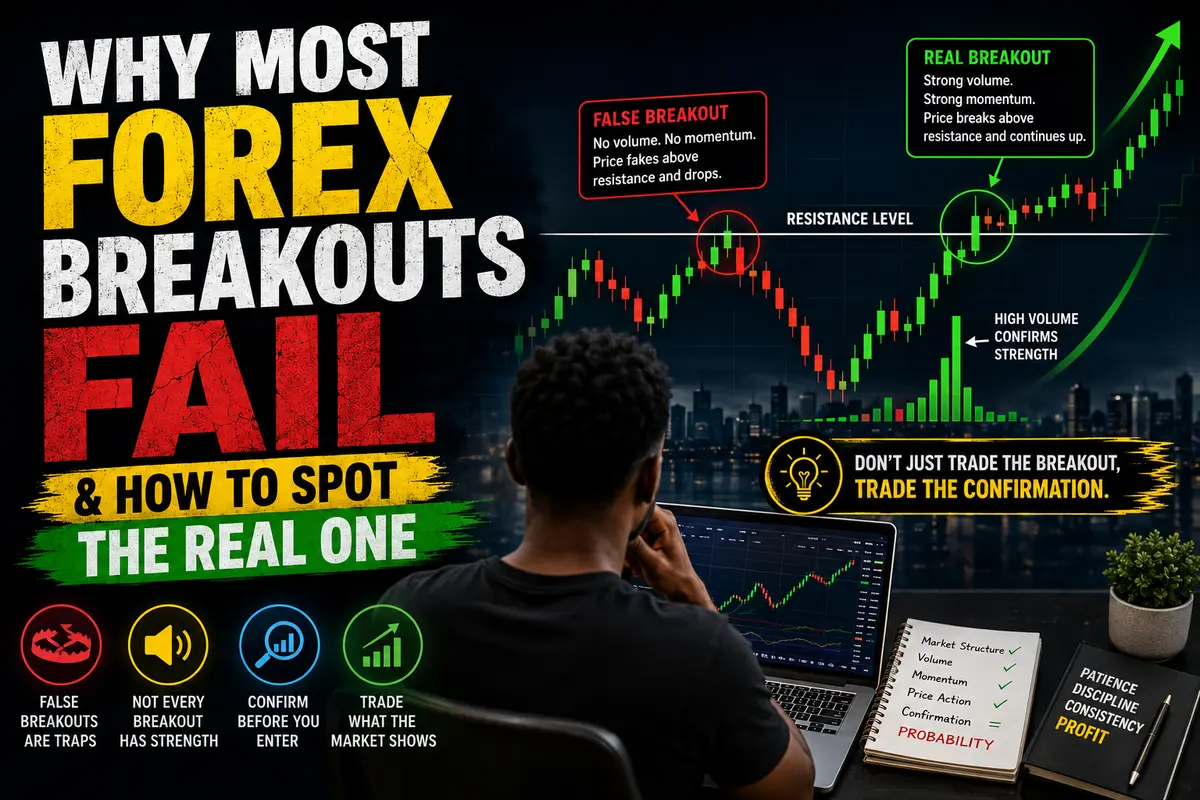
Why most breakout fail, and how to spot the real one.

Why most breakout fail, and how to spot the real one.

Before you continue reading, let me ask you something.

Have you ever sat in front of your chart, spotted a resistance level, and said to yourself, "If this price breaks, I'm entering immediately"? I have seen many traders do exactly that. In fact, almost every beginner does it at some point.

The funny thing is, the market has a way of humbling us.

You wait for hours. Price keeps respecting one level. Eventually, one candle breaks through it and your heart starts racing. You don't want to miss the move, so you click Buy. Five minutes later, price turns around as if nothing happened and starts moving against you. Your stop loss gets hit, and you just sit there looking at the screen, wondering, "What just happened?"

If you've experienced this before, welcome to the club.

One mistake many of us made when we started learning forex was believing that every breakout was the beginning of a new trend. We assumed that once price crossed support or resistance, the market had already chosen its direction.

With experience, you realise the market is not always that straightforward.

Sometimes, that breakout is nothing more than a trap.

I remember discussing this with another trader one evening. He said, "Anytime I enter on a breakout, the market reverses. But when I don't enter, that is when the trade flies."

We both laughed because almost every trader has felt that frustration.

The problem isn't that breakouts don't work. They do. The problem is that not every breakout deserves your money.

Let's imagine price has been struggling to move above a resistance level all morning. Around the London session, one strong green candle suddenly closes above that resistance.

A beginner immediately thinks, "This is it."

An experienced trader thinks differently.

Instead of rushing into the...

Continue reading...
0
0
Navigation menu
instaforex banner