Bar Pipa
We pay for a post of 10$

XAUUSD Technical Outlook – 4 June 2026
XAUUSD Technical Outlook – 4 June 2026


Descending channel, the dominant structure since February peak

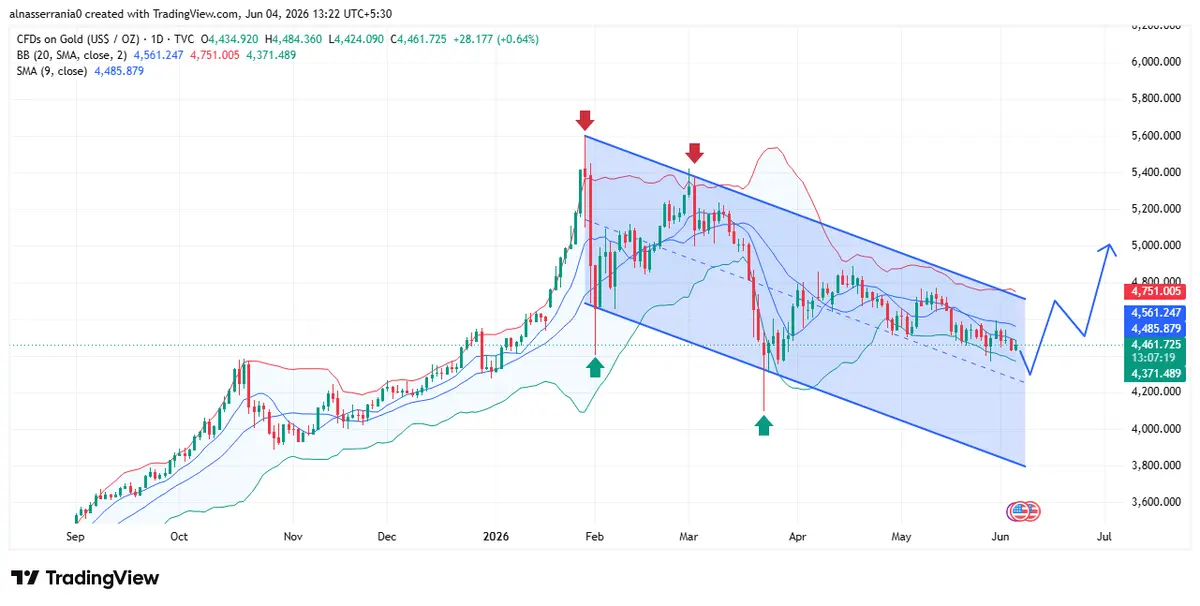
Gold peaked sharply near $5,500+ in early February 2026 and has been carving a clear descending channel (drawn in blue on the chart) ever since. Both the upper and lower channel lines are well-respected, price has tested both boundaries multiple times. The channel is sloping down from top-right to bottom-left, which tells you the sellers have been in control for 4+ months

Price is sandwiched, squeezed between channel support and SMA9

At $4,461, price is sitting right at the lower boundary of the descending channel a historically significant bounce zone. Both prior green arrows on the chart (February and March) marked rebounds from this exact region. The SMA9 ($4,485) is overhead acting as immediate dynamic resistance. Price needs to close above SMA9 on a daily basis to even hint at recovery. Until that happens, this is a range-bound squeeze with downside risk still alive.

Key Levels to watch

Channel top / BB upper - $4,751 Major resistance — unlikely near-term

SMA20 midline - $4,561 Bears defend this level

SMA9 dynamic resistance - $4,485 Immediate ceiling today

Current price - $4,461 At channel lower support

BB lower / channel floor - $4,371 Critical support — bounce or break

Breakdown target - $3,800 If $4,371 fails decisively

Continue reading...
0
0
Tom Maffin

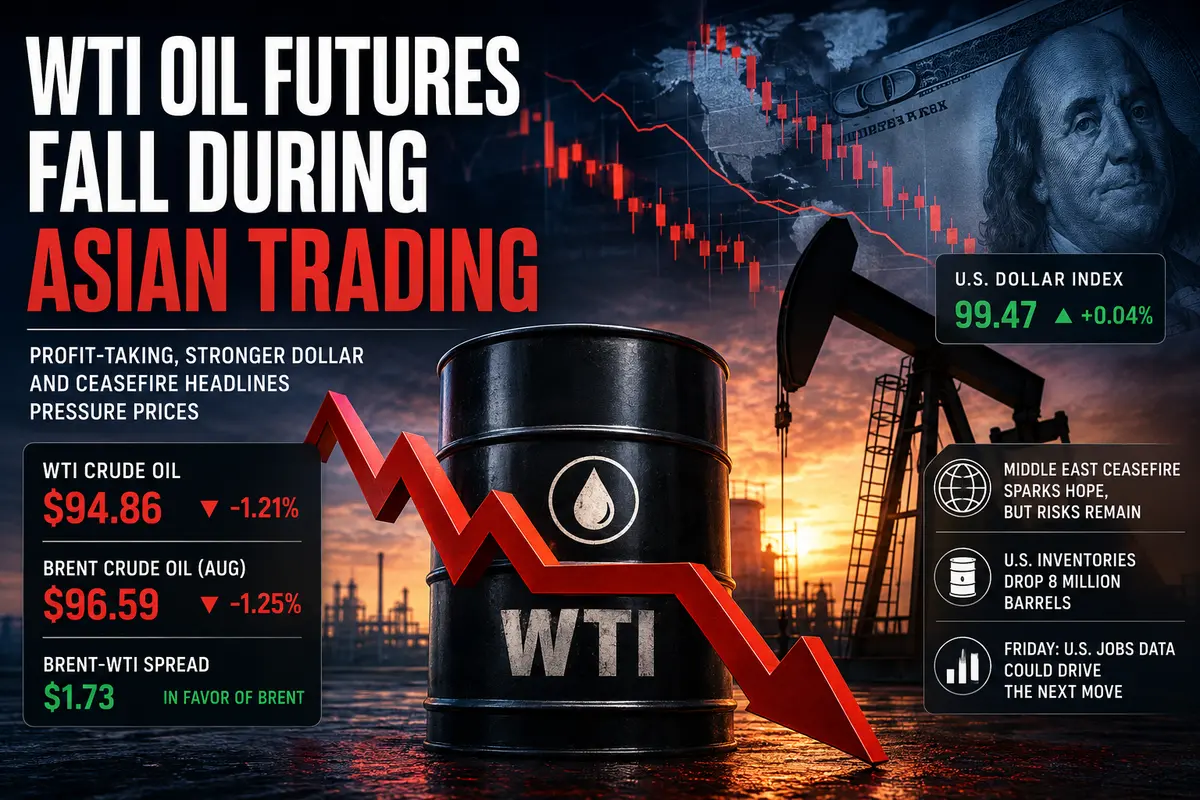
WTI Crude Oil Futures Fall During Asian Trading

WTI Crude Oil Futures Fall During Asian Trading
A Morning That Started in the Red

Thursday’s Asian trading session delivered a cold shower for oil bulls. Futures on West Texas Intermediate (WTI) crude oil, the benchmark for the U.S. market, moved into negative territory. And not just slightly—at the time of writing, WTI was down 1.21%, trading at $94.86 per barrel.

For traders accustomed to volatility, a one-percent move is hardly dramatic. But context matters. Just a day earlier, oil had posted its third consecutive session of gains. Market participants were beginning to embrace the idea that crude was back in favor, with geopolitics and tightening inventories providing strong support. Then came the pullback—not a crash, but sharp enough to make investors pause.

The decline coincided with a stronger U.S. dollar. The U.S. Dollar Index futures, which track the greenback against a basket of six major currencies, rose 0.04% to 99.47. It may seem insignificant, but in currency markets even small moves matter. When the dollar strengthens, oil—priced in dollars—typically becomes more expensive for foreign buyers, putting downward pressure on prices. The inverse correlation remains intact even on days when geopolitical headlines suggest higher oil prices.

Brent crude, the European benchmark, also came under pressure. August Brent futures fell 1.25% to $96.59 per barrel. The price spread between Brent and WTI narrowed to $1.73 in favor of Brent. Just a week ago, the spread was above $2. A narrowing spread suggests that U.S. crude is appreciating relative to its European counterpart, reflecting shifts in global supply flows.

The technical picture also offers food for thought. WTI has established support at $86.35 per barrel—a level sellers failed to break during previous sessions. Resistance stands at $96.98. With the current price at $94.86, the market sits roughly in the middle of that range. Traders looking at the charts see upside...

Continue reading...
0
0

Gold Rises After Lebanon Ceasefire; U.S. Labor Market Data in Focus

Gold Rises After Lebanon Ceasefire; U.S. Labor Market Data in Focus
The Yellow Metal Finds a Reason to Climb

Thursday began with cautious optimism for gold. Spot gold gained just over half a percent, rising to $4,460 per ounce. Futures followed the same path, up 0.5% to $4,486. These are not record highs, but they are welcome gains—especially after Wednesday, when gold lost more than 1% under pressure from a stronger U.S. dollar.

What changed overnight? First, geopolitics. Second, expectations. Both factors worked in favor of the yellow metal.

The geopolitical backdrop remains complicated, but the first signs have emerged that the worst may be behind us. Late Wednesday, Washington announced a ceasefire agreement between Israel and Lebanon. The wording was cautious—the deal depends on Hezbollah halting hostilities—but the fact that diplomats managed to reach an agreement after talks appeared stalled only a day earlier is a meaningful signal.

Investors took notice. Oil, which had been rising this week on fears of supply disruptions, moved lower on Thursday morning. Crude prices fell after three consecutive days of gains. Lower oil prices mean lower inflation expectations. Lower inflation expectations ease pressure on central banks, reducing the need for aggressive anti-inflation measures.

Still, it is too early to relax. The Middle East conflict has not disappeared—it has merely cooled somewhat. Reports of Iranian missile strikes on Kuwait and Bahrain from Wednesday remain relevant, as do U.S. strikes on Iran’s Qeshm Island in the Strait of Hormuz. Israeli military operations in southern Lebanon also continue.

The ceasefire between Israel and Lebanon is important, but it is only one piece of a much larger puzzle. Iran remains the primary source of concern, while Hezbollah remains an unpredictable player. As a result, gold is moving higher, but without euphoria—cautiously and with one eye on the risks.

U.S. Economic Data: Two Sides of the Same...
Continue reading...
0
0

Oil Pulls Back After Rally: Middle East and U.S. Inventories in Focus

Oil Pulls Back After Rally: Middle East and U.S. Inventories in Focus
The Three-Day Holiday Is Over

Thursday began with a reality check for the oil market. After three straight days of gains—delighting bulls, frustrating bears, and forcing traders to revise their models—the market finally saw a correction. A modest one. A measured one. Almost a polite one. But a correction nonetheless.

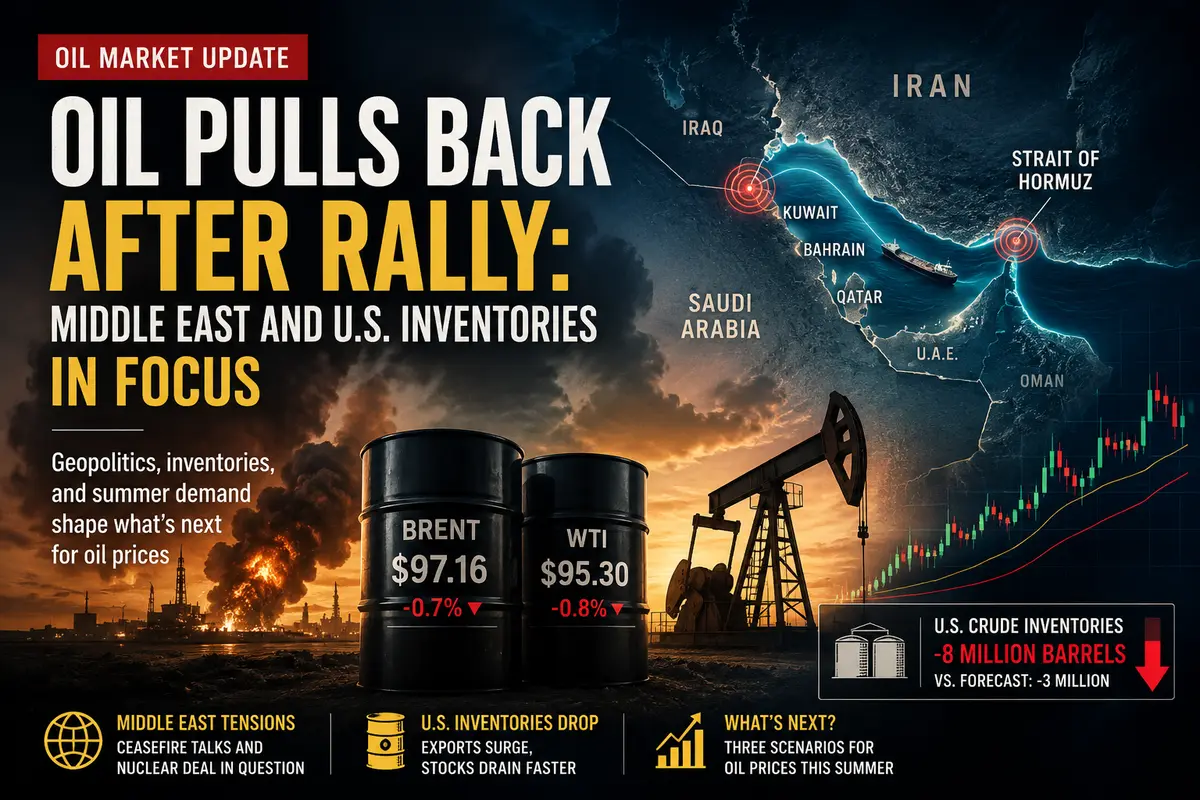
Brent crude futures, the European benchmark, were down 0.7% on Thursday morning, trading at $97.16 per barrel. Its American counterpart, WTI, slipped slightly more, losing 0.8% to $95.30 per barrel. Prices that would have seemed extraordinary just a week ago now look like business as usual.

Still, this decline is hardly dramatic. It is simply profit-taking. Investors who entered the market last week when prices were 5–7% lower have decided it is time to take some money off the table. They sell, prices fall. Nothing personal—just business.

Yet beneath this routine profit-taking lies something more interesting: risk assessment.

The oil market today resembles a tightrope walker balancing above a canyon. On one side is geopolitical turmoil in the Middle East; on the other are the hard numbers coming from U.S. crude inventories. Both factors are pushing prices higher. But there are forces pulling in the opposite direction as well. More on those shortly.

The Middle East: War, Ceasefire, and a Nuclear Deal

Let's begin with the biggest source of oil market volatility in recent weeks: the Middle East—a region that gave the world agriculture, writing, and seemingly an endless supply of conflict.

Events unfolded at cinematic speed this week.

First came Iranian missile strikes against Kuwait and Bahrain. These small but wealthy Gulf monarchies, accustomed to life under the American security umbrella, suddenly found themselves on the front line. The missiles came from Iran—the United States' primary regional adversary, Hezbollah's main backer, and a perennial source of instability.

Then came...

Continue reading...
0
0
Lin Brings

Asian Currencies Stabilize After a Dollar-Driven Selloff

Asian Currencies Stabilize After a Dollar-Driven Selloff
A Chance to Catch Their Breath

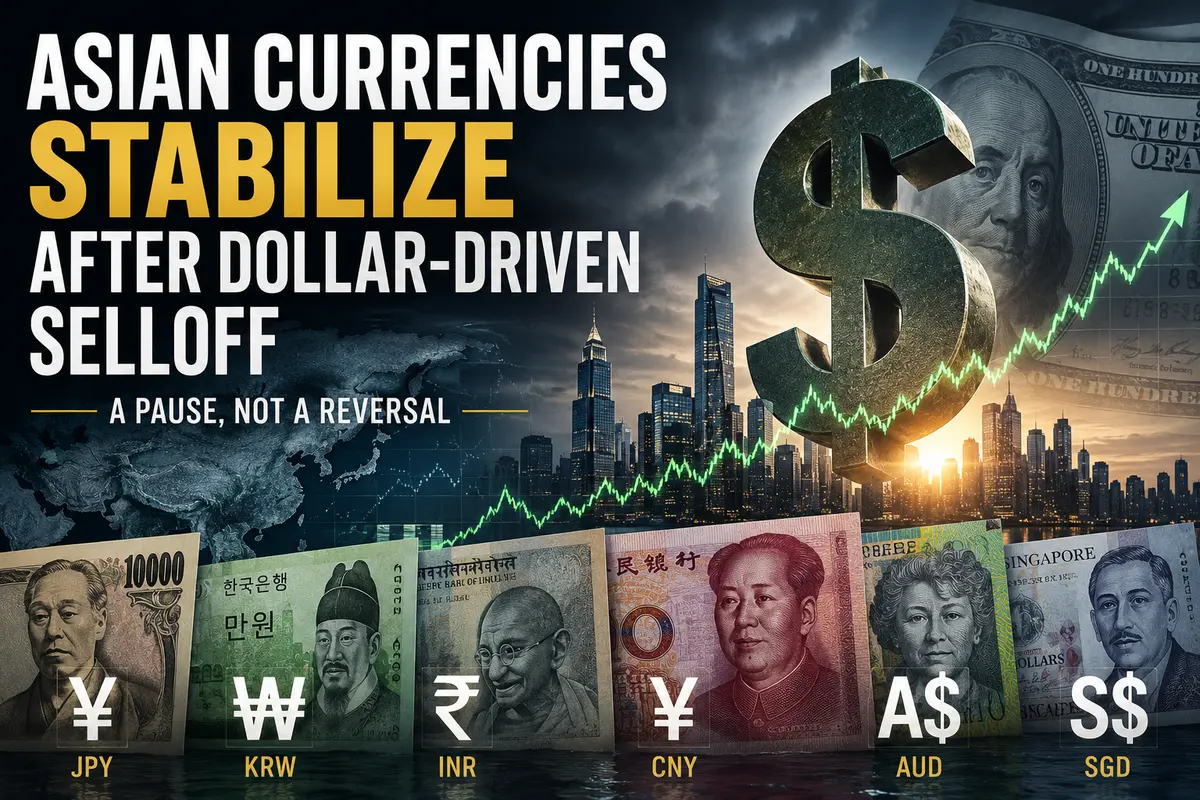
Thursday brought a welcome pause to Asia’s currency markets. After several days of relentless pressure from the U.S. dollar—rolling through markets like a tank—things finally calmed down. Asian currencies, which had been losing ground day after day, stopped falling. They are not rising yet, but they are no longer sliding either. For now, they have dug in and are waiting.

The U.S. Dollar Index (DXY), the main gauge of the dollar’s strength against a basket of six major currencies, also held steady. Just a day earlier, it had climbed to a two-month high. Two months may not sound like much, but in the currency market, that is a meaningful stretch. The dollar has not been this strong since the spring, when markets were gripped by another round of anxiety over the Federal Reserve and inflation.

Now comes a pause. Traders are taking a breath, reassessing positions, and scanning economic calendars for the next major catalyst. And there are plenty of them ahead. Any one of them could tip the balance further in favor of the dollar—or spark a recovery in battered Asian currencies.

So what happened over the past few days? Why has the dollar suddenly become so strong? And why do Asian currencies remain under pressure despite this temporary stabilization?

There are several reasons, all tightly intertwined in a knot that analysts around the world are trying to untangle.

The Middle East: A Ceasefire That Solves Little

The first and most obvious driver of dollar strength is geopolitics.

The Middle East has been on edge all week. Iran and the United States exchanged airstrikes. Missiles were launched toward Kuwait and Bahrain. U.S. forces struck Iran’s Qeshm Island—the strategic outpost guarding the Strait of Hormuz, through which roughly one-fifth of the world’s oil supply...

Continue reading...
0
0

HSBC Expects a Weaker Dollar as Markets Change Their Reaction to Data

HSBC Expects a Weaker Dollar as Markets Change Their Reaction to Data
When Good News Stops Being Good News for a Currency

There is an old, almost cliché truth in finance: a strong U.S. economy means a strong dollar. It seems logical enough. GDP rises, and investors bring money into America. Strong employment data strengthens the dollar. Geopolitical tensions drive investors into the dollar as a safe haven. This relationship worked for decades. It was an axiom that required no proof.

But, as it turns out, even axioms can become outdated.

HSBC Asset Management, which oversees $863 billion in assets, has made a rather provocative claim. According to the firm's strategists, the dollar is headed for weakness. Not merely a temporary correction or a short-term pullback, but a structural downward trend. Their key argument sounds almost paradoxical: the dollar no longer responds to good news the way it once did.

Joe Little, Global Chief Strategist at HSBC Asset Management, articulated the idea with remarkable precision. Historically, the combination of strong domestic growth and geopolitical tension created a powerful and sustained uptrend for the U.S. currency. Investors from around the world flocked to the dollar because America was both a haven of stability and an engine of growth. Today, that dynamic appears to be fading. The dollar still rises at times, but reluctantly, sluggishly, and with frequent reversals. Little sees this as a symptom of a deeper problem.

Something has changed. The question is: what exactly?

The Dollar That Doesn't Want to Rise

Let's look at the numbers. The Bloomberg Dollar Spot Index gained just 0.6% over the past month. In currency markets, six-tenths of a percent is barely a move. It's a tremor rather than a trend.

And this happened despite the U.S. economy continuing to surprise on the upside. Job openings exceeded expectations. Consumer spending remains resilient. Industrial production is expanding....

Continue reading...
0
0
BCR

Daily Analysis 4 June 2026 | Dollar Climbs to Two-Month High as Oil Extends Gains and Markets Eye Rate Hikes

Daily Analysis 4 June 2026 | Dollar Climbs to Two-Month High as Oil Extends Gains and Markets Eye Rate Hikes

Currency & Commodity Analysis:


US Dollar Index


The US dollar index rose further to 99.50 on Wednesday, reaching its highest level in nearly two months, after an ADP report showed that the private sector added 122,000 jobs in May, exceeding expectations and reaching a new high since January 2025. The data shows a continued strengthening labor market, further solidifying market expectations that the Fed may raise interest rates later this year. Earlier this week, Jolts data showed that job openings in April rose to their highest level since November 2024, further highlighting the resilience of labor demand. The dollar has been supported by escalating tensions in the Middle East, and oil prices rose for the third consecutive trading day, exacerbating concerns about inflationary pressures. The market currently estimates an 85% probability of the Federal Reserve raising interest rates by 25 basis points before the end of the year, up from 60% a week ago.


The US dollar index is trending slightly higher on the daily chart, currently trading above 99.30 and holding above all moving averages. Short-term resistance is seen at the previous high of 99.55, with medium-term resistance at 100.00 (a psychological level). Support lies at the 20-day and 50-day moving averages and the previous low of 97.63. The MACD remains above the zero line, with the DIFF above the DEA, indicating a slight continuation of bullish momentum. The RSI is between 55 and 60, above the 50 level, suggesting bulls are in control but not yet overbought. The moving average system is bullish, with the medium-term center of gravity steadily rising. Short-term consolidation is seen due to resistance at the previous high. The market is trending slightly higher, supported by moving averages. Key levels to watch are the 99.55-100.00 (psychological resistance) level and the 99.00-98.58...

Continue reading...
0
0
Lin Brings

Asian Stocks Rise as Nikkei 225 Hits a Record High

Asian Stocks Rise as Nikkei 225 Hits a Record High
A Morning That Began With a Surge

Asian stock markets delivered a pleasant surprise on Wednesday, staging a remarkable rally despite a global backdrop that offered little reason for optimism. The Middle East remained engulfed in conflict. Iran and the United States exchanged airstrikes for the third time in a week. Oil prices climbed. Diplomatic negotiations stalled. Diplomats stayed silent while military forces took action.

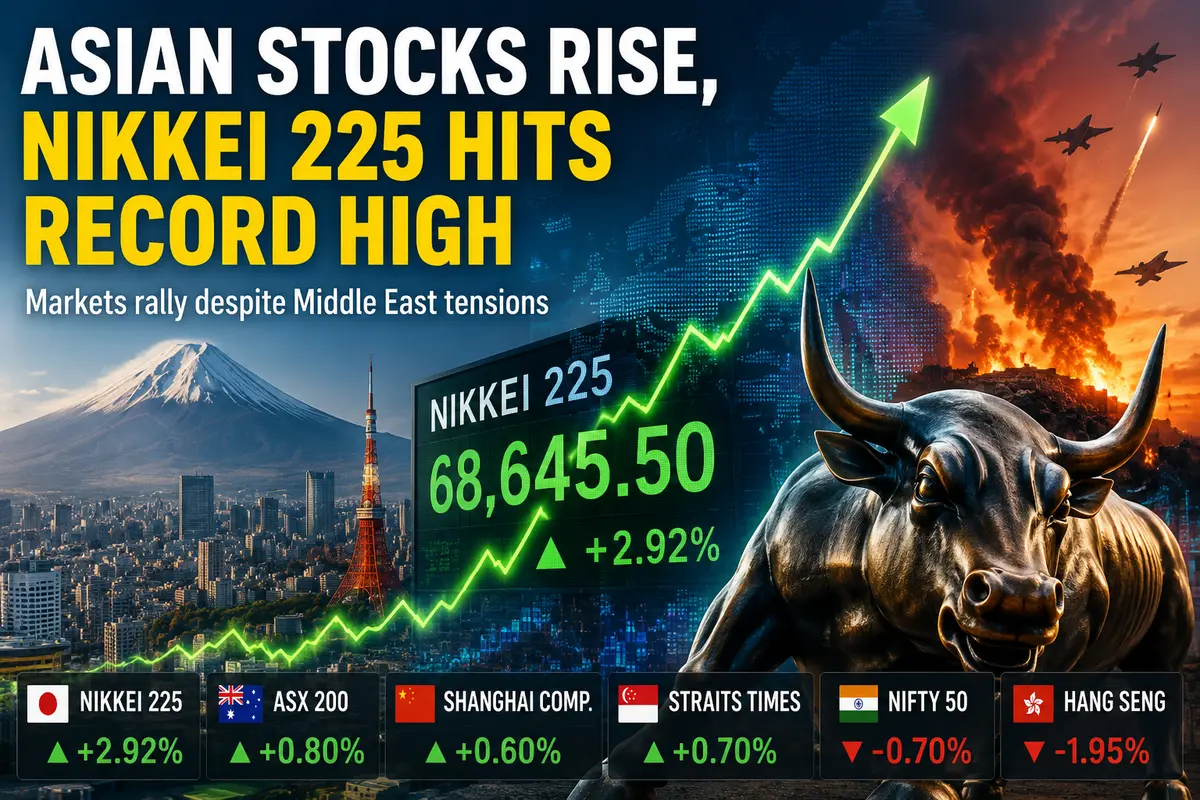
Under such circumstances, most markets would be expected to fall—or at least pause in anxious anticipation. But Asian markets ignored the script. They rose. And not just modestly: Japan’s Nikkei 225 surged to an all-time record high, surpassing a milestone many believed was unattainable after three decades of economic stagnation.

What happened? Have investors stopped worrying? Or are they seeing something that analysts obsessed with geopolitics are missing?

As is often the case, the answer is more complicated. On Wednesday, Asia demonstrated a remarkable ability to tune out negative headlines and focus on the factors working in its favor. And there are plenty of them: a technology boom, government stimulus measures, and weak economic data that paradoxically reinforce expectations for accommodative monetary policy. Together, these factors created a cocktail strong enough to outweigh fears of escalating military conflict.

Japan: Thirty Years Later

The star of the day was Japan’s Nikkei 225. The index climbed nearly 3% to reach 68,645.5 points—an all-time high in its history dating back to 1950.

To appreciate the significance of this achievement, it helps to remember where Japan stood three decades ago. In 1990, the Nikkei collapsed following the bursting of the country’s asset bubble. Since then, despite periods of recovery and decline, the peak reached in 1989 had seemed permanently out of reach.

Now, a new record has been set.

The Nikkei was not alone in its triumph. The broader...

Continue reading...
0
0

U.S. Futures Hold Steady After Record Highs Amid Rising Tensions With Iran

U.S. Futures Hold Steady After Record Highs Amid Rising Tensions With Iran
When Records Meet Rockets

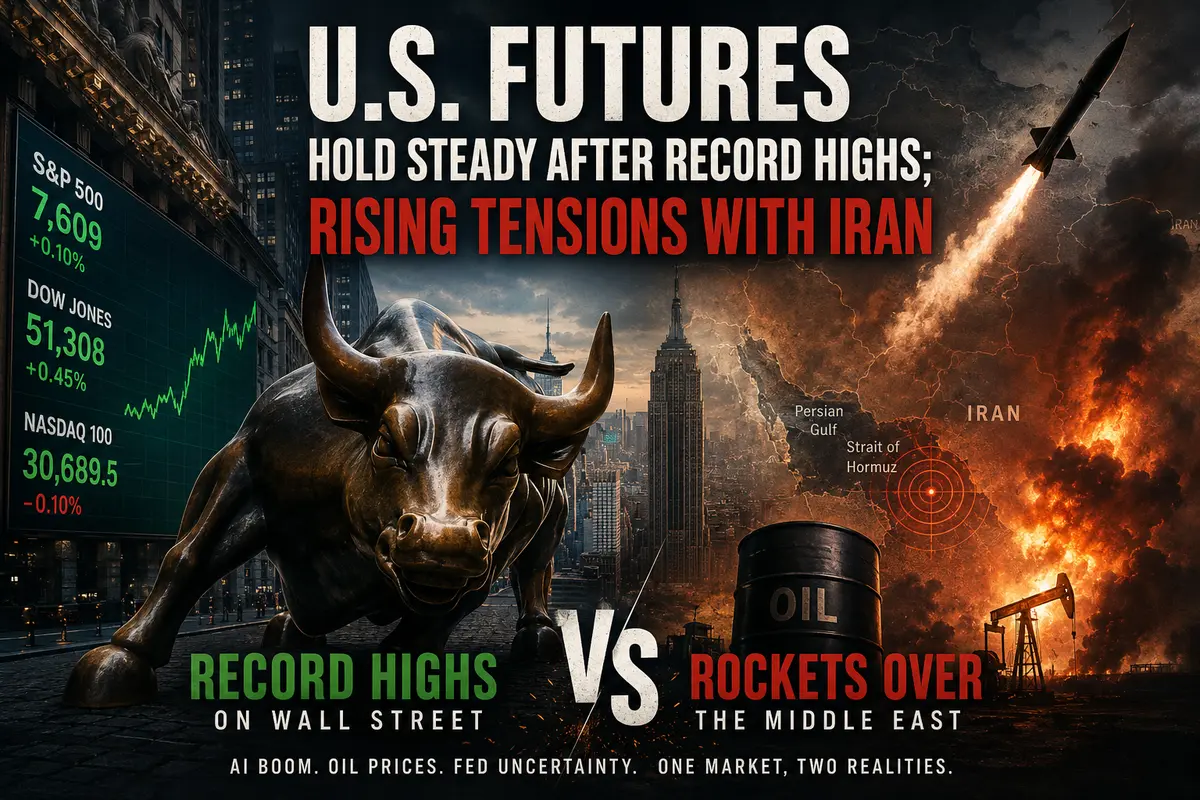
Tuesday evening brought a nervous mood to the U.S. market. Not because investors were panicking. Quite the opposite — everyone seemed frozen in place. Futures on the major Wall Street indexes settled into a strange state of calm: the S&P 500 was virtually unchanged, the Dow Jones Industrial Average stood still, and the Nasdaq 100 edged slightly lower, slipping by just one-tenth of a percent. At 30,689.5 points, Nasdaq futures looked impressive on paper — but the number carried an undertone of unease.

That unease has a name: Iran.

A country that has dominated global headlines in recent weeks once again commanded attention — not through words, but through actions. New airstrikes against neighboring targets marked the third such incident in a week. The United States responded, and now the financial world is holding its breath, watching the Middle East and asking a crucial question: is this merely another chapter in a long-running confrontation, or the beginning of something far larger and more dangerous?

The paradox of the day is that only hours before these developments, Wall Street was celebrating. Major indexes had reached fresh all-time highs. The S&P 500 climbed to 7,609 points. The Dow Jones crossed the 51,000 mark. The Nasdaq advanced as well. Technology stocks — especially semiconductor manufacturers — staged a remarkable rally. Against that backdrop of optimism came news of missile strikes and stalled negotiations.

The market suddenly found itself caught between two powerful forces. On one side stood enthusiasm for artificial intelligence, record profits from technology giants, and the belief that a prosperous future has already arrived. On the other stood geopolitical turmoil, the threat of disruptions in the Strait of Hormuz, rising oil prices, and the prospect of renewed inflation that few had anticipated.

In the face of these...

Continue reading...
0
0
Tom Maffin

WTI Crude Oil Futures Rise in Asian Trading

WTI Crude Oil Futures Rise in Asian Trading
Green Light in the East

Oil traders came into Wednesday with more questions than answers. The previous few weeks had been anything but straightforward. Prices jumped on geopolitical headlines, slipped on weak economic data, then bounced back again when supply concerns resurfaced. Every trading session seemed to bring a new narrative.

But when Asian markets opened on Wednesday, the message was surprisingly clear.

WTI crude futures moved higher almost from the start of trading. The gains were not spectacular, but they were steady and broad-based. By the middle of the session, prices had climbed close to 1%, reaching $94.62 per barrel. In a market that has spent much of the year struggling to find direction, that kind of move attracts attention.

What matters most isn't the size of the gain. It's the fact that buyers are once again willing to step in.

Markets rarely move in a straight line. Oil, perhaps more than any other major commodity, is driven by a constant tug-of-war between fear and optimism. On one side are concerns about economic growth, consumer demand, and industrial activity. On the other are supply disruptions, geopolitical risks, and tightening inventories.

This week, the balance appears to be shifting in favor of the bulls.

Adding support was a slightly weaker U.S. dollar. The Dollar Index slipped to around 99.21, a modest decline that would barely register in many markets. For oil, however, currency moves matter. Crude is priced globally in dollars, so when the dollar weakens, oil becomes cheaper for buyers using euros, yen, yuan, or other currencies. That often encourages demand and provides a tailwind for prices.

Brent crude followed the same path. The global benchmark rose to $96.78 per barrel, outperforming WTI by a small margin. The spread between the two contracts widened to roughly ...

Continue reading...
0
0
Navigation menu
instaforex banner