

Bar Pipa
We pay for a post of 10$

HSBC

HSBC Expects a Weaker Dollar as Markets Change Their Reaction to Data

HSBC Expects a Weaker Dollar as Markets Change Their Reaction to Data
When Good News Stops Being Good News for a Currency

There is an old, almost cliché truth in finance: a strong U.S. economy means a strong dollar. It seems logical enough. GDP rises, and investors bring money into America. Strong employment data strengthens the dollar. Geopolitical tensions drive investors into the dollar as a safe haven. This relationship worked for decades. It was an axiom that required no proof.

But, as it turns out, even axioms can become outdated.

HSBC Asset Management, which oversees $863 billion in assets, has made a rather provocative claim. According to the firm's strategists, the dollar is headed for weakness. Not merely a temporary correction or a short-term pullback, but a structural downward trend. Their key argument sounds almost paradoxical: the dollar no longer responds to good news the way it once did.

Joe Little, Global Chief Strategist at HSBC Asset Management, articulated the idea with remarkable precision. Historically, the combination of strong domestic growth and geopolitical tension created a powerful and sustained uptrend for the U.S. currency. Investors from around the world flocked to the dollar because America was both a haven of stability and an engine of growth. Today, that dynamic appears to be fading. The dollar still rises at times, but reluctantly, sluggishly, and with frequent reversals. Little sees this as a symptom of a deeper problem.

Something has changed. The question is: what exactly?

The Dollar That Doesn't Want to Rise

Let's look at the numbers. The Bloomberg Dollar Spot Index gained just 0.6% over the past month. In currency markets, six-tenths of a percent is barely a move. It's a tremor rather than a trend.

And this happened despite the U.S. economy continuing to surprise on the upside. Job openings exceeded expectations. Consumer spending remains resilient. Industrial production is expanding....

Continue reading...
0
0

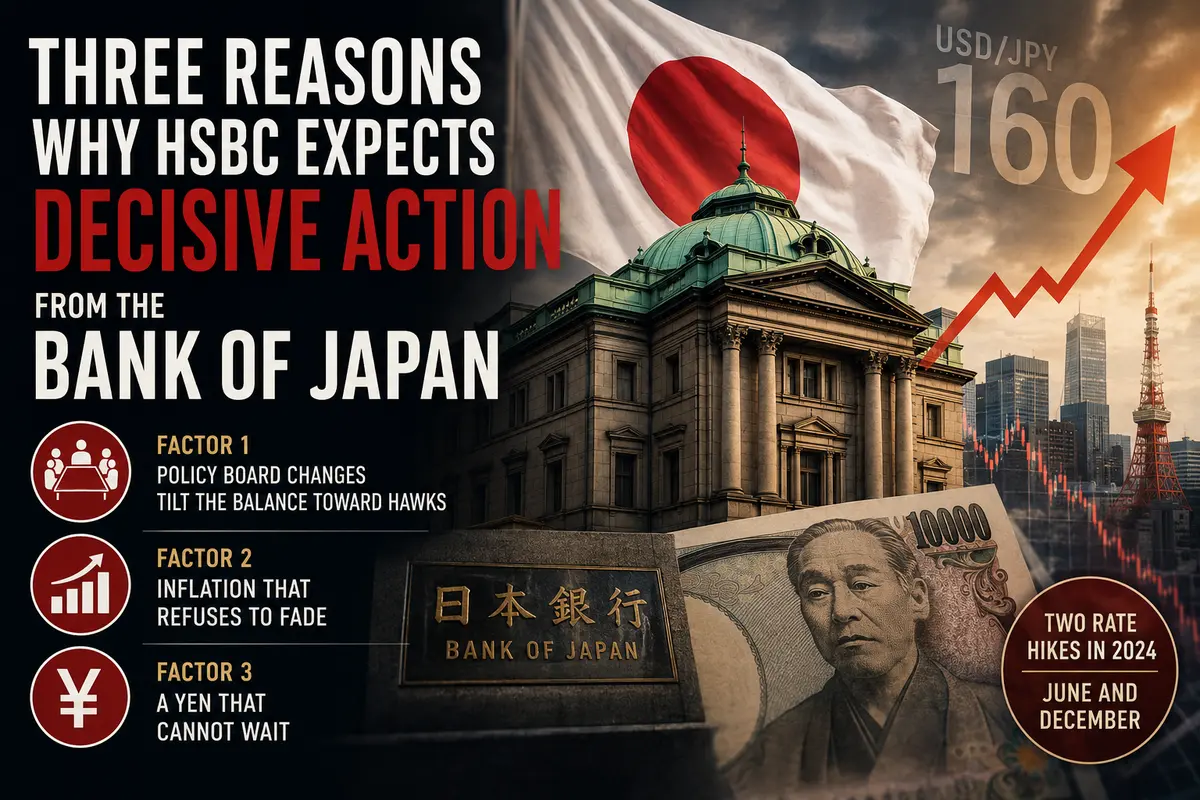
Three Reasons Why HSBC Expects Decisive Action from the Bank of Japan

Three Reasons Why HSBC Expects Decisive Action from the Bank of Japan

For decades, the Bank of Japan has been synonymous with monetary easing. While the Federal Reserve, the European Central Bank, and the Bank of England raised interest rates, fought inflation, and adopted more hawkish rhetoric, Tokyo remained an island of cheap money in a world of expensive capital. But that island now appears to be sinking.

HSBC has revised its forecast and now expects the Japanese central bank to raise rates twice this year. The first hike is projected for June rather than July, as previously anticipated. The second is expected in December. By year-end, the policy rate is forecast to reach 1.25%.

For a country that has spent decades with zero or even negative interest rates, this is close to a revolution. HSBC economist Frederik Neumann outlined three factors behind the revised outlook, and each deserves close attention.

Factor One: Changes on the Policy Board

Central banks are not abstract institutions run by algorithms. They are run by people—specific men and women who sit around a table, debate, vote, and make decisions. The fate of entire economies can depend on who occupies those seats. At the Bank of Japan, a changing of the guard is underway that could shift the balance of power toward the hawks.

Junko Nakagawa, a member of the Policy Board, will leave her post on June 29. Her final meeting will take place on June 16—the very meeting at which HSBC believes a rate hike could be approved. Nakagawa was one of three dissenting members who voted in favor of a rate increase at the previous meeting. In other words, she was already part of the hawkish camp. Yet her departure could paradoxically strengthen that camp’s influence.

Her likely successor is Ayano Sato, whom HSBC characterizes as more inclined toward accommodative monetary policy. This means...

Continue reading...
0
0
Navigation menu
