

Asian Stocks Rise as Nikkei 225 Hits a Record High
A Morning That Began With a Surge
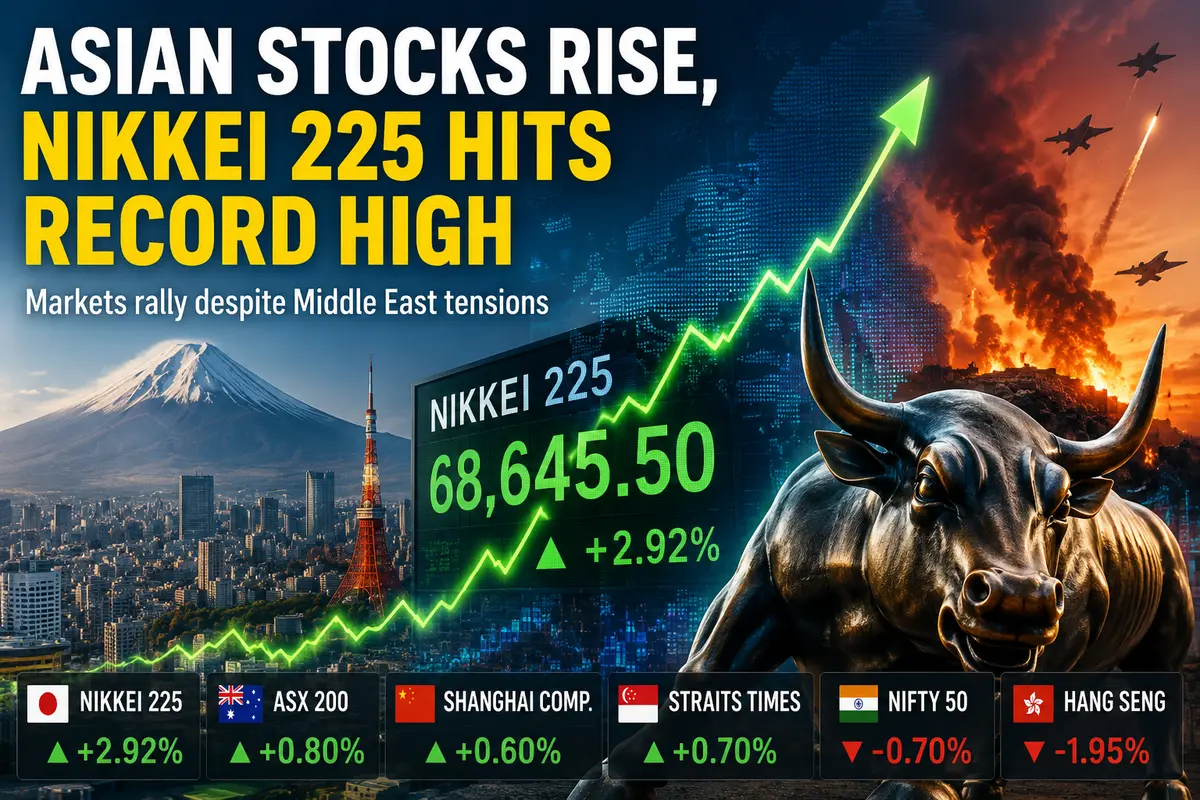
Asian stock markets delivered a pleasant surprise on Wednesday, staging a remarkable rally despite a global backdrop that offered little reason for optimism. The Middle East remained engulfed in conflict. Iran and the United States exchanged airstrikes for the third time in a week. Oil prices climbed. Diplomatic negotiations stalled. Diplomats stayed silent while military forces took action.
Under such circumstances, most markets would be expected to fall—or at least pause in anxious anticipation. But Asian markets ignored the script. They rose. And not just modestly: Japan’s Nikkei 225 surged to an all-time record high, surpassing a milestone many believed was unattainable after three decades of economic stagnation.
What happened? Have investors stopped worrying? Or are they seeing something that analysts obsessed with geopolitics are missing?
As is often the case, the answer is more complicated. On Wednesday, Asia demonstrated a remarkable ability to tune out negative headlines and focus on the factors working in its favor. And there are plenty of them: a technology boom, government stimulus measures, and weak economic data that paradoxically reinforce expectations for accommodative monetary policy. Together, these factors created a cocktail strong enough to outweigh fears of escalating military conflict.
Japan: Thirty Years Later
The star of the day was Japan’s Nikkei 225. The index climbed nearly 3% to reach 68,645.5 points—an all-time high in its history dating back to 1950.
To appreciate the significance of this achievement, it helps to remember where Japan stood three decades ago. In 1990, the Nikkei collapsed following the bursting of the country’s asset bubble. Since then, despite periods of recovery and decline, the peak reached in 1989 had seemed permanently out of reach.
Now, a new record has been set.
The Nikkei was not alone in its triumph. The broader TOPIX index, which includes all stocks listed on the Tokyo Stock Exchange, also reached a fresh high, coming within touching distance of the symbolic 4,000-point mark. The rally was broad-based, lifting not only technology giants but also industrial firms, banks, and retail companies.
Two key drivers stand behind this surge: technology and fiscal stimulus.
The technology story is straightforward. Japan is home to major semiconductor equipment manufacturers such as Tokyo Electron, Advantest, and Disco Corp. These names may mean little to the average person, but they are closely watched by professional investors.
These companies manufacture the equipment used to produce semiconductors. And semiconductors have become the new oil. Artificial intelligence requires massive computing power. Computing power requires chips. Chips require manufacturing equipment supplied by Japanese companies. It is a simple chain of logic that has fueled explosive gains in the sector.
Yet technology alone is not enough to propel an entire stock market to record levels. A domestic catalyst is also needed.
And that catalyst arrived in the form of government subsidies.
Supplemental Budget: The Government Adds Fuel to the Fire
Japan’s government, increasingly active in economic intervention over recent years, unveiled another major stimulus package.
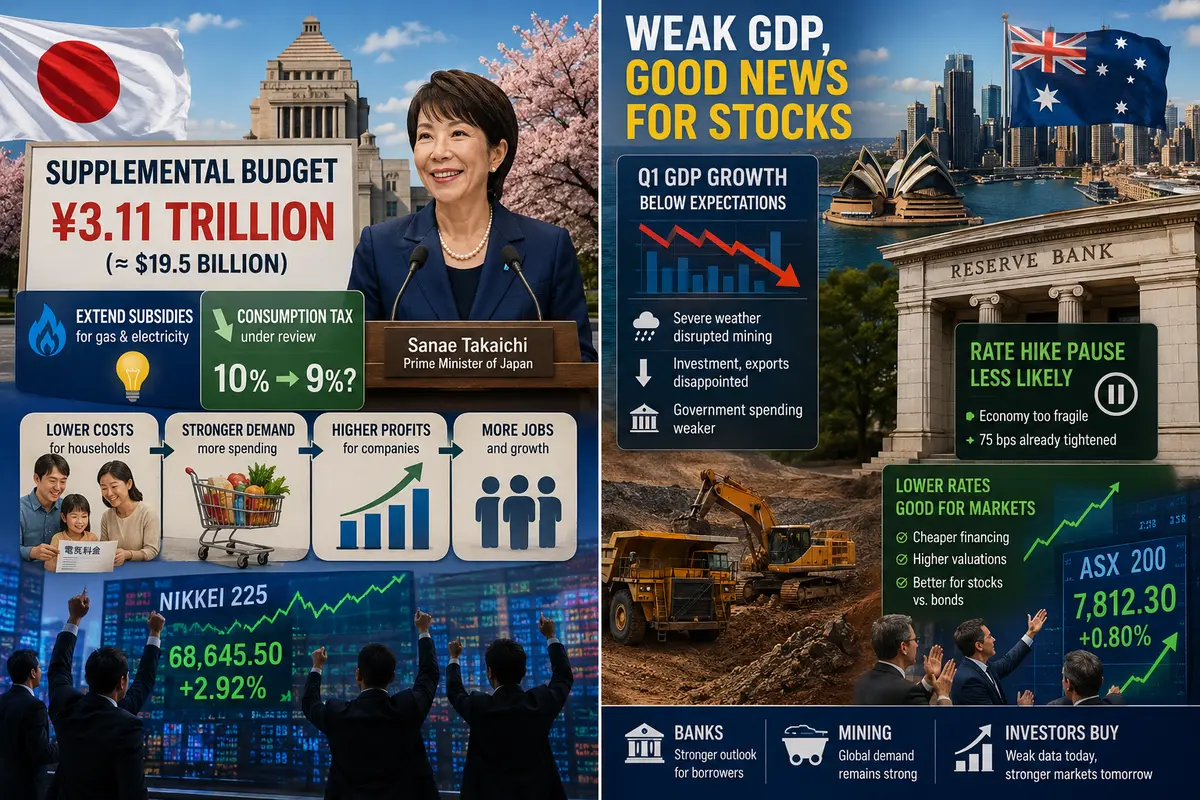
The supplementary budget amounts to ¥3.11 trillion, roughly $19.5 billion. The funds are intended to offset rising living costs, which have been exacerbated by the conflict involving Iran and the resulting surge in energy prices.
The primary measure involves extending subsidies for gas and electricity. Like consumers across the developed world, Japanese households have faced sharply rising utility bills. The government hopes to cushion the blow by covering part of these expenses. The policy is popular and helps Prime Minister Sanae Takaichi maintain public support.
There is also a more ambitious proposal. Takaichi announced plans to consider reducing Japan’s consumption tax, currently set at 10%. Even a one-percentage-point cut would represent a significant hit to government revenues but a substantial boost for consumers—and, by extension, for the companies that serve them.
Markets welcomed the prospect of fiscal stimulus enthusiastically.
Subsidies and tax relief inject money directly into the economy. They stimulate demand, support corporate profits, and encourage job creation. Investors quickly priced these expectations into stock valuations.
Parliament is expected to approve the budget by Friday. While technically a formality, it is an important one. Few doubt that the legislation will pass given the governing coalition’s parliamentary majority.
Australia: Bad GDP, Good News for Stocks
Australia delivered a different kind of surprise.
First-quarter GDP data came in below expectations, indicating slower economic growth than analysts had forecast. Consumer spending remained relatively resilient, but investment, exports, and government expenditures disappointed. Severe weather events—including cyclones and floods—also disrupted mining operations, weighing heavily on economic activity.
Ordinarily, weak GDP growth would be considered negative for equities. A slowing economy generally translates into weaker corporate earnings.
Yet Australia’s stock market interpreted the news differently. The ASX 200 gained 0.8%.
The apparent contradiction makes sense when viewed through the lens of monetary policy.
Weak GDP data significantly reduce the likelihood that the Reserve Bank of Australia will raise interest rates again in the near future. After already tightening policy by a cumulative 75 basis points earlier this year, the central bank has signaled caution. The economy appears too fragile to absorb additional increases in borrowing costs.
For equity investors, that is welcome news.
Lower interest rates mean cheaper financing for businesses, higher company valuations, and a more attractive environment for stocks relative to bonds. Investors effectively concluded that weak economic growth today could mean lower rates tomorrow—and responded by buying equities.
Banks and mining companies, two pillars of the Australian market, led the gains. Banks benefited from expectations that mortgage borrowers would avoid further financial strain, while miners remained supported by continued global demand for iron ore and coal, particularly from China.
China and the Rest of Asia: Mostly Positive
Chinese equities also advanced.
The Shanghai Composite gained 0.6%, while the broader CSI 300 index rose 1.5%.
Two factors helped support sentiment.
The first was, surprisingly, related to Iran. China is the world’s largest oil importer and Iran’s largest trading partner. Beijing possesses leverage over Tehran that Washington lacks. Investors are betting that China could play a mediating role in future negotiations, benefiting from regional stabilization while continuing to secure discounted Iranian oil supplies.
The second factor was domestic.
China’s government continues its efforts to revive the economy following the post-pandemic slowdown. Although stimulus measures have been more modest than many investors hoped, they are showing results. Manufacturing activity improved in April, and retail sales also strengthened. The recovery is gradual rather than spectacular, but progress is visible.
Singapore’s Straits Times Index gained 0.7%.
As a small economy heavily dependent on trade and finance, Singapore is highly sensitive to global conditions. When global sentiment improves, Singapore typically benefits.
India, however, was one of the few exceptions.
The Nifty 50 fell 0.7% at the open, approaching a two-month low.
India faces two major challenges. First, it imports more than 80% of its oil consumption, making it particularly vulnerable to rising crude prices. Higher oil costs worsen the trade balance, increase inflationary pressures, and strain public finances.
Second, India lacks major players in the artificial intelligence ecosystem. The technology boom driving gains in Japan and the United States has had a much smaller impact on Indian markets. Indian firms excel in outsourcing and IT services, but they have yet to establish leadership positions in semiconductor manufacturing or large-scale AI model development.
Hong Kong: The Exception That Proves the Rule
Hong Kong stood apart from the broader regional rally.
The Hang Seng Index fell nearly 2%, significantly underperforming other Asian markets.
However, the decline reflected profit-taking rather than panic.
The previous day had seen strong gains in major technology stocks such as Tencent, Alibaba, and Meituan. Investors who entered earlier chose to lock in profits.
Such behavior is perfectly normal. Markets do not rise in a straight line. Corrections and profit-taking are healthy components of any bull market.
Hong Kong’s status as an international financial center also makes it more sensitive to global risks than mainland Chinese markets. That helps explain why the Hang Seng fell while the Shanghai Composite moved higher.
Asia Ignores Oil
Perhaps the most remarkable development on Wednesday was how effectively Asian markets ignored rising oil prices.
Crude oil rallied following renewed military exchanges between the United States and Iran. Normally, higher oil prices are bearish for equities. More expensive energy translates into higher transportation costs, more expensive goods, and greater inflationary pressure.
Inflation, in turn, often forces central banks to raise interest rates—a negative outcome for stock markets.
Yet investors across Asia appeared willing to treat oil as tomorrow’s problem.
Today’s focus remained firmly on technology, fiscal stimulus, and hopes that the conflict would not escalate further.
Optimism proved stronger than fear.
The stabilization of S&P 500 futures also helped. The U.S. market continues to set the tone for global sentiment. If America is not falling, Asia often feels comfortable moving higher.
Records and Rockets: How Long Can It Last?
The question troubling investors now is simple:
How long can Asian markets continue to ignore geopolitical risks?
No one knows for certain. However, several factors could alter the picture.
The first is genuine escalation. Thus far, military strikes have remained limited. Both sides have demonstrated strength while avoiding full-scale war. If that balance breaks—if critical infrastructure is targeted or civilian casualties rise significantly—markets could react swiftly and brutally.
The second factor is the U.S. Federal Reserve. Policymakers remain on hold for now. But if oil prices remain above $100 per barrel and inflation begins accelerating again, Fed Chair Jerome Powell may be forced to tighten policy further. Any renewed monetary tightening in the United States would weigh on markets worldwide, including Asia.
The third factor is domestic vulnerability.
Japan’s stimulus measures are temporary. Energy subsidies will eventually expire. Any reduction in the consumption tax may one day need to be reversed. The key question is whether Japan’s economy can transition from government-supported growth to self-sustaining expansion.
For now, the answer remains uncertain.
A Few Words About the Future
The Nikkei 225’s record high is undeniably a historic milestone.
It suggests that Japan may finally have emerged from its three-decade economic malaise. It signals renewed investor confidence and highlights the growing strength of the country’s technology sector.
Yet records are not permanent.
The Nikkei also stood at record highs in 1989 before collapsing and spending decades trying to recover. No one is predicting a repeat of that history, but neither should the risks be ignored.
On Wednesday, Asian markets chose optimism.
They looked at missiles, oil prices, and stalled negotiations and essentially said: “We’re not interested. We have artificial intelligence, fiscal stimulus, and hope.”
It is an attractive narrative.
But tomorrow’s headlines from the Middle East could tell a different story.
For now, though, it is a celebration.
The Nikkei has set a new record. Asia is broadly higher. Traders are making money.
And while rockets may be flying outside, the charts on trading screens keep moving upward.
Such is the modern financial world—slightly irrational, somewhat cynical, but never boring.

Comments
No comments yet. Be the first to share your thoughts!
Authentication Required
You must be logged in to post a comment.