

U.S. Futures Hold Steady After Record Highs Amid Rising Tensions With Iran
When Records Meet Rockets
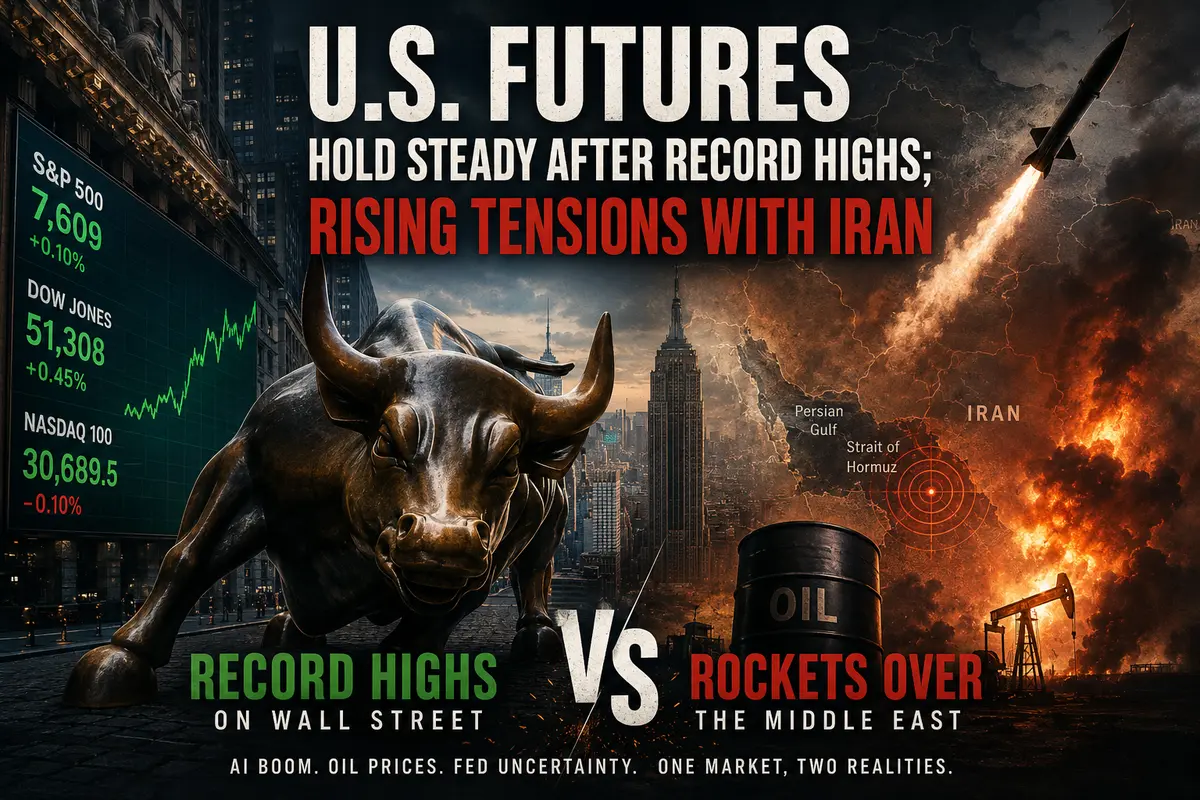
Tuesday evening brought a nervous mood to the U.S. market. Not because investors were panicking. Quite the opposite — everyone seemed frozen in place. Futures on the major Wall Street indexes settled into a strange state of calm: the S&P 500 was virtually unchanged, the Dow Jones Industrial Average stood still, and the Nasdaq 100 edged slightly lower, slipping by just one-tenth of a percent. At 30,689.5 points, Nasdaq futures looked impressive on paper — but the number carried an undertone of unease.
That unease has a name: Iran.
A country that has dominated global headlines in recent weeks once again commanded attention — not through words, but through actions. New airstrikes against neighboring targets marked the third such incident in a week. The United States responded, and now the financial world is holding its breath, watching the Middle East and asking a crucial question: is this merely another chapter in a long-running confrontation, or the beginning of something far larger and more dangerous?
The paradox of the day is that only hours before these developments, Wall Street was celebrating. Major indexes had reached fresh all-time highs. The S&P 500 climbed to 7,609 points. The Dow Jones crossed the 51,000 mark. The Nasdaq advanced as well. Technology stocks — especially semiconductor manufacturers — staged a remarkable rally. Against that backdrop of optimism came news of missile strikes and stalled negotiations.
The market suddenly found itself caught between two powerful forces. On one side stood enthusiasm for artificial intelligence, record profits from technology giants, and the belief that a prosperous future has already arrived. On the other stood geopolitical turmoil, the threat of disruptions in the Strait of Hormuz, rising oil prices, and the prospect of renewed inflation that few had anticipated.
In the face of these conflicting narratives, futures stopped moving. Neither forward nor backward. The market is waiting.
The Middle East: The Day Hope Faded
To understand why investors have become uneasy, it helps to look beyond stock charts and into the reality unfolding across the region.
The story began when Iranian media outlets — which rarely publish sensitive information without consideration of the country’s leadership — reported a dramatic development: Tehran had suspended communication with Washington. No back channels. No intermediaries. No signals. Silence.
The news emerged earlier in the week and initially attracted limited attention. By Tuesday evening, however, it had taken on a far more ominous significance.
Only two weeks ago, discussions centered on the possibility of a breakthrough agreement. Commentators spoke of a framework deal and suggested that both sides were closer than they had been in years. Donald Trump reiterated this week that negotiations remained active and that an agreement could be reached within days. His confidence was unmistakable.
Yet Iranian reports painted a different picture. According to those accounts, there was no ongoing exchange of messages. Tehran was silent while Washington maintained that talks continued.
Who is right? Is someone misleading the public? Or are different sources simply operating with different levels of information and reliability?
Markets dislike mysteries. Markets prefer certainty. Right now, certainty is in short supply.
Then came the airstrikes. U.S. strikes against Iranian-linked positions. Iranian strikes against targets in neighboring countries. Reciprocal actions. The third incident in a week.
Whether these events represent isolated provocations, military signaling, or the inevitable consequence of failed diplomacy remains unclear. What is clear is that oil markets have reacted. Crude prices have been moving higher — not explosively, but steadily. Each new strike has added another layer of risk premium.
And that is where the real challenge for equities begins.
Oil is not merely a commodity. Oil is inflation.
When oil prices rise, fuel becomes more expensive. Transportation costs increase. Airfares rise. Consumer goods cost more to move and produce. Inflation accelerates.
And inflation remains the Federal Reserve’s primary concern.
If inflation remains elevated, the Fed cannot comfortably lower interest rates. Higher rates, in turn, are a headwind for equities — particularly technology stocks, whose valuations depend heavily on future cash flows.
In that sense, rockets flying over the Persian Gulf are not only targeting military installations. They are striking stock valuations, soft-landing expectations, and the market’s vision of a prosperous 2026.
Wall Street’s Feast in the Midst of Uncertainty
Yet there is another side to the story — the side that continues to make investors smile despite geopolitical tensions.
Tuesday was a triumph for technology stocks.
The catalyst was not a macroeconomic surprise, but one individual and one company.
The individual: Jensen Huang, CEO of NVIDIA.
The company: Marvell Technology.
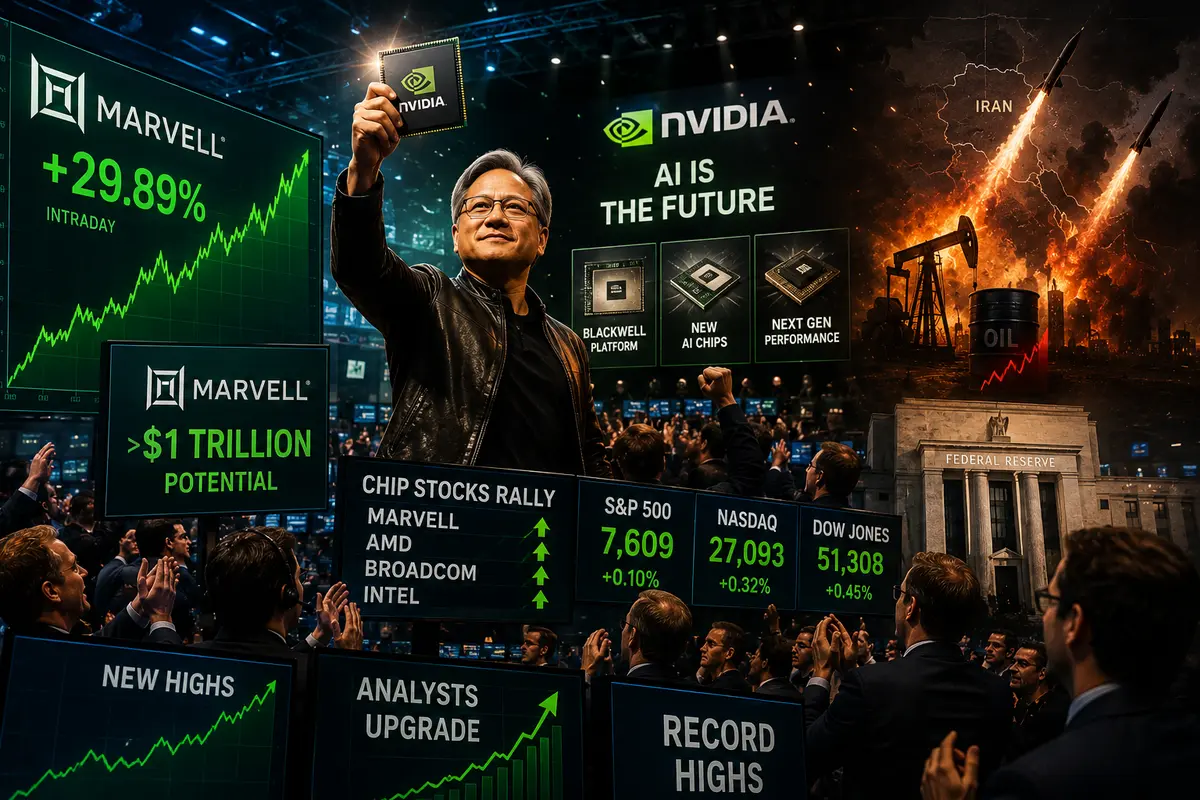
Marvell’s shares surged nearly 30% in a single session. Such a move is not a routine rally; it is an explosion of optimism. The reason was Huang’s suggestion that Marvell could eventually achieve a valuation exceeding $1 trillion.
One trillion dollars.
Marvell is not NVIDIA, which has already become a symbol of the AI era. Yet it operates in the same semiconductor ecosystem. When the industry’s most influential executive expresses confidence in a company’s future, investors listen.
And listen they did.
The enthusiasm quickly spread throughout the chip sector. Investors who missed NVIDIA’s meteoric rise began searching for the next major winner. Marvell, AMD, Broadcom, and even Intel benefited from the wave of optimism.
NVIDIA itself added fuel to the rally by unveiling a range of new AI-related products. New chips, new platforms, and expanded capabilities reinforced the narrative that artificial intelligence remains the dominant investment theme.
Analysts applauded. Price targets rose. Confidence strengthened.
The result was another day of records:
-
S&P 500: 7,609
-
Nasdaq Composite: 27,093
-
Dow Jones: 51,308
Record after record.
It seemed as though nothing could stop the rally.
But something can.
It’s called profit-taking.
After extended gains, investors eventually decide to lock in profits. Not because they expect a crash, but because realized gains are real money.
Late Tuesday, following the record highs, some investors began quietly taking profits. That helps explain why futures were flat on Wednesday morning instead of extending the rally.
Investors are not fleeing. They are pausing.
Watching Iran.
Watching oil.
Watching the Federal Reserve.
And deciding what comes next.
Artificial Intelligence vs. Geopolitics
The market now faces a fundamental question:
Which matters more — the technological revolution or geopolitical risk?
The answer could shape market direction for months.
The bullish case for technology remains compelling. Artificial intelligence is no longer just a buzzword. Companies are using AI to reduce costs, accelerate development, and open new markets. NVIDIA continues to sell advanced chips faster than it can manufacture them. Marvell, AMD, and others are benefiting from expanding demand.
Unlike the dot-com era, many of these companies generate substantial revenue and cash flow.
The geopolitical argument is equally powerful.
Oil at $95 per barrel is manageable.
Oil at $110 becomes a problem.
Oil at $120 becomes a crisis.
Higher energy prices would push inflation higher and force the Federal Reserve to abandon hopes of easier monetary policy. Growth stocks, which trade at elevated valuation multiples, would be particularly vulnerable.
For now, markets are voting in favor of technology. The record highs in the S&P 500 and Nasdaq are evidence of that preference.
Yet the pause in futures suggests confidence has begun to crack.
Investors are no longer moving in lockstep.
Some remain committed to the AI boom.
Others are rotating into oil and gold.
Some are sitting on cash and waiting.
The Federal Reserve as a Spectator
The Federal Reserve officially focuses on economic data: inflation, employment, and growth.
Unofficially, every policymaker is watching developments in the Persian Gulf just as closely as traders are.
An oil shock represents a nightmare scenario for central bankers.
It simultaneously raises inflation and weakens economic growth.
Raise rates, and growth suffers.
Hold back, and inflation accelerates.
That combination — stagflation — is among the most challenging environments policymakers can face.
Markets currently expect the Fed to leave rates unchanged at its next meeting. However, expectations for future rate increases have risen as geopolitical risks have intensified.
The logic is simple:
Higher oil prices lead to higher inflation.
Higher inflation leads to higher interest rates.
Fed Chair Jerome Powell has remained cautious, avoiding comments that could be misinterpreted. Behind the scenes, however, economic models are being updated and forecasts revised.
If the conflict expands, the Fed will be prepared to respond.
The question is how.
Three Scenarios for Investors
Scenario 1: Escalation
If military exchanges intensify and evolve into a broader conflict, oil prices could surge toward $120–130 per barrel.
Equity markets would likely experience a sharp correction. Technology stocks, which have led the rally, could face the largest declines.
Gold and the U.S. dollar would likely emerge as safe-haven assets.
In this scenario, today’s flat futures could quickly turn into tomorrow’s selloff.
Scenario 2: De-escalation
If Washington and Tehran return to negotiations and military activity subsides, oil prices could retreat toward $85–90 per barrel.
Markets would breathe a sigh of relief.
Technology’s rally could resume, pushing the S&P 500 toward 8,000 points and lifting the Nasdaq to new highs.
Futures would likely transition from caution to renewed momentum.
Scenario 3: The Most Likely Outcome
Paradoxically, the most probable scenario may be neither peace nor war.
Limited strikes continue.
Negotiations advance, stall, and resume.
Oil fluctuates between $90 and $100 per barrel.
Equity markets continue rising, but with frequent pullbacks triggered by regional headlines.
Volatility increases, yet the long-term trend remains positive, supported by technological innovation.
For investors, diversification becomes critical.
Betting entirely on technology exposes portfolios to geopolitical shocks.
Betting entirely on energy assumes an escalation that may never materialize.
A balanced approach offers the greatest resilience.
The Night Watch
U.S. index futures are standing still.
Perhaps this is the calm before a storm.
Perhaps it is simply a pause after record highs.
Or perhaps it marks the beginning of another leg higher.
No one knows.
Not even the most sophisticated analysts with the most advanced models.
While they debate, reality continues to intrude.
Missiles fly.
Diplomats remain silent.
Oil prices climb.
Chipmakers reach new highs.
All of it is happening at once.
And amid that chaos, investors must decide whether to buy, sell, or wait.
The wisest investors may be choosing patience.
The market is digesting two realities at the same time: record highs and rising geopolitical risks.
Stable futures suggest that process is still underway.
Not panic.
Not euphoria.
Just a pause.
A deep breath before the next move.
Where that move leads, no one can say.
But watching futures remain motionless while the world around them grows increasingly turbulent is both unsettling and fascinating.
Welcome to a market where records coexist with rockets.
Welcome to the reality we all now inhabit.

Comments
No comments yet. Be the first to share your thoughts!
Authentication Required
You must be logged in to post a comment.