Bar Pipa
We pay for a post of 10$

Markets

Tom Maffin

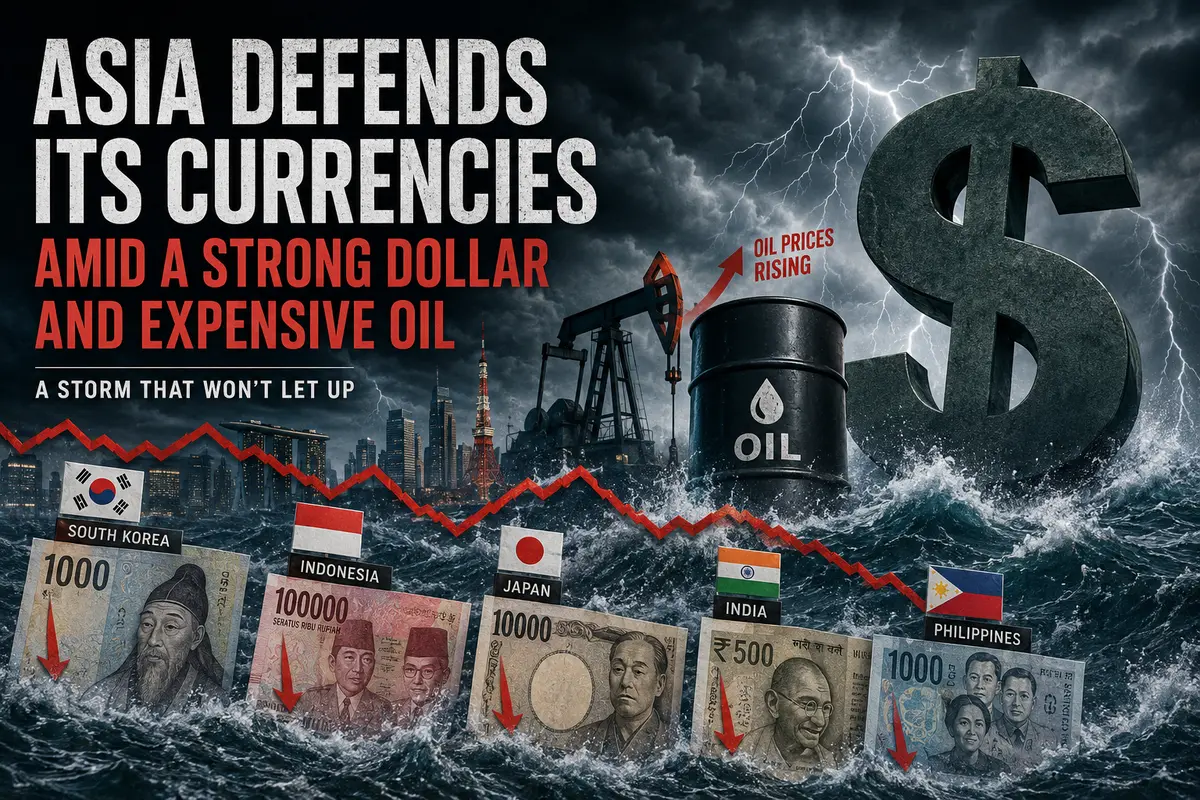
Asia Defends Its Currencies Amid a Strong Dollar and Expensive Oil

Asia Defends Its Currencies Amid a Strong Dollar and Expensive Oil
A Storm That Won’t Let Up

Asia wakes up on Thursday, and the first thing traders see on their screens is red once again. Regional currencies have fallen for a fourth consecutive day. Bloomberg’s Asian currency index—a barometer of the financial health of hundreds of millions of people across the region—continues its relentless slide. The biggest losers are the South Korean won and the Indonesian rupiah, but few others are faring much better.

Behind these numbers lies a simple and uncomfortable story. The dollar is strong. Oil is expensive. Capital is flowing out of Asia and into the United States. Meanwhile, local central banks are trying to preserve what they can. Interventions, warnings, interest-rate hikes—every tool is being deployed. So far, however, the results have been limited.

Asian countries have found themselves in a perfect storm. Two powerful forces are putting simultaneous pressure on their currencies. The first is the policy stance of the U.S. Federal Reserve. The American economy has remained stronger than expected, inflation remains stubborn, and the Fed is not only delaying rate cuts but is even considering further hikes. The second factor is the Middle East. Rising tensions between the United States and Iran are pushing oil prices higher. For Asia, which imports most of the oil it consumes, expensive oil delivers a triple blow: higher inflation, worsening trade balances, and weaker currencies.

Regional authorities are fighting back. Some are intervening directly, selling dollars from their reserves and buying local currencies. Others are raising interest rates to make their currencies more attractive to investors. Some are imposing administrative measures to limit capital outflows. Yet the U.S. dollar remains a formidable opponent. It is difficult to fight when domestic economies are slowing and inflation is rising.

South Korea: Words and Actions

South Korea, Asia’s fourth-largest economy and...

Continue reading...
0
0

HSBC Expects a Weaker Dollar as Markets Change Their Reaction to Data

HSBC Expects a Weaker Dollar as Markets Change Their Reaction to Data
When Good News Stops Being Good News for a Currency

There is an old, almost cliché truth in finance: a strong U.S. economy means a strong dollar. It seems logical enough. GDP rises, and investors bring money into America. Strong employment data strengthens the dollar. Geopolitical tensions drive investors into the dollar as a safe haven. This relationship worked for decades. It was an axiom that required no proof.

But, as it turns out, even axioms can become outdated.

HSBC Asset Management, which oversees $863 billion in assets, has made a rather provocative claim. According to the firm's strategists, the dollar is headed for weakness. Not merely a temporary correction or a short-term pullback, but a structural downward trend. Their key argument sounds almost paradoxical: the dollar no longer responds to good news the way it once did.

Joe Little, Global Chief Strategist at HSBC Asset Management, articulated the idea with remarkable precision. Historically, the combination of strong domestic growth and geopolitical tension created a powerful and sustained uptrend for the U.S. currency. Investors from around the world flocked to the dollar because America was both a haven of stability and an engine of growth. Today, that dynamic appears to be fading. The dollar still rises at times, but reluctantly, sluggishly, and with frequent reversals. Little sees this as a symptom of a deeper problem.

Something has changed. The question is: what exactly?

The Dollar That Doesn't Want to Rise

Let's look at the numbers. The Bloomberg Dollar Spot Index gained just 0.6% over the past month. In currency markets, six-tenths of a percent is barely a move. It's a tremor rather than a trend.

And this happened despite the U.S. economy continuing to surprise on the upside. Job openings exceeded expectations. Consumer spending remains resilient. Industrial production is expanding....

Continue reading...
0
0

The Canadian Dollar Holds Near a Multi-Week Low

The Canadian Dollar Holds Near a Multi-Week Low
Where the Loonie Has Stalled

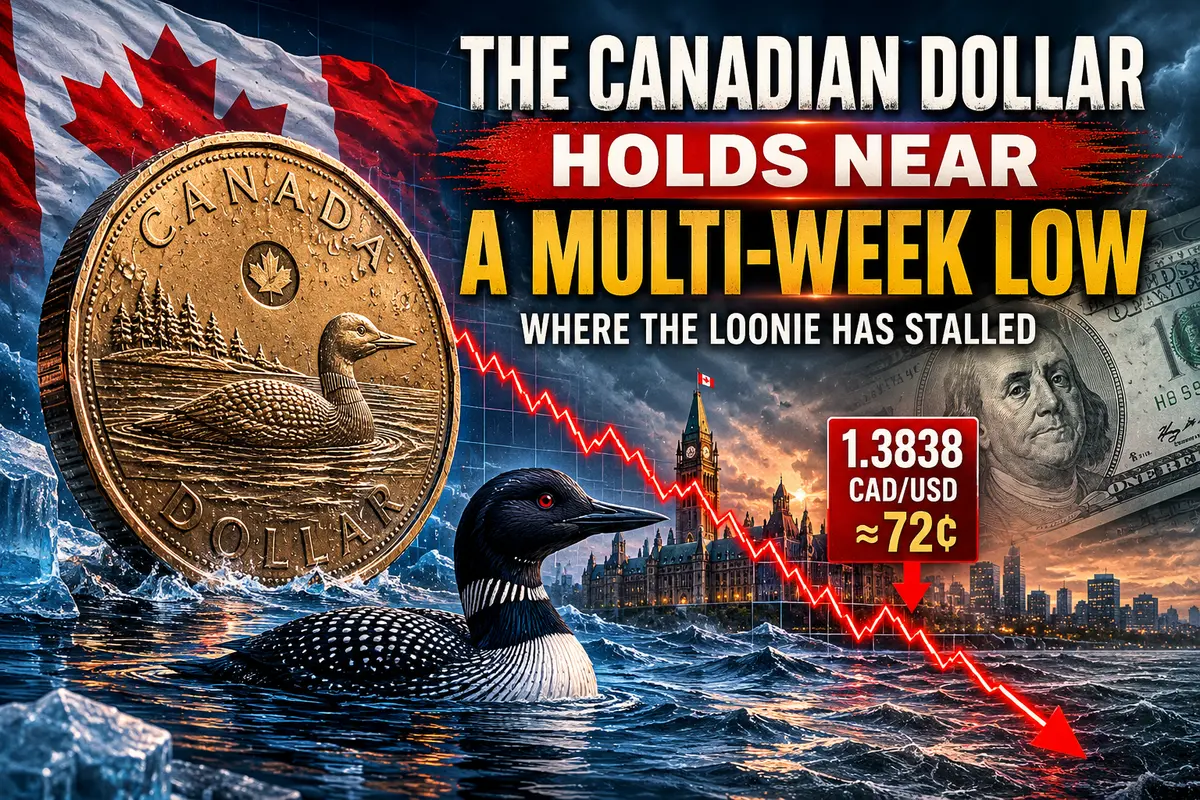
Wednesday was not a particularly good day for the Canadian currency. Then again, neither were the previous several weeks. The Canadian dollar, affectionately known as the “loonie” after the solitary loon depicted on the one-dollar coin, remained dangerously close to its multi-month lows against its American counterpart.

It did not plunge. It did not collapse. It did not crash. It simply stood still. And that stillness — that stubborn pause at a level that pleases no one — speaks more loudly about the challenges facing the currency than any dramatic selloff could.

During trading, the Canadian dollar was virtually unchanged at 1.3838 per U.S. dollar. Converted into U.S. cents, that works out to roughly 72¼ cents for one Canadian dollar — a level that would have seemed insultingly low to many Canadians just a few years ago. Today, it has become an uncomfortable reality to which people are gradually adapting.

Throughout the session, the currency traded within a narrow range between 1.3816 and 1.3854. By foreign-exchange standards, that range is almost laughably small. This is not volatility; it is indecision. Traders do not know which direction to run, so they remain frozen in place, clinging tightly to their positions.

The most troubling moment came last Thursday, when the Canadian dollar slipped to a six-week low of 1.3869. Since then, conditions have not improved, but at least they have not deteriorated dramatically. Whether this calm is the quiet before a storm or merely the beginning of a long and tedious period of stagnation remains to be seen.

What Is Pressuring the Loonie?

Trying to explain the Canadian dollar’s weakness with a single factor would be impossible. As always, it is a cocktail of problems — a bitter blend that financial markets swallow reluctantly because they have...

Continue reading...
0
0
Lin Brings

Trump’s Words as a Market Catalyst

Trump’s Words as a Market Catalyst

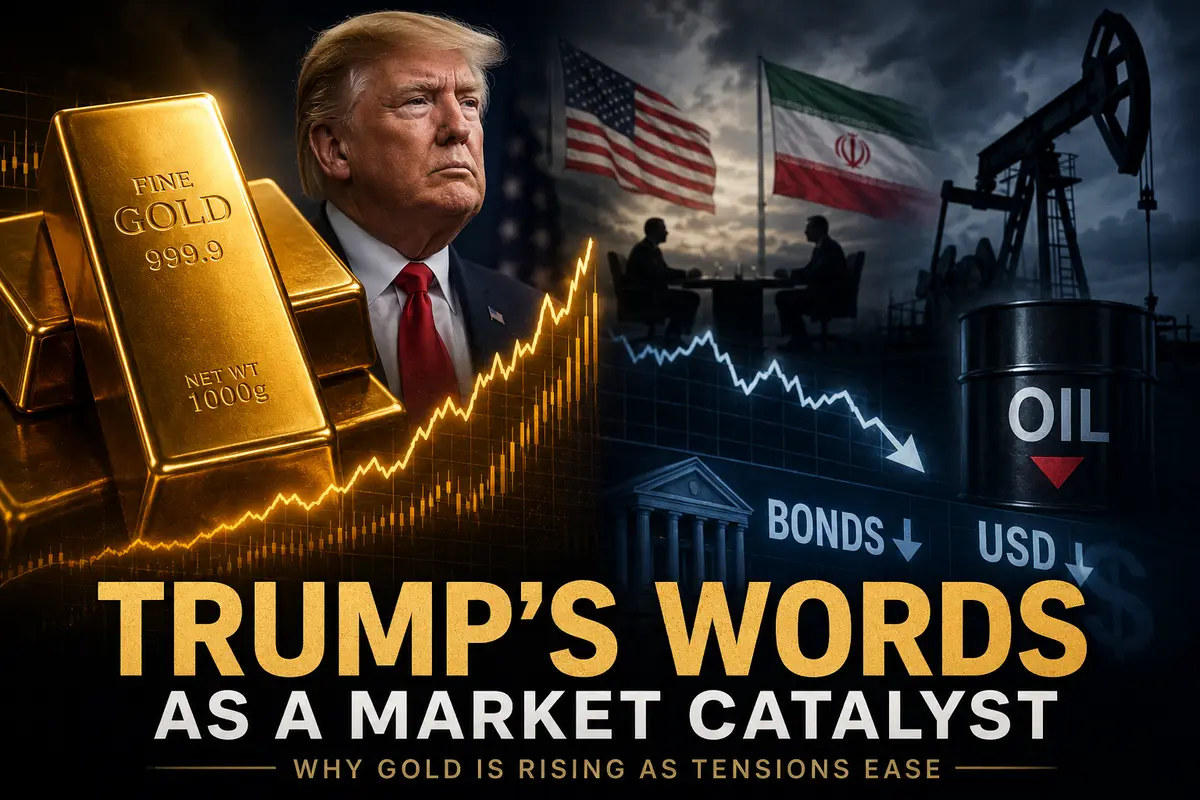
Tuesday began with a cautious but confident rise in the precious metals market. Spot gold gained one tenth of a percent and settled around $4,570 per ounce, while futures climbed three tenths of a percent to $4,574. At first glance, the move looked modest. But behind these numbers stood an event that changed the mood of the entire financial world the previous evening: Donald Trump announced a postponement of the planned strike on Iran and confirmed that negotiations were ongoing.

Markets, which for weeks had been pricing in the possibility of a major war in the Middle East, interpreted these remarks as the first real signal of de-escalation in a long time. The reaction was multifaceted: oil moved lower, bonds stopped falling, the dollar weakened, and gold — contrary to the usual logic linking its rise to heightened geopolitical fears — also moved higher. To understand this apparent paradox, it is necessary to look at the mechanics currently driving the precious metals market.

Oil Down, Gold Up: Breaking the Pattern

Normally, gold and oil move in the same direction when geopolitics is the main driver. War sends oil higher and gold higher. Peace pushes both lower. But Tuesday morning broke this familiar pattern. Oil prices fell sharply after Trump’s comments, while gold rose.

The explanation lies in the fact that gold is currently far more sensitive to the bond market than to geopolitical risk itself. Recent weeks have shown that the metal’s main enemy was not hope for peace, but rising yields. When investors sold bonds on fears that a war with Iran would fuel inflation and force central banks to tighten policy further, yields surged and gold declined. Now that dynamic is beginning to reverse.

Trump’s announcement that the strike was postponed and that serious negotiations were underway sparked...

Continue reading...
0
0

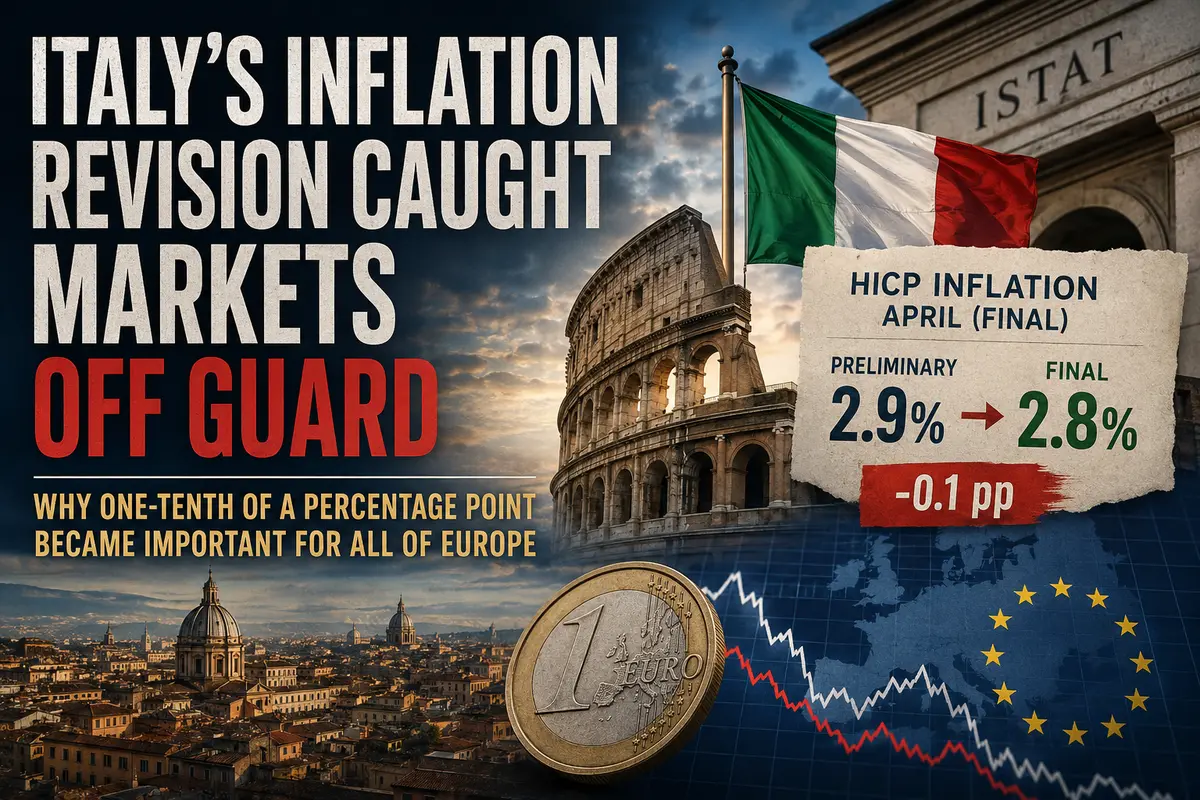
Italy’s Inflation Revision Caught Markets Off Guard

Italy’s Inflation Revision Caught Markets Off Guard
Why One-Tenth of a Percentage Point Became Important for All of Europe

When Italy’s national statistics agency ISTAT released revised inflation data for April on Friday, nothing dramatic seemed to happen at first glance. The preliminary estimate for annual inflation under the harmonized HICP index stood at 2.9 percent, while the final figure came in at 2.8 percent. The difference was just one-tenth of a percentage point. To someone far removed from financial markets, that may look like an accounting detail nobody should care about. But today, it is precisely these “small details” that move bond markets, reshape investor expectations, and force central bankers to study statistical reports line by line.

The modern financial system operates in a state of extreme sensitivity. When the economy is balancing between slowing growth and the threat of a new inflation wave, any deviation from forecasts becomes a signal. Sometimes a single number is enough to sharply alter expectations for interest rates, government bond yields, or the euro exchange rate. That is why the revision of Italy’s inflation data turned out to be far more significant than it initially appeared.

April’s Inflation Surge Looked Too Sharp

The dynamics of April itself look troubling. As recently as March, Italy’s HICP inflation stood at 1.6 percent year-over-year. One month later, it had jumped to 2.8 percent. An increase of 1.2 percentage points in such a short period is not a normal fluctuation — it is a sharp acceleration. And the issue goes beyond the numbers themselves. For Italy, inflation is almost a painful topic because the country’s economy is especially vulnerable to external shocks.

Italy has been living in a state of chronic economic fatigue for years. Formally, it is the eurozone’s third-largest economy, a country with a powerful industrial base, famous global brands, a massive...

Continue reading...
0
0
Navigation menu