
Gold Rises After Lebanon Ceasefire; U.S. Labor Market Data in Focus

The Yellow Metal Finds a Reason to Climb
Thursday began with cautious optimism for gold. Spot gold gained just over half a percent, rising to $4,460 per ounce. Futures followed the same path, up 0.5% to $4,486. These are not record highs, but they are welcome gains—especially after Wednesday, when gold lost more than 1% under pressure from a stronger U.S. dollar.
What changed overnight? First, geopolitics. Second, expectations. Both factors worked in favor of the yellow metal.
The geopolitical backdrop remains complicated, but the first signs have emerged that the worst may be behind us. Late Wednesday, Washington announced a ceasefire agreement between Israel and Lebanon. The wording was cautious—the deal depends on Hezbollah halting hostilities—but the fact that diplomats managed to reach an agreement after talks appeared stalled only a day earlier is a meaningful signal.
Investors took notice. Oil, which had been rising this week on fears of supply disruptions, moved lower on Thursday morning. Crude prices fell after three consecutive days of gains. Lower oil prices mean lower inflation expectations. Lower inflation expectations ease pressure on central banks, reducing the need for aggressive anti-inflation measures.
Still, it is too early to relax. The Middle East conflict has not disappeared—it has merely cooled somewhat. Reports of Iranian missile strikes on Kuwait and Bahrain from Wednesday remain relevant, as do U.S. strikes on Iran’s Qeshm Island in the Strait of Hormuz. Israeli military operations in southern Lebanon also continue.
The ceasefire between Israel and Lebanon is important, but it is only one piece of a much larger puzzle. Iran remains the primary source of concern, while Hezbollah remains an unpredictable player. As a result, gold is moving higher, but without euphoria—cautiously and with one eye on the risks.
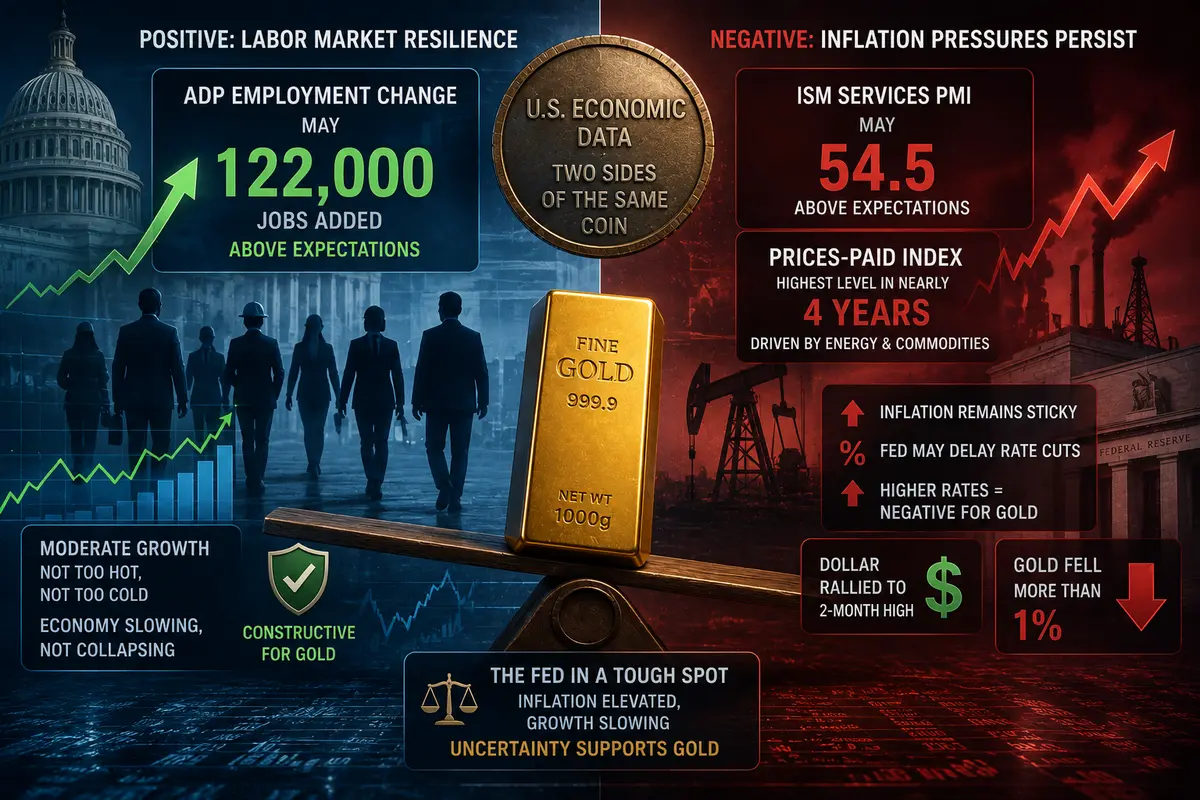
U.S. Economic Data: Two Sides of the Same Coin
Wednesday brought important economic data from the United States, creating a mixed picture that helps explain why gold initially fell on dollar strength and is now attempting to recover.
Let’s start with the positive news for gold.
ADP, the payroll-processing company, reported that U.S. private employers added 122,000 jobs in May, slightly above expectations. The labor market continues to demonstrate resilience.
At first glance, a strong labor market should be negative for gold because it gives the Federal Reserve less incentive to cut interest rates. However, there is an important nuance. A gain of 122,000 jobs is not 200,000 or 300,000. It represents moderate growth, suggesting the economy is slowing rather than collapsing. For gold, which is often purchased as protection against recession, that is a constructive signal.
Now for the negative side—which dominated market sentiment on Wednesday and triggered gold’s decline.
The ISM Services PMI rose to 54.5, beating expectations. The services sector continues to expand. More importantly, a key component within the report delivered an unpleasant surprise.
The prices-paid index—which measures how much companies pay for goods and services—jumped to its highest level in nearly four years, driven by rising energy and commodity costs.
This is bad news for gold in the short term because it suggests inflation remains stubborn. As a result, the Federal Reserve may delay interest-rate cuts. Higher rates are generally negative for gold because they increase the opportunity cost of holding a non-yielding asset.
Markets reacted swiftly. The U.S. dollar climbed to a two-month high, and gold fell more than 1%.
By Thursday morning, however, investors had reassessed the situation. Inflation remains elevated, but economic growth is slowing. The Fed finds itself in a difficult position—and in uncertain environments, gold often looks attractive.
The Ceasefire, Oil, and Gold: How They Are Connected
For those outside financial markets, the relationship between a ceasefire in Lebanon, oil prices, and gold prices may not seem obvious. In reality, the connection is direct.
When conflict escalates in the Middle East, oil prices tend to rise because markets fear supply disruptions. Higher oil prices lead to higher inflation. Higher inflation leads to higher interest rates. Higher rates are generally negative for gold.
When fighting subsides—or at least there is hope that it will—oil prices often fall. Lower oil prices reduce inflation expectations. Lower inflation expectations increase the likelihood of a more accommodative Federal Reserve. Easier monetary policy is supportive for gold.
That exact chain of events unfolded Thursday morning. News of the Israel-Lebanon ceasefire pushed oil prices lower after three days of gains. Oil fell, inflation expectations eased, and gold moved higher.
Of course, the effect could prove temporary. If the ceasefire breaks down and hostilities resume, oil could rebound and gold could come under pressure again. For now, however, markets are choosing the optimistic scenario.
U.S. Employment Data: The Key Event of the Week
All eyes are now on Friday’s U.S. Nonfarm Payrolls report—the most closely watched indicator of labor-market health in the world’s largest economy.
The report matters for all asset classes, but particularly for gold, because it could influence Federal Reserve policy.
Consensus forecasts point to roughly 180,000 jobs added in May. That would be below April’s 250,000 figure but still a healthy reading.
If the actual number lands near expectations—between 170,000 and 190,000—markets are likely to interpret it as confirmation of a soft-landing scenario. Economic growth is slowing but not collapsing, inflation is easing, and the Fed may begin cutting rates later this year. That would be positive for gold.
If payrolls significantly exceed expectations—220,000 to 250,000 or more—it would suggest the labor market remains overheated. Inflationary pressures could persist, and the Fed might not only postpone rate cuts but even consider further tightening. Such a result would likely be bearish for gold.
If payrolls come in far below expectations—120,000 to 130,000 or lower—it would indicate the economy is slowing faster than anticipated. The Fed could begin cutting rates as early as July or August. That scenario would likely provide a strong boost to gold.
All three outcomes remain possible. Predicting Nonfarm Payrolls with precision is notoriously difficult. As a result, markets are treading carefully ahead of Friday’s release.
The Dollar and Gold: An Old Dance
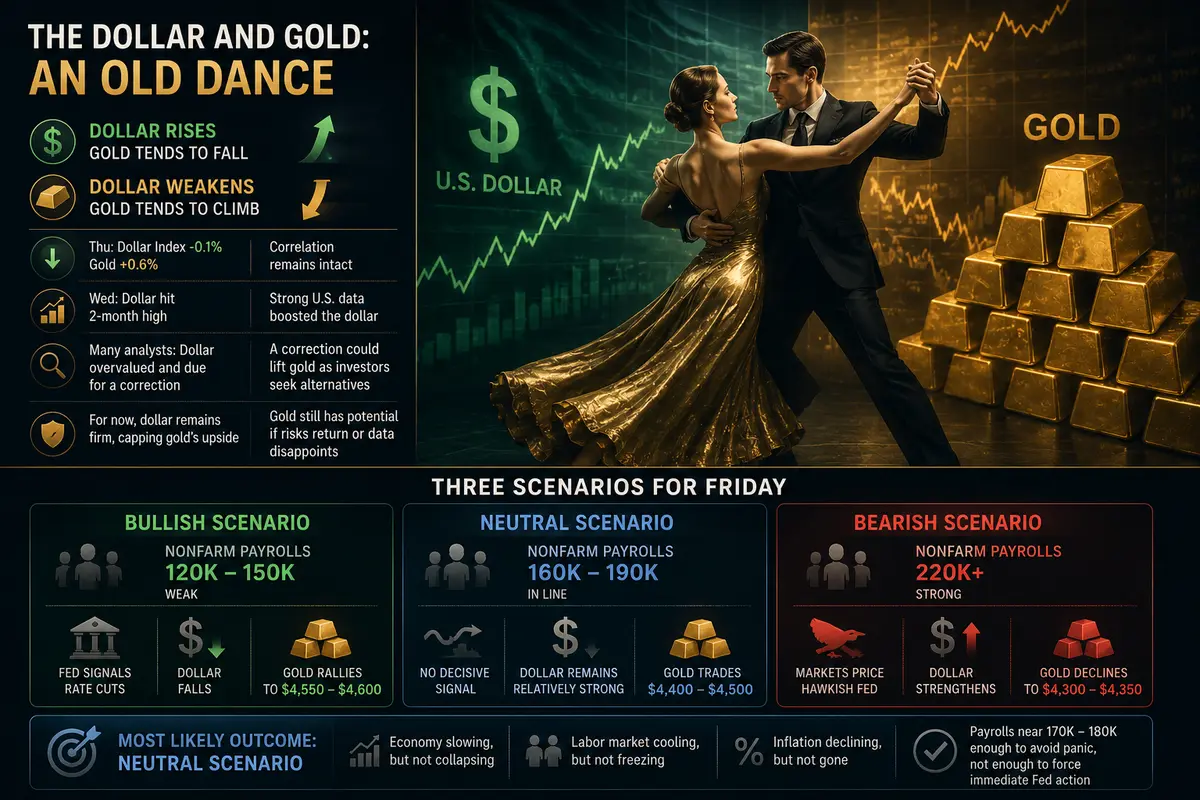
The relationship between the U.S. dollar and gold is a classic one. When the dollar rises, gold usually falls. When the dollar weakens, gold tends to climb.
On Thursday, the Dollar Index slipped just 0.1%, a relatively minor move. Yet gold gained around 0.6%. The correlation remains intact.
The day before, the dollar reached a two-month high, supported by stronger-than-expected U.S. economic data. A strong dollar reflects investor confidence in the U.S. economy relative to the rest of the world.
However, many analysts argue that the dollar is overvalued and due for a correction. If such a correction materializes, gold could become one of the primary beneficiaries as investors seek alternatives to dollar-denominated assets.
For now, the dollar remains firm, limiting gold’s upside. Nevertheless, the metal still has growth potential—particularly if geopolitical tensions flare up again or U.S. employment data disappoint.
Three Scenarios for Friday
Bullish Scenario
Nonfarm Payrolls come in weak, between 120,000 and 150,000. The Fed begins signaling rate cuts. The dollar falls, and gold rallies toward $4,550–$4,600 per ounce.
Neutral Scenario
Payrolls land between 160,000 and 190,000. Markets receive no decisive signal. Gold trades in a $4,400–$4,500 range, while the dollar remains relatively strong.
Bearish Scenario
Payrolls exceed 220,000. Markets price in a more hawkish Fed. The dollar strengthens, and gold declines. Initial support could emerge around $4,300–$4,350 per ounce.
Which outcome appears most likely?
Most analysts lean toward the neutral scenario. The U.S. economy shows signs of slowing but not collapsing. The labor market is cooling, but not freezing. Inflation is declining, but not disappearing.
In that environment, payroll growth near the consensus forecast of 170,000–180,000 seems plausible—strong enough to avoid panic, but not strong enough to force immediate action from the Fed.
Other Precious Metals Join the Rally
Gold was not the only winner on Thursday.
Silver rose 0.5% to $73.11 per ounce, while platinum gained 0.7%, reaching $1,875.60 per ounce.
Silver has a dual personality: it is both a precious metal and an industrial commodity. Geopolitical uncertainty tends to support silver as a safe haven, while industrial demand from solar panels, electronics, and manufacturing also plays a significant role.
On Thursday, the safe-haven factor dominated.
Platinum, meanwhile, remains heavily tied to the automotive industry through its use in catalytic converters. While the long-term transition toward electric vehicles poses challenges, platinum often follows gold’s direction in the short term.
The fact that all major precious metals moved higher together suggests investors are pricing in geopolitical risks and the possibility of future Fed easing.
Technical Outlook: Support and Resistance Levels
Spot gold is currently trading just below $4,470 per ounce.
The nearest resistance level lies around $4,480. A breakout above that area could open the door toward $4,520, followed by $4,550.
Key support remains near $4,400. The market tested that level on Wednesday and held. If Friday’s payroll report surprises to the upside, a break below $4,400 becomes more likely. The next support zones would be $4,350 and then $4,300.
Technical indicators offer mixed signals. Daily moving averages continue to display a bullish “golden cross,” while the Relative Strength Index is approaching overbought territory, suggesting the potential for a correction.
Trading volumes on Thursday remain below average as investors wait for Friday’s employment report.
It is the calm before the storm.
Wait or Act?
Gold investors face a familiar dilemma: buy, sell, or stay put.
Buy now, and weak employment data could produce gains. Strong data could generate losses.
Sell now—or establish a short position—and weak data could prove costly, while strong data could be rewarding.
Many professional traders prefer not to guess. Instead, they reduce exposure ahead of major economic releases, close positions entirely, or use options to hedge risk.
For retail investors who cannot employ complex strategies, the most important advice is simple: do not make decisions based on emotion.
The labor-market report is important, but it is not the end of the world. Gold remains gold—a defensive asset that tends to retain value even when uncertainty dominates the broader financial landscape.
Thursday delivered a modest rally. Friday is likely to bring a much larger move in one direction or the other.
And after that comes the weekend—a chance for markets, and investors, to cool down and reassess. The market will still be there on Monday.
And so will gold.
Comments
No comments yet. Be the first to share your thoughts!
Comments only for logged-in users.