Bar Pipa
We pay for a post of 10$
Lin Brings

Millions Spent on Bodyguards: How the Crypto Industry Is Becoming a Fortress Under Siege

Millions Spent on Bodyguards: How the Crypto Industry Is Becoming a Fortress Under Siege

Las Vegas, May 2026. At first glance, the Bitcoin 2026 conference looks little different from any other tech expo: the same brightly lit booths, the same panel discussions, the same constant hum of networking in the hallways. But it only takes a closer look at how the speakers move around to realize that something unusual is happening here. Top executives are surrounded by men with military posture, dressed in tailored suits and wearing discreet earpieces. These are not assistants. They are professional bodyguards — former special forces operatives hired to protect against a threat that would have seemed unimaginable just a few years ago.

The crypto industry, born from idealistic dreams of freedom from intermediaries, has found itself cornered by brutal physical reality. And that reality is armed with a crowbar.

The Wrench as a Hacking Tool

In the professional jargon of security specialists, it’s called a “wrench attack.” The scheme is brutally simple: criminals identify the owner of a large crypto wallet, break into their home, beat them or threaten their family until they transfer the funds. No sophisticated code. No exploits. No phishing. Just brute force and human fear. And statistics show the method works with alarming efficiency.

The database maintained by Casa, a company specializing in custody solutions, records a threefold increase in such attacks since 2023. CertiK, one of the leading blockchain security auditing firms, reports even more disturbing numbers: in 2025, confirmed physical incidents rose by seventy-five percent. Seventy-two documented cases. Forty-one million dollars in direct losses. And those are only the incidents that made it into official reports. Many victims stay silent, fearing repeat attacks or unwilling to reveal the scale of their losses.

The wording used by CertiK sounds almost like a verdict: “2025 became the turning point. Physical violence is now the...


Continue reading...
0
0

“The Liberation of Cuba”: What Lies Behind Trump’s Bold Words and the Charges Against Castro

“The Liberation of Cuba”: What Lies Behind Trump’s Bold Words and the Charges Against Castro

The White House once again reminded the world on Wednesday that under Donald Trump, foreign policy is, above all, theater. When the president says, “we are liberating Cuba,” the world pauses, trying to understand whether this is the prelude to a military operation, a diplomatic bluff, or another act of political drama aimed at a domestic audience. The statement came only hours after the U.S. Department of Justice announced charges against Raúl Castro — the man who stood at the helm of Cuban power for nearly half a century and who has long symbolized, for successive American administrations, the indestructible enemy just off America’s shores. Yet between the grand rhetoric of liberation and the reality of the Cuban issue lies a vast gap filled with decades of failed attempts, economic embargoes, and geopolitical calculations.

Raúl Castro in the Dock: A Symbolic Gesture or the Beginning of a New Era?

The charges brought against Raúl Castro are difficult both to overstate in importance and to interpret unambiguously. For the American justice system, this is an unprecedented step. Never before has a former Cuban leader of such stature become the subject of a criminal case in the United States. The mere fact that the Department of Justice decided to take this step suggests a tectonic shift in Washington’s approach to the Cuban question. For decades, U.S. policy toward Cuba oscillated between isolation and cautious rapprochement, between embargoes and secret diplomacy. The current administration, however, appears determined to abandon all shades of gray.

Trump called the indictment “a very important moment.” For him, it undoubtedly is. The timing is perfect. Raúl Castro has long stepped away from formal power, handing the reins to a new generation, yet his name still carries enormous symbolic weight. For the Cuban diaspora in Miami — whose votes...

Continue reading...
0
0
Tom Maffin

Silent Expansion: How Google Is Turning Missouri Cornfields into a Digital Empire

Silent Expansion: How Google Is Turning Missouri Cornfields into a Digital Empire

Fifteen billion dollars. A sum large enough to build several skyscrapers in New York, finance the space program of a small nation, or reshape the transportation system of an entire metropolis. But Google has chosen to spend that money differently. On Wednesday, the company announced it would invest the funds into land, concrete, steel frameworks, and miles of fiber-optic infrastructure in the state of Missouri.

At first glance, the news about a new data center in the small town of New Florence, tucked away among the fields of Montgomery County, looks like just another line in a corporate press release. In reality, however, the project fundamentally changes how we think about the direction of the digital economy — and who its next beneficiaries will be.

Cornfields Become the New Silicon Valley

Missouri is not the first place that comes to mind when people hear the phrase “technology hub.” Known for its ranches, beer breweries, and the blues clubs of St. Louis, the state has never seriously competed with California or Texas. Yet this is precisely where Google has chosen to place one of its largest infrastructure projects — and the decision is far from accidental.

A modern data center is not simply an office building filled with servers. It is an industrial facility comparable in scale to a steel plant, except instead of consuming coking coal, it consumes electricity. Gigawatts of electricity.

The fact that Google has already contracted more than one gigawatt of new power generation capacity in Missouri speaks volumes about the scale of its appetite. One gigawatt is roughly equivalent to the output of a large nuclear power plant or two million solar panels. And this is only the beginning. The company’s partnership with local utility provider Ameren includes the development of an additional 500 megawatts of...

Continue reading...
0
0

Oil Raises Its Head: WTI Climbs Back Toward $100 as the World Speculates About War

Oil Raises Its Head: WTI Climbs Back Toward $100 as the World Speculates About War

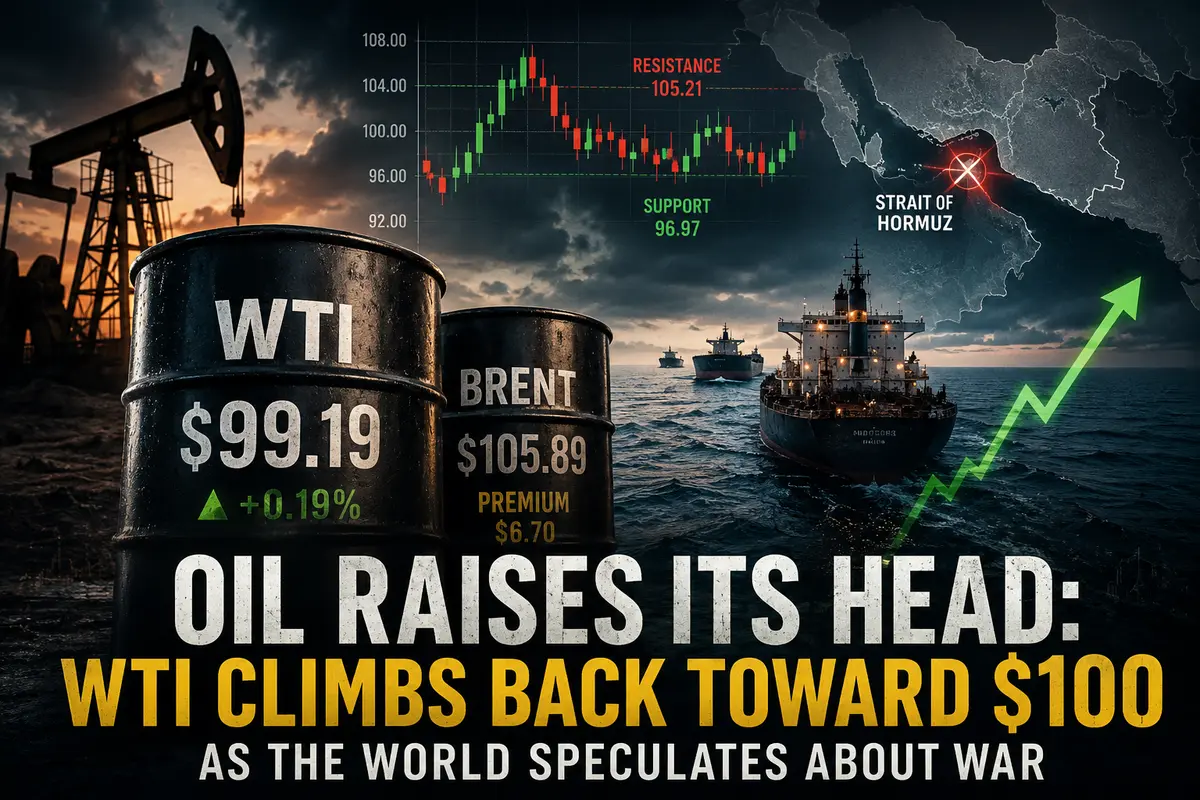
Thursday’s Asian trading session brought a cautious but steady revival to oil markets. July WTI crude futures rose to $99.19 per barrel, gaining a modest 0.19%. In ordinary times, such a move would barely make headlines. But now, when every cent of price movement translates into billions of dollars in budget fluctuations for entire nations, even this small green candle on the chart tells a much larger story. It is the story of oil trying to find a bottom after the collapse triggered by hopes for peace — and of that bottom potentially settling far higher than consumers from Tokyo to London would like.

Between Support and Resistance: Oil Searches for Balance

The technical picture painted by WTI quotes resembles a boxing match in which both opponents are exhausted, yet neither is willing to give ground. The support level at $96.97 marks the line below which the market refuses to let sellers pass. Every time prices approach this level, buyers step in, as though an invisible hand is catching the market before it falls further. Resistance at $105.21 serves the opposite role — a ceiling that has crushed every rally attempt over recent weeks.

This range between $97 and $105 is no accident. It contains all the conflicting information the market is digesting right now. On one hand, hopes for peace with Iran — repeatedly promoted throughout the week by Donald Trump — are pushing prices lower. If the conflict truly is in its “final stage,” as the U.S. president claims, then sooner or later the Strait of Hormuz will reopen, supplies will normalize, and oil prices will return to pre-crisis levels. On the other hand, reality stubbornly resists optimism. The strait remains largely blocked, tankers are forced to seek alternative routes or wait for passage, insurance premiums for shipping...

Continue reading...
0
0

Gold at a Crossroads: Peace With Iran Beckons, but War Still Lingers

Gold at a Crossroads: Peace With Iran Beckons, but War Still Lingers

Gold is climbing again. During Thursday’s Asian trading session, prices turned green, extending a rally that seemed to begin against all logic. Spot gold rose to $4,560 per ounce, while futures reached $4,562. A gain of four-tenths of a percent for the session marked a confident recovery after recent losses. But the real mystery behind this move lies not in the numbers — it’s in what caused it. Gold, which for weeks had been suffocating under the pressure of rising rates and a strong dollar, suddenly found support where few expected it: in hopes for peace with Iran. And that paradox reflects the complex, multilayered logic of a market that no longer reacts to headlines in a straightforward way.

Peace as a Catalyst: An Unexpected Twist

At first glance, everything should have played out differently. Gold is the classic safe-haven asset. It rises when the world descends into chaos — when guns fire and diplomats throw up their hands. A war with Iran, a blocked Strait of Hormuz, oil prices soaring into the stratosphere — all of that should have sent gold flying higher. Instead, the yellow metal hovered near recent lows, unable to break resistance. And now, just as Trump speaks of the conflict entering its “final stage” and negotiations progressing successfully, gold suddenly comes alive. How can that be explained?

The answer lies in the transmission mechanism — the invisible conduit linking geopolitics to monetary policy. The conflict with Iran created an inflationary shock. Disruptions to oil supplies drove energy prices sharply higher, which in turn fueled inflation worldwide. Central banks, especially the Federal Reserve, responded with more hawkish rhetoric and threats of higher rates. High interest rates are gold’s deadliest enemy because they increase the opportunity cost of holding a non-yielding asset. That mechanism has been choking...

Continue reading...
0
0
Lin Brings

Hawks in Washington, Calm in Asia: The Dollar Holds Firm While the Aussie Loses Ground

Hawks in Washington, Calm in Asia: The Dollar Holds Firm While the Aussie Loses Ground

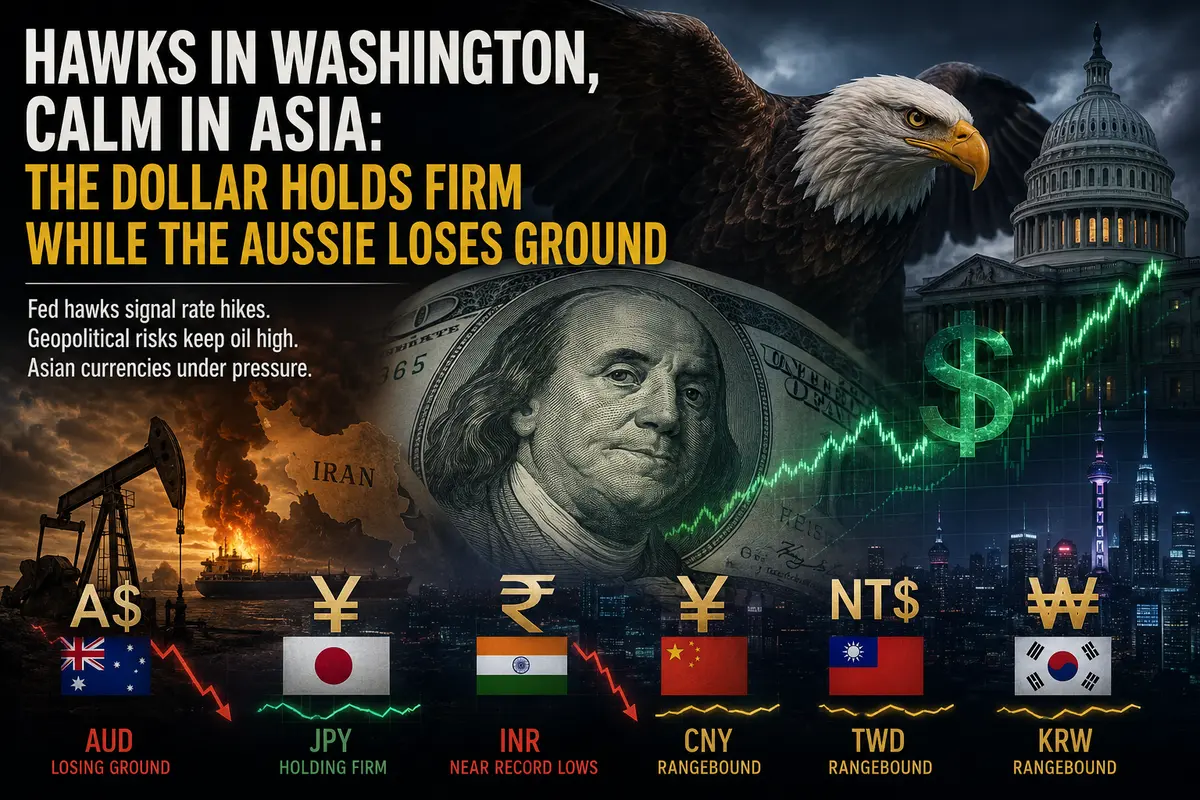
Thursday’s Asian trading session unfolded under the shadow of what the Federal Reserve released the previous evening. The minutes from April’s Fed meeting — anticipated with a level of tension rivaling that of Big Tech earnings reports — did not disappoint those betting on a hawkish turn. The document confirmed what markets had been whispering about for weeks: the hawks inside the Fed are spreading their wings, and the idea of further rate hikes is no longer fringe speculation. The dollar, sensing renewed strength, stabilized near six-week highs, while Asian currencies — with the exception of the yen — retreated into defensive mode. The Australian dollar, meanwhile, suffered a particularly sharp blow from an unexpected source: its own labor market.

Fed Minutes: The Hawks Step Out of the Shadows

Reading Fed minutes is always an exercise in decoding. Dry language conceals dramatic clashes of opinion, cautious hints, and diplomatically softened disagreements. But the April document was surprisingly candid. More and more officials on the Federal Open Market Committee now acknowledge the possibility of raising interest rates. This is not merely a shift in tone — it is a tectonic change in the monetary landscape, one that would have seemed unthinkable just a few months ago.

The reason behind this shift is simple and ominous: inflation. The very inflation the Fed vowed to keep near two percent refuses to cool. On the contrary, it has accelerated sharply over the past two months. The chief culprit is oil. Supply disruptions caused by the war against Iran have driven energy prices to levels that ripple through the cost of everything — from gasoline and airfare to grocery baskets. This is supply-side inflation, the most troublesome kind for central banks because it cannot be fought effectively through traditional demand cooling. Yet judging by the...

Continue reading...
0
0

The Rupee on the Edge of the Abyss: Why India Is Facing a Currency Storm

The Rupee on the Edge of the Abyss: Why India Is Facing a Currency Storm

Seven consecutive record lows. This is no longer a simple decline — it is a free fall with eyes wide open, where every new step downward stops being a shock and becomes routine. The level of 96.8650 rupees per dollar, recorded on Wednesday, is not the bottom but merely another mark carved into the wall of shame. The psychological threshold of 100 rupees per dollar no longer feels like fantasy. It looms on the horizon as an inevitability — one that even the corridors of the Reserve Bank of India seem to have accepted. But the real drama of the rupee is unfolding not on trading charts, but within the deep structural cracks that have spread through the foundation of the Indian economy. Cracks that did not exist even six months ago.

The Oil Curse: Anatomy of Vulnerability

India is the world’s third-largest consumer of oil. The phrase sounds impressive, almost like the status of a superpower. But behind it hides a statistical nightmare: more than 80 percent of the crude oil consumed by the country is imported. Saudi Arabia, Iraq, and the United Arab Emirates effectively hold the Indian energy sector by the throat. And when oil prices surge by more than fifty percent, as they have since late February, India’s economy literally begins to suffocate.

The mechanism of destruction is simple and ruthless. Oil importers — India’s state-owned and private refining companies — must pay for every shipment in U.S. dollars. To obtain those dollars, they sell rupees. When the price of a barrel rises by one and a half times, the demand for dollars rises proportionally. An avalanche of rupees floods the currency market, wiping out every support level. A weaker rupee then makes every subsequent oil purchase even more expensive in local currency terms. The result...

Continue reading...
0
0
NorthRay

Trader’s Journal: My Black Notebook Where I Keep My Mistakes (and Wins)

Trader’s Journal: My Black Notebook Where I Keep My Mistakes (and Wins)

Hi, this is NorthRay.💰

You know what saved me from repeating the same stupid mistakes over and over again?

Not some super strategy.
Not a smart mentor.
Not even a stop-loss (though that helps too).

It was something simple that I ignored at first.

A trader’s journal.

When I first heard about it, I thought:
“Seriously? I have to write too? I came here to trade, not write essays.”

For the first two weeks, I wrote nothing down.
I opened trades randomly. Closed them. Forgot about them.

And you know what happened?

I kept making the same mistakes. Again and again. Like a broken record.

Then I read a quote from an experienced trader:

“If you don’t record your trades, you’re not a trader. You’re a casino gambler who doesn’t even remember what he bet on.”

So I started a journal.

And now I can’t imagine trading without it.🔔

What Is a Trader’s Journal (In Simple Words)

A trader’s journal is a place where you record every trade you make.

Not just: “Bought, sold, made money.”

But in detail:

— What you bought/sold (EUR/USD, gold, Apple).
— Why you entered (saw a signal, breakout, news release).
— Position size.
— Where you placed your stop-loss and take-profit.
— The outcome (profit/loss and how much).
— What you felt (fear, greed, confidence, panic).
— What you did wrong (or right).

It’s like a pilot’s flight log. Pilots record everything so that if something goes wrong, they can understand why.

And avoid repeating the mistake.🛠️

Why It Matters (Honestly, No Fluff)

When someone first recommended a journal to me, I asked:

“What’s the point? I already remember my trades.”

Spoiler: I didn’t.

Three days later, I had already forgotten why I opened certain trades and how I felt at the time.

Here’s...

Continue reading...
0
0

Millions Spent on Bodyguards: How the Crypto Industry Is Defending Itself Against Kidnappings

Millions Spent on Bodyguards: How the Crypto Industry Is Defending Itself Against Kidnappings

Las Vegas, Bitcoin 2026 conference. On the surface, everything looks familiar: booths packed with mining hardware, Bitcoin-logo T-shirts, endless networking parties. But it only takes a closer look at how top crypto executives move through the venue to realize something has changed. They are surrounded by people in tailored suits wearing the unmistakable transparent coiled earpieces. These are not assistants or colleagues. They are professional bodyguards — former military personnel and private security contractors.

Step into one of the overcrowded seminars, and you may hear a topic that would have sounded exotic just a few years ago: how to protect your assets during a physical home invasion. The crypto industry, built on ideals of anonymity and decentralization, has run into the most primitive and terrifying threat imaginable — physical violence.

A Wrench Versus a Private Key

The threat known in security circles as a “wrench attack” — when a victim is beaten until they surrender a password — is no longer a dark joke shared among cybersecurity professionals. It has become the industry’s reality.

A database maintained by custody solutions provider Casa shows that such attacks have tripled since 2023. CertiK’s statistics are even more alarming: in 2025, the number of confirmed physical incidents rose by seventy-five percent. Seventy-two documented cases. Forty-one million dollars in losses. And those are only the incidents that became public. CertiK analysts are blunt in their assessment: 2025 marked a turning point, when physical violence became a primary threat vector for crypto holders.

The criminals’ logic is simple and ruthless. Cryptocurrency was designed to eliminate intermediaries. There is no bank that can freeze a transfer, no regulator that can lock an account. The private key is the only thing separating an owner from their fortune. And that also makes it the perfect target.

Steal the...

Continue reading...
0
0
Lin Brings

Asia’s Red Screen: How a Samsung Strike, the Oil Crisis, and Rate Fears Crushed Markets

Asia’s Red Screen: How a Samsung Strike, the Oil Crisis, and Rate Fears Crushed Markets

Asian markets were painted deep red on Wednesday — and this was no mild correction. It was a full-scale selloff, triggered by a wave from Wall Street and intensified by local disasters. Three consecutive sessions of declines in U.S. indexes, a collapsing tech sector dragging everything else down with it, and South Korea’s KOSPI plunging more than two and a half percent to lead regional losses. This is what happens when several storms converge at one point: geopolitics pushes oil higher, oil fuels inflation, inflation drives interest rates up, and higher rates crush technology stocks. And in the middle of all this sits Samsung’s own drama, adding another canister of fuel to an already raging fire.

KOSPI and Samsung: When a Labor Dispute Becomes a Systemic Risk

South Korea’s KOSPI didn’t just fall — it collapsed, and the main culprit was the company that for decades symbolized national pride. Shares of Samsung Electronics, which erased early gains and plunged more than four percent, dragged the entire index down with them. The breakdown of negotiations with the labor union, reported by Yonhap, became exactly the trigger the market feared but hoped until the last moment to avoid.

The strike scheduled for Thursday, May 21, now looks almost inevitable. Forty-eight thousand workers, eighteen days of potential shutdowns, and no sign that the two sides will reach an agreement in time. For investors, this means an immediate repricing of risk. Samsung is not just another stock in the index — it is the pillar supporting a substantial portion of the Korean market’s capitalization. When that pillar shakes, the whole building trembles. The KOSPI’s drop of more than two and a half percent reflects growing recognition that Samsung’s problems may not be a short-term incident, but the beginning of a prolonged conflict with unpredictable...

Continue reading...
0
0
Navigation menu
instaforex banner