Bar Pipa
We pay for a post of 10$

Platinum

Lin Brings

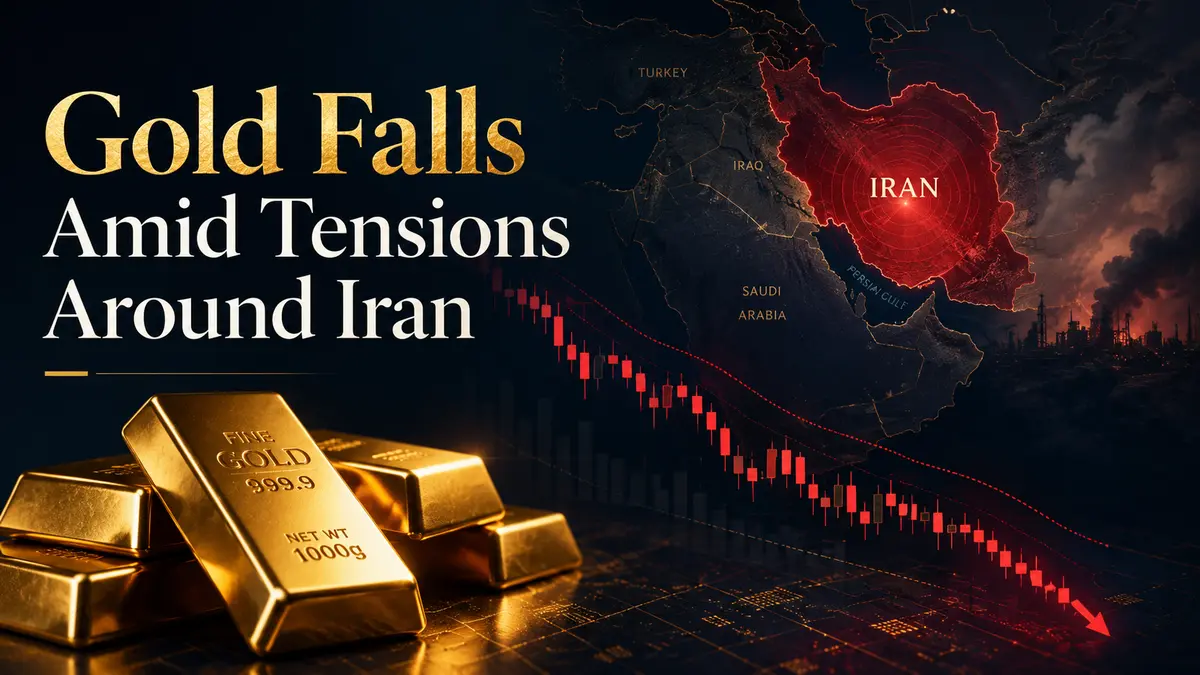
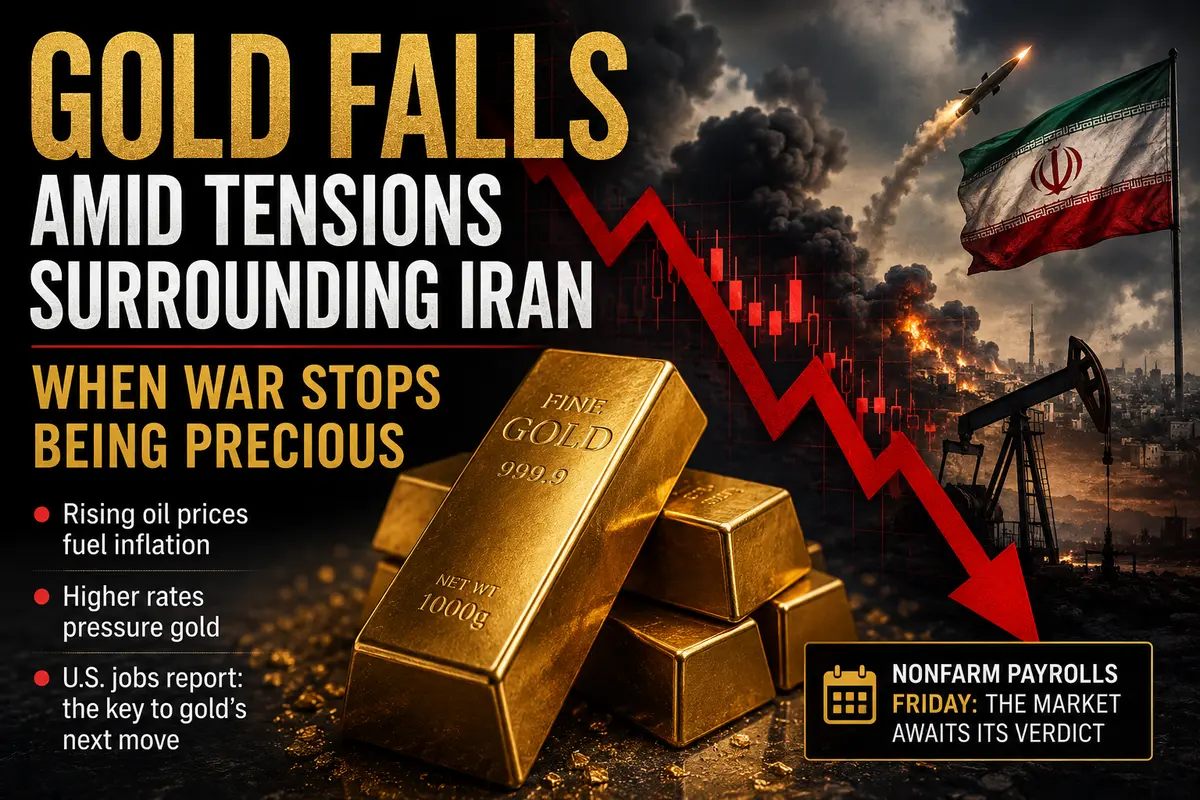
Gold Falls Amid Tensions Surrounding Iran

Gold Falls Amid Tensions Surrounding Iran
When War Stops Being Precious

Friday began on a disappointing note for precious metals markets in Asia. Gold, which has already been struggling this week, moved lower once again. Spot gold fell 0.8% to $4,440.84 per ounce, while futures declined by the same margin to $4,467. And this is happening even as the Middle East remains engulfed in conflict.

At first glance, war, missile strikes, military operations, and stalled negotiations should provide the perfect environment for gold to rally. Investors are traditionally expected to flock to the yellow metal as a safe haven. That is how it has always worked. That is what textbooks teach. That is what market logic suggests. But not today—and not this week.

The paradox has a simple explanation. The conflict between the United States and Iran, which has been ongoing for several months, has ceased to be a source of uncertainty. Instead, it has become a source of inflation. And inflation means higher interest rates. Higher interest rates, in turn, are a major headwind for gold.

Gold is down approximately 2.2% for the week, marking its worst performance since early May. The reason is not the absence of geopolitical risks, but rather their abundance. The market is no longer afraid of war itself. It is afraid of what war does to oil prices and, through oil, to inflation and interest rates.

Let’s examine how a conflict in the Middle East has become a bearish factor for gold—and what may lie ahead for the yellow metal following the release of key U.S. employment data.

Middle East: Hope Is Gone, Long Live Inflation

Developments in the Middle East have been rapid and, for those hoping for peace, discouraging. Hopes for a U.S.–Iran agreement, which still seemed realistic earlier in the week, had all but vanished by Friday.

...

Continue reading...
0
0

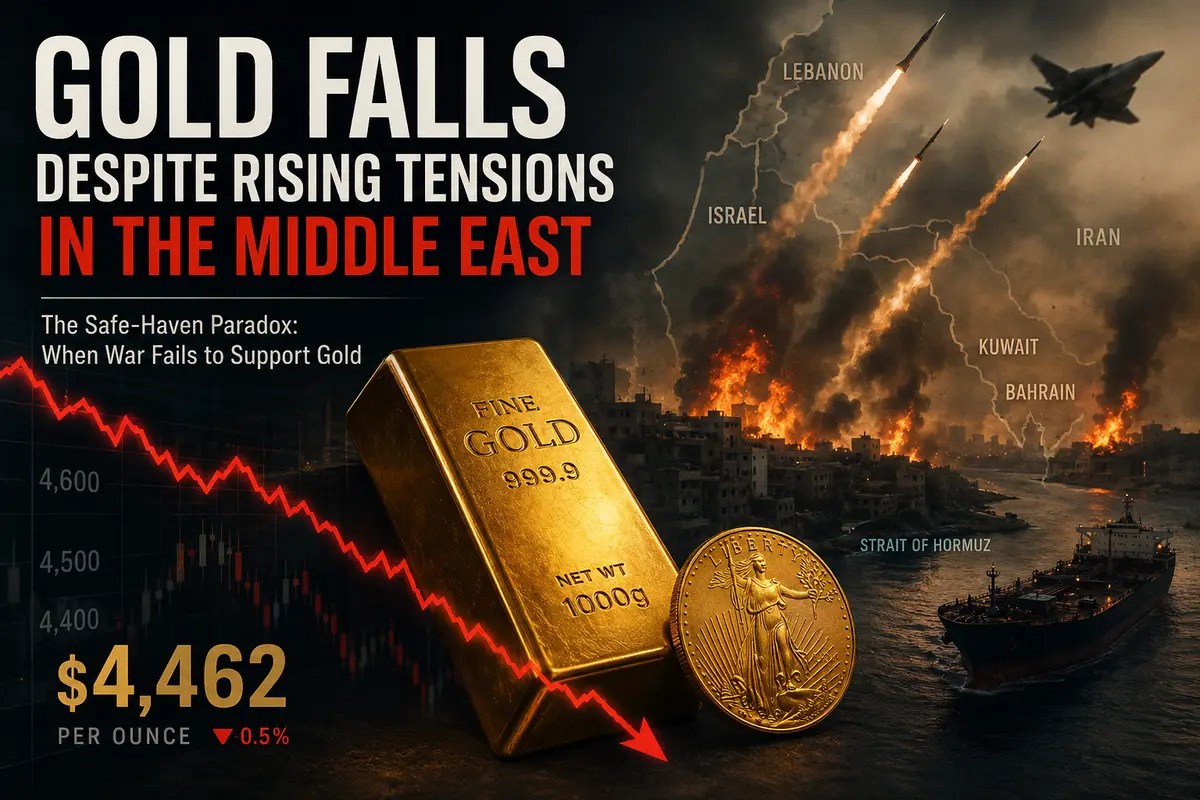
Gold Falls Despite Rising Tensions in the Middle East

Gold Falls Despite Rising Tensions in the Middle East
The Safe-Haven Paradox: When War Fails to Support Gold

In finance, there are a few principles that rarely get questioned. One of them is simple: geopolitical tensions push gold prices higher. Wars, conflicts, and threats typically drive investors away from fragile paper currencies and toward the timeless, yellow, dependable metal. Gold is a safe haven. And safe havens are supposed to rise in value when bullets start flying.

Wednesday's Asian trading session politely—but firmly—challenged that assumption.

Because the Middle East was on fire. Not figuratively, but literally. Missiles were flying. Troops were moving. Negotiations were starting and stalling in equal measure. Yet against this backdrop, gold actually fell. Only slightly—about half a percent—but it fell nonetheless. Spot gold slipped to around $4,462 per ounce, while futures mirrored the move.

Was this a market mistake? A temporary lapse of judgment among traders? Or has the old safe-haven rule stopped working in today's increasingly chaotic world?

Neither.

The reality is that the world has become more complicated. A single conflict can now push gold both higher and lower at the same time. Every coin has two sides—and in the Middle East, it often has ten.

What's Happening in the Middle East?

To understand gold's behavior, we first need to understand the situation in a region that gave humanity writing but has yet to discover lasting peace.

On Wednesday, the picture was far from calm.

Israel, which in recent months has operated under the principle that "the best defense is a strong offense," continued military operations in southern Lebanon. This is an area where Hezbollah traditionally maintains significant influence—a place Israeli forces often describe as a hornet's nest, where every move provokes a response. These were not isolated retaliatory strikes but a systematic campaign aimed at degrading hostile infrastructure.

Meanwhile, Iran—widely regarded as...

Continue reading...
0
0

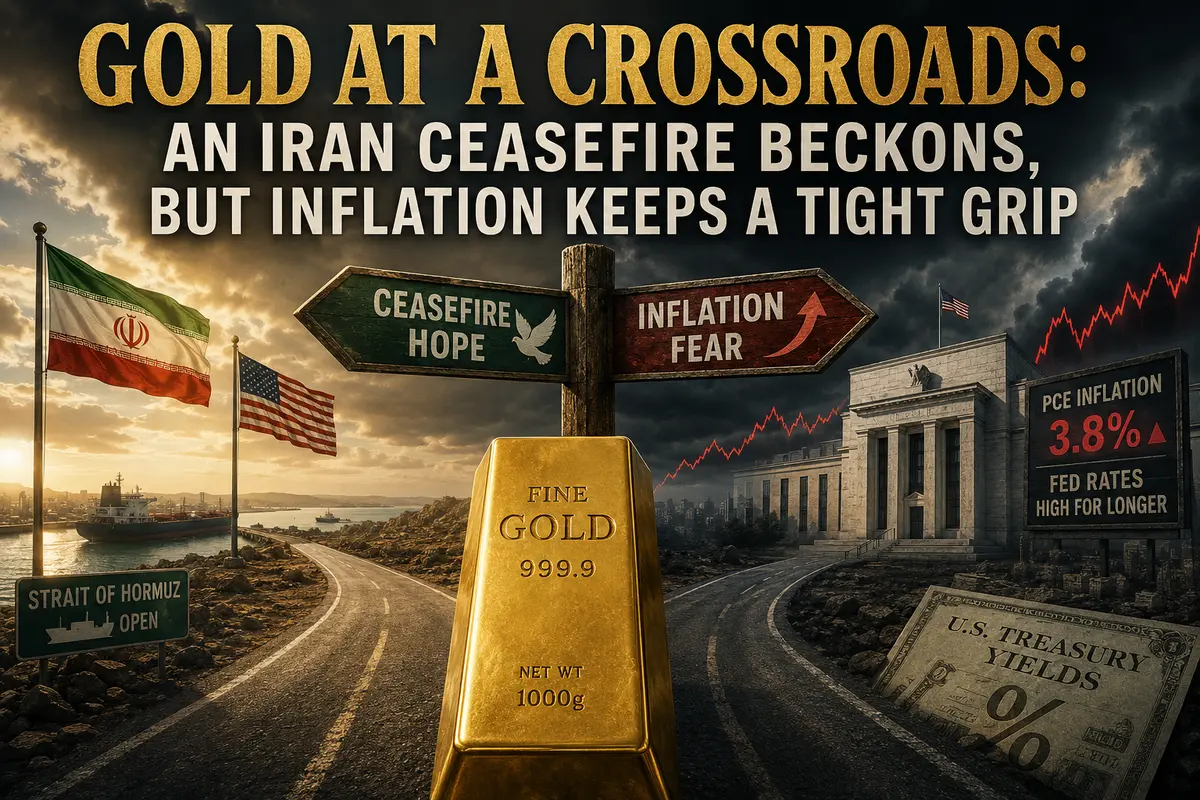
Gold at a Crossroads: An Iran Ceasefire Beckons, but Inflation Keeps a Tight Grip

Gold at a Crossroads: An Iran Ceasefire Beckons, but Inflation Keeps a Tight Grip

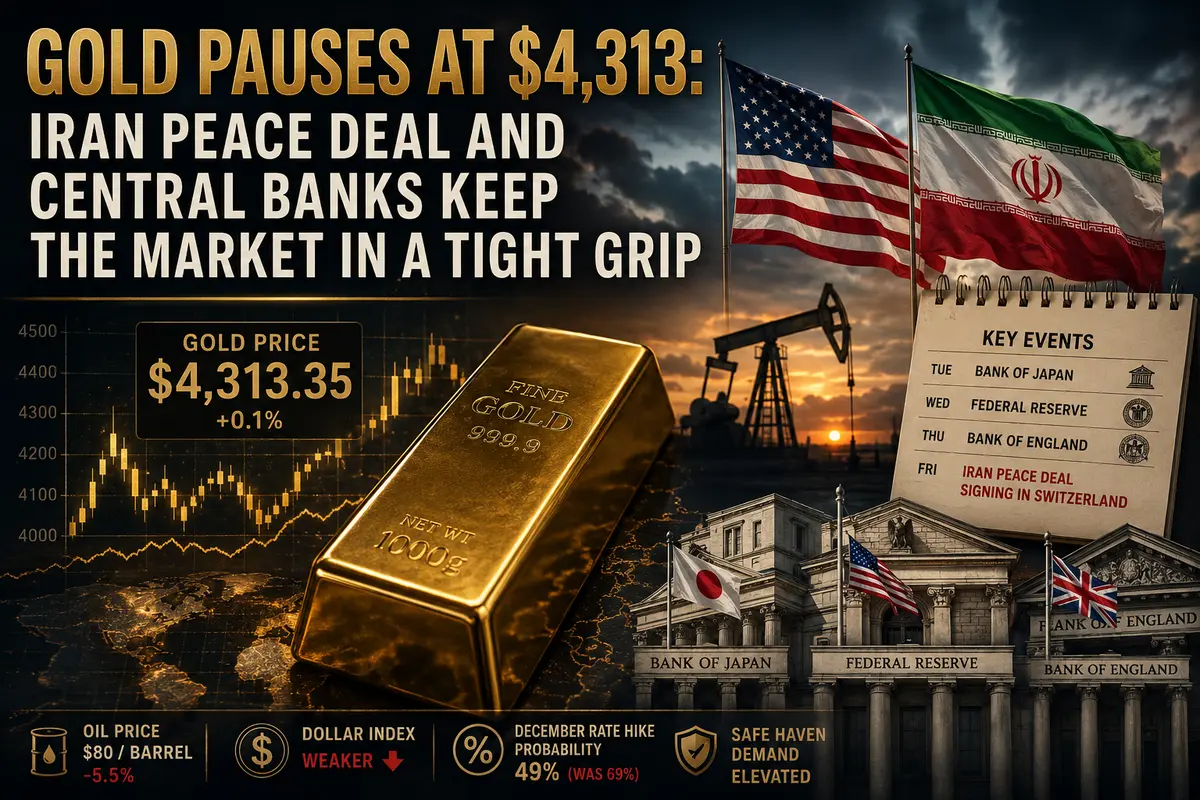
Friday’s gold market was defined by painful uncertainty. Spot gold held steady at $4,495.90 per ounce, virtually unchanged, while futures edged slightly lower to $4,526. Beneath this calm surface lies a market being pulled in opposite directions. On one side is hope for peace, which pushed prices higher on Thursday. On the other is persistent inflation, preventing gold from gaining real momentum. Caught between these forces, the yellow metal remains stuck, unable to choose a clear direction.

Ceasefire on the Table: What Changed Overnight

The main development driving markets on Thursday and continuing to influence sentiment on Friday is reports that the United States and Iran are close to extending a ceasefire agreement. According to sources, the preliminary arrangement includes a 60-day truce and, critically, the reopening of the Strait of Hormuz to maritime traffic.

This is precisely the breakthrough markets have been waiting for over the past several months. Since the conflict began, the closure of the Strait of Hormuz has been a major source of oil market disruption, inflationary pressure, and monetary policy concerns. Now, with renewed hopes that the waterway could reopen, markets reacted immediately.

Gold initially fell to a two-month low on Thursday as investors feared that de-escalation would reduce demand for safe-haven assets. However, as the implications of the news became clearer, the metal reversed course and finished the day up 0.8%. This turnaround is key to understanding how the market currently operates.

Investors realized that a ceasefire would mean not only a reduction in geopolitical risk premiums but also lower oil prices. Lower oil prices would ease inflationary pressures. Lower inflation would reduce the need for the Federal Reserve to raise interest rates. And a pause in rate hikes is exactly what gold needs.

However, the agreement is not yet final....

Continue reading...
0
0

Gold Under Siege: How New Bombings in Iran Have Cornered the Metal

Gold Under Siege: How New Bombings in Iran Have Cornered the Metal

Thursday’s Asian trading session brought another wave of pain for gold. Spot prices slipped 0.4% to $4,438 per ounce, while futures followed, falling to $4,467. Silver plunged nearly 1%, and platinum lost 0.7%. Precious metals are under pressure once again, and the culprit is an old familiar force — war. Not the war itself, but its economic consequences, which the market has learned to price in with ruthless precision. New U.S. strikes on Iran — the second this week — once again triggered the chain reaction: “oil rises → inflation rises → interest rates rise → gold falls.” And as long as that chain remains intact, gold will stay trapped.

Ten Days in a Box: Gold Cannot Break the Walls

Since mid-May, spot gold has been stuck in a range between $4,400 and $4,600 per ounce. Ten days. For an asset capable of moving hundreds of dollars in a single session, that is an eternity. Gold keeps crashing into invisible walls like a fly against glass, unable to break either higher or lower.

The reason for this paralysis is both simple and painful. The market is being torn between two opposing forces. On one side, geopolitical uncertainty — war, strikes on Iran, the blocked Strait of Hormuz — should push gold higher as a safe-haven asset. On the other side, the inflationary consequences of that same war — expensive oil, rising prices, and the threat of higher rates — should push gold lower, because high interest rates make holding a non-yielding metal unattractive.

On Thursday, the second force prevailed. New U.S. strikes on Iranian targets pushed oil prices roughly 2% higher. Oil climbed again, and inflation expectations climbed with it. Rising inflation expectations strengthen the belief that the Federal Reserve will not cut rates — and may even raise them...

Continue reading...
0
0

Gold Under Fire: How New Bombings in Iran Crushed the Precious Metals Rally

Gold Under Fire: How New Bombings in Iran Crushed the Precious Metals Rally

Tuesday’s Asian trading session delivered a brutal reality check to gold traders. Just yesterday, spot gold prices were confidently climbing higher amid hopes for peace with Iran, while futures painted bullish charts suggesting the rally would continue. Today, everything reversed.

Spot gold plunged 0.8% to $4,535 per ounce. Futures followed, falling by the same margin. Silver collapsed by more than 2%, while platinum lost 0.6%. Precious metals, which had celebrated a return to life on Monday, came under attack on Tuesday — both literally and figuratively. And the reason for this reversal was the very bombs the United States dropped on southern Iran.

The Paradox of War and Gold: Why Bombs Are Sinking Prices

At first glance, this seems backward. Gold is the classic safe-haven asset. When guns fire, investors usually run into gold. This rule has worked for decades and entire investment strategies are built around it.

But the current conflict with Iran has rewritten those rules. To understand why, we need to look at how this war affects gold — not directly, but through a complex chain of macroeconomic consequences.

The conflict with Iran triggered an energy crisis. The closure of the Strait of Hormuz sent oil prices soaring. Rising energy prices fueled inflation worldwide. And accelerating inflation forced the Federal Reserve and other central banks to start talking about higher interest rates.

This is where the mechanism becomes deadly for gold.

Gold generates no yield. When rates rise — or even when there is merely a threat of higher rates — holding gold becomes an expensive luxury. Investors look at a gold bar sitting idle in a vault, then compare it with Treasury bonds offering guaranteed dollar returns, and make the rational choice in favor of bonds.

That is why gold fell during the hottest phases of...

Continue reading...
0
0

Golden Reversal: Why Hopes for Peace with Iran Sent Gold Prices Soaring

Golden Reversal: Why Hopes for Peace with Iran Sent Gold Prices Soaring

Monday’s Asian trading session delivered a surprise that many gold traders did not expect. Spot gold jumped by one and a half percent, reaching $4,577 per ounce. Futures followed, gaining 1.2% and climbing above $4,600. Silver posted an even more explosive move — up 3.8% in a single session. Platinum added 2%. The entire precious metals sector seemed to awaken from hibernation and surge higher. And the reason behind this rally was not fear or panic, but something entirely opposite — hopes for peace.

At first glance, this seems paradoxical. Gold is traditionally viewed as a safe-haven asset, a refuge during wars and crises. When the world descends into chaos, the yellow metal usually rises, and when peace appears on the horizon, it tends to fall. But today we are witnessing the opposite. The explanation lies in how the conflict with Iran has affected gold over recent months — not directly, but through a complex chain of macroeconomic consequences.

How War Suppressed Gold — and Why Peace Is Setting It Free

The war with Iran triggered an energy crisis. The disruption of shipping through the Strait of Hormuz pushed oil prices above $110 per barrel. Rising energy costs accelerated inflation worldwide. Higher inflation, in turn, forced the Federal Reserve and other major central banks to discuss raising interest rates. And it was this final link in the chain — the threat of higher rates — that became gold’s biggest enemy.

Gold does not generate income. It pays no dividends, no coupons, no interest. When interest rates rise, the opportunity cost of holding gold becomes enormous. Why hold bullion sitting in a vault when you can buy Treasury bonds and earn a guaranteed return? That logic has pressured gold for months. The war was raging, geopolitical risks were extreme, yet gold...

Continue reading...
0
0

Gold at a Crossroads: Peace With Iran Beckons, but War Still Lingers

Gold at a Crossroads: Peace With Iran Beckons, but War Still Lingers

Gold is climbing again. During Thursday’s Asian trading session, prices turned green, extending a rally that seemed to begin against all logic. Spot gold rose to $4,560 per ounce, while futures reached $4,562. A gain of four-tenths of a percent for the session marked a confident recovery after recent losses. But the real mystery behind this move lies not in the numbers — it’s in what caused it. Gold, which for weeks had been suffocating under the pressure of rising rates and a strong dollar, suddenly found support where few expected it: in hopes for peace with Iran. And that paradox reflects the complex, multilayered logic of a market that no longer reacts to headlines in a straightforward way.

Peace as a Catalyst: An Unexpected Twist

At first glance, everything should have played out differently. Gold is the classic safe-haven asset. It rises when the world descends into chaos — when guns fire and diplomats throw up their hands. A war with Iran, a blocked Strait of Hormuz, oil prices soaring into the stratosphere — all of that should have sent gold flying higher. Instead, the yellow metal hovered near recent lows, unable to break resistance. And now, just as Trump speaks of the conflict entering its “final stage” and negotiations progressing successfully, gold suddenly comes alive. How can that be explained?

The answer lies in the transmission mechanism — the invisible conduit linking geopolitics to monetary policy. The conflict with Iran created an inflationary shock. Disruptions to oil supplies drove energy prices sharply higher, which in turn fueled inflation worldwide. Central banks, especially the Federal Reserve, responded with more hawkish rhetoric and threats of higher rates. High interest rates are gold’s deadliest enemy because they increase the opportunity cost of holding a non-yielding asset. That mechanism has been choking...

Continue reading...
0
0

Gold in a Trap: Caught Between the Iranian Crisis and Suffocating Interest Rates

Gold in a Trap: Caught Between the Iranian Crisis and Suffocating Interest Rates

Gold has frozen. It’s a strange, almost unnatural state for an asset that for centuries symbolized movement — either a panicked flight to safety or a violent collapse driven by profit-taking. But Wednesday’s Asian session showed a market that seemed paralyzed. Spot gold hovered around $4,488 per ounce, futures near $4,490 — neither rising nor falling, but holding its breath. Gold, which by all logic should be soaring amid a war disrupting oil supplies and fueling geopolitical chaos, instead lingers near its lowest levels since early April. And within this paradox lies perhaps the most important story of today’s financial world — the story of how timeless truths stop working when monetary policy and inflation fears enter a deadly collision.

Why War Hasn’t Sent Gold Prices Soaring

To understand the drama surrounding the yellow metal, one must rewind the tape and remember how gold behaved during previous geopolitical crises. Escalation in the Middle East, the closure of the Strait of Hormuz, warships facing each other at close range — any one of these headlines would once have triggered a massive gold rally. Investors would have rushed into bars and coins, driving prices toward historic highs. But now, when President Trump and Vice President Vance report progress in peace negotiations and gold barely reacts, it becomes clear: the market no longer dances to the tune of geopolitics the way it once did.

The reason is that the current conflict with Iran is not just a war — it is a war that generates inflation. And inflation, once an old friend of gold, has returned wearing a more dangerous face. Traditionally, rising prices benefited gold because people bought it to protect themselves against the erosion of paper currencies. But today’s inflation is not the result of loose monetary policy. It is a...

Continue reading...
0
0
Lin Brings

Trump’s Words as a Market Catalyst

Trump’s Words as a Market Catalyst

Tuesday began with a cautious but confident rise in the precious metals market. Spot gold gained one tenth of a percent and settled around $4,570 per ounce, while futures climbed three tenths of a percent to $4,574. At first glance, the move looked modest. But behind these numbers stood an event that changed the mood of the entire financial world the previous evening: Donald Trump announced a postponement of the planned strike on Iran and confirmed that negotiations were ongoing.

Markets, which for weeks had been pricing in the possibility of a major war in the Middle East, interpreted these remarks as the first real signal of de-escalation in a long time. The reaction was multifaceted: oil moved lower, bonds stopped falling, the dollar weakened, and gold — contrary to the usual logic linking its rise to heightened geopolitical fears — also moved higher. To understand this apparent paradox, it is necessary to look at the mechanics currently driving the precious metals market.

Oil Down, Gold Up: Breaking the Pattern

Normally, gold and oil move in the same direction when geopolitics is the main driver. War sends oil higher and gold higher. Peace pushes both lower. But Tuesday morning broke this familiar pattern. Oil prices fell sharply after Trump’s comments, while gold rose.

The explanation lies in the fact that gold is currently far more sensitive to the bond market than to geopolitical risk itself. Recent weeks have shown that the metal’s main enemy was not hope for peace, but rising yields. When investors sold bonds on fears that a war with Iran would fuel inflation and force central banks to tighten policy further, yields surged and gold declined. Now that dynamic is beginning to reverse.

Trump’s announcement that the strike was postponed and that serious negotiations were underway sparked...

Continue reading...
0
0

A Month and a Half Down: Gold Falls Back to March Levels

A Month and a Half Down: Gold Falls Back to March Levels

Monday began with a heavy blow for the precious metals market. During Asian trading, spot gold plunged 1.3%, falling to $4,483.67 per ounce. This marks the lowest level since late March — a month and a half of gains and optimism erased in a single trading session. Futures performed even worse, dropping 1.7% and settling near $4,484. For those accustomed to viewing gold as an unshakable fortress during turbulent times, what is happening now feels almost like betrayal: the world is burning, yet the safe-haven asset is failing to provide safety.

But the gold market has never been a simple mechanism reacting solely to geopolitics. It has its own rules, its own internal logic — and right now, that logic is working against the metal with the same force that political crises usually work in its favor. To understand what is happening, one must step away from war headlines and look at the bond market — because that is where the main drama is unfolding, casting its shadow over precious metals prices.

Yields Not Seen in Decades

The main killer of gold on Monday was the global rise in bond yields. Not in one country or one region, but almost everywhere simultaneously, as if an invisible conductor had waved a baton and forced the world’s bond markets to move in unison.

In the United States, yields on 10-year Treasury bonds climbed to a monthly high. This is the benchmark that guides nearly every other debt market in the world, and when it rises, the consequences ripple through the entire financial system. But an even more striking signal came from Japan. Yields on Japanese 10-year government bonds reached their highest level in 29 years on Monday. Nearly three decades — longer than the careers of many traders currently sitting at their...

Continue reading...
0
0
Navigation menu