
Bar Pipa
We pay for a post of 10$

Wallets

Millions Spent on Bodyguards: How the Crypto Industry Is Defending Itself Against Kidnappings

Millions Spent on Bodyguards: How the Crypto Industry Is Defending Itself Against Kidnappings

Las Vegas, Bitcoin 2026 conference. On the surface, everything looks familiar: booths packed with mining hardware, Bitcoin-logo T-shirts, endless networking parties. But it only takes a closer look at how top crypto executives move through the venue to realize something has changed. They are surrounded by people in tailored suits wearing the unmistakable transparent coiled earpieces. These are not assistants or colleagues. They are professional bodyguards — former military personnel and private security contractors.

Step into one of the overcrowded seminars, and you may hear a topic that would have sounded exotic just a few years ago: how to protect your assets during a physical home invasion. The crypto industry, built on ideals of anonymity and decentralization, has run into the most primitive and terrifying threat imaginable — physical violence.

A Wrench Versus a Private Key

The threat known in security circles as a “wrench attack” — when a victim is beaten until they surrender a password — is no longer a dark joke shared among cybersecurity professionals. It has become the industry’s reality.

A database maintained by custody solutions provider Casa shows that such attacks have tripled since 2023. CertiK’s statistics are even more alarming: in 2025, the number of confirmed physical incidents rose by seventy-five percent. Seventy-two documented cases. Forty-one million dollars in losses. And those are only the incidents that became public. CertiK analysts are blunt in their assessment: 2025 marked a turning point, when physical violence became a primary threat vector for crypto holders.

The criminals’ logic is simple and ruthless. Cryptocurrency was designed to eliminate intermediaries. There is no bank that can freeze a transfer, no regulator that can lock an account. The private key is the only thing separating an owner from their fortune. And that also makes it the perfect target.

Steal the...
Continue reading...
0
0

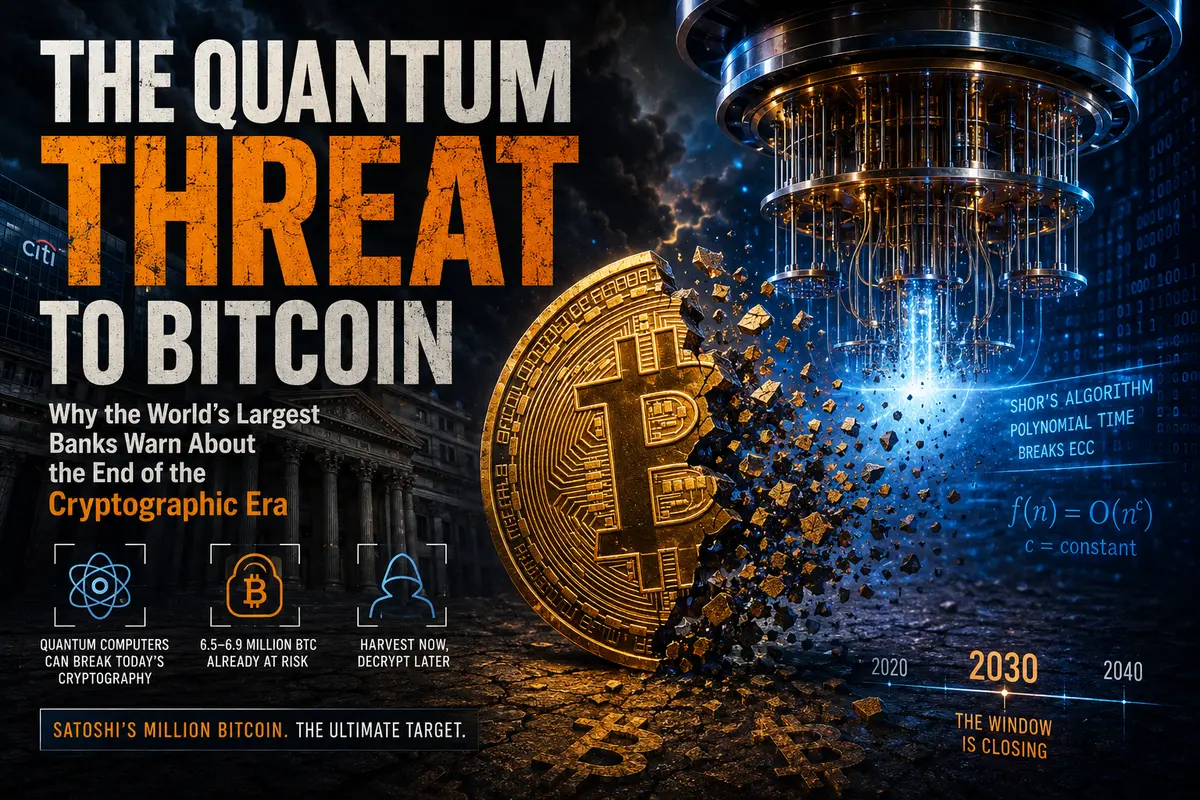
The Quantum Threat to Bitcoin: Why the World’s Largest Banks Are Warning About the End of the Cryptographic Era

The Quantum Threat to Bitcoin: Why the World’s Largest Banks Are Warning About the End of the Cryptographic Era

When financial giants like Citigroup publish alarming analytical reports, they rarely do so with sensational headlines or emotional rhetoric. Their language is usually dry, calculated, and clinically precise. That is exactly why such reports carry so much weight. Behind the carefully chosen wording lies not speculation, but a cold assessment of systemic risk.

And when an institution managing trillions of dollars begins warning about “shrinking time horizons” and a “growing threat” to the very foundation of cryptocurrencies, it is no longer science fiction. It is a signal that a fundamental problem has moved from theory into strategic reality.

This is not about another Bitcoin price correction, a temporary bear market, or the collapse of a crypto exchange. The issue runs much deeper: can the cryptographic foundation of digital assets survive the coming age of quantum computing?

Cryptography Is the Real Foundation of Bitcoin

Most people think about Bitcoin in terms of price movements, mining, ETFs, or halving cycles. But the true backbone of the network lies much deeper — in mathematics.

Bitcoin’s security is built on public-key cryptography, specifically the Elliptic Curve Digital Signature Algorithm, or ECDSA. This system allows users to prove ownership of funds without exposing their private keys.

In simplified terms, a Bitcoin address is like a lock that anyone can see and send money to. The private key is the unique key capable of opening that lock and moving the funds.

The entire architecture depends on one critical assumption: deriving a private key from a public key must be computationally impossible within any practical timeframe. Even with the combined power of modern supercomputers, the task remains effectively unattainable.

For years, this mathematical barrier was considered absolute.

Why Quantum Computers Change the Rules Entirely

The danger of quantum computing is not merely that quantum machines are “faster.”...

Continue reading...
0
0
Navigation menu