
Millions Spent on Bodyguards: How the Crypto Industry Is Becoming a Fortress Under Siege

Las Vegas, May 2026. At first glance, the Bitcoin 2026 conference looks little different from any other tech expo: the same brightly lit booths, the same panel discussions, the same constant hum of networking in the hallways. But it only takes a closer look at how the speakers move around to realize that something unusual is happening here. Top executives are surrounded by men with military posture, dressed in tailored suits and wearing discreet earpieces. These are not assistants. They are professional bodyguards — former special forces operatives hired to protect against a threat that would have seemed unimaginable just a few years ago.
The crypto industry, born from idealistic dreams of freedom from intermediaries, has found itself cornered by brutal physical reality. And that reality is armed with a crowbar.
The Wrench as a Hacking Tool
In the professional jargon of security specialists, it’s called a “wrench attack.” The scheme is brutally simple: criminals identify the owner of a large crypto wallet, break into their home, beat them or threaten their family until they transfer the funds. No sophisticated code. No exploits. No phishing. Just brute force and human fear. And statistics show the method works with alarming efficiency.
The database maintained by Casa, a company specializing in custody solutions, records a threefold increase in such attacks since 2023. CertiK, one of the leading blockchain security auditing firms, reports even more disturbing numbers: in 2025, confirmed physical incidents rose by seventy-five percent. Seventy-two documented cases. Forty-one million dollars in direct losses. And those are only the incidents that made it into official reports. Many victims stay silent, fearing repeat attacks or unwilling to reveal the scale of their losses.
The wording used by CertiK sounds almost like a verdict: “2025 became the turning point. Physical violence is now the primary threat vector.” Not smart-contract hacks. Not attacks on blockchain bridges. Not exploits in DeFi protocols. Physical violence. It marks a tectonic shift in the threat landscape — and the industry was completely unprepared for it.
Transparency as a Curse
The paradox of cryptocurrency is that its greatest technical strength has turned against its users. The blockchain is transparent. Every transaction, every balance, every transfer is permanently recorded in a public ledger visible to anyone. Criminals no longer need to guess whether a target has money. They simply analyze the blockchain, identify addresses with large balances, and begin hunting. It’s like leaving your bank statement on public display with your home address attached to the top.
Data leaks from crypto exchanges add the final — and most dangerous — element to this equation. When hackers breach a trading platform and dump passport scans, home addresses, and phone numbers online, they create a ready-made directory for organized crime groups. Matching stolen personal information with public blockchain addresses is trivial for any technically skilled attacker. Suddenly, criminals know not only that you own cryptocurrency, but exactly how much, where you live, and even your daily routines.
The situation has become especially alarming in France, where a wave of attacks targeting crypto entrepreneurs’ families has swept through the country in recent months. Details of these crimes rarely become public, but rumors circulating within the industry paint a picture of highly organized operations involving surveillance, intelligence gathering on family members, and meticulous planning of attack windows. The criminals act methodically, striking when victims are most vulnerable. These are not spontaneous robberies. This is targeted hunting.
Corporate Armor: Millions Spent on Personal Security
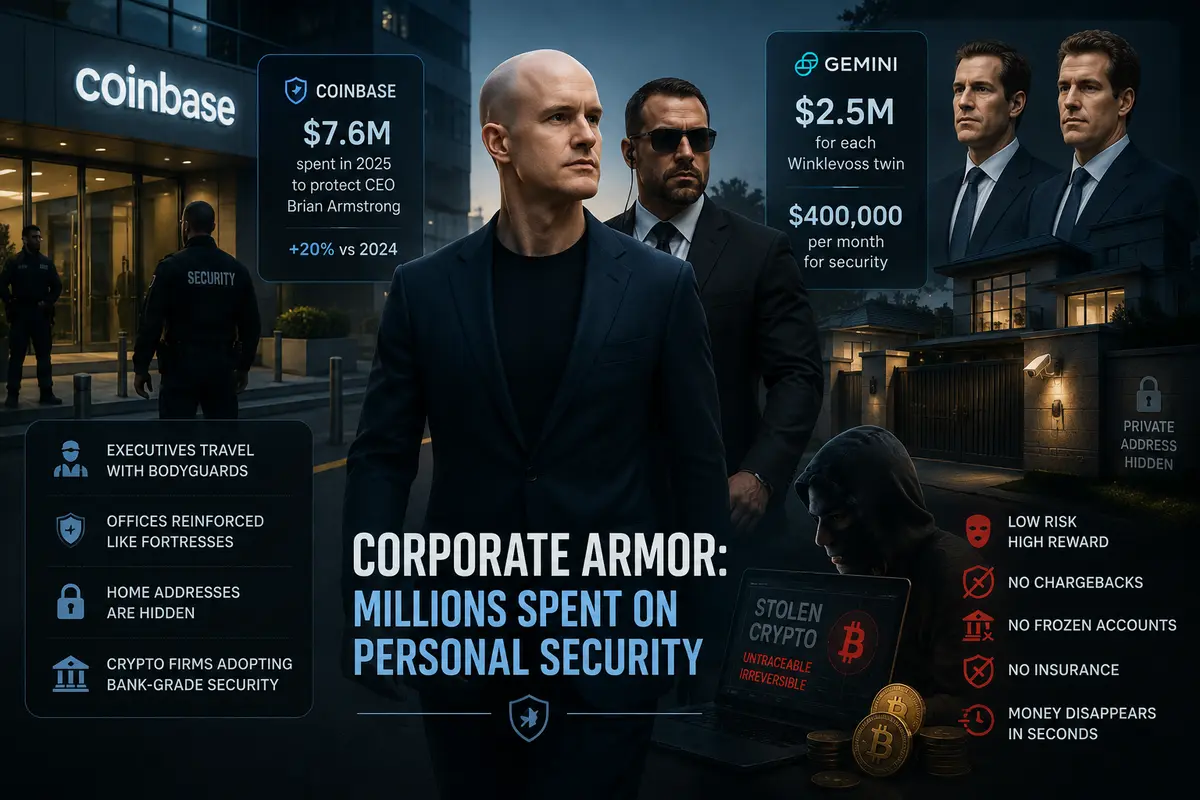
The crypto industry’s response to this new reality has been predictable — and extraordinarily expensive. Major exchanges have dramatically increased spending on physical protection for their executives. In 2025, Coinbase spent $7.6 million solely on protecting CEO Brian Armstrong — twenty percent more than the year before. Gemini, founded by the Winklevoss twins, allocated $2.5 million for each brother. Their current security contract reportedly costs $400,000 per month. This is not vanity spending by celebrity founders indulging in luxury. It is cold, calculated risk management.
Phil Ariss of TRM Labs, a company specializing in tracking crypto-related crime, notes that crypto firms are now adopting practices refined over decades in the traditional banking sector. Executives travel with bodyguards. Offices are reinforced and turned into miniature fortresses. Home addresses are hidden. For an industry built on libertarian ideals of decentralization and freedom from banks, the irony is difficult to ignore. The crypto world, which dreamed of dismantling traditional financial institutions, is now forced to imitate their methods of protection against physical threats.
Adam Healy, CEO of security firm Station70, explains the criminals’ logic with unsettling clarity: “From an attacker’s perspective, this is low risk and high return on investment.” Unlike bank robberies — where criminals face armed guards, surveillance systems, silent alarms, and entire law enforcement infrastructures — robbing a crypto holder means targeting a private individual who often has little training or protection. Most importantly, stolen cryptocurrency is almost impossible to recover. Transactions are irreversible. There are no chargebacks, no frozen accounts, no insurance reimbursements. The money disappears into the void within seconds.
Decoy Wallets and Seven-Day Delays: The Art of Survival
While corporations spend millions on bodyguards, wealthy individual holders are developing their own survival strategies. Security experts recommend creating so-called decoy wallets — addresses containing relatively small but believable amounts that owners are prepared to surrender under duress. A robber who gains access to such a wallet may believe they have taken everything and leave the victim alone. The real assets remain hidden on separate addresses unknown to the attacker.
Another, more sophisticated method involves time locks — delays programmed into smart contracts. Even with access to a private key, an attacker cannot immediately move the funds. The transaction enters a queue and executes only after a predefined waiting period. One founder of a major crypto protocol, speaking anonymously, revealed his own security system to journalists: all assets are divided among four physical storage locations, each requiring in-person access. Any withdrawal triggers a seven-day waiting period. During those seven days, the victim has time to alert authorities, cancel the operation, or simply disappear physically from danger. It reintroduces time into an equation otherwise defined by the instantaneous nature of blockchain transactions.
Such precautions may sound paranoid, but statistics from CertiK and Casa show that paranoia has become a professional necessity. Crypto holders have discovered that their digital gold requires physical protection comparable to safeguarding an actual gold reserve.
Drift: When Offline Becomes Online
The most sophisticated example of the convergence between physical and cyber threats was demonstrated in the April attack on the Drift exchange. Hackers allegedly linked to North Korean groups stole $285 million. But what makes the operation remarkable is the method of infiltration. The attackers spent six months building trust with exchange employees. They met them at offline conferences, maintained friendly relationships, and cultivated the image of serious, reliable business partners. To lower suspicion even further, they deposited one million dollars onto the platform — a gesture intended to demonstrate both legitimacy and financial credibility. Only after completely dismantling the victims’ defenses did they strike, infecting employee devices with malware and opening pathways to private keys and internal systems.
This state-level operation demonstrates that the boundary between physical and cybersecurity has effectively disappeared. It is no longer enough to protect servers. It is no longer enough to write flawless code. A criminal can shake your hand at a conference and steal your keys through a trojan delivered in what appears to be an innocent email from an “old acquaintance.”
A Single Point of Failure
The central idea behind cryptocurrency — eliminating intermediaries and giving users complete control over their assets — has produced an unintended and brutal consequence. The private key holder became the single point of failure for the entire system. In traditional finance, stealing money from an account requires bypassing multiple layers of protection: compliance procedures, withdrawal limits, physical branch security, transaction monitoring systems, and ultimately deposit insurance. In the crypto world, all those layers are replaced by one private key. Steal the key, and you steal everything. Instantly. Irreversibly.
Adam Healy summarizes this new reality with devastating brevity: “Criminals go where the money is. And crypto holders combine significant wealth with unique vulnerability.” It is a perfect storm created by the convergence of three factors: enormous fortunes, the public nature of blockchain data, and the physical vulnerability of the victims.
The industry that promised to free people from the constraints of traditional financial institutions has discovered that freedom comes at a price. And that price is measured not only in market volatility, but also in millions of dollars spent on bodyguards, reinforced doors, and panic buttons hidden beneath office desks. Crypto-anarchy has collided with raw physical reality — and so far, reality is winning. The wrench has proven more effective than the most sophisticated encryption algorithm.
Comments
No comments yet. Be the first to share your thoughts!
Comments only for logged-in users.