

Trader’s Journal: My Black Notebook Where I Keep My Mistakes (and Wins)

Hi, this is NorthRay.💰
You know what saved me from repeating the same stupid mistakes over and over again?
Not some super strategy.
Not a smart mentor.
Not even a stop-loss (though that helps too).
It was something simple that I ignored at first.
A trader’s journal.
When I first heard about it, I thought:
“Seriously? I have to write too? I came here to trade, not write essays.”
For the first two weeks, I wrote nothing down.
I opened trades randomly. Closed them. Forgot about them.
And you know what happened?
I kept making the same mistakes. Again and again. Like a broken record.
Then I read a quote from an experienced trader:
“If you don’t record your trades, you’re not a trader. You’re a casino gambler who doesn’t even remember what he bet on.”
So I started a journal.
And now I can’t imagine trading without it.🔔
What Is a Trader’s Journal (In Simple Words)
A trader’s journal is a place where you record every trade you make.
Not just: “Bought, sold, made money.”
But in detail:
— What you bought/sold (EUR/USD, gold, Apple).
— Why you entered (saw a signal, breakout, news release).
— Position size.
— Where you placed your stop-loss and take-profit.
— The outcome (profit/loss and how much).
— What you felt (fear, greed, confidence, panic).
— What you did wrong (or right).
It’s like a pilot’s flight log. Pilots record everything so that if something goes wrong, they can understand why.
And avoid repeating the mistake.🛠️
Why It Matters (Honestly, No Fluff)
When someone first recommended a journal to me, I asked:
“What’s the point? I already remember my trades.”
Spoiler: I didn’t.
Three days later, I had already forgotten why I opened certain trades and how I felt at the time.
Here’s what a journal actually gives you:🛡️
1. You Stop Repeating the Same Mistakes
After a week, you look back and realize:
“Ah, I’ve already lost money three times because I opened trades before major news releases. I should stop doing that.”
Without a journal, you only feel that “something is wrong,” but you don’t understand what exactly.
2. You See Your Weak Spots
My journal showed me:
— I lose money more often on Mondays (because I don’t sleep enough after the weekend).
— I close profitable trades too early (afraid of losing profits).
— I open bad trades when I’m angry.
Without notes, I would never have noticed this.
3. You Start Learning From Mistakes Instead of Repeating Them
A mistake without analysis is just a mistake.
A mistake that’s written down and reviewed becomes a lesson.
Every evening, I reread my notes and ask myself:
“What did I do wrong today? What did I do well?”
This works better than most trading courses.
4. You See Your Progress
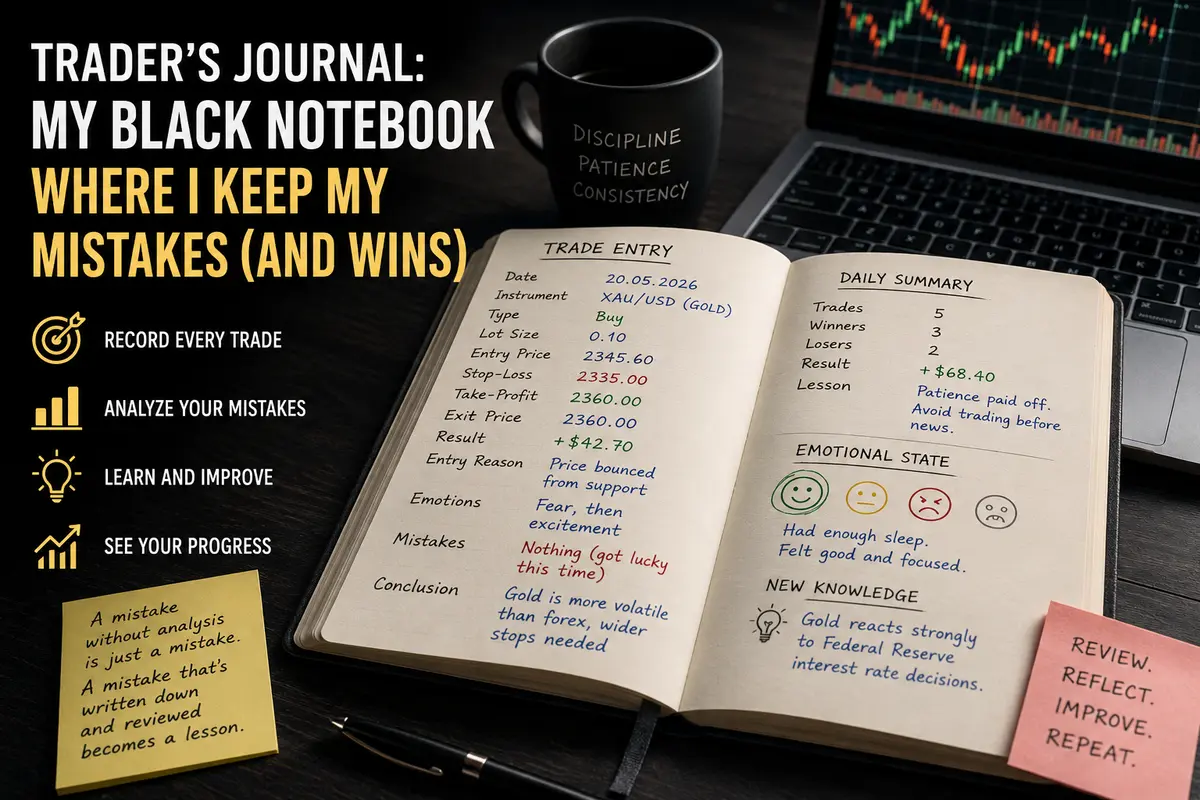
When I opened my first journal entries, they looked like this:
“Opened a trade because it felt right. Closed at a loss. Why? Don’t know.”
Now my journal looks like this:
“Opened a Sell on gold because price reached a resistance level. Stop-loss placed $10 higher. Take-profit set $20 lower. Trade closed with +$42.70 profit. Decision was correct. No mistakes made.”
Feel the difference?
I can actually see myself improving. That’s incredibly motivating.
How I Keep My Journal (and What Might Help You)
I don’t use any magical app. Nothing complicated.
What I use:
A simple spreadsheet.
At first I used Google Docs, then switched to Excel (or Google Sheets).
You can even use a regular notebook and a pen.
But digital journals are easier for searching and analysis.😎
What Else I Record (Besides Trades)
A journal isn’t just about individual trades.
I also include:
1. Daily Summary
— How many trades I opened.
— How many were winners and losers.
— Total daily result.
— What new thing I learned today.
2. Weekly Summary
— I review all trades from the week.
— I see which days were successful and which weren’t.
— I understand when I trade better (morning or evening).
3. New Knowledge
— If I learn something useful, I write it down.
— Example: “Gold reacts strongly to Federal Reserve interest rate decisions.”
4. Emotional State Before Trading
Sounds weird, but it works.
I write things like:
“Had enough sleep.”
“Nervous.”
“Angry after an argument.”
And later I can clearly see that I lose more often when I’m in a bad mood.
My Biggest Discoveries Thanks to the Journal
When I started journaling, I learned some unexpected things about myself as a trader.🧠
Discovery #1: I Lose Money When I Rush
70% of my losing trades were opened within the first 5 minutes after sitting down at the computer.
Now I have a rule:
For the first 15 minutes, I only watch the charts. I don’t open anything.
Discovery #2: I’m Afraid of Profit (Yes, Really)
When a trade goes into profit, I want to close it as fast as possible.
I’m afraid the market will reverse and take the money back.
My journal showed that if I had simply held trades according to my plan, my profits would’ve been 2–3 times bigger.
Discovery #3: I Trade Better in the Morning
My trades between 10 AM and 12 PM are more profitable than evening trades.
In the evening I’m tired, nervous, and make more mistakes.
I never noticed this before.
How to Start a Journal (For Lazy and Busy People)
I get it — it sounds like extra work.
But honestly:
— One trade entry takes me 2–3 minutes.
— Daily summaries take 5 minutes.
— Weekly reviews take 15 minutes.
That’s not much compared to the hours I spend trading.
If starting from scratch feels overwhelming, here’s an easy beginning:
Open Google Sheets or grab a notebook.
Create 5 columns:
Date | Instrument | Lot Size | Result ($) | Why I Entered
Track your trades for just one week.
After a week, you’ll have 20–30 trades.
Look through them.
You’ll see your mistakes. I promise.✍️
What You DON’T Need to Write (Important)
A journal is not a novel. No need for poetry.
Don’t write:
— Long philosophical thoughts about the market (unless it’s related to a specific trade).
— Random filler just for the sake of writing.
— Emotions unrelated to trading decisions (“it’s raining today, feeling sad”).
Only write what helps you trade better.🥳
My Journal Format (Real Example)
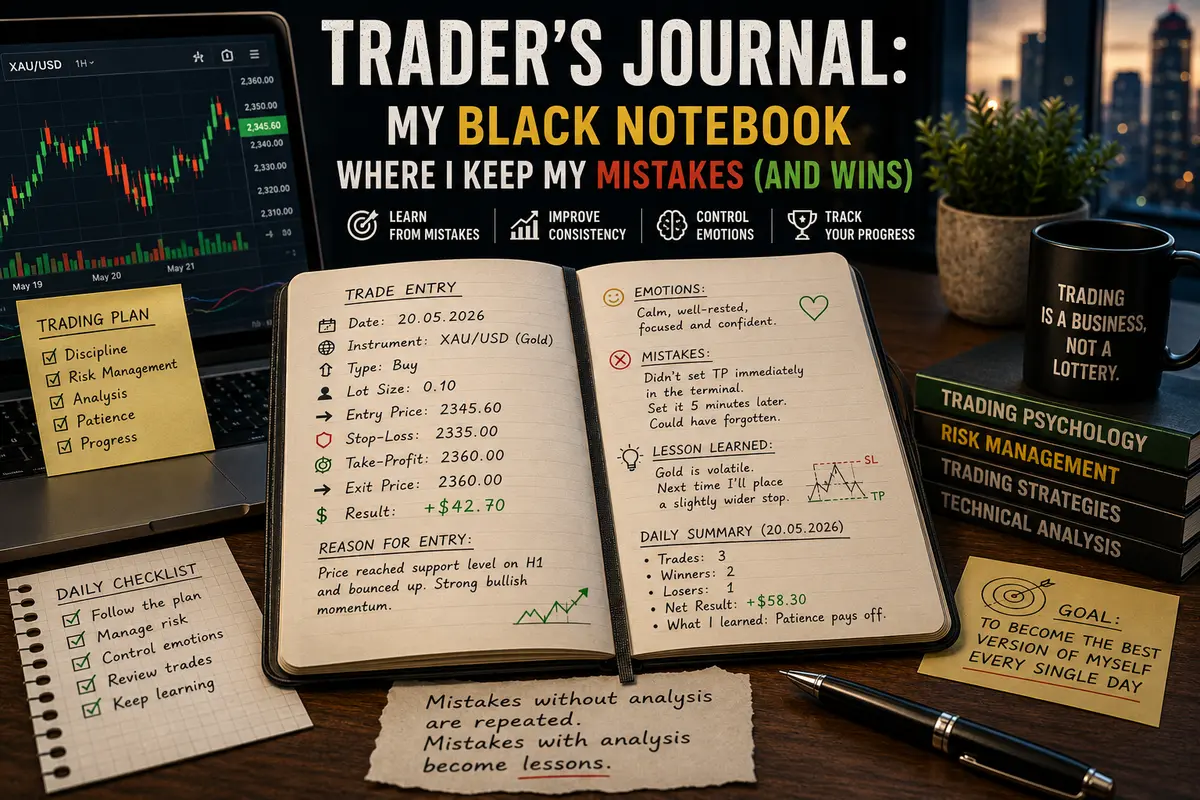
Here’s what one of my gold trade entries looked like:
20.05.2026 | XAU/USD | Buy | 0.10 lot
Entry: 2345.60
SL: 2335.00
(-$10 in price, roughly -$100 with this lot size — actually wait, recalculated… gotta be careful with gold)
TP: 2360.00
Why I entered:
Price reached support on the H1 chart and bounced upward. Strong bullish impulse appeared.
Emotions:
Calm. Slept well. Focused.
Mistakes:
Didn’t place TP immediately in the terminal. Added it 5 minutes later. Could’ve forgotten.
Result:
+$42.70
Conclusion:
Gold is great, but volatile. Next time I’ll place a slightly wider stop.
That’s it. Clear. Straight to the point. Three minutes.💪
What I Realized Today
First:
Without a journal, I’m not a trader. I’m a casino gambler — because I don’t remember what I did, why I did it, or what I was thinking.
Second:
Mistakes that aren’t recorded get repeated.
Mistakes that are written down and analyzed become lessons.
Third:
A journal helps you see progress.
On bad days, I open my old entries and realize:
“I’ve grown. I’m not that helpless beginner anymore.”👀
What’s Next
— I’ll keep journaling. Every day. Every trade.
— Soon I’ll review my first weekly results and see what I’m doing well and what needs improvement.
— I’ll share the results here on the blog.
If you still don’t keep a journal — start today.
You don’t need complicated apps.
Just open a spreadsheet or grab a notebook.
Write down your latest trade.
You’ll be surprised how much you learn about yourself.
— NorthRay
(with an open spreadsheet, a pen just in case, and a habit of recording every trade — even the losing ones)🤫

Comments
No comments yet. Be the first to share your thoughts!
Authentication Required
You must be logged in to post a comment.