

The Rupee on the Edge of the Abyss: Why India Is Facing a Currency Storm
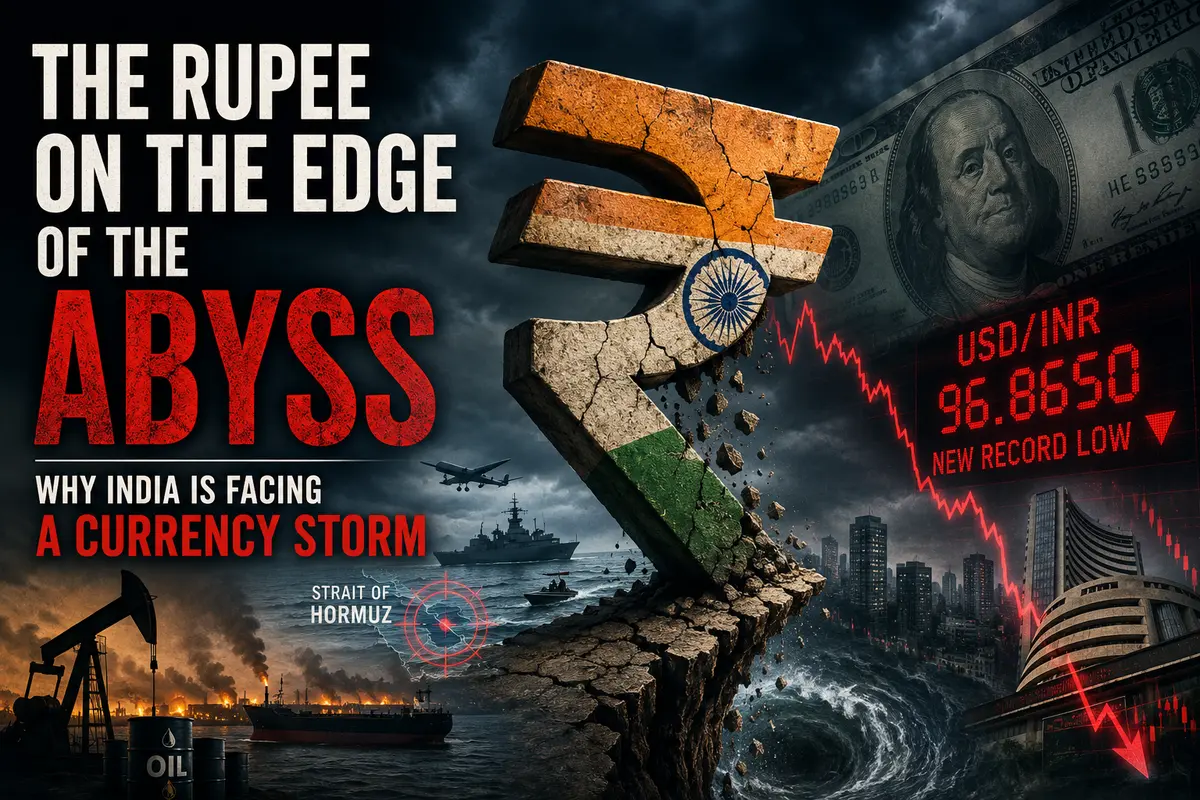
Seven consecutive record lows. This is no longer a simple decline — it is a free fall with eyes wide open, where every new step downward stops being a shock and becomes routine. The level of 96.8650 rupees per dollar, recorded on Wednesday, is not the bottom but merely another mark carved into the wall of shame. The psychological threshold of 100 rupees per dollar no longer feels like fantasy. It looms on the horizon as an inevitability — one that even the corridors of the Reserve Bank of India seem to have accepted. But the real drama of the rupee is unfolding not on trading charts, but within the deep structural cracks that have spread through the foundation of the Indian economy. Cracks that did not exist even six months ago.
The Oil Curse: Anatomy of Vulnerability
India is the world’s third-largest consumer of oil. The phrase sounds impressive, almost like the status of a superpower. But behind it hides a statistical nightmare: more than 80 percent of the crude oil consumed by the country is imported. Saudi Arabia, Iraq, and the United Arab Emirates effectively hold the Indian energy sector by the throat. And when oil prices surge by more than fifty percent, as they have since late February, India’s economy literally begins to suffocate.
The mechanism of destruction is simple and ruthless. Oil importers — India’s state-owned and private refining companies — must pay for every shipment in U.S. dollars. To obtain those dollars, they sell rupees. When the price of a barrel rises by one and a half times, the demand for dollars rises proportionally. An avalanche of rupees floods the currency market, wiping out every support level. A weaker rupee then makes every subsequent oil purchase even more expensive in local currency terms. The result is the vicious cycle economists call an inflationary spiral and traders call a suicide trap. Imports become more expensive, inflation accelerates, household incomes shrink, and the rupee falls further. Breaking this cycle without stabilizing oil prices is nearly impossible.
The Ghost of Hormuz: A War That Never Begins and Never Ends
The confrontation between the United States and Iran in the Strait of Hormuz is the geopolitical spark that ignited the oil fuse. The strait, through which a massive share of Middle Eastern oil flows — including shipments bound for Indian ports — has become a zone of permanent military risk. American destroyers and Iranian speedboats play cat-and-mouse games in waters only a few dozen kilometers wide at their narrowest point. Every incident, every hint of escalation, instantly translates into higher insurance premiums for shipping — and those premiums feed directly into the cost of every barrel.
Statements from Washington about “some progress” in negotiations sound like a worn-out record. The market no longer reacts to them. Traders burned by past diplomatic failures now treat every promise with suspicion. The recent pullback in oil prices is not a trend reversal but merely a short-lived pause. Prices have retained almost all of their gains. And as long as Iranian drones and American missile defense systems remain within direct sight of each other, any accidental spark could send oil prices soaring once again. The Indian rupee, trapped between the hammer of oil prices and the anvil of geopolitics, continues paying a wartime premium without having the slightest ability to influence events.
Capital Flight: Voting With Their Feet
The oil shock alone would have been a serious challenge. But it coincided with something far worse — a mass exodus of foreign capital. Between 22 and 25 billion dollars have flowed out of Indian equities and bonds since late February. Behind that figure are closed positions from global hedge funds, sovereign investors, and pension managers. This is not merely selling — it is an evacuation.
The reason lies in a global reassessment of risk triggered by events unfolding far beyond India’s borders. Global bond markets are experiencing a major selloff. Yields on U.S. Treasury securities — the benchmark risk-free asset for the entire financial world — surged in May to multi-year highs. When the world’s safest instrument suddenly offers far higher returns than before, global investors rapidly lose their appetite for risk.
Why hold rupee-denominated assets suffering from currency depreciation, inflation, and geopolitical instability when attractive dollar yields are available with virtually zero default risk? The calculation is rational and merciless. Foreign investors withdraw their dollars and leave behind a drained stock market and additional pressure on the rupee.

The Reserve Bank’s Dilemma: Between a Rock and a Hard Place
The Reserve Bank of India now resembles a firefighter running out of water. Defending the currency through interventions and spending foreign exchange reserves works only up to a point. Reserves are finite, while pressure from oil imports and capital outflows appears endless. Burning through reserves merely to help foreign investors exit at comfortable exchange rates is a strategy that risks an even larger catastrophe once reserves are depleted.
Raising interest rates could slow capital flight and support the rupee by making rupee-denominated assets more attractive. But it would also crush an economy already suffering from inflation, make borrowing prohibitively expensive for businesses and households, and further weaken already fragile GDP growth. Every available option is deeply painful.
For now, India’s central bank appears to be pursuing a strategy of controlled retreat. The rupee is allowed to weaken while officials attempt to smooth the sharpest moves to avoid panic. Yet with every new record low, that strategy becomes less convincing. Traders see that interventions are unable to reverse the trend and intensify their pressure. Speculative attacks on the rupee multiply, and rumors about the imminent arrival of 100 rupees per dollar are gradually turning into a self-fulfilling prophecy.
Six Percent Weaker — and Asia’s Outsider
The rupee’s roughly six percent decline since the start of the conflict places it among Asia’s weakest currencies. It is an embarrassing position for a country that recently aspired to become the next engine of global growth. The Singapore dollar, South Korean won, and Taiwanese dollar have all held up far better.
The issue is not necessarily poor economic management. It is structural vulnerability — a problem ignored for decades: enormous dependence on energy imports, a chronic current account deficit, and the inability to expand exports enough to offset import costs.
When global markets enter turmoil, Asian currencies usually split into two groups: those protected by trade surpluses or massive reserves, and those without such cushions. India, despite its achievements in technology and space exploration, belongs to the second group. It imports energy and exports services. But services cannot compensate for the oil bill when crude prices explode. And the rupee is paying the price for that imbalance.
What Comes Next
The Indian currency faces difficult times ahead. If the Strait of Hormuz remains a zone of tension, if oil continues trading above $100 per barrel, and if the Federal Reserve signals further rate hikes, the 97 level will likely fall just as routinely as 95 and 96 did before it. Beyond that lies the psychological barrier of 100 rupees per dollar — a level whose arrival could trigger a fresh wave of panic among businesses and households alike.
India’s economy is balancing on the edge of a currency abyss. And for now, nobody can say whether there is a bottom beneath it.

Comments
No comments yet. Be the first to share your thoughts!
Authentication Required
You must be logged in to post a comment.