

Asia’s Red Screen: How a Samsung Strike, the Oil Crisis, and Rate Fears Crushed Markets
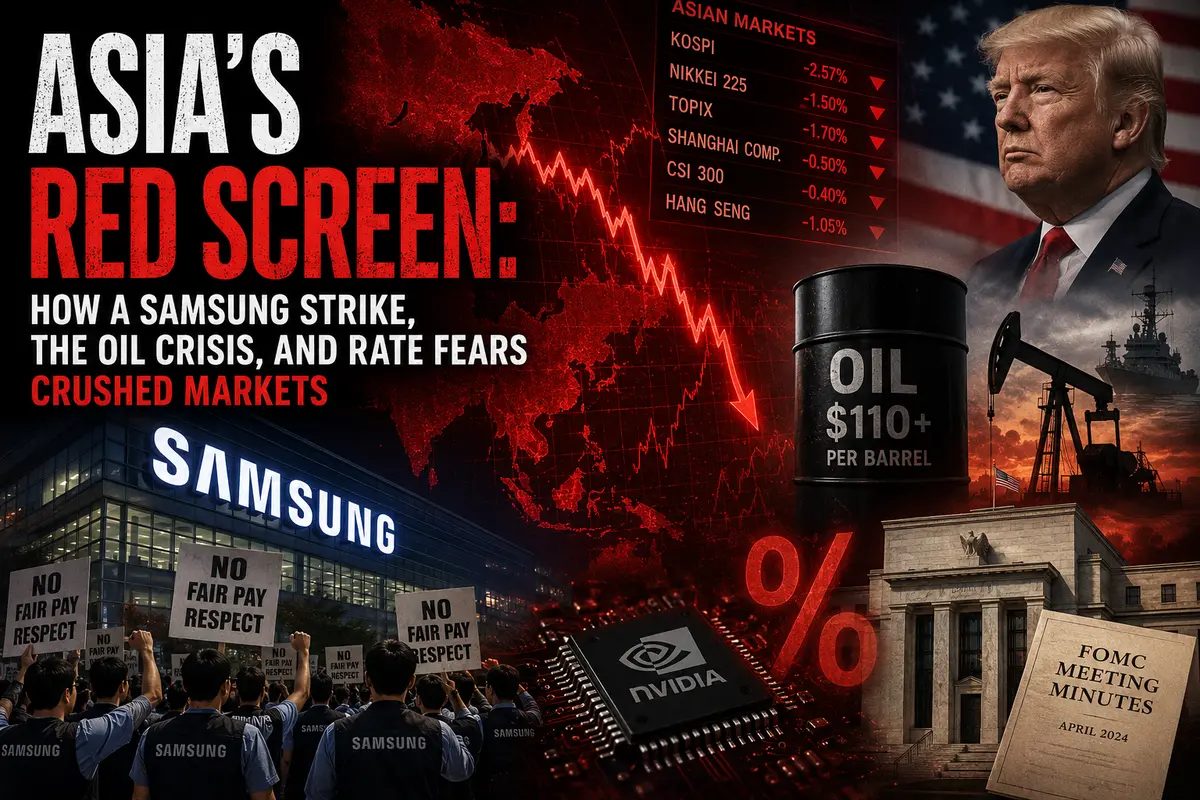
Asian markets were painted deep red on Wednesday — and this was no mild correction. It was a full-scale selloff, triggered by a wave from Wall Street and intensified by local disasters. Three consecutive sessions of declines in U.S. indexes, a collapsing tech sector dragging everything else down with it, and South Korea’s KOSPI plunging more than two and a half percent to lead regional losses. This is what happens when several storms converge at one point: geopolitics pushes oil higher, oil fuels inflation, inflation drives interest rates up, and higher rates crush technology stocks. And in the middle of all this sits Samsung’s own drama, adding another canister of fuel to an already raging fire.
KOSPI and Samsung: When a Labor Dispute Becomes a Systemic Risk
South Korea’s KOSPI didn’t just fall — it collapsed, and the main culprit was the company that for decades symbolized national pride. Shares of Samsung Electronics, which erased early gains and plunged more than four percent, dragged the entire index down with them. The breakdown of negotiations with the labor union, reported by Yonhap, became exactly the trigger the market feared but hoped until the last moment to avoid.
The strike scheduled for Thursday, May 21, now looks almost inevitable. Forty-eight thousand workers, eighteen days of potential shutdowns, and no sign that the two sides will reach an agreement in time. For investors, this means an immediate repricing of risk. Samsung is not just another stock in the index — it is the pillar supporting a substantial portion of the Korean market’s capitalization. When that pillar shakes, the whole building trembles. The KOSPI’s drop of more than two and a half percent reflects growing recognition that Samsung’s problems may not be a short-term incident, but the beginning of a prolonged conflict with unpredictable consequences for supply chains, export revenues, and the Korean economy as a whole.
Korean traders, long accustomed to treating Samsung as synonymous with stability, are now forced to price in scenarios unseen since the Asian financial crisis. A shutdown of memory chip production lines at a moment when global demand is being fueled by the artificial intelligence boom is not merely lost profit — it is the risk of losing market share that competitors would immediately seize. Investors are voting with their feet, and their exit from Samsung shares is pulling the entire index lower, creating a domino effect extending far beyond Seoul.
The Technology Sector Under Crossfire
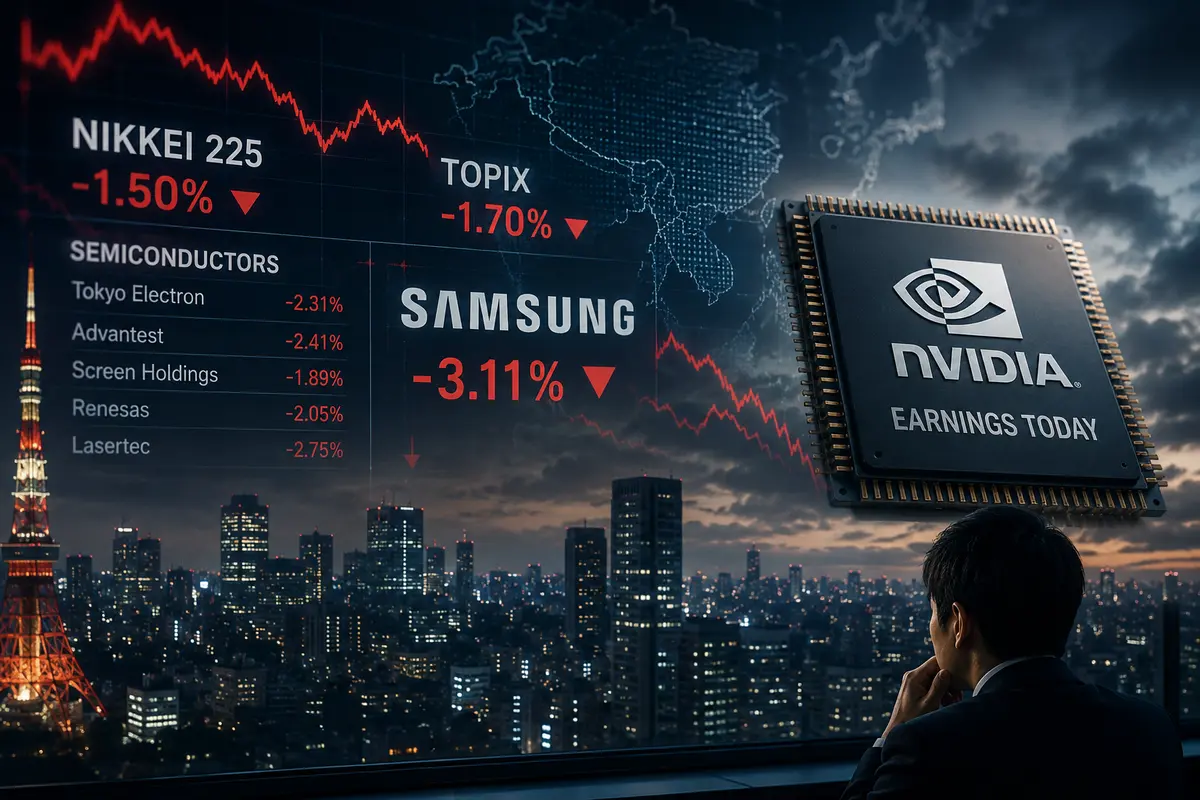
But it would be unfair to blame everything solely on Samsung. Asia’s technology sector was falling in unison, following overnight losses on Wall Street where semiconductor companies led the selloff. Japan’s Nikkei 225 fell one and a half percent, while the TOPIX lost 1.7 percent. Not a crash, but a heavy, confident decline signaling that investors are reassessing their bets on technology-driven growth.
The reasons behind this reassessment are complex. First, the rise in global bond yields over recent weeks has hit growth stocks and the tech sector particularly hard. As Treasury yields climb, the future profits of technology companies are discounted at higher rates, reducing their present value. It is simple mathematics, and right now it is working against the entire sector. Companies that had been the engines of this year’s rally amid AI euphoria suddenly find themselves under pressure precisely because they rose too far, too fast, and now must prove their valuations are justified.
Second, all eyes are fixed on Nvidia. The chip giant’s quarterly earnings report, due later on Wednesday, has become a defining moment for the entire sector. Nvidia is the barometer of AI demand, and its numbers will determine whether the rally continues or collapses under its own weight. But that very anticipation is creating intense nervousness. Some investors fear expectations have become unrealistically high. Nvidia’s stock has soared to extraordinary levels, setting the bar so high that even a strong report may fail to satisfy investors — let alone any hint of slowing growth. That fear is pushing traders to lock in profits ahead of the announcement rather than wait for the verdict. And this wave of profit-taking is spreading across Asian technology stocks, from Tokyo to Taipei.
Oil, Trump, and Geopolitics: A Combustible Mix
While technology stocks burned, oil prices continued hovering at dangerously elevated levels above $110 per barrel. A slight decline following Donald Trump’s statement that Washington had postponed a planned military strike on Iran failed to significantly cool the market. Traders understand too well that this is not the removal of the threat — merely a delay.
Trump, in his characteristic style, first offered hope for de-escalation and then immediately warned that the United States could still attack if diplomacy failed. It is a classic “carrot and stick” strategy that keeps markets under constant tension. Oil traders cannot relax because headlines can shift from peaceful to military at any moment. As long as uncertainty persists, the geopolitical risk premium remains embedded in every barrel.
That uncertainty feeds directly into inflation expectations, which in turn pressure global equity markets. High energy prices accelerate inflation worldwide, forcing central banks to maintain a hawkish tone. Anticipation surrounding the release of the Federal Reserve’s April meeting minutes later on Wednesday only intensifies those concerns. Investors will comb through the minutes searching for any indication of how seriously the Fed is considering additional rate hikes.
China: Frozen Rates and Unfrozen Problems
China, which usually acts as a stabilizing anchor for Asian markets, failed to play that role this time. The People’s Bank of China’s decision to leave benchmark lending rates unchanged for the twelfth consecutive month was widely expected, but it only highlighted the difficult position Beijing now faces.
On one hand, domestic demand remains weak, the property market continues sliding into a prolonged crisis, and the need for economic stimulus is obvious. On the other hand, rising global energy prices are creating inflationary pressure that limits the room for monetary easing. The central bank is trapped between a rock and a hard place, and its decision to stand still is effectively an admission that there are no good options available right now. The Shanghai Composite fell half a percent, the CSI 300 dropped four-tenths of a percent, and Hong Kong’s Hang Seng declined more than one percent. These numbers may not look dramatic compared to the KOSPI’s plunge, but they reflect the same underlying anxiety spreading across the entire region.
The global economy has entered a phase where geopolitical risks are no longer an abstract background noise but concrete figures in corporate earnings reports. A strike at a Samsung factory in South Korea, military threats in the Strait of Hormuz, Federal Reserve minutes in Washington, and Nvidia earnings in Silicon Valley — all these events, scattered across different continents, converged at a single point on Asian market charts. And the red color dominating those charts on Wednesday became the color of collective disillusionment with the belief that the rally could continue forever.

Comments
No comments yet. Be the first to share your thoughts!
Authentication Required
You must be logged in to post a comment.