Bar Pipa
We pay for a post of 10$

Google

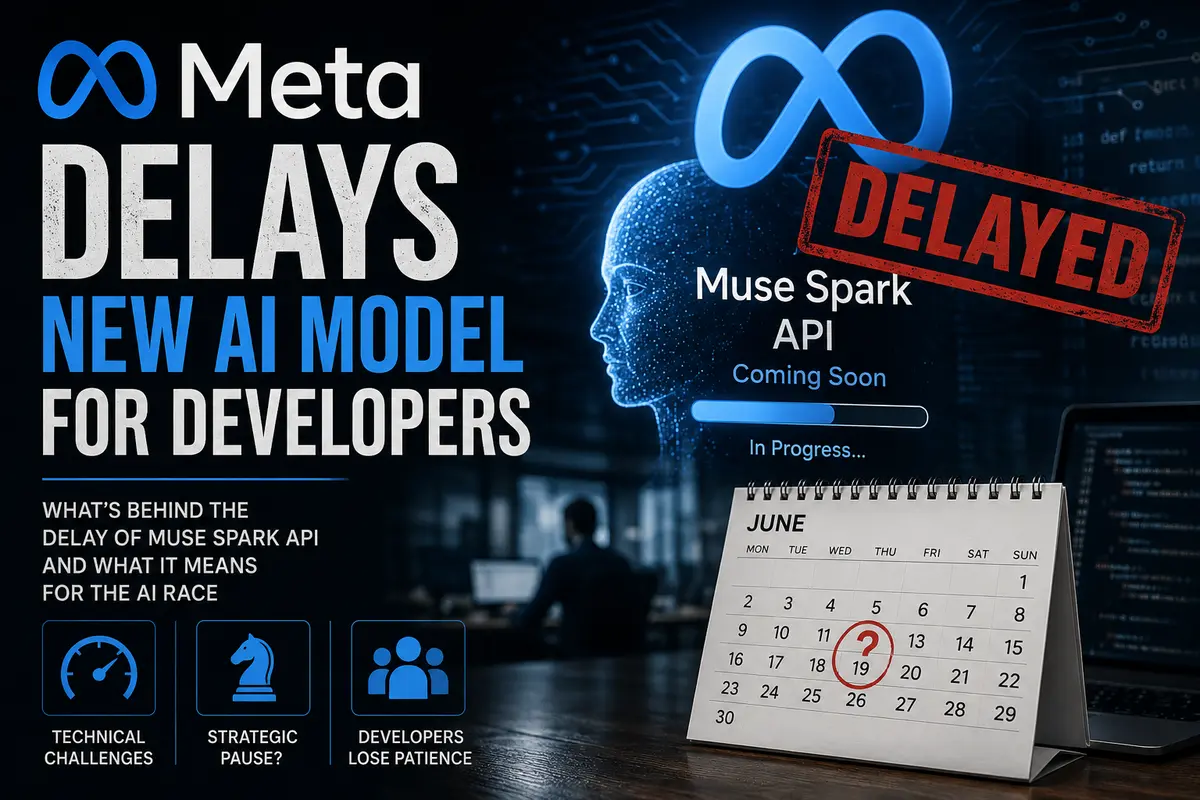
Meta Delays Release of New AI Model for Developers
Meta Delays Release of New AI Model for Developers
Promises That Haven’t Materialized

The world of artificial intelligence has grown accustomed to a relentless pace. Every week brings a new breakthrough. Every month sets a new benchmark. Companies compete to launch smarter models, more convenient APIs, and cheaper tokens. In this race, Meta Platforms has occupied the position of a confident middle-ground player—not the fastest, but not the slowest either.

Until now.

According to information published by The Wall Street Journal on Wednesday, Meta has repeatedly postponed the release of its latest AI model for developers. The delay has stretched to nearly two months, and more importantly, the company still has not committed to a new release date.

What is behind this delay? Why has a company that recently promoted its openness and rapid development suddenly gone quiet and started pushing back deadlines?

As is often the case in technology, the answer is more complicated than it appears. This is not simply a matter of unfinished code. It is a strategic pause—perhaps even a reassessment of the company’s entire approach.

The story began in April, when Meta unveiled its newest AI model, Muse Spark, with considerable fanfare. The company promised a model capable of competing with OpenAI’s GPT-4 and Google’s Gemini while remaining partially open, consistent with Meta’s broader philosophy. Developers around the world eagerly anticipated the launch of an API that would allow them to integrate Muse Spark’s capabilities into their own applications. The expected timeline was ambitious: the API would be released alongside the model itself.

April came and went. Then May.

The API never arrived.

A Promise Left Unfulfilled

According to sources cited by The Wall Street Journal, the head of Meta’s AI division assured developers that the release was coming “soon.” That statement was made nearly two months ago.

“Soon” has stretched considerably.

Developers who...
Continue reading...
0
0

Server Fever: How Dell Transformed from a PC Maker into an Artificial Intelligence King

Server Fever: How Dell Transformed from a PC Maker into an Artificial Intelligence King

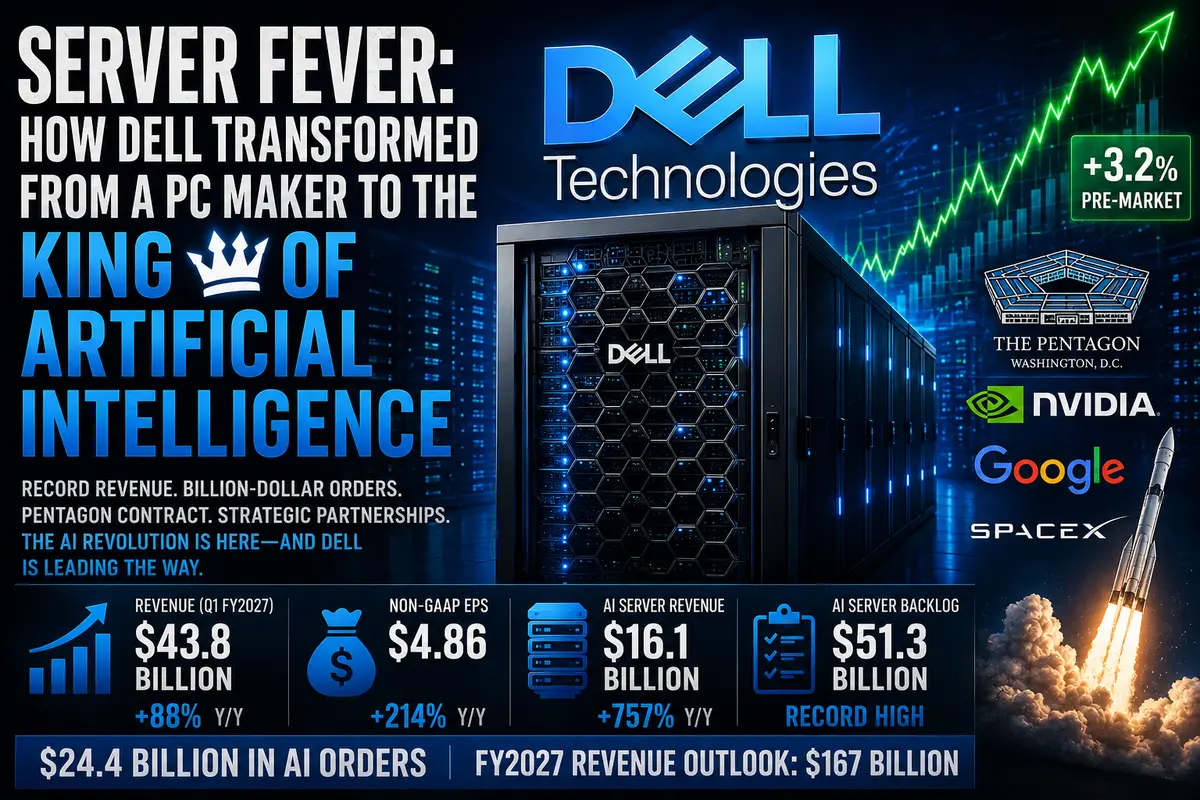
There are moments in corporate history when a company stops being what it has been for decades and becomes something entirely different. For Dell Technologies, that moment has arrived. The stock rose 3.2% in pre-market trading, extending a rally that began after the company released its quarterly earnings. Dell, a company millions of people know as a manufacturer of laptops and desktop computers, has suddenly found itself at the center of the hottest theme in global equity markets—artificial intelligence. And the numbers it reported force investors to rethink everything they thought they knew about the business.

A Quarter That Will Be Studied in Business Schools

Dell’s financial results for the first quarter of fiscal 2027 look almost too good to be true. Revenue reached $43.8 billion, up 88% year-over-year—the fastest quarterly growth rate since the company returned to the public markets in 2018. GAAP diluted earnings per share came in at $5.24, a 282% increase. Non-GAAP earnings per share reached $4.86, up 214%.

But the most astonishing figure was the magnitude of the earnings beat. Analysts had expected non-GAAP EPS of $2.93. Dell delivered $4.86—nearly 66% above consensus expectations. In a market where companies typically beat estimates by a few cents, such a deviation is extraordinary.

The primary driver of this explosive growth was Dell’s Infrastructure Solutions Group (ISG). Revenue from AI-optimized servers reached $16.1 billion, soaring 757% year-over-year. Yes, 757%. ISG as a whole generated $29 billion in revenue, representing 181% growth.

$24 Billion in Orders: AI Demand Shows No Signs of Slowing

Dell COO Jeff Clarke summarized the situation perfectly:

“We received $24.4 billion in AI orders and recognized $16.1 billion in AI server revenue. We are raising our fiscal 2027 AI server revenue outlook to $60 billion, further reinforcing that AI opportunities show no signs of slowing...

Continue reading...
0
0
Tom Maffin

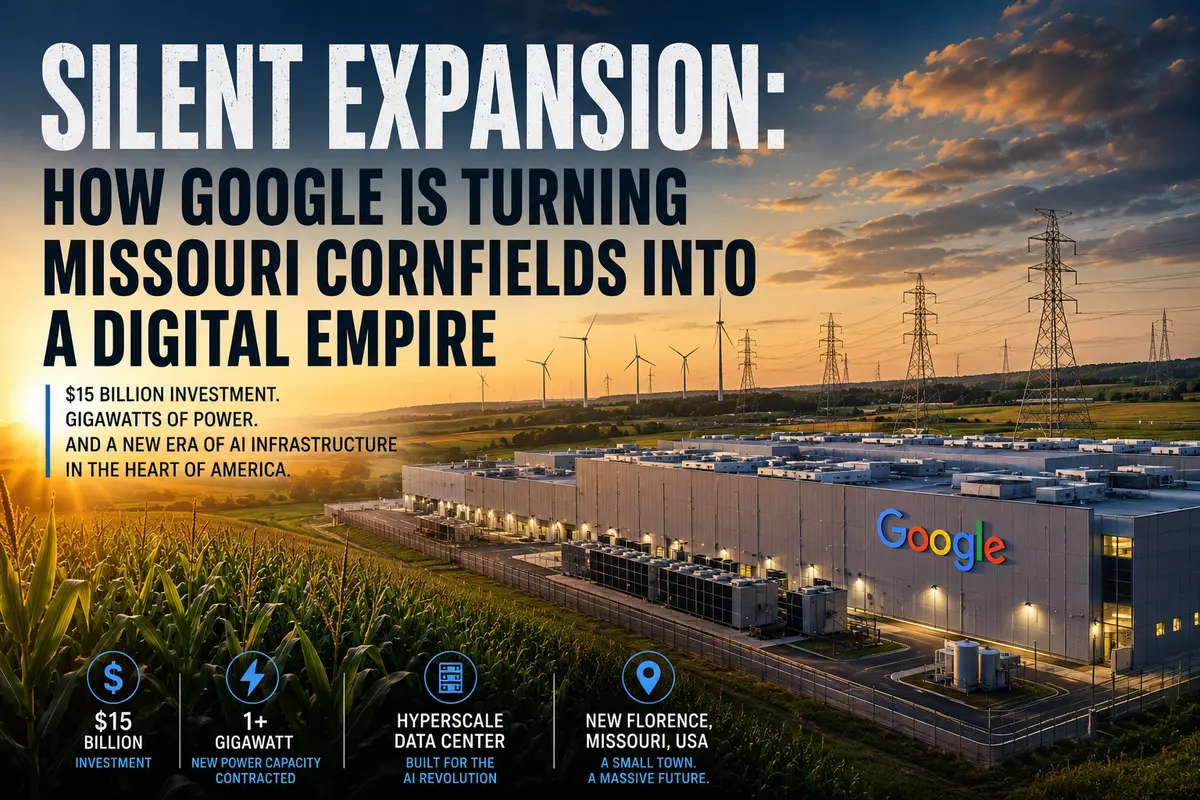
Silent Expansion: How Google Is Turning Missouri Cornfields into a Digital Empire

Silent Expansion: How Google Is Turning Missouri Cornfields into a Digital Empire

Fifteen billion dollars. A sum large enough to build several skyscrapers in New York, finance the space program of a small nation, or reshape the transportation system of an entire metropolis. But Google has chosen to spend that money differently. On Wednesday, the company announced it would invest the funds into land, concrete, steel frameworks, and miles of fiber-optic infrastructure in the state of Missouri.

At first glance, the news about a new data center in the small town of New Florence, tucked away among the fields of Montgomery County, looks like just another line in a corporate press release. In reality, however, the project fundamentally changes how we think about the direction of the digital economy — and who its next beneficiaries will be.

Cornfields Become the New Silicon Valley

Missouri is not the first place that comes to mind when people hear the phrase “technology hub.” Known for its ranches, beer breweries, and the blues clubs of St. Louis, the state has never seriously competed with California or Texas. Yet this is precisely where Google has chosen to place one of its largest infrastructure projects — and the decision is far from accidental.

A modern data center is not simply an office building filled with servers. It is an industrial facility comparable in scale to a steel plant, except instead of consuming coking coal, it consumes electricity. Gigawatts of electricity.

The fact that Google has already contracted more than one gigawatt of new power generation capacity in Missouri speaks volumes about the scale of its appetite. One gigawatt is roughly equivalent to the output of a large nuclear power plant or two million solar panels. And this is only the beginning. The company’s partnership with local utility provider Ameren includes the development of an additional 500 megawatts of...

Continue reading...
0
0
Navigation menu