
Oil Raises Its Head: WTI Climbs Back Toward $100 as the World Speculates About War
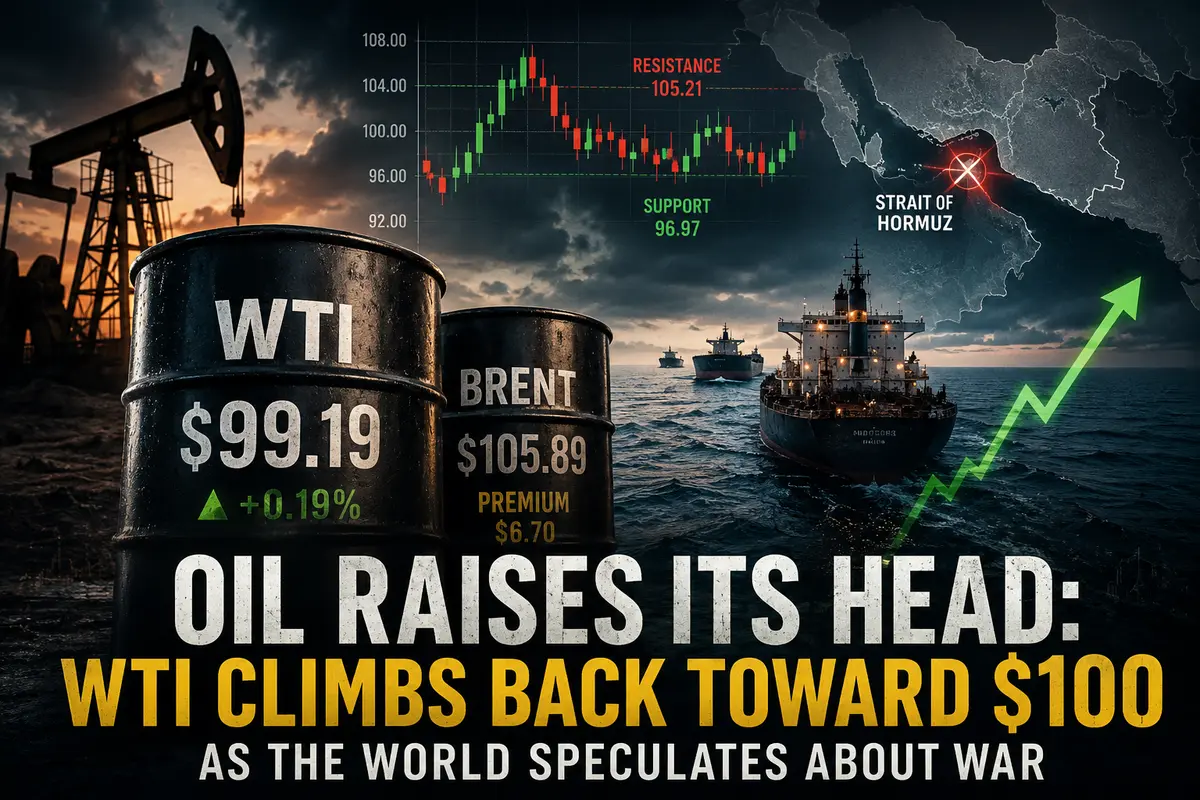
Thursday’s Asian trading session brought a cautious but steady revival to oil markets. July WTI crude futures rose to $99.19 per barrel, gaining a modest 0.19%. In ordinary times, such a move would barely make headlines. But now, when every cent of price movement translates into billions of dollars in budget fluctuations for entire nations, even this small green candle on the chart tells a much larger story. It is the story of oil trying to find a bottom after the collapse triggered by hopes for peace — and of that bottom potentially settling far higher than consumers from Tokyo to London would like.
Between Support and Resistance: Oil Searches for Balance
The technical picture painted by WTI quotes resembles a boxing match in which both opponents are exhausted, yet neither is willing to give ground. The support level at $96.97 marks the line below which the market refuses to let sellers pass. Every time prices approach this level, buyers step in, as though an invisible hand is catching the market before it falls further. Resistance at $105.21 serves the opposite role — a ceiling that has crushed every rally attempt over recent weeks.
This range between $97 and $105 is no accident. It contains all the conflicting information the market is digesting right now. On one hand, hopes for peace with Iran — repeatedly promoted throughout the week by Donald Trump — are pushing prices lower. If the conflict truly is in its “final stage,” as the U.S. president claims, then sooner or later the Strait of Hormuz will reopen, supplies will normalize, and oil prices will return to pre-crisis levels. On the other hand, reality stubbornly resists optimism. The strait remains largely blocked, tankers are forced to seek alternative routes or wait for passage, insurance premiums for shipping remain extremely high, and the naval forces of two major powers continue operating dangerously close to one another.
Thursday’s rise in WTI, however symbolic, suggests the market is beginning to view peace rhetoric with skepticism. Too many times in recent months, hopes for de-escalation have collided with harsh reality. Traders, hardened by experience, now trust not political statements but physical conditions in the Persian Gulf. And the physical reality is simple: there is less oil on the market than the world requires, and that deficit has not disappeared.
Brent and WTI: A Story Told in Six and a Half Dollars
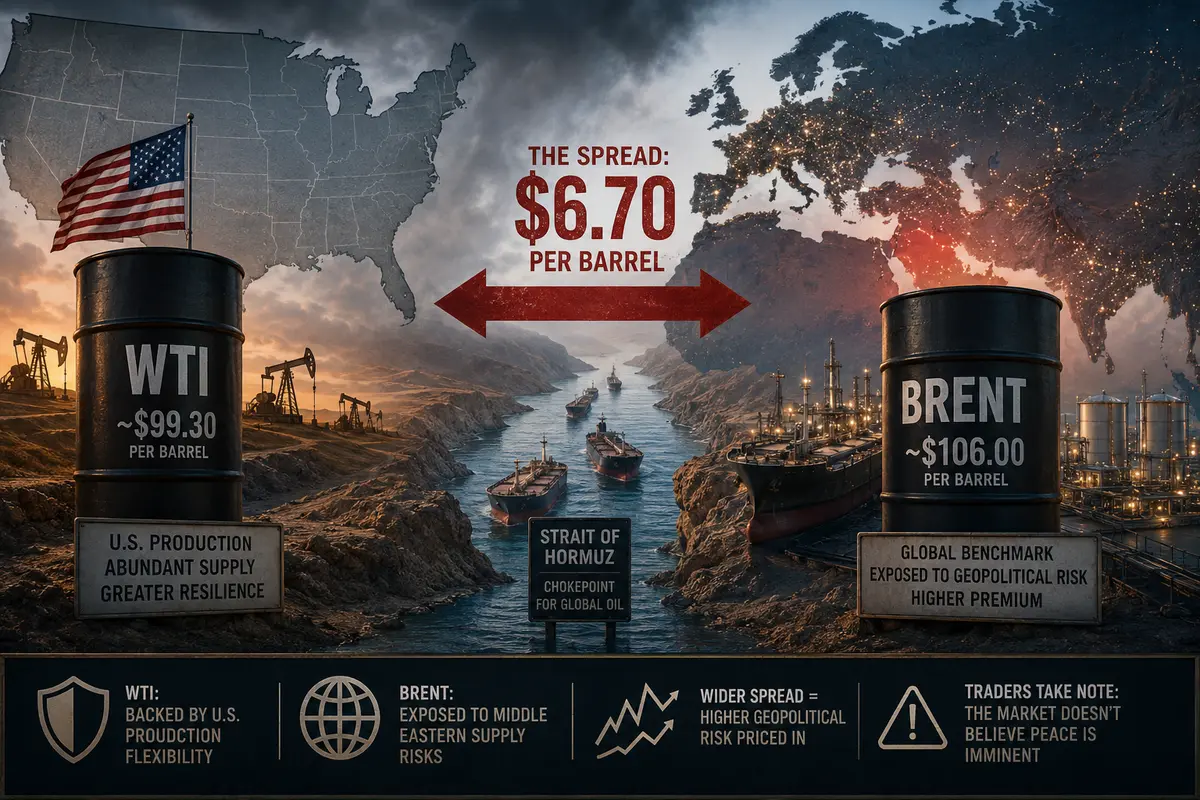
The price gap between Brent and WTI crude, standing at $6.70 per barrel, is more than just a technical detail for specialists. It is a full-fledged geopolitical indicator revealing how unevenly oil stress is distributed across the planet. Brent, trading near $106 per barrel with almost a seven-dollar premium over the American benchmark, reflects the desperate situation facing European and Asian consumers.
WTI is American crude, produced in Texas, New Mexico, and shale formations across the United States. It is less dependent on Middle Eastern supply. Although the U.S. remains part of the global market, it possesses substantial domestic production capacity and can partially cushion disruptions from the Persian Gulf. Brent, by contrast, is a North Sea benchmark used for most global trade, including supplies from Africa and the Middle East. It is Brent that absorbs the primary shock from the closure of the Strait of Hormuz. Brent is what European refineries, Japanese traders, and Indian importers pay for. And that $6.70 spread directly reflects the fact that conflict involving Iran hits those geographically closer to the crisis zone the hardest.
For traders watching the Brent-WTI spread, this widened premium is a signal to remain cautious. If the market truly believed peace was imminent, the gap would begin to narrow, as Brent would fall faster than WTI. But that is not happening. Brent’s premium remains intact, meaning the market continues pricing in serious risks to Middle Eastern supply.
The Dollar Pressures Oil — But Does Not Suffocate It
The U.S. dollar index, which gained 0.05% to reach 99.11, is also contributing to oil market dynamics. Traditionally, a stronger dollar pressures oil prices by making crude more expensive for holders of other currencies. But in the current environment, that effect is weaker than usual. The reason is simple: fundamental supply disruptions outweigh currency fluctuations.
The dollar strengthened after the release of Federal Reserve minutes showing that more officials are willing to consider additional rate hikes to combat inflation. This hawkish rhetoric supports the U.S. currency while simultaneously limiting gains in oil prices. The result is a tug-of-war: geopolitics and physical shortages push oil upward, while a strong dollar and fears of economic slowdown pull it downward. The outcome of this battle is the narrow trading range in which WTI has been trapped for several sessions.
What stands out is that oil did not collapse even after Trump’s statements about progress in negotiations with Iran. In earlier times, even a hint of de-escalation could have triggered a five-to-ten percent plunge in prices. But today the market is wiser. It understands that even if negotiations are progressing successfully, there remains a long road between a diplomatic agreement and the restoration of normal oil flows. Ceasefire terms must be agreed upon, tanker security guaranteed, damaged infrastructure repaired, and insurance companies persuaded to lower premiums. All of this takes time. And in the oil business, time is measured in tens of millions of barrels that fail to reach the market every single day.
A Market Waiting for Resolution
A rise of 0.19% is, essentially, statistical noise. The market has not made a decisive move either upward or downward. It is frozen in anticipation — waiting to see how the roller coaster of Trump-era diplomacy ends, whether the Strait of Hormuz reopens within weeks or remains blocked for months, and whether the Federal Reserve moves ahead with rate hikes that could cool the economy and reduce fuel demand.
There is something ominous in this pause. Oil markets, as history shows, dislike uncertainty. But when uncertainty becomes the only certainty, markets eventually adapt to it as well. WTI near $99 and Brent above $105 have become the new reality the world has lived with for months. A reality in which conflict involving Iran is no longer treated as an emergency, but as a prolonged backdrop. And in that reality, oil — even retreating on peace headlines — no longer falls below levels that just a year ago would have seemed catastrophic.
Thursday’s Asian session ended without surprises. Oil remained within its range, balancing between hope for peace and fear of another escalation. The dollar stayed firm, Brent preserved its premium, and WTI attempted to hold above support. This is a market waiting. But history teaches that such periods of calm rarely last long. Too much explosive material has accumulated beneath the surface — both literally and figuratively.
Comments
No comments yet. Be the first to share your thoughts!
Comments only for logged-in users.