

Silent Expansion: How Google Is Turning Missouri Cornfields into a Digital Empire
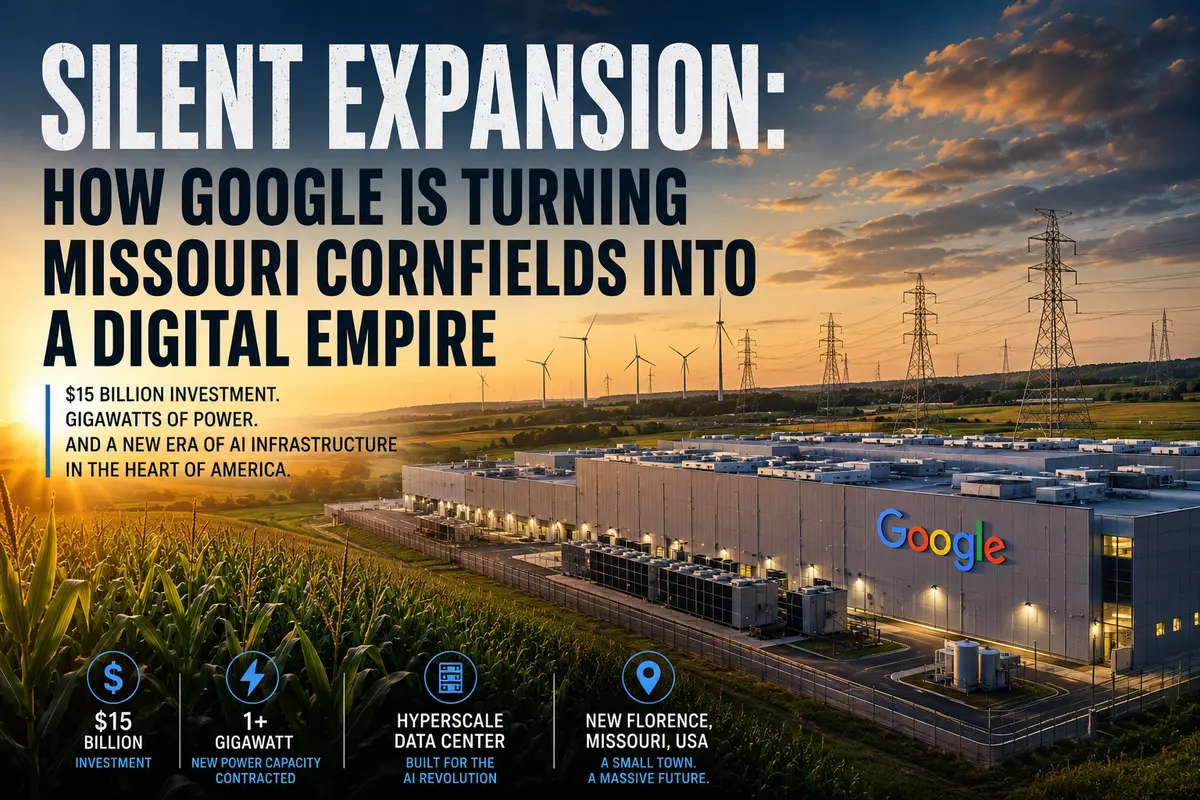
Fifteen billion dollars. A sum large enough to build several skyscrapers in New York, finance the space program of a small nation, or reshape the transportation system of an entire metropolis. But Google has chosen to spend that money differently. On Wednesday, the company announced it would invest the funds into land, concrete, steel frameworks, and miles of fiber-optic infrastructure in the state of Missouri.
At first glance, the news about a new data center in the small town of New Florence, tucked away among the fields of Montgomery County, looks like just another line in a corporate press release. In reality, however, the project fundamentally changes how we think about the direction of the digital economy — and who its next beneficiaries will be.
Cornfields Become the New Silicon Valley
Missouri is not the first place that comes to mind when people hear the phrase “technology hub.” Known for its ranches, beer breweries, and the blues clubs of St. Louis, the state has never seriously competed with California or Texas. Yet this is precisely where Google has chosen to place one of its largest infrastructure projects — and the decision is far from accidental.
A modern data center is not simply an office building filled with servers. It is an industrial facility comparable in scale to a steel plant, except instead of consuming coking coal, it consumes electricity. Gigawatts of electricity.
The fact that Google has already contracted more than one gigawatt of new power generation capacity in Missouri speaks volumes about the scale of its appetite. One gigawatt is roughly equivalent to the output of a large nuclear power plant or two million solar panels. And this is only the beginning. The company’s partnership with local utility provider Ameren includes the development of an additional 500 megawatts of...
