Bar Pipa
We pay for a post of 10$

Price Magnet: How Tuesday’s Option Expiries Could Pull Currency Rates

Price Magnet: How Tuesday’s Option Expiries Could Pull Currency Rates

Tuesday, 6:00 PM Moscow time. For most people, it’s just another hour when the workday winds down and thoughts shift toward home. But for FX traders, this moment marks a point of maximum tension. At the New York cut, option contracts worth billions of dollars across major currency pairs will expire. And these expiries are not just accounting entries. They are a force capable of pulling spot exchange rates toward specific levels in the final hours before expiration — like a magnet drawing in iron filings. Let’s go through the major pairs and see where the traps are set.

EUR/USD: A Narrow Corridor Around 1.16

Two significant option clusters are expiring in euro-dollar. The first is €140 million at the 1.1640 strike. The second is €122 million at 1.1625. At the time the data was recorded, the spot rate stood at 1.1628 — right between the two expiry levels.

This is no coincidence. It’s a classic situation where option barriers create an invisible corridor in which price can remain trapped until the cut.

The mechanics are straightforward. Large option holders — banks and market makers — hedge their exposure. If they sold options at 1.1640, then as price approaches that level they are likely to sell euros to protect themselves from potential losses. Those flows create artificial resistance. The same mechanism works in reverse at 1.1625: as price falls toward that strike, market makers buy euros, creating artificial support.

As a result, the exchange rate becomes squeezed in a vice, and breaking these levels ahead of expiry becomes extremely difficult unless some overwhelming news shock hits the market.

USD/JPY: A Quarter Billion at 159.5

Dollar-yen looks even more intriguing. Options worth $231 million expire at the 159.50 strike. Another $240 million sits at 159.25. The spot rate is currently 159.26...

Continue reading...
0
0
Tom Maffin

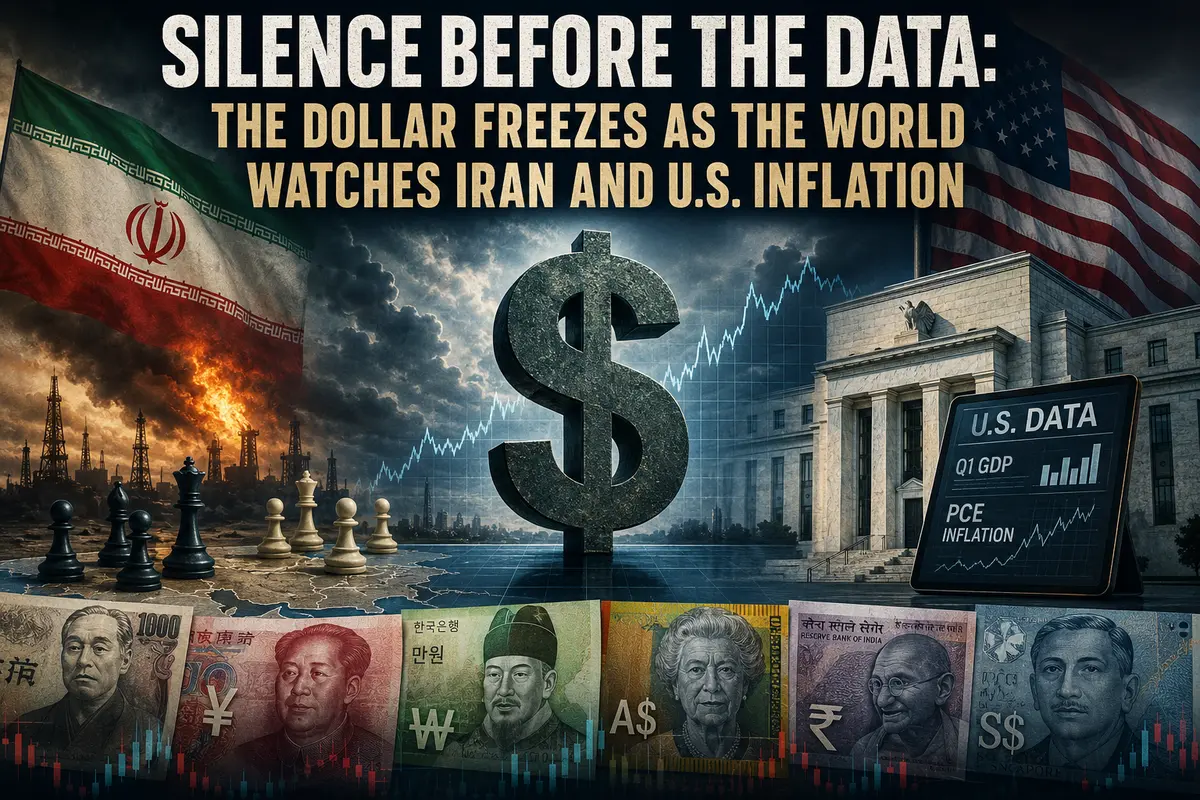
Silence Before the Data: The Dollar Freezes as the World Watches Iran and U.S. Inflation

Silence Before the Data: The Dollar Freezes as the World Watches Iran and U.S. Inflation

Wednesday on the currency markets was defined by anticipation. The dollar stood still, like a predator before the leap, making no sharp moves either upward or downward. The U.S. dollar index and its futures were virtually unchanged during Asian trading, stabilizing after a brief surge earlier in the week.

But this stillness is deceptive. Beneath it lies enormous tension — traders are frozen ahead of two events capable of turning the market upside down. One is geopolitical, the other macroeconomic. And both sit at a point of maximum uncertainty.

Iran Talks: Diplomacy Through a Crosshair

The main factor preventing the dollar from falling — and at the same time keeping it from rallying — is Iran.

Negotiations between the United States and Iran over de-escalating the conflict are continuing, but no one seems to fully understand their real condition. According to media reports, indirect contacts are still ongoing even after U.S. forces struck targets in southern Iran.

It is a strange, almost surreal picture: bombs are falling while diplomats continue talking. War and peace exist simultaneously, in parallel realities.

As recently as the weekend, U.S. officials sounded optimistic. Trump spoke of a memorandum that was “largely agreed upon.” Markets celebrated, oil prices fell, and the dollar weakened.

But this week Washington’s tone has become more restrained. The strikes on Iranian facilities were presented as defensive, yet the very fact they occurred suggests the negotiating process is stalling. The sides remain stuck on key issues — the fate of Iran’s enriched uranium, the timeline for reopening the Strait of Hormuz, and security guarantees.

Until those issues are resolved, the dollar will continue to receive support as a safe-haven asset.

The mechanics here are simple and ruthless. As long as there is a risk of escalation, there is a risk of disruptions...

Continue reading...
0
0
NorthRay

I Started Learning Technical Analysis. The Chart Stopped Being Just a Picture.

I Started Learning Technical Analysis. The Chart Stopped Being Just a Picture.

Hi, this is NorthRay.😎

For a long time, I looked at charts like abstract art.

Red candles, green candles, lines crawling somewhere across the screen. I understood where the price moved, but I didn’t understand WHY it moved there or WHERE it might go next.

I traded randomly. I clicked Buy because “I feel like it’ll go up.” I clicked Sell because “it seems too high.”

That worked about half the time. Because honestly, both I and my cat could flip a coin.

And then I told myself: “Enough guessing. Time to understand.”

That’s when I started learning technical analysis.

What I Used to Think About Technical Analysis (and How Wrong I Was)

Honestly? I thought it was something complicated and unnecessary.

“Why do I need all these lines and patterns? The market is chaotic. News and crowd emotions decide everything.”

I was wrong.

Yes, news matters. Yes, emotions drive the crowd. But all of that is REFLECTED on the chart. Price doesn’t come out of nowhere. It’s created by the actions of thousands of traders.

And those actions have patterns.

Technical analysis isn’t magic. It’s simply an attempt to find repeating patterns on a chart and use them to make forecasts.

In simple terms:

If every time the price touches a certain level it bounces upward, that’s not a coincidence. It means buy orders are sitting there.

Technical analysis helps identify those levels.🔥

Where I Started (Slowly, Without Overdoing It)

I didn’t try to learn everything at once. I have no goal of becoming a professor.

I decided to master three basic things that, according to experienced traders, cover 80% of a beginner’s needs.

My minimum program:

Support and resistance levels

Trend lines

One confirmation indicator (for me it’s the Stochastic oscillator, which I already wrote about)

That’s it....

Continue reading...
0
0
Lin Brings

Bitcoin on a Rollercoaster: How Hopes for Peace and Nasdaq Options Brought Crypto Back to Life

Bitcoin on a Rollercoaster: How Hopes for Peace and Nasdaq Options Brought Crypto Back to Life

Monday began with a number that still seemed lost on Saturday: seventy-seven thousand dollars. A round, psychologically important level from which the world’s leading cryptocurrency bounced back after falling to seventy-four thousand three hundred over the weekend. A market that was licking its wounds yesterday is once again looking upward today. And there are at least two reasons for it: one rooted in geopolitics, the other in institutional finance. Together, they created the perfect cocktail that pulled Bitcoin out of the pit and forced traders to rethink the near-term outlook.

Iranian Optimism: How Peace Talks Are Moving Crypto

The connection between Bitcoin and negotiations in Doha is not obvious at first glance. But dig deeper, and the logic becomes clear. Hopes for a peace agreement between the United States and Iran, which emerged over the weekend, imply the potential reopening of the Strait of Hormuz. Reopening the strait means restoring oil supplies. Restored supplies mean lower energy prices. Lower energy prices mean weaker inflationary pressure. And weaker inflation means the Federal Reserve may not need to tighten policy further or raise rates.

For Bitcoin, which has spent recent months suffocating under fears of persistently high interest rates, this chain reaction is like a breath of fresh air. High rates crush appetite for risk assets. Investors move into bonds, the dollar, and anything offering guaranteed yield. Cryptocurrency, which generates no cash flow, suffers first in such an environment. But the moment there is hope for easier monetary policy, capital starts flowing back in.

Of course, geopolitical optimism is fragile. We have seen how quickly it can evaporate. One strike on Iranian facilities, one harsh statement from Tehran, one Trump tweet — and Bitcoin could tumble again. But on Monday, the market chose to focus on the bright side. Talks are ongoing,...

Continue reading...
0
0

Digital Lari: How Tether and Georgia Are Rewriting the Rules of the Game in the Post-Soviet Space

Digital Lari: How Tether and Georgia Are Rewriting the Rules of the Game in the Post-Soviet Space

Tbilisi rarely makes headlines in global financial news. Mountain landscapes, ancient wineries, khachapuri, and hospitality — those are usually the first things that come to mind when people think of Georgia. But today, this small country at the crossroads of Europe and Asia has taken a step that could turn it into one of the world’s most intriguing testing grounds for digital currency experiments.

Tether, the issuer of the world’s largest dollar-backed stablecoin, USDT, with a market capitalization of $189 billion, has announced the launch of GEL₮ — a stablecoin pegged to the Georgian lari. And this is not a private initiative carried out around the authorities. The project is being implemented with the direct support of the Georgian government. The world has never seen an alliance between a state and the crypto industry quite like this.

What Is GEL₮ and Why Does It Matter?

GEL₮ is a digital token whose value is tied to the Georgian lari. One token equals one lari. Unlike volatile cryptocurrencies such as Bitcoin, a stablecoin does not swing wildly in price. It performs the same function as ordinary money, but within a digital environment.

Transfers, payments, and transaction settlements can all be carried out using GEL₮ faster, cheaper, and more transparently than through the traditional banking system.

Tether describes the advantages in the same language tech companies use to market their products: lower transaction costs, near-instant settlements, programmable payments, and efficient movement of funds within digital financial infrastructure. Behind these technical terms lies a simple reality: GEL₮ could become the bridge connecting Georgia’s traditional economy with the world of decentralized finance.

A Georgian farmer selling wine to Europe could receive payment instantly in stablecoins, without waiting weeks for an international bank transfer and without losing margins to fees. A Georgian freelancer working for overseas...

Continue reading...
0
0
Tom Maffin

Korean Record Amid the Ashes of War: How Asian Markets Live Between Bombs and Chips

Korean Record Amid the Ashes of War: How Asian Markets Live Between Bombs and Chips

Asian stock markets on Tuesday looked like a chessboard where the black and white squares had been mixed together without any logic. Japan declined, China fell, Australia and Singapore slipped into the red. But in the middle of this sea of red indices, like an iceberg rising above the waves, stood the KOSPI — South Korea’s benchmark index hit a new all-time high, surging above 8,131 points. Hong Kong, lifted by a rally in chipmakers, also closed higher. This market schizophrenia perfectly reflects the current moment: geopolitics is pulling markets down, technology is pushing them up, and investors are swinging between fear of Iranian bombs and greed for artificial intelligence.

Strikes on Iran: Markets Back in “Run or Freeze” Mode

New U.S. strikes on missile positions and vessels in southern Iran, revealed on Monday, hit the markets like a bucket of cold water poured over the smoldering embers of optimism. Just on Sunday, markets were celebrating hopes for peace. As recently as Monday morning, oil had fallen below $100 a barrel, Asian indices were climbing, and traders were pricing in a swift reopening of the Strait of Hormuz. Today, everything looks different. Brent is back near $98, while WTI hovers around $92. Oil prices have bounced back, reminding everyone that the war is not over — it has merely paused.

Washington describes the strikes as defensive. The wording matters: it leaves room for diplomacy. Had the attacks been labeled offensive, markets would have interpreted them as escalation and reacted far more aggressively. But even “defensive” bombings during ongoing negotiations in Doha send a message. A message that diplomacy is stalling, that the sides cannot reach an agreement, and that military force remains the primary argument. And although Trump continues to say the talks are “going well,” markets have learned to...

Continue reading...
0
0

The Pharaohs’ Treasure Hunt: How Egypt Plans to Redraw the Map of Its Subsoil Wealth

The Pharaohs’ Treasure Hunt: How Egypt Plans to Redraw the Map of Its Subsoil Wealth

Forty-two years is not just a number. It is more than half a human lifetime. In that span, the world moved from rotary phones to smartphones, from typewriters to artificial intelligence, from the Cold War to war with Iran. Yet in Egypt, one crucial sector remained frozen in time throughout all those decades. A country whose gold mines supplied precious metal for the tombs of pharaohs, whose quarries produced copper and turquoise for queens’ jewelry, whose stone pits provided material for the pyramids, had not carried out a single comprehensive airborne survey of its mineral wealth for more than four decades. Now, that paradox is coming to an end. Egypt has announced a large-scale mineral exploration initiative, a decision that could transform not only the country’s economy but also the entire geological map of North Africa.

Xcalibur and Drones Over the Desert: How the Treasure Hunt Will Work

Egypt’s Minister of Petroleum and Mineral Resources, Karim Badawi, personally attended the signing ceremony — and this was far more than a ceremonial gesture. For Cairo, the project carries strategic importance. The contractor selected for the mission is Xcalibur Smart Mapping, one of the world’s leading companies in airborne geophysical surveying, with experience across every continent. The company will work alongside Egypt’s Nuclear Materials Authority and the local firm Drone Tech. The consortium is carefully balanced: global expertise, state oversight of nuclear materials, and domestic technological capability.

The technologies involved have advanced dramatically since the early 1980s, when Egypt last conducted anything comparable. Modern airborne geophysical exploration is far more than aerial photography. It is a sophisticated combination of magnetic surveys, gravimetry, electromagnetic sounding, and gamma spectrometry. Aircraft or drones equipped with this technology fly over targeted areas while instruments detect even the slightest anomalies in Earth’s magnetic field, gravity, and rock...

Continue reading...
0
0

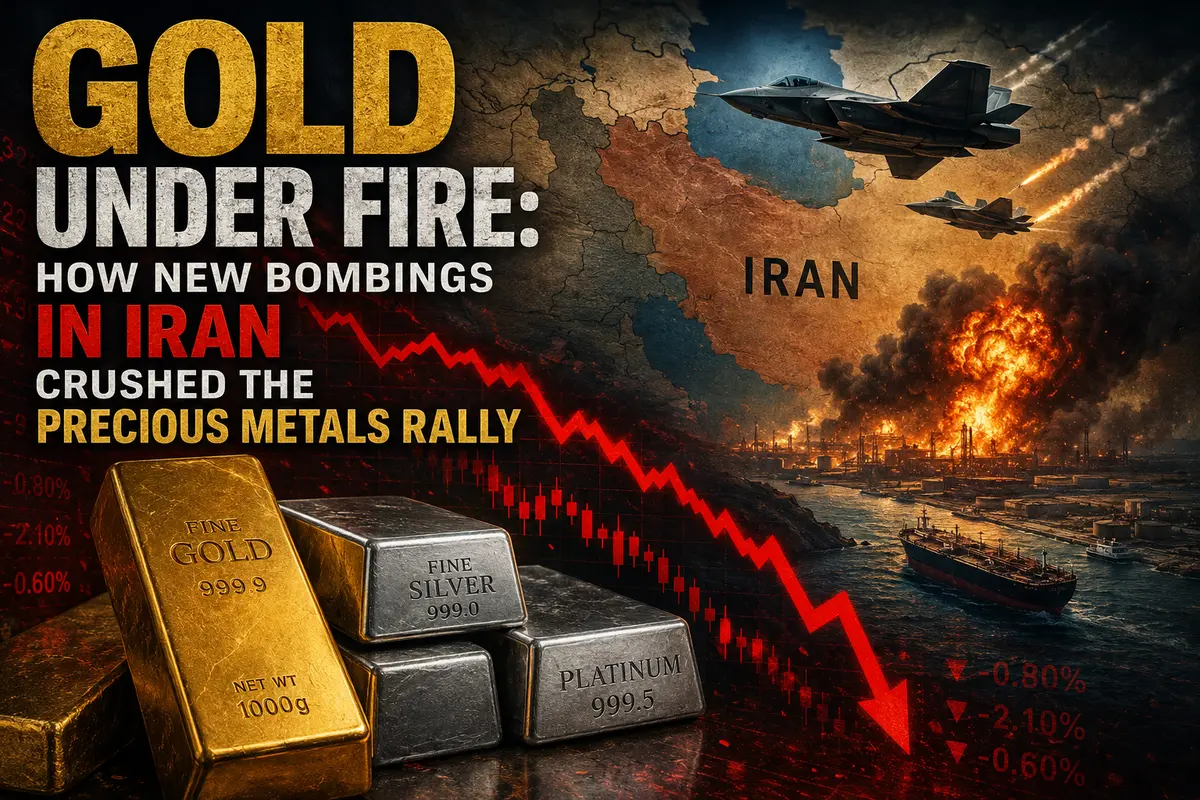
Gold Under Fire: How New Bombings in Iran Crushed the Precious Metals Rally

Gold Under Fire: How New Bombings in Iran Crushed the Precious Metals Rally

Tuesday’s Asian trading session delivered a brutal reality check to gold traders. Just yesterday, spot gold prices were confidently climbing higher amid hopes for peace with Iran, while futures painted bullish charts suggesting the rally would continue. Today, everything reversed.

Spot gold plunged 0.8% to $4,535 per ounce. Futures followed, falling by the same margin. Silver collapsed by more than 2%, while platinum lost 0.6%. Precious metals, which had celebrated a return to life on Monday, came under attack on Tuesday — both literally and figuratively. And the reason for this reversal was the very bombs the United States dropped on southern Iran.

The Paradox of War and Gold: Why Bombs Are Sinking Prices

At first glance, this seems backward. Gold is the classic safe-haven asset. When guns fire, investors usually run into gold. This rule has worked for decades and entire investment strategies are built around it.

But the current conflict with Iran has rewritten those rules. To understand why, we need to look at how this war affects gold — not directly, but through a complex chain of macroeconomic consequences.

The conflict with Iran triggered an energy crisis. The closure of the Strait of Hormuz sent oil prices soaring. Rising energy prices fueled inflation worldwide. And accelerating inflation forced the Federal Reserve and other central banks to start talking about higher interest rates.

This is where the mechanism becomes deadly for gold.

Gold generates no yield. When rates rise — or even when there is merely a threat of higher rates — holding gold becomes an expensive luxury. Investors look at a gold bar sitting idle in a vault, then compare it with Treasury bonds offering guaranteed dollar returns, and make the rational choice in favor of bonds.

That is why gold fell during the hottest phases of...

Continue reading...
0
0
Lin Brings

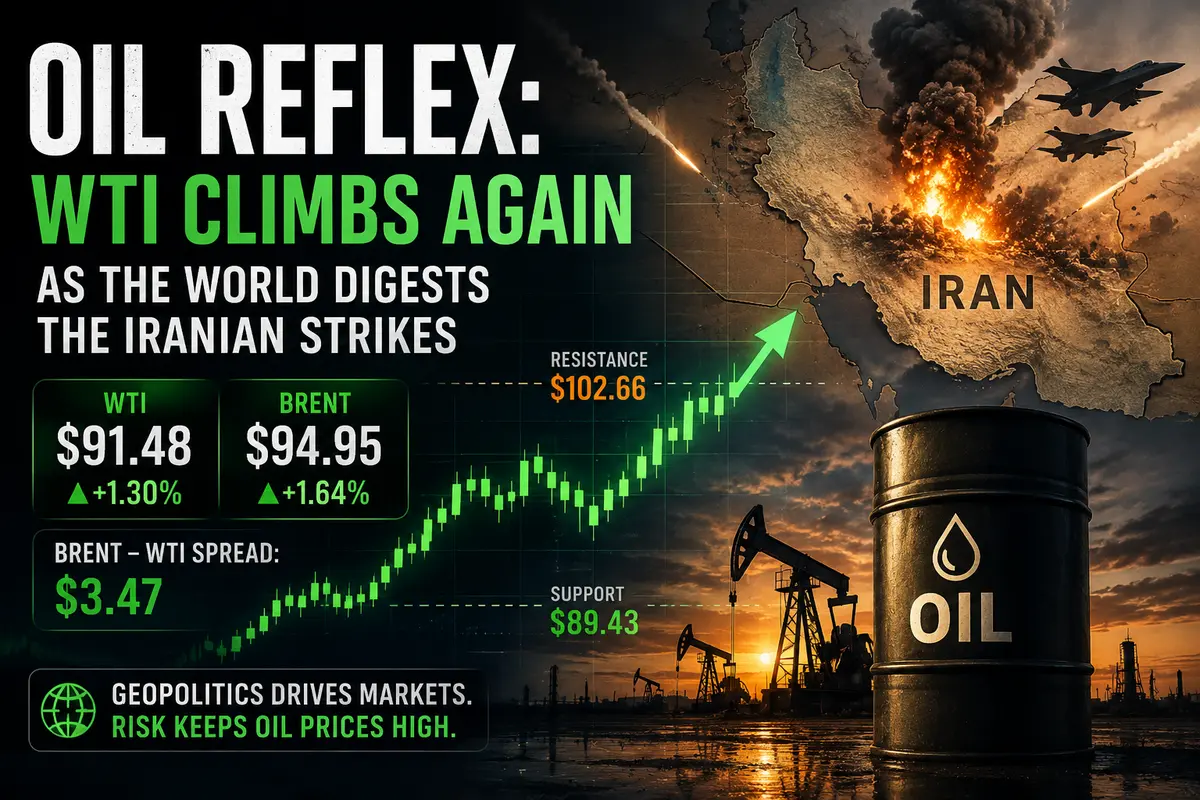
Oil Reflex: WTI Climbs Again as the World Digests the Iranian Strikes

Oil Reflex: WTI Climbs Again as the World Digests the Iranian Strikes

Tuesday’s Asian session painted oil prices firmly green. July WTI futures rose 1.3%, reaching $91.48 per barrel. The move was not explosive, but the direction was unmistakable. After Sunday’s hopes for peace and Monday’s collapse in oil below $100, the market has once again switched into “buy the fear” mode. The reason is obvious: renewed U.S. strikes on Iran on Monday forced traders to reassess their recent optimism and restore the geopolitical premium they had so eagerly removed from the price of a barrel.

Between $89 and $103: Oil Searches for Balance

The technical picture drawn by Tuesday’s WTI quotes resembles a classic rebound from support. The $89.43 level became the point where sellers ran out of momentum. Oil, which had plunged on Monday amid hopes for a peace agreement, hit that floor and bounced higher. Resistance near $102.66 looms overhead, separating the current range from the territory oil occupied during the hottest days of the conflict. This corridor — between $89 and $103 — is the zone of uncertainty in which the market will remain until the situation around Iran becomes clearer.

A 1.3% rise during the session is not panic buying. It is more a cautious digestion of the news. Traders are not rushing to buy barrels at any price as they did in the first days of the war. Instead, they are methodically pricing in higher risk. The strikes on southern Iran reported on Monday are not the beginning of a full-scale ground operation. They are targeted actions that, despite their seriousness, still leave room for diplomacy. But they also serve as a reminder that diplomacy is not a substitute for war — it is often its continuation by other means. And as long as bombs are falling, even while negotiations continue in parallel, the oil market...

Continue reading...
0
0

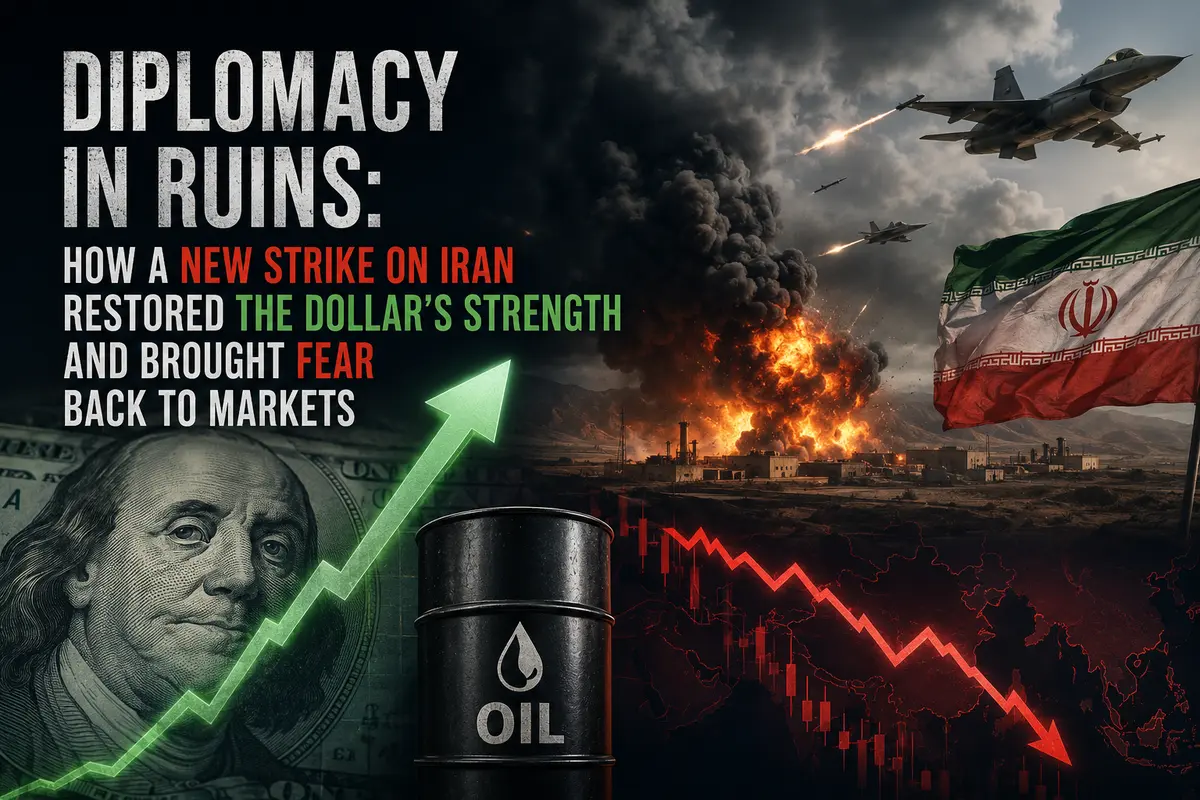
Diplomacy in Ruins: How a New Strike on Iran Restored the Dollar’s Strength and Brought Fear Back to Markets

Diplomacy in Ruins: How a New Strike on Iran Restored the Dollar’s Strength and Brought Fear Back to Markets

Monday ended with explosions. By Tuesday, markets woke up in a different world — one where hopes for imminent peace, which had lifted Asian stocks and currencies just a day earlier, were shattered by the harsh reality of military force. The United States carried out strikes on targets in southern Iran. Although details remain scarce and official statements cautious, that alone was enough for the markets. The dollar resumed its climb. Oil surged alongside it. Asian currencies, which had celebrated gains on Monday morning, came under pressure by Tuesday. The geopolitical pendulum swung back — and this time, those who had rushed to believe in peace were the ones falling.

Strikes on Southern Iran: What We Know and Why It Matters

Reports of new U.S. strikes on Iranian facilities emerged on Monday. The targets were located in the south of the country — a region strategically important both for Iran’s military infrastructure and for control over the Persian Gulf coastline. Details of the operation remain classified, but the mere resumption of military action after several days of intense negotiations suggests either that diplomacy has hit a dead end or that talks are being used as cover for continued military pressure.

Iranian officials reacted immediately. Their warning was blunt and unequivocal: any attacks on the country’s military facilities would trigger retaliation. This was not rhetoric — it was a promise of escalation. Markets interpreted it exactly that way: as a signal that the conflict is far from over and that the risks of a new spiral of violence are growing by the hour.

The contrast with the mood over the weekend could not be sharper. As recently as Saturday and Sunday, Trump had spoken about a memorandum that was “mostly agreed upon,” about reopening shipping routes through the Strait of Hormuz,...

Continue reading...
0
0
Navigation menu
instaforex banner