

Digital Lari: How Tether and Georgia Are Rewriting the Rules of the Game in the Post-Soviet Space
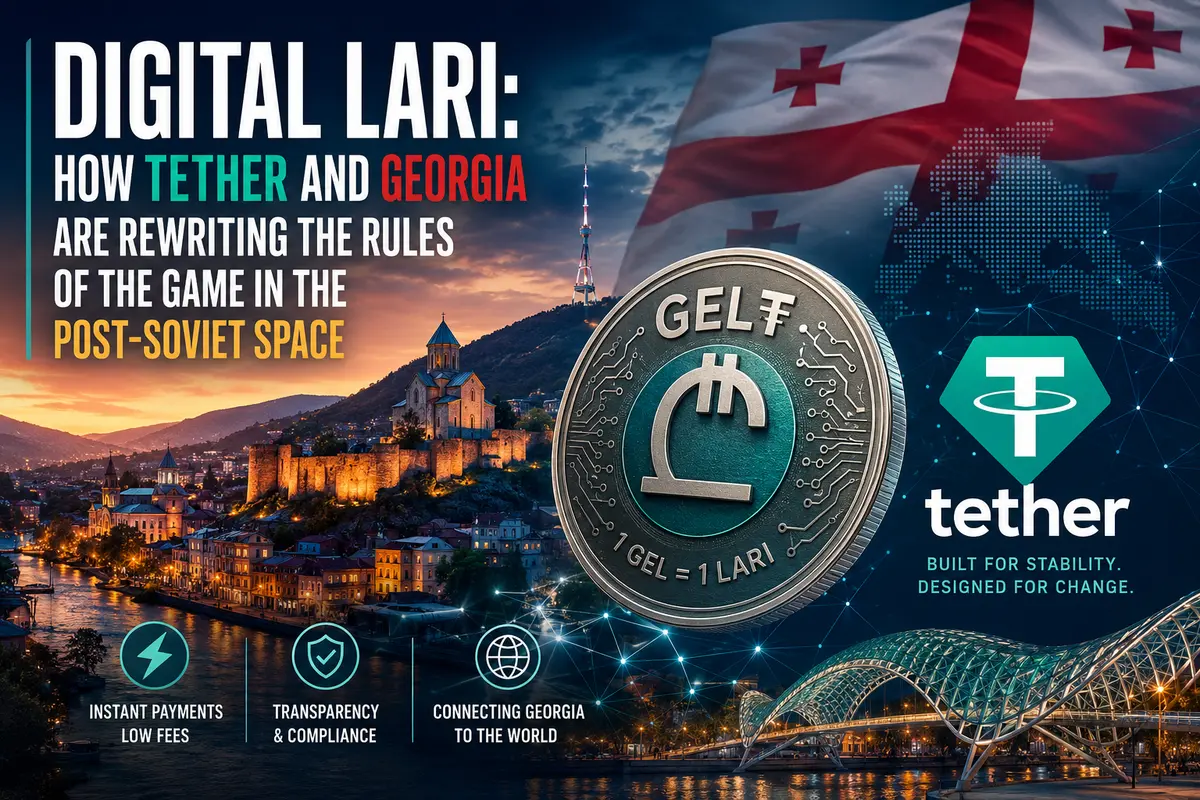
Tbilisi rarely makes headlines in global financial news. Mountain landscapes, ancient wineries, khachapuri, and hospitality — those are usually the first things that come to mind when people think of Georgia. But today, this small country at the crossroads of Europe and Asia has taken a step that could turn it into one of the world’s most intriguing testing grounds for digital currency experiments.
Tether, the issuer of the world’s largest dollar-backed stablecoin, USDT, with a market capitalization of $189 billion, has announced the launch of GEL₮ — a stablecoin pegged to the Georgian lari. And this is not a private initiative carried out around the authorities. The project is being implemented with the direct support of the Georgian government. The world has never seen an alliance between a state and the crypto industry quite like this.
What Is GEL₮ and Why Does It Matter?
GEL₮ is a digital token whose value is tied to the Georgian lari. One token equals one lari. Unlike volatile cryptocurrencies such as Bitcoin, a stablecoin does not swing wildly in price. It performs the same function as ordinary money, but within a digital environment.
Transfers, payments, and transaction settlements can all be carried out using GEL₮ faster, cheaper, and more transparently than through the traditional banking system.
Tether describes the advantages in the same language tech companies use to market their products: lower transaction costs, near-instant settlements, programmable payments, and efficient movement of funds within digital financial infrastructure. Behind these technical terms lies a simple reality: GEL₮ could become the bridge connecting Georgia’s traditional economy with the world of decentralized finance.
A Georgian farmer selling wine to Europe could receive payment instantly in stablecoins, without waiting weeks for an international bank transfer and without losing margins to fees. A Georgian freelancer working for overseas clients could convert earnings into lari without predatory exchange rates. Georgian businesses could program payments — automatically distributing revenue among suppliers, tax authorities, and employees.
Georgia as a Regulatory Pioneer
To understand why Tether chose Georgia, one has to look at what the country has been doing in crypto regulation over recent years. Tbilisi has methodically built a legal framework that makes the country attractive for digital businesses.
In March, the National Bank of Georgia adopted rules allowing companies registered in the country to issue stablecoins denominated in lari and other currencies. The requirements are reasonable: issuers must have at least 500,000 lari in authorized capital, and issuance requires regulatory approval. This filters out obvious opportunists without creating barriers for serious players.
But the most interesting aspect is how Georgian legislation positions itself relative to U.S. law. Tether explicitly states that Georgian crypto legislation was developed with compatibility in mind with the American legal framework for digital assets, including the GENIUS Act.
This is not an accident or a technical detail. It is a strategic choice.
Georgia aims to become one of the first countries whose financial system is directly compatible with the American digital financial system. In a world where regulatory arbitrage is becoming a competitive advantage, such positioning is a golden ticket.
For American and global crypto companies, Georgia is becoming the ideal gateway into the post-Soviet region and the Middle East. Businesses can operate under rules that are familiar and understandable to Western investors, without fearing that regulators will suddenly change the game overnight. At the same time, Georgia offers access to markets that would otherwise be difficult to reach because of sanctions risks, political instability, or simply the absence of a legal framework.

Tether: From Dollar Giant to Multi-Currency Empire
For Tether, this project is more than just another launch. It represents an expansion of its business model into a new direction.
USDT, pegged to the U.S. dollar, remains the company’s flagship product. With a market capitalization of $189 billion, it is the world’s largest stablecoin. But the dollar is not the only currency people need. In many countries and regions, commerce is conducted in local currencies, and demand for digital versions of those currencies is enormous.
Tether already has experience with multi-currency products. Its XAUT token, backed by physical gold, allows investors to hold precious metal in digital form. Now the company is adding a national currency to its portfolio.
And this is likely just the beginning.
If the Georgian experiment proves successful, nothing prevents Tether from launching similar projects in other countries with favorable regulation. Armenia, Kazakhstan, the Baltic states, Southeast Asian nations — the list of potential candidates is long.
But GEL₮ is not simply another stablecoin. It is a new form of public-private partnership.
The Georgian government officially supports the project. That means GEL₮ will not be perceived as a foreign element imported by a global corporation, but as part of the country’s national financial infrastructure.
Taxes may eventually be payable in GEL₮. Government services could potentially be paid for in GEL₮. Public-sector disbursements could be distributed in GEL₮.
If that happens, Georgia would become the first country in the world where a stablecoin issued by a private company is integrated into public finance at such a deep level.
Taxes Through Instant Conversion: How It Works
Tether mentions one detail that deserves particular attention. Georgia has already implemented the ability to pay taxes through the instant conversion of digital assets into national currency.
This is not theory — it already works in practice.
A Georgian entrepreneur who receives payment in Bitcoin or USDT can instantly convert it into lari and pay taxes without going through complicated exchange procedures.
This solves one of the biggest problems facing crypto businesses: interaction with tax authorities.
In many countries, crypto entrepreneurs operate in a gray zone. They may have income, but there is little clarity about how to declare it, how to pay taxes on it, or which exchange rate should apply. Georgia has solved this problem.
And GEL₮, integrated into this infrastructure, could make the process even more seamless. Taxes could potentially be paid directly in stablecoins pegged to the lari, without any conversion at all.
A Small Country With Big Ambitions
Georgia does not have a massive economy, huge foreign exchange reserves, or armies of multinational corporations. But it does possess something that, in the twenty-first century, may prove even more important: flexibility, speed of decision-making, and a willingness to experiment.
While giants such as the United States, the European Union, and China move slowly and cautiously toward regulating digital currencies, small Georgia may slip through their fingers and become a global hub for stablecoins.
This is a classic strategy for small nations: find a niche the big players have not yet occupied and become a global leader within it.
Switzerland did this with private banking. Singapore did it with trading and asset management. Estonia did it with digital citizenship. Georgia is attempting to do it with stablecoins.
And its partnership with Tether is a powerful move in that game.
Of course, there are risks.
Tether is a company with a controversial reputation. Its dollar-backed stablecoin has repeatedly been criticized for insufficient transparency regarding reserves. Regulators in various countries have questioned whether every USDT is truly backed by a real dollar.
If similar doubts emerge around GEL₮, it could damage not only Tether’s reputation, but also that of the Georgian government.
Much will depend on the reserve mechanisms and auditing systems built into the project. Tether has promised to announce additional details about GEL₮’s structure, launch timeline, and regulatory mechanisms at a later date. The market will watch those details very closely.
A New Chapter in the History of Money
The launch of GEL₮ is not just another crypto news story. It is a signal.
A signal that the boundary between sovereign money and private digital currencies is beginning to blur.
A signal that small countries can use crypto technologies for leapfrogging — jumping over generations of financial infrastructure.
A signal that the post-Soviet region, contrary to stereotypes, may become not a zone of backwardness, but a laboratory of the future.
And if Tether and the Georgian government successfully bring this project to life, the world will see the first example of a national currency gaining a second life on the blockchain — not as a central bank pilot project, not as a CBDC experiment, but as a market product created by a private company with state support.
This is a new chapter in the history of money, and it is being written in Tbilisi.

Comments
No comments yet. Be the first to share your thoughts!
Authentication Required
You must be logged in to post a comment.