

Bitcoin on a Rollercoaster: How Hopes for Peace and Nasdaq Options Brought Crypto Back to Life
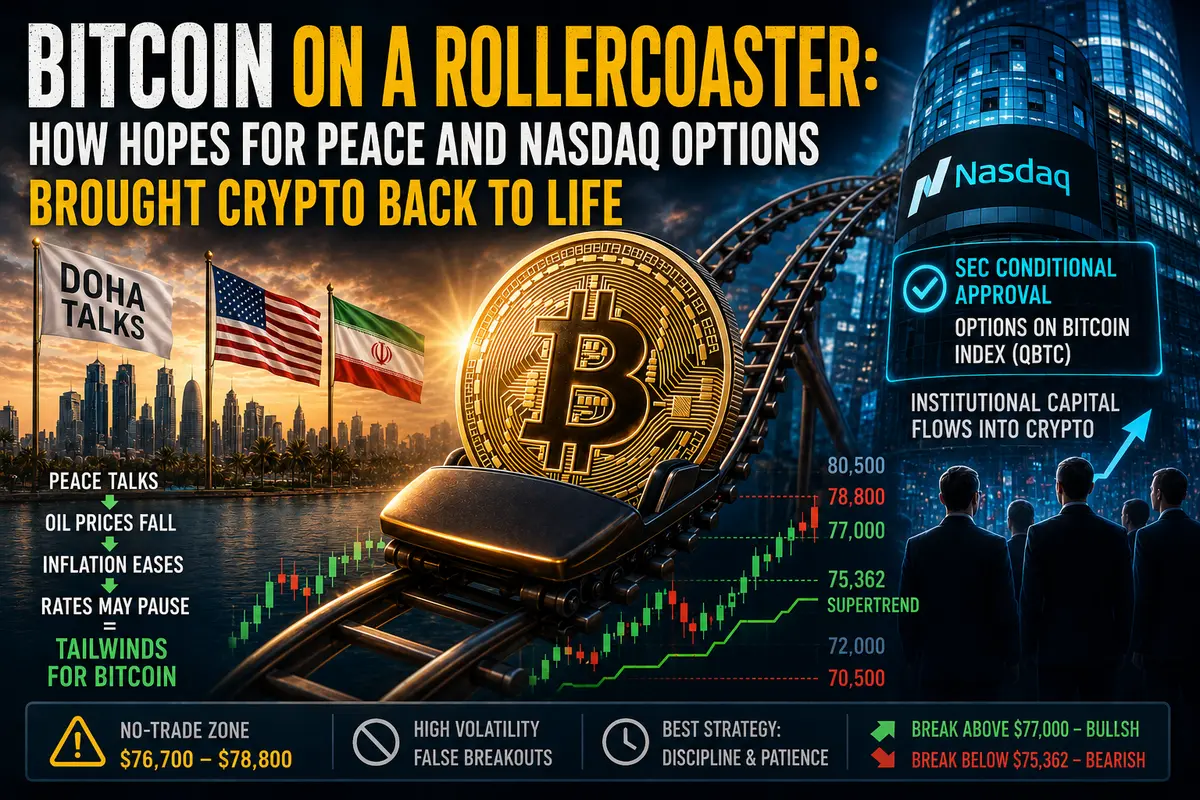
Monday began with a number that still seemed lost on Saturday: seventy-seven thousand dollars. A round, psychologically important level from which the world’s leading cryptocurrency bounced back after falling to seventy-four thousand three hundred over the weekend. A market that was licking its wounds yesterday is once again looking upward today. And there are at least two reasons for it: one rooted in geopolitics, the other in institutional finance. Together, they created the perfect cocktail that pulled Bitcoin out of the pit and forced traders to rethink the near-term outlook.
Iranian Optimism: How Peace Talks Are Moving Crypto
The connection between Bitcoin and negotiations in Doha is not obvious at first glance. But dig deeper, and the logic becomes clear. Hopes for a peace agreement between the United States and Iran, which emerged over the weekend, imply the potential reopening of the Strait of Hormuz. Reopening the strait means restoring oil supplies. Restored supplies mean lower energy prices. Lower energy prices mean weaker inflationary pressure. And weaker inflation means the Federal Reserve may not need to tighten policy further or raise rates.
For Bitcoin, which has spent recent months suffocating under fears of persistently high interest rates, this chain reaction is like a breath of fresh air. High rates crush appetite for risk assets. Investors move into bonds, the dollar, and anything offering guaranteed yield. Cryptocurrency, which generates no cash flow, suffers first in such an environment. But the moment there is hope for easier monetary policy, capital starts flowing back in.
Of course, geopolitical optimism is fragile. We have seen how quickly it can evaporate. One strike on Iranian facilities, one harsh statement from Tehran, one Trump tweet — and Bitcoin could tumble again. But on Monday, the market chose to focus on the bright side. Talks are ongoing, progress is being reported, hope remains alive. And Bitcoin is pricing in that hope.
Nasdaq and Options: The Institutional Bridge to Bitcoin
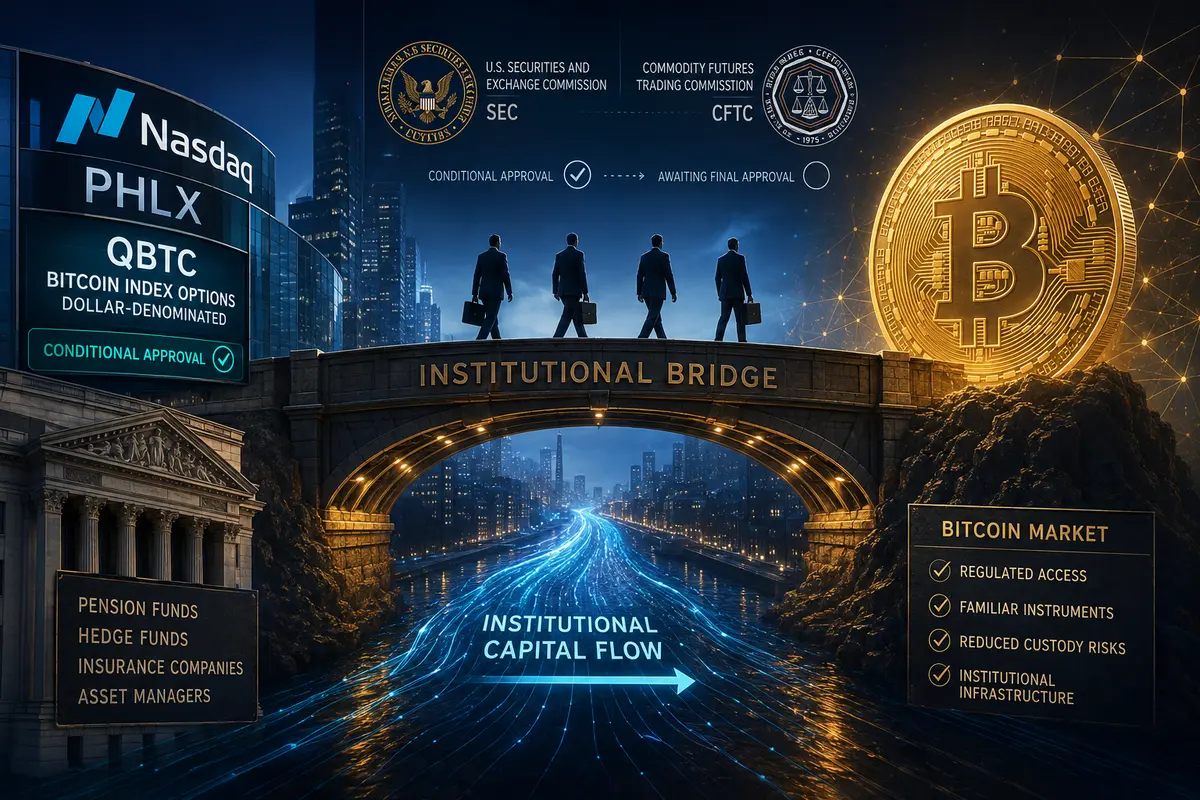
The second piece of news pushing crypto higher came from the world of traditional finance. Nasdaq PHLX received conditional approval from the U.S. Securities and Exchange Commission to list dollar-denominated options on a Bitcoin index under the ticker QBTC. The exchange is now waiting for final approval from the Commodity Futures Trading Commission.
It may sound like a bureaucratic technicality, but in reality this is a tectonic event. Bitcoin index options traded on a regulated U.S. exchange represent the very bridge institutional capital has been waiting for to enter crypto without worrying about custody risks or the complexities of cold wallets. Pension funds, hedge funds, insurance companies — all of them gain a familiar instrument for betting on Bitcoin’s price movements through established financial infrastructure.
The inflow of institutional capital into crypto derivatives, noted by analysts, is a direct consequence of these developments. Smart money sees that the regulatory infrastructure is maturing and is beginning to move in. And this is the type of demand that does not disappear at the first correction. Institutions do not panic, dump positions on stop-losses, or react to every tweet. They enter seriously and for the long term. Their presence changes the very structure of the market, making it more mature and less volatile.
The Technical Picture: Bitcoin in a Trap
But if we step away from the fundamentals and look at the charts, the picture becomes far less optimistic. WarrenAI, an analytical tool scanning technical indicators, paints a deeply conflicting outlook. Bitcoin is trapped in a tight corridor between support and resistance, and neither bulls nor bears can take control.
On the downside, price is supported by the dynamic SuperTrend line at seventy-five thousand three hundred sixty-two dollars. This is the boundary separating the current correction from a full-scale collapse. As long as the price remains above this line, the market structure stays bullish. But overhead sits a heavy cluster of moving averages — the 20-day and 50-day averages lie between seventy-eight thousand eight hundred and eighty thousand five hundred dollars. Bitcoin has failed to break through this zone for weeks. Every attempt ends in another pullback.
The MACD indicator signals weakening upward momentum. Price cannot establish itself above the key moving averages. The Ichimoku Cloud, beneath which price still trades, remains bullish for now, but its thickness is shrinking. Altogether, it creates the image of a market stuck in uncertainty.
The technical analysis dashboard itself looks almost schizophrenic. On short timeframes, algorithms scream “strong buy.” On daily, weekly, and monthly horizons, the signal is merely “neutral.” Basic indicators even point toward weakness. This is the classic situation where the best trade may be no trade at all.
The “No-Trade Zone” and the Lesson of Discipline
WarrenAI identifies the range between seventy-six thousand seven hundred and seventy-eight thousand eight hundred dollars as a “no-trade zone.” That does not mean money cannot be made there. It means the risk-to-reward ratio is so unfavorable that a rational trader should stay away.
Bitcoin’s daily swings, measured by the ATR indicator, are around eighteen hundred dollars. That is high volatility even by crypto standards. In such an environment, false breakouts happen constantly. Price can pierce a level, lure traders into positions, and reverse immediately. It is the kind of “whipsaw” action that wipes out the most impatient market participants.
According to the algorithm, the best strategy right now is discipline and patience. Conservative investors should consider long positions only if Bitcoin confidently secures itself above seventy-seven thousand dollars — and not just briefly, but with confirmation from daily candle closes. Until that happens, every entry is essentially a guessing game.
On the other hand, if Bitcoin breaks below the SuperTrend support at seventy-five thousand three hundred sixty-two dollars, it would become a powerful bearish signal. The first downside target in that scenario would be around seventy thousand five hundred dollars. Not a catastrophe, but a meaningful decline that could trigger cascades of stop-losses and margin calls.
Between Geopolitics and Technical Analysis
On Monday, Bitcoin found itself in a unique position. Fundamental forces — geopolitical optimism and institutional developments — are pushing it higher. Technical indicators are pointing lower. No one knows which side will win this battle. That uncertainty is exactly what makes the cryptocurrency market both attractive and dangerous.
The main lesson of the current moment is simple: the best trades happen outside zones of uncertainty. Trying to predict direction inside a narrow range is not trading — it is gambling. And those who understand this are sitting in cash right now, waiting. Waiting for Bitcoin either to break resistance and signal a new rally, or to lose support and open the door to a deeper correction. Everything else is just noise. And the crypto market always has plenty of noise.

Comments
No comments yet. Be the first to share your thoughts!
Authentication Required
You must be logged in to post a comment.