

Oil Reflex: WTI Climbs Again as the World Digests the Iranian Strikes
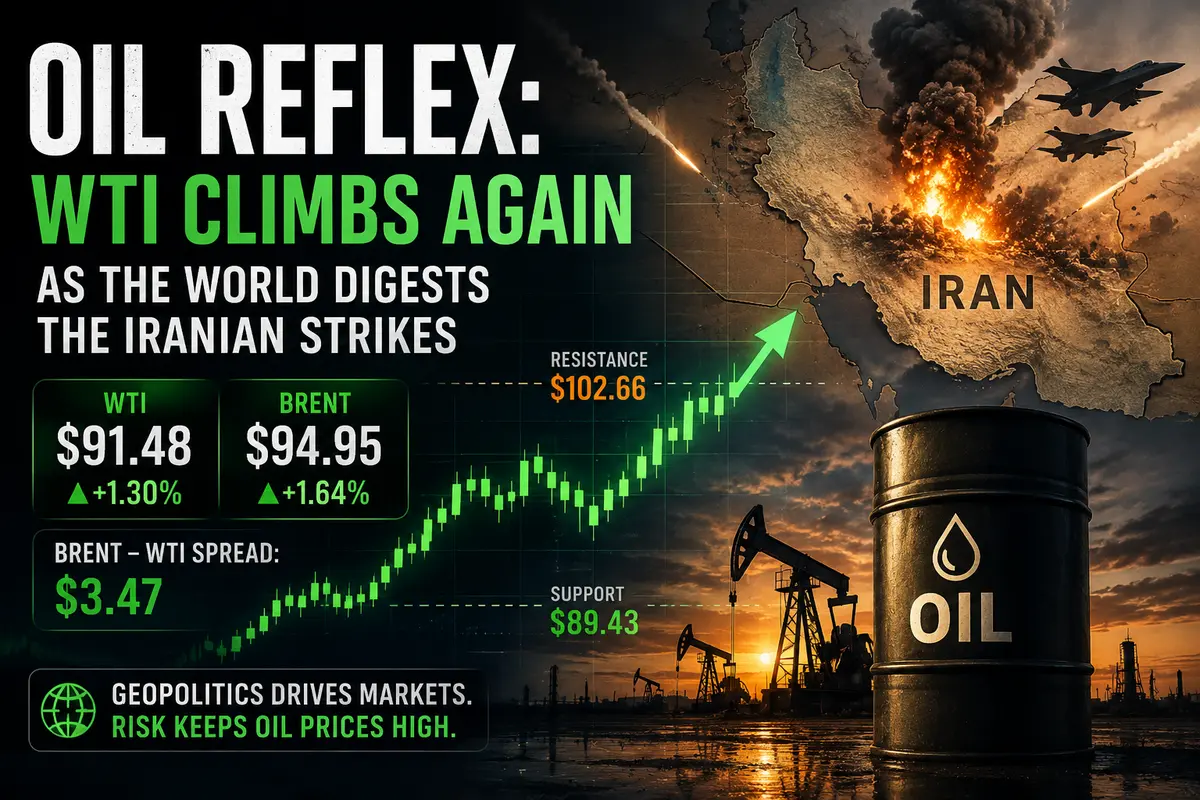
Tuesday’s Asian session painted oil prices firmly green. July WTI futures rose 1.3%, reaching $91.48 per barrel. The move was not explosive, but the direction was unmistakable. After Sunday’s hopes for peace and Monday’s collapse in oil below $100, the market has once again switched into “buy the fear” mode. The reason is obvious: renewed U.S. strikes on Iran on Monday forced traders to reassess their recent optimism and restore the geopolitical premium they had so eagerly removed from the price of a barrel.
Between $89 and $103: Oil Searches for Balance
The technical picture drawn by Tuesday’s WTI quotes resembles a classic rebound from support. The $89.43 level became the point where sellers ran out of momentum. Oil, which had plunged on Monday amid hopes for a peace agreement, hit that floor and bounced higher. Resistance near $102.66 looms overhead, separating the current range from the territory oil occupied during the hottest days of the conflict. This corridor — between $89 and $103 — is the zone of uncertainty in which the market will remain until the situation around Iran becomes clearer.
A 1.3% rise during the session is not panic buying. It is more a cautious digestion of the news. Traders are not rushing to buy barrels at any price as they did in the first days of the war. Instead, they are methodically pricing in higher risk. The strikes on southern Iran reported on Monday are not the beginning of a full-scale ground operation. They are targeted actions that, despite their seriousness, still leave room for diplomacy. But they also serve as a reminder that diplomacy is not a substitute for war — it is often its continuation by other means. And as long as bombs are falling, even while negotiations continue in parallel, the oil market will continue pricing in the possibility of further escalation.
Brent Catches Up: The Spread Narrows
August Brent futures rose even more confidently — up 1.64% to $94.95 per barrel. The spread between Brent and WTI stood at $3.47. That matters. Just a few weeks ago, during the height of the Strait of Hormuz crisis, the spread between the two benchmarks reached $7–8. Brent, as the global benchmark most sensitive to Middle Eastern disruptions, traded at a massive premium to U.S. WTI.
The narrowing of that spread to roughly three and a half dollars suggests the market no longer sees a catastrophic gap in oil availability between regions. Yes, the risk remains. Yes, supplies from the Persian Gulf are still disrupted. But the world has partially adapted, logistics chains have adjusted, and the panic characteristic of the war’s first weeks has faded.
Nevertheless, the very fact that Brent continues to rise and the spread remains positive shows that the geopolitical premium has not disappeared. It has simply compressed to more realistic levels. And any new escalation could easily inflate it back to previous extremes.
The Dollar Stepped Back — But Did Not Leave
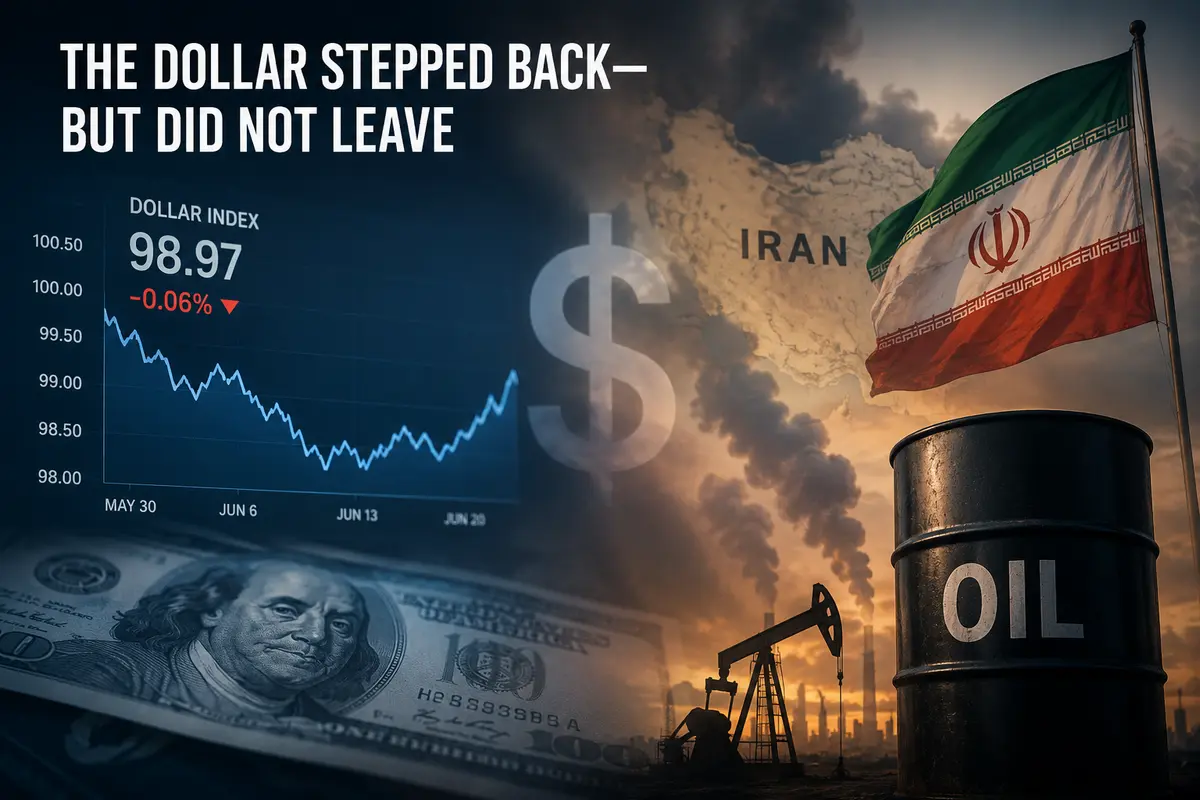
The dollar index, which slipped slightly on Tuesday by 0.06% to 98.97, is sending mixed signals. On one hand, a weaker dollar should support oil prices by making crude cheaper for holders of other currencies. On the other hand, the decline is so minor that it is hard to speak of any meaningful impact. The dollar remains near recent highs and historically strong, continuing to exert background pressure on commodity markets.
But in the current environment, oil traders are not watching the dollar. They are watching headlines from Iran. Macroeconomic factors have taken a back seat to geopolitics. And that will likely continue until the conflict reaches some form of resolution — whether through a peace agreement or a full-scale escalation.
Monday’s Strikes: What Exactly Happened?
The new U.S. strikes on facilities in southern Iran, reported Monday, were a cold shower for markets that had begun believing in imminent peace. Just over the weekend, Trump had spoken about a memorandum that was “mostly agreed.” Negotiation progress was widely reported Sunday. By Monday morning, oil had fallen below $100 and traders were celebrating a return to normality.
Then came the bombs.
Iranian officials reacted sharply, warning that any attacks on military facilities would trigger retaliation. That means the conflict is not only continuing but entering a phase where every action provokes a counteraction. U.S. strikes provoke an Iranian response, which in turn invites further American strikes — a cycle feeding itself. In such an atmosphere, hopes for a peace deal remain only hopes, while oil traders are forced to keep a substantial risk premium embedded in prices.
At the same time, it is important to understand that strikes on southern Iran do not necessarily mean the end of negotiations. Military force and diplomacy often move hand in hand, especially in Middle Eastern conflicts. One side applies pressure through bombs to strengthen its negotiating position. The other threatens retaliation to show it cannot be coerced by force. It is bargaining with extraordinarily high stakes — and oil prices are the visible indicator of that bargaining process.
When prices rise, the market believes negotiations are stalling. When prices fall, hope for a breakthrough emerges.
Asian Session: Quiet Digestion
Tuesday’s Asian trading session remained relatively calm. Volumes were moderate, and no violent swings occurred. Oil moved higher, but it did not explode upward. Traders seemed to pause and assess exactly what happened Monday and what consequences it might have for the negotiation process.
That pause could prove short-lived. If fresh headlines emerge in the coming hours — whether about an Iranian response, new strikes, failed talks, or renewed diplomacy — oil prices could make sharp moves in either direction. For now, the market has chosen cautious optimism adjusted for risk. WTI around $91 and Brent near $95 reflect a scenario where “the war continues, but does not expand.” It is not catastrophe, but neither is it peace. It is the suspended state in which markets have learned to operate over recent months.
Oil has once again proven itself to be the most sensitive barometer of geopolitical tension. Monday’s strikes on Iran erased the discount that had formed on hopes for peace. WTI and Brent returned to levels reflecting reality: the conflict is not over, diplomacy is stumbling, and the Strait of Hormuz remains a zone of risk.
Yet the market is not panicking. It is methodically pricing in every new fact, every new strike, every new statement. And it will continue doing so until one morning the world wakes up to find that the war has truly ended. When that will happen, nobody knows. But as long as bombs continue to fall, oil will remain more expensive than consumers from Tokyo to London would like. That is the harsh mathematics of conflict — and Tuesday’s Asian session merely confirmed it.

Comments
No comments yet. Be the first to share your thoughts!
Authentication Required
You must be logged in to post a comment.