

The Pharaohs’ Treasure Hunt: How Egypt Plans to Redraw the Map of Its Subsoil Wealth
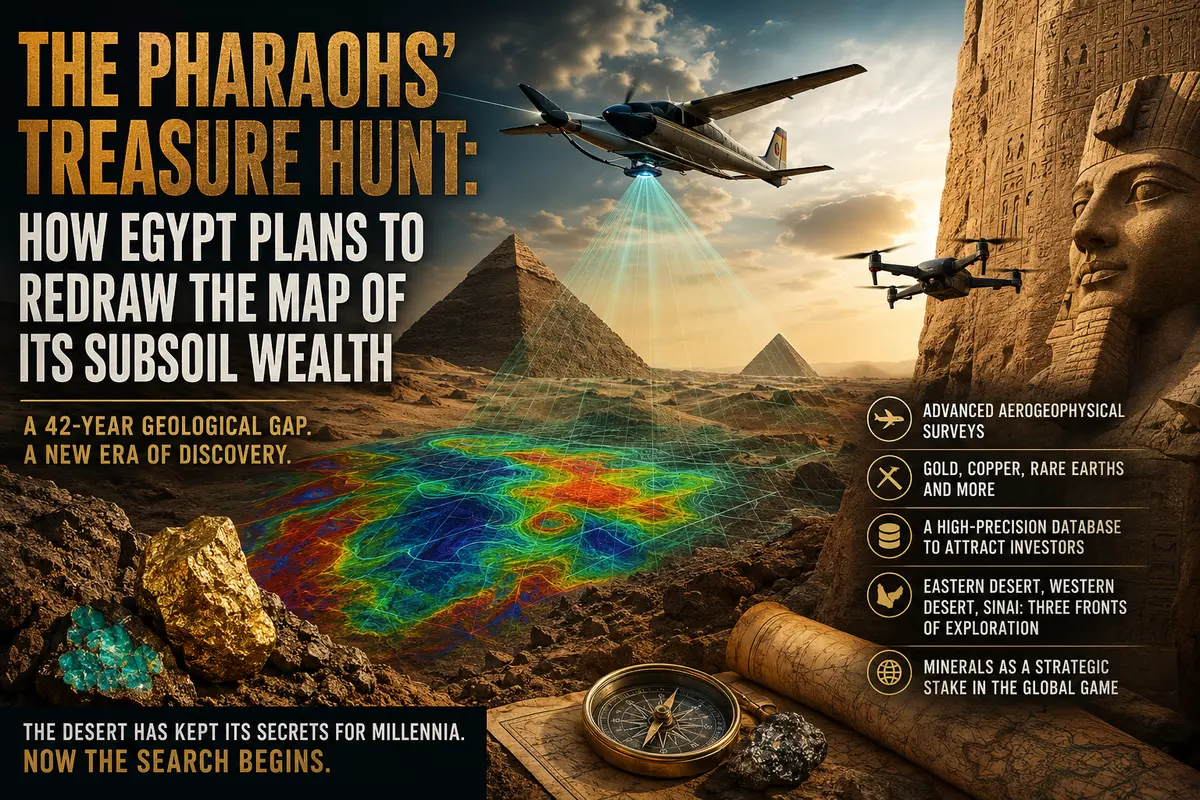
Forty-two years is not just a number. It is more than half a human lifetime. In that span, the world moved from rotary phones to smartphones, from typewriters to artificial intelligence, from the Cold War to war with Iran. Yet in Egypt, one crucial sector remained frozen in time throughout all those decades. A country whose gold mines supplied precious metal for the tombs of pharaohs, whose quarries produced copper and turquoise for queens’ jewelry, whose stone pits provided material for the pyramids, had not carried out a single comprehensive airborne survey of its mineral wealth for more than four decades. Now, that paradox is coming to an end. Egypt has announced a large-scale mineral exploration initiative, a decision that could transform not only the country’s economy but also the entire geological map of North Africa.
Xcalibur and Drones Over the Desert: How the Treasure Hunt Will Work
Egypt’s Minister of Petroleum and Mineral Resources, Karim Badawi, personally attended the signing ceremony — and this was far more than a ceremonial gesture. For Cairo, the project carries strategic importance. The contractor selected for the mission is Xcalibur Smart Mapping, one of the world’s leading companies in airborne geophysical surveying, with experience across every continent. The company will work alongside Egypt’s Nuclear Materials Authority and the local firm Drone Tech. The consortium is carefully balanced: global expertise, state oversight of nuclear materials, and domestic technological capability.
The technologies involved have advanced dramatically since the early 1980s, when Egypt last conducted anything comparable. Modern airborne geophysical exploration is far more than aerial photography. It is a sophisticated combination of magnetic surveys, gravimetry, electromagnetic sounding, and gamma spectrometry. Aircraft or drones equipped with this technology fly over targeted areas while instruments detect even the slightest anomalies in Earth’s magnetic field, gravity, and rock conductivity. These anomalies reveal what lies underground: metallic ore deposits, underground water reservoirs, geological formations that may contain oil or gas.
The territories to be surveyed include the Eastern Desert, the Western Desert, and the Sinai Peninsula. Together, these regions cover hundreds of thousands of square kilometers, much of it extremely difficult terrain — rocky outcrops, sand dunes, and mountain ranges. Conducting geological surveys on the ground under such conditions would require years of work, enormous expenses, and significant risks to personnel. Airborne surveys can gather in months the amount of data that would otherwise take decades to collect.
A Database That Could Change the Rules of the Game
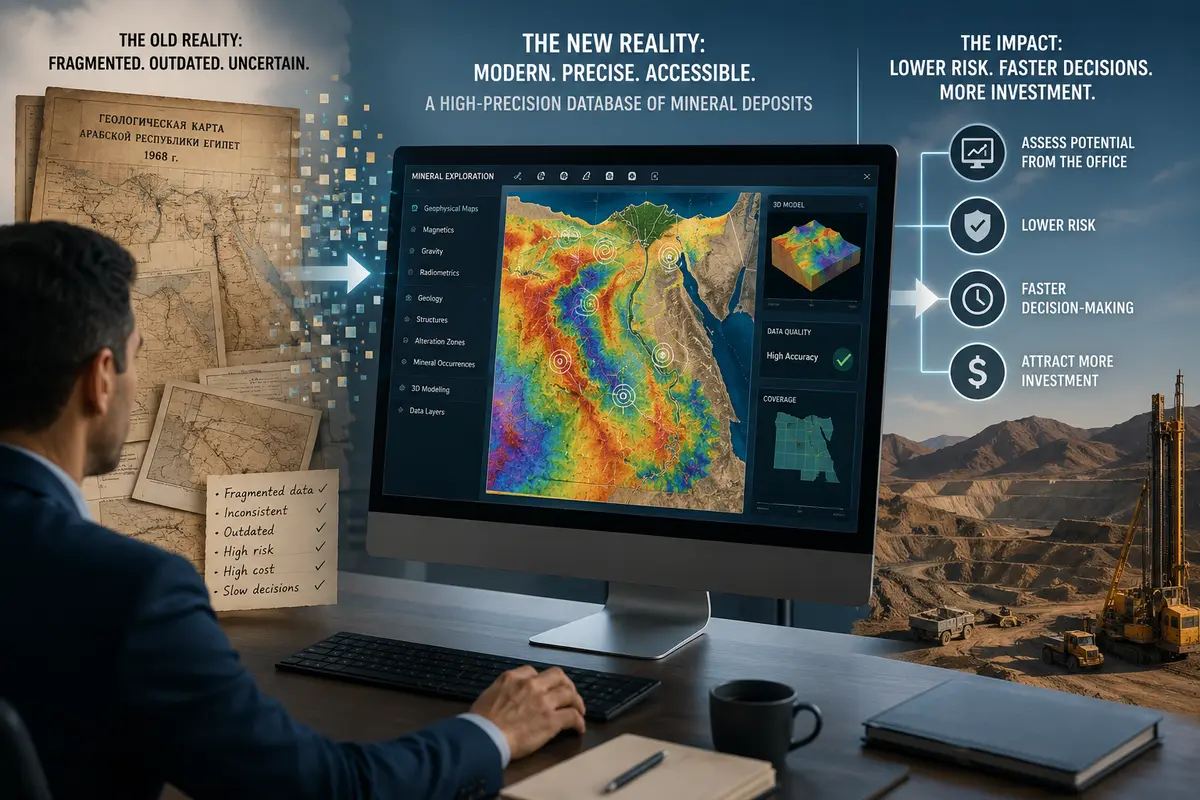
Karim Badawi emphasized that the project would create a “modern, high-precision database of mineral deposits.” That may sound like bureaucratic language, but in reality it represents a revolution in Egyptian mining.
Today, any investor considering mineral exploration in Egypt faces an information vacuum. Geological data are fragmented, scattered, and often outdated. Many maps were compiled decades ago — some by Soviet specialists working in Egypt during the Nasser era. To determine whether a particular area is worth investing millions of dollars in, companies either have to rely on intuition or spend enormous sums on preliminary surveys. Both options discourage investors.
The new database could radically change that situation. High-precision geophysical maps available to potential investors would allow them to assess the viability of deposits without leaving their offices. This lowers risks, accelerates decision-making, and ultimately attracts capital. That is precisely what Badawi is referring to when he says investors will be able to identify commercially viable deposits more quickly and with less risk.
Pharaohs’ Gold and Modern Bureaucracy
Egypt possesses one of the oldest mining traditions in the world. Gold mines in the Eastern Desert were already operating in predynastic times. Under the pharaohs of the Old Kingdom, gold flowed abundantly: it decorated sarcophagi, formed burial masks, and was sent abroad as tribute to allied states. The Nubian mines controlled by Egypt became the Mediterranean world’s primary source of gold. Copper from Sinai was used for tools and weapons. Turquoise from the Serabit el-Khadim mines adorned queens’ headdresses. Ancient Egypt was a mining superpower of its era.
The paradox is that despite all this historical wealth, modern Egypt remains largely underdeveloped in terms of mineral extraction. Gold is mined, but production remains far below the country’s potential. Many promising areas have never been thoroughly explored. Foreign investors who could bring both capital and technology were long discouraged not only by geological uncertainty but also by regulatory barriers.
Six years ago, Cairo began implementing reforms. New regulations were introduced limiting fees imposed on mining companies. More importantly, the government abolished the requirement forcing foreign investors to establish joint ventures with the state. That requirement, common in many developing countries, had long been one of the main obstacles to investment. International mining giants were unwilling to share control and profits with state entities whose efficiency often left much to be desired. Removing mandatory joint ventures sent a clear signal: Egypt was open for business.
Combined with the new geological database, those reforms could now produce a cumulative effect. Investors gain both transparent rules and a clearer understanding of what lies beneath the ground. That combination is exactly the kind of magnet that attracts capital.
Eastern Desert, Western Desert, Sinai: Three Fronts of Exploration
The three regions included in the project represent three very different geological provinces.
The Eastern Desert is part of the Arabian-Nubian Shield, an ancient crystalline formation rich in gold, copper, silver, and rare earth elements. This is where Egypt’s legendary gold mines have operated since antiquity. Modern surveys may uncover entirely new deposits previously unknown.
The Western Desert, part of the Sahara, is a vast sedimentary basin traditionally associated with oil and gas but also believed to contain mineral resources such as phosphates, iron ore, and possibly uranium. Geophysical surveys could identify underground structures that hold water reservoirs — an issue no less important for Egypt, with its growing population and mounting water shortages, than mineral extraction itself.
The Sinai Peninsula is a geological bridge between Africa and Asia, a zone with a highly complex tectonic history. Manganese and copper are already mined there, but Sinai’s potential is far from exhausted. Political instability and terrorist activity in parts of the peninsula have long hampered geological exploration. Airborne methods, which do not require a permanent human presence on the ground, offer a way around that problem.
The Geopolitical Dimension: Minerals as Stakes in a Global Game
Egypt’s initiative does not exist in a vacuum. The world is undergoing a global restructuring of supply chains for critical minerals. Rare earth elements, lithium, cobalt, graphite — everything needed for green energy and electronics — has become the focus of fierce competition among major powers. China dominates rare earth processing. The United States and Europe are scrambling to find alternative sources. Africa, with its immense mineral wealth, has become central to this struggle.
By launching this exploration effort now, Egypt is making a strategic bet. If significant reserves of rare earth elements or other critical minerals are discovered in the Eastern Desert or Sinai, Cairo could instantly become a major player in the global resource game. Investors who currently avoid Chinese rare earth projects because of geopolitical risks may turn to Egypt as an alternative.
The first large-scale mineral exploration project in forty-two years is therefore not merely a technical undertaking. It is a declaration of intent. Egypt is signaling that its subsoil riches — which sustained pharaohs for millennia — have not yet spoken their final word. And if Xcalibur and its partners find what they are looking for, the economic map of North Africa could change beyond recognition.
For now, aircraft equipped with geophysical instruments are preparing to fly over deserts that have guarded their secrets since long before humanity invented writing. The silence of the sands is about to be broken by the roar of engines. And that roar may herald the beginning of a new era for a country that was once the granary and treasure house of the ancient world.

Comments
No comments yet. Be the first to share your thoughts!
Authentication Required
You must be logged in to post a comment.