Bar Pipa
We pay for a post of 10$

Bank of Japan

Yen Tests the 160-per-Dollar Level Amid Intervention Threats

Yen Tests the 160-per-Dollar Level Amid Intervention Threats
The line that must not be crossed

The silence during Wednesday’s Asian trading session was tense. Not the kind of silence where nothing happens, but the kind where everyone holds their breath and stares at a single number on their screens: 160. Three digits that, for the Japanese yen, matter more than any economic forecast or government report.

The dollar-yen exchange rate hovered around 159.9. It was like standing at the edge of a cliff and looking down. One step forward, and you're at 160 — precisely the level Japanese authorities deemed unacceptable back in April.

Four months ago, Japan’s Ministry of Finance woke up to a yen trading at 160 and launched a currency intervention on a scale the country had not seen in decades. Officials spent a record ¥11.5 trillion — nearly $73 billion — defending the currency. It was the largest single-round intervention in modern Japanese history.

But markets are notoriously stubborn. The impact proved short-lived. As soon as Japanese officials breathed a sigh of relief and congratulated themselves, the dollar resumed its slow, relentless advance. And today, the 160 level was briefly touched again. Only for a few minutes — but those few minutes were enough to make thousands of traders around the world forget about their coffee and everything else.

Why the Yen Is Falling Again: Three Pillars of Weakness

There are several explanations, rooted not in emotion but in the hard realities of global finance.

1. U.S. Interest Rates

The most obvious factor is U.S. monetary policy. The Federal Reserve has made it clear that it is in no rush to cut interest rates. Contrary to gloomy predictions, the U.S. economy continues to show remarkable resilience.

Labor market data surprised analysts with stronger-than-expected job openings, while consumer spending has softened only modestly...

Continue reading...
0
0

Dollar Back in the Saddle: Strikes on Iran and Inflation Fears Push Asian Currencies Lower

Dollar Back in the Saddle: Strikes on Iran and Inflation Fears Push Asian Currencies Lower

Thursday’s Asian trading session opened with news that, while increasingly familiar in recent weeks, remains deeply unsettling. U.S. armed forces launched another round of strikes on targets in southern Iran — the second such operation in a week. Markets reacted instantly and predictably: a rush into the dollar. The U.S. dollar index edged higher, Asian currencies fell into negative territory, and oil prices surged. All of this is unfolding on the very day the Federal Reserve is set to release its preferred inflation gauge — the PCE index. Thursday is shaping up to be a volatile one.

Second Strike in a Week: Why Bombs Move Currencies

Whenever the U.S. strikes Iranian targets, currency markets tend to follow the same script. The dollar rises, while nearly every other currency weakens. This has little to do with patriotism or confidence in American military power. It is simply cold financial logic.

Conflict involving Iran threatens oil supplies. Disruptions in oil supplies drive energy prices higher. Rising energy costs fuel inflation. Higher inflation, in turn, forces the Federal Reserve to keep interest rates elevated — or even raise them further. And high interest rates make the dollar more attractive to investors searching for yield.

But on Thursday, another element was added to this familiar chain reaction. President Trump personally rejected recent reports suggesting Iran was prepared to reopen the Strait of Hormuz within thirty days. That statement dealt a blow to the fragile optimism that had supported markets over the past few days. Investors who only yesterday hoped for a near-term peace agreement are now being forced to admit that the conflict may drag on. And a prolonged conflict means prolonged inflation. Prolonged inflation means rates staying higher for longer.

Markets have largely abandoned hopes for a quick resolution, and safe-haven capital is pouring...

Continue reading...
0
0

Diplomacy in Ruins: How a New Strike on Iran Restored the Dollar’s Strength and Brought Fear Back to Markets

Diplomacy in Ruins: How a New Strike on Iran Restored the Dollar’s Strength and Brought Fear Back to Markets

Monday ended with explosions. By Tuesday, markets woke up in a different world — one where hopes for imminent peace, which had lifted Asian stocks and currencies just a day earlier, were shattered by the harsh reality of military force. The United States carried out strikes on targets in southern Iran. Although details remain scarce and official statements cautious, that alone was enough for the markets. The dollar resumed its climb. Oil surged alongside it. Asian currencies, which had celebrated gains on Monday morning, came under pressure by Tuesday. The geopolitical pendulum swung back — and this time, those who had rushed to believe in peace were the ones falling.

Strikes on Southern Iran: What We Know and Why It Matters

Reports of new U.S. strikes on Iranian facilities emerged on Monday. The targets were located in the south of the country — a region strategically important both for Iran’s military infrastructure and for control over the Persian Gulf coastline. Details of the operation remain classified, but the mere resumption of military action after several days of intense negotiations suggests either that diplomacy has hit a dead end or that talks are being used as cover for continued military pressure.

Iranian officials reacted immediately. Their warning was blunt and unequivocal: any attacks on the country’s military facilities would trigger retaliation. This was not rhetoric — it was a promise of escalation. Markets interpreted it exactly that way: as a signal that the conflict is far from over and that the risks of a new spiral of violence are growing by the hour.

The contrast with the mood over the weekend could not be sharper. As recently as Saturday and Sunday, Trump had spoken about a memorandum that was “mostly agreed upon,” about reopening shipping routes through the Strait of Hormuz,...

Continue reading...
0
0

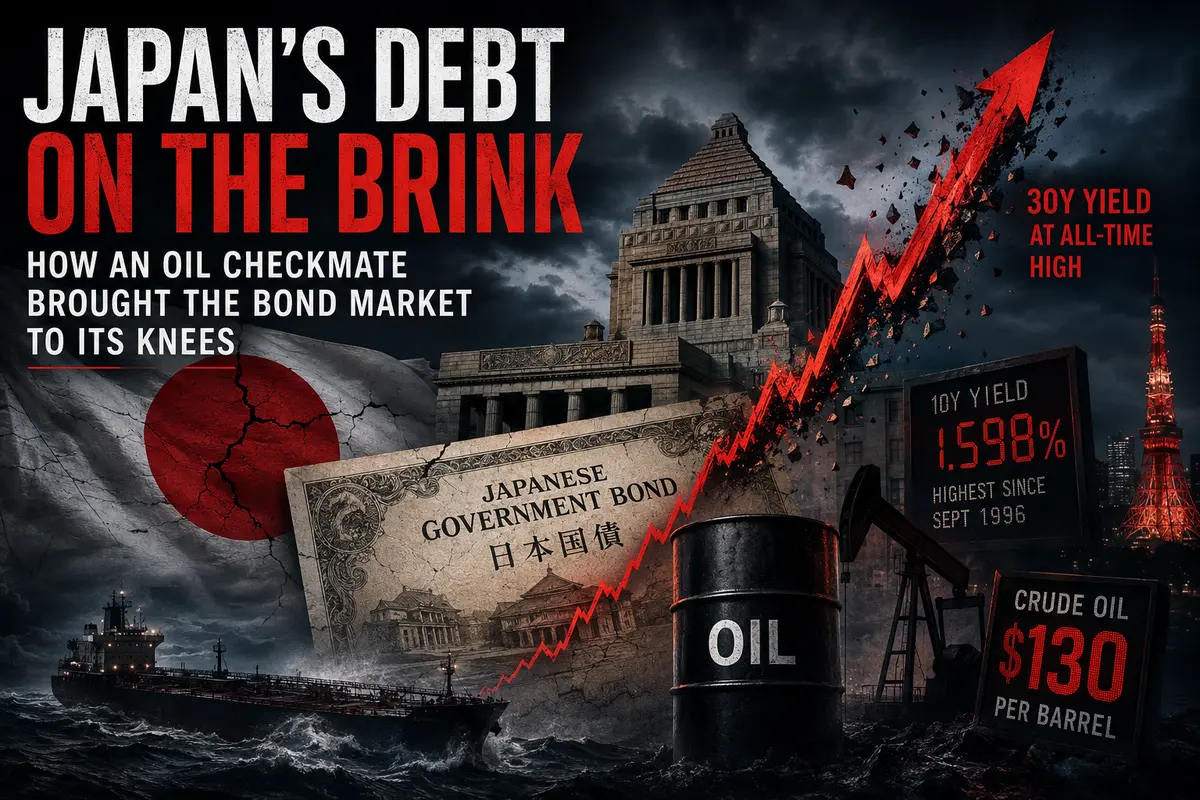
Japan’s Debt on the Brink: How an Oil Checkmate Brought the Bond Market to Its Knees

Japan’s Debt on the Brink: How an Oil Checkmate Brought the Bond Market to Its Knees

The global bond selloff, which two weeks ago looked like a chaotic stampede for the exits, has eased somewhat in recent days. But that does not mean the fire has been extinguished. Rather, the flames have spread elsewhere, and now the fiercest blaze is raging in a market that for decades was considered a bastion of stability. Japanese government bonds are facing a moment of truth. Yields on ten-year bonds have surged to levels unseen since September 1996 — an era when Bill Clinton was president of the United States and the word “smartphone” did not yet exist. Thirty-year bond yields have reached an all-time record high. And this is happening not just anywhere, but in Japan — a country that spent decades battling deflation and whose bonds seemed like a permanent refuge of calm. Now that refuge is beginning to crack.

The Reflation Trade: How a Longstanding Bet Ran Out of Steam

In recent years, Japan’s debt market has lived in a reality unlike that of other developed nations. While the Federal Reserve, the ECB, and the Bank of England fought inflation by raising interest rates, the Bank of Japan stubbornly maintained an ultra-loose monetary policy. This gave rise to the so-called “reflation trade” — investors betting that Japan would finally escape its deflationary spiral, inflation would begin to rise, and the central bank would eventually be forced to normalize policy. It was a profitable trade: Japanese bonds fell in price, yields crept higher, and traders made money.

But now, as Thomas Mathews of Capital Economics warns, that trade is nearing a critical point. “Most of the recent rise in yields has been benign,” he wrote in a recent note. In other words, the market had gradually priced in normalization, and that was considered a healthy process. But now,...

Continue reading...
0
0

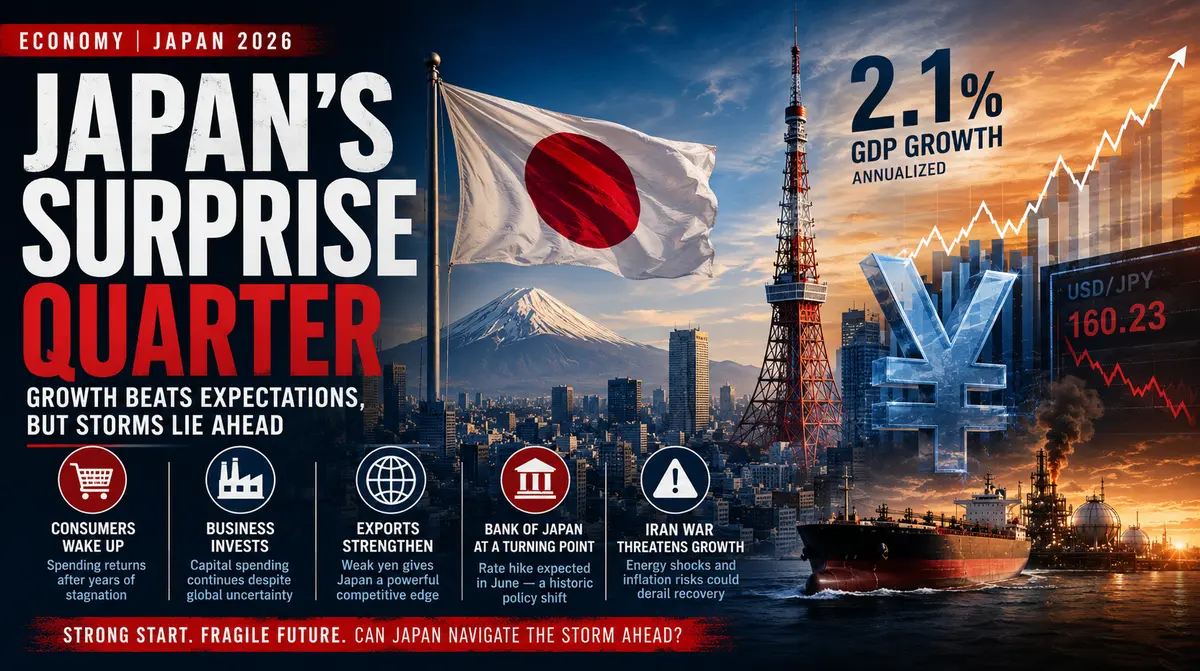
A Quarter That Shocked the Skeptics

A Quarter That Shocked the Skeptics

Japan has spent so many years being described as a stagnant economy that even modest growth now feels like a surprise. For decades the country was treated as the textbook example of what happens when demographics deteriorate, consumers stop spending, and deflation becomes embedded in national psychology. Economists built entire careers around explaining why Japan could no longer grow the way it once did.

And then the first-quarter GDP numbers arrived.

On paper, the figures may not look explosive by the standards of fast-growing emerging markets. But for Japan, they were remarkable. Annualized GDP growth accelerated to 2.1 percent, significantly above expectations and far stronger than the previous quarter’s revised 0.8 percent. Quarterly growth came in at 0.5 percent, also beating forecasts. Those are not numbers associated with an economy supposedly trapped in permanent paralysis.

What makes these results important is not just the headline growth itself. It is the composition of that growth. Japan is not being carried by a single temporary factor. Consumption improved. Investment remained positive. Exports strengthened. Inflation stayed elevated. In other words, several engines of the economy started moving at the same time.

That combination matters because Japan has spent years trying to escape a vicious cycle in which weak demand led to falling prices, falling prices encouraged consumers to delay purchases, and delayed spending weakened growth even further. Breaking that cycle was the central mission of the Bank of Japan for more than a decade.

Now, for the first time in years, there are signs that the psychology of the country may actually be changing.

The Most Important Story: Consumers Are Spending Again

The biggest development inside the GDP report was private consumption. It rose by 0.3 percent after stagnating in the previous quarter. In many economies, that would barely attract attention. In Japan,...

Continue reading...
0
0
Tom Maffin

The Dollar Catches Its Breath After the Bond Storm

The Dollar Catches Its Breath After the Bond Storm

Tuesday morning on the currency market began in relative calm. The U.S. dollar index and dollar futures stabilized during Asian trading, offering a long-awaited pause after several days of relentless selling in the bond market that had dragged virtually every other asset down with it. Investors, exhausted by surging yields and constant repricing of interest-rate expectations, stepped back to reassess the situation and consider what might come next.

Two factors helped trigger this temporary relief.

The first was a technical correction in the Treasury market. Yields on 10-year U.S. government bonds fell by half a percentage point from levels that had hovered near yearly highs just a day earlier. Thirty-year yields dropped by two-tenths of a percentage point after coming within arm’s reach of their highest levels in nineteen years. Nineteen years ago is so far back that many traders sitting at their terminals today were still in school — or had not even considered a career in finance.

The second factor was oil. The bond selloff eased alongside declining energy prices. The reason for that decline has a name: Donald Trump. The American president stated that he had postponed a planned military operation against Iran and that negotiations were progressing successfully. Markets, which had spent recent weeks bracing for the possibility of another Middle East war, interpreted the statement as a cautiously optimistic signal. Oil moved lower, and bonds calmed down with it.

Still, this calm remains highly conditional. Oil prices continue to hold onto much of their recent gains, and the inflationary consequences of the Iranian conflict have not disappeared. Markets remain tense — just slightly less tense today than yesterday.

The Japanese Paradox: The Economy Grows, the Yen Falls

The most intriguing story of Tuesday revolves around the Japanese yen. The dollar-yen pair rose by one-tenth of...

Continue reading...
0
0
Navigation menu