Bar Pipa
We pay for a post of 10$

Iran

Crying Wolf on Iran Cost Oil Traders the Best Setup of the Year
Crying Wolf on Iran Cost Oil Traders the Best Setup of the Year

Monday morning, the number hit the tape: 43 days of crude supply left in the United States, the lowest since the early 1980s. That's not a typo and it's not some fringe blogger's math —it's Bank of America Global Research, built off Bloomberg data, using the same days-of supply methodology the EIA has run for decades.

Inventory divided by expected refinery demand. Forty-three days against a long-term average of roughly 65.

And the market shrugged. OIL ... sat around $81 a barrel, well off the $112 highs from the last

time Iran headlines sent traders scrambling. For a few hours, one of the tightest supply

cushions in 45 years traded like a non-event.

I don't think that was calm. I think it was fatigue.

A 45-Year-Low Number Nobody Reacted To — At First

Here's the setup: fresh U.S. airstrikes on Iran, renewed chatter about the Strait of Hormuz, and a supply cushion thinner than at almost any point since the Reagan administration. On paper, that's the kind of combination that should send crude vertical within minutes.

Instead, WTI ... opened the session basically flat. Traders who'd normally jump at "Iran" in a headline just... didn't. If you'd shown me that setup a year ago without telling me the date, I'd have guessed a 5%+ pop by lunch. It didn't happen. Not immediately, anyway.

That gap between what the data said and how price actually moved is the whole story.

Why the Market Was Asleep at the Wheel

The Iran Headline Cycle Has Cried Wolf Too Many Times

This isn't the first Iran scare this year, and it won't be the last. BZUSD ... spiked to over $112 a barrel during the previous flare-up, then spent weeks grinding back down as the disruption everyone feared never fully materialized.

Traders who bought that spike and...

Continue reading...
0
0

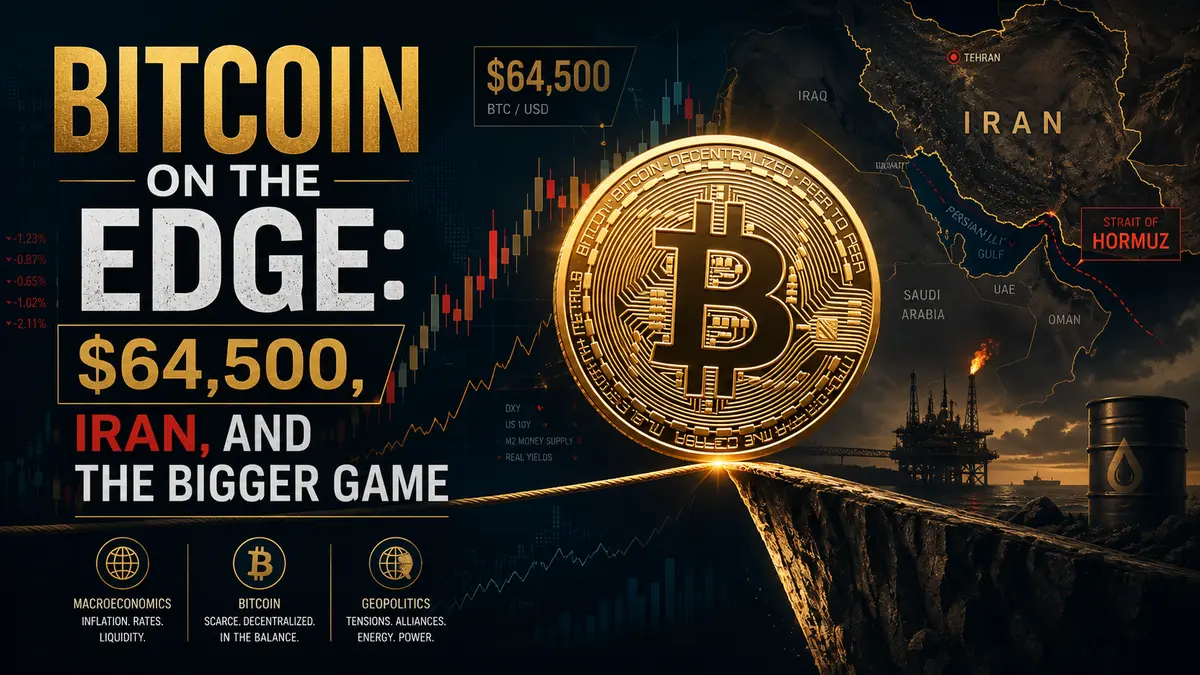
Bitcoin on the Edge: $64,500, Iran, and the Bigger Game

Bitcoin on the Edge: $64,500, Iran, and the Bigger Game

Thursday: The Crypto Market Freezes in Anticipation

Bitcoin BTCUSD ... appeared frozen in indecision on Thursday. The world’s largest cryptocurrency slipped only slightly—less than 1%—and settled at around $64,800. This followed several days of attempts to climb out of the hole it had fallen into earlier this month. Although Bitcoin has gained nearly 1.6% over the past week, the mood across the market is far from triumphant.

The problem is that cryptocurrencies are currently caught between two opposing forces. On one side are softer US inflation figures, which suggest that further interest-rate hikes may be put on hold, creating a more favorable environment for risk assets. On the other side is geopolitics, which is becoming more alarming by the day. Iran, military strikes, and the Strait of Hormuz are keeping investors on high alert and preventing them from celebrating even positive macroeconomic news.

Two Opposing Forces: Inflation and the Middle East

Let us examine exactly what is driving prices.

First, the good news: US consumer and producer inflation figures for June came in below expectations. For the market, this means that the Federal Reserve may be able to avoid rushing into further interest-rate hikes.

This is critically important for Bitcoin, which does not generate interest income. High interest rates have always put pressure on cryptocurrencies because investors prefer to keep their money in US dollar-denominated assets that offer attractive yields rather than in volatile digital assets. That source of pressure has now weakened.

However, a second and far more troubling factor has entered the picture. Exchanges of military strikes between the United States and Iran have continued for five consecutive days. Oil prices have risen, triggering a mechanism as old as the markets themselves: higher oil prices increase inflation expectations, and rising inflation may push the Federal Reserve toward tighter monetary...

Continue reading...
0
0

Rand Falls to One-Week Low Amid Tensions Around Iran

Rand Falls to One-Week Low Amid Tensions Around Iran

Introduction: The Wednesday When Geopolitics Turned Markets Around

Wednesday. Johannesburg, the JSE stock exchange. Traders who had hoped for a calm day in the morning saw their screens turn red. The South African rand, the country’s main currency, fell to its lowest level in a week. 16.3850 per dollar — a loss of about 0.5% compared with the previous close. This is not a collapse, but it is a serious decline that reflects global fear.

What happened? U.S. President Donald Trump announced the breakdown of a temporary peace agreement with Iran. And that changed everything. Iran’s Revolutionary Guards launched strikes on U.S. military facilities in Bahrain and Kuwait. The U.S. response was immediate. Geopolitical tensions in the Middle East erupted with renewed force.

For markets, this means the return of fear. Investors who had only just begun to believe in stabilization are once again fleeing into safe-haven assets. Emerging market currencies, including the rand, are coming under pressure. The dollar, by contrast, remains stable, while oil prices jump by more than 5%, reaching a two-week high.

The rand, as a typical emerging market currency, is sensitive to global risks. When geopolitical tensions rise, investors pull capital out of developing countries and move it into safer assets. This leads to currency weakness.

What comes next? Analysts expect the rand’s short-term dynamics to remain closely tied to developments in the Middle East, as well as to the release of the Federal Reserve meeting minutes scheduled for the same day. If the conflict escalates, the rand may fall even further. If the situation calms down, it may recover.

Let’s break down what is really happening, why Iran has once again become the main topic for markets, and how this affects the South African currency.

Breakdown of the Peace Agreement: What Happened

Trump Breaks...

Continue reading...
0
0
Tom Maffin

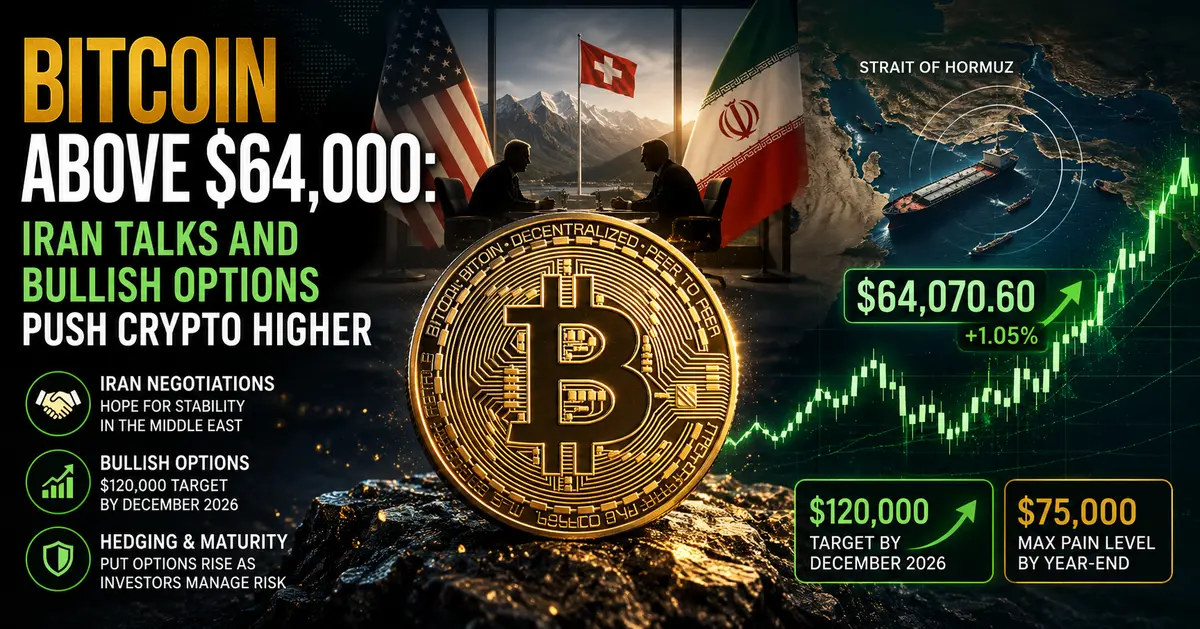
Bitcoin Above $64,000: Iran Talks and Bullish Options Push Crypto Higher

Bitcoin Above $64,000: Iran Talks and Bullish Options Push Crypto Higher

A Sunday Morning That Started in the Green

Sunday. Traditional markets are closed, but cryptocurrencies never sleep. While many people are just sipping their morning coffee, Bitcoin has already gained 1.05%, breaking above the $64,000 mark and settling at $64,070.60. After a week that left many investors on edge, seeing green on the chart feels like a breath of fresh air.

So what happened? Why has Bitcoin, which only a few days ago seemed vulnerable to every negative headline, suddenly found the strength to rally?

As has often been the case lately, the answer lies at the intersection of geopolitics and market expectations. On one side are the ongoing U.S.–Iran negotiations in Switzerland, offering the prospect of greater stability in the Middle East. On the other are options markets that continue to paint bullish scenarios, even as short-term volatility encourages traders to hedge their positions.

At the center of it all is Bitcoin, once again proving that it is more than just a digital asset—it is a complex financial instrument that reacts to macroeconomic and geopolitical signals. Let’s take a closer look at what is really driving this recovery and where the price could head next.

The Geopolitical Factor: Iran, Switzerland, and the Strait of Hormuz

Negotiations Keeping Markets on Edge

The peace agreement between the United States and Iran signed last week was met with cautious optimism. But diplomacy is a process, not an event. Now that the initial documents have been signed, the difficult part begins: negotiating the details.

Officials from both countries have met in Switzerland to transform a memorandum of understanding into something more durable and sustainable.

For markets, this is highly significant. The Middle East remains one of the world’s primary sources of geopolitical uncertainty. Any conflict in the region can trigger a surge in...

Continue reading...
0
0
Tom Maffin

Silence Before the Data: The Dollar Freezes as the World Watches Iran and U.S. Inflation

Silence Before the Data: The Dollar Freezes as the World Watches Iran and U.S. Inflation

Wednesday on the currency markets was defined by anticipation. The dollar stood still, like a predator before the leap, making no sharp moves either upward or downward. The U.S. dollar index and its futures were virtually unchanged during Asian trading, stabilizing after a brief surge earlier in the week.

But this stillness is deceptive. Beneath it lies enormous tension — traders are frozen ahead of two events capable of turning the market upside down. One is geopolitical, the other macroeconomic. And both sit at a point of maximum uncertainty.

Iran Talks: Diplomacy Through a Crosshair

The main factor preventing the dollar from falling — and at the same time keeping it from rallying — is Iran.

Negotiations between the United States and Iran over de-escalating the conflict are continuing, but no one seems to fully understand their real condition. According to media reports, indirect contacts are still ongoing even after U.S. forces struck targets in southern Iran.

It is a strange, almost surreal picture: bombs are falling while diplomats continue talking. War and peace exist simultaneously, in parallel realities.

As recently as the weekend, U.S. officials sounded optimistic. Trump spoke of a memorandum that was “largely agreed upon.” Markets celebrated, oil prices fell, and the dollar weakened.

But this week Washington’s tone has become more restrained. The strikes on Iranian facilities were presented as defensive, yet the very fact they occurred suggests the negotiating process is stalling. The sides remain stuck on key issues — the fate of Iran’s enriched uranium, the timeline for reopening the Strait of Hormuz, and security guarantees.

Until those issues are resolved, the dollar will continue to receive support as a safe-haven asset.

The mechanics here are simple and ruthless. As long as there is a risk of escalation, there is a risk of disruptions...

Continue reading...
0
0
Navigation menu
instaforex banner