

Korean Record Amid the Ashes of War: How Asian Markets Live Between Bombs and Chips
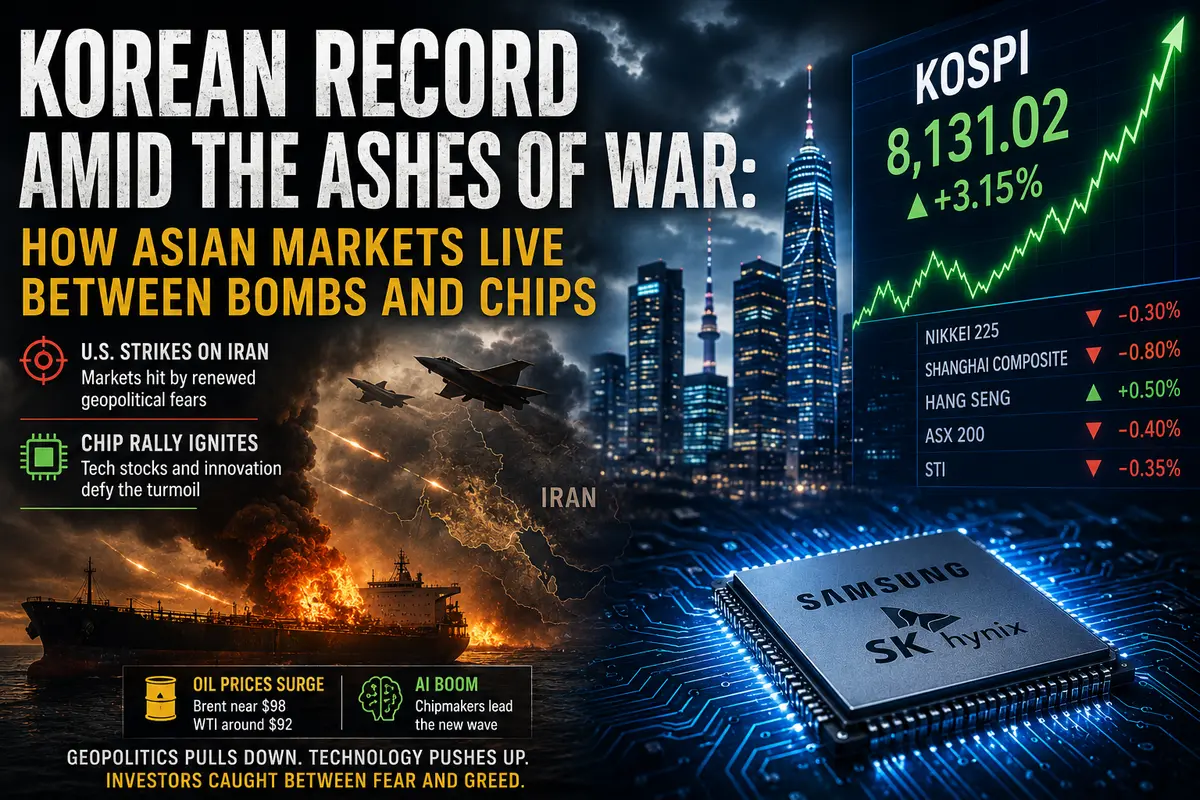
Asian stock markets on Tuesday looked like a chessboard where the black and white squares had been mixed together without any logic. Japan declined, China fell, Australia and Singapore slipped into the red. But in the middle of this sea of red indices, like an iceberg rising above the waves, stood the KOSPI — South Korea’s benchmark index hit a new all-time high, surging above 8,131 points. Hong Kong, lifted by a rally in chipmakers, also closed higher. This market schizophrenia perfectly reflects the current moment: geopolitics is pulling markets down, technology is pushing them up, and investors are swinging between fear of Iranian bombs and greed for artificial intelligence.
Strikes on Iran: Markets Back in “Run or Freeze” Mode
New U.S. strikes on missile positions and vessels in southern Iran, revealed on Monday, hit the markets like a bucket of cold water poured over the smoldering embers of optimism. Just on Sunday, markets were celebrating hopes for peace. As recently as Monday morning, oil had fallen below $100 a barrel, Asian indices were climbing, and traders were pricing in a swift reopening of the Strait of Hormuz. Today, everything looks different. Brent is back near $98, while WTI hovers around $92. Oil prices have bounced back, reminding everyone that the war is not over — it has merely paused.
Washington describes the strikes as defensive. The wording matters: it leaves room for diplomacy. Had the attacks been labeled offensive, markets would have interpreted them as escalation and reacted far more aggressively. But even “defensive” bombings during ongoing negotiations in Doha send a message. A message that diplomacy is stalling, that the sides cannot reach an agreement, and that military force remains the primary argument. And although Trump continues to say the talks are “going well,” markets have learned to filter his statements. They look not at words, but at bombs.
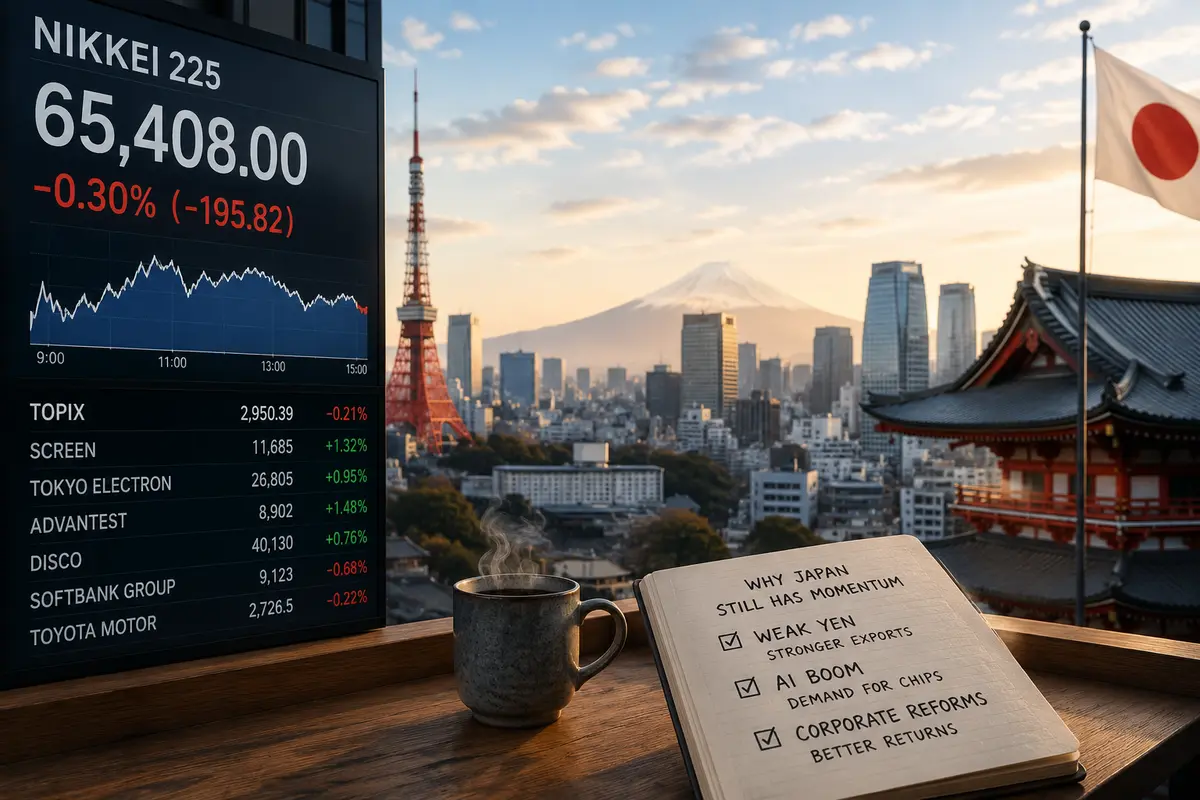
Still, panic did not overwhelm trading. The declines across most indices were moderate rather than catastrophic. Japan’s Nikkei 225 lost only three-tenths of a percent, pulling back from the all-time high reached the previous day. TOPIX slipped by one-tenth. This is not a stampede for the exits — it is cautious shifting from one foot to another. Investors are not dumping everything indiscriminately; they are simply loosening their grip slightly while waiting for new headlines.
Tokyo Catches Its Breath After the Record
Monday was a triumph for the Japanese market. The Nikkei 225 reached 65,408 points — a level that would have seemed фантастical just a few years ago. The rally was driven by chipmaker stocks, fueled by global optimism around artificial intelligence and strong earnings from U.S. semiconductor companies. On Tuesday, that momentum partially faded. The market paused to lock in profits after the rally.
But a correction of just three-tenths of a percent after a historic peak is not a trend reversal. It is healthy breathing from a market that cannot rise every single day. The fundamental factors supporting Japanese equities — a weak yen making exporters more competitive, the AI boom stimulating demand for components, and corporate reforms improving shareholder returns — have not disappeared. They simply stepped temporarily into the background today, giving center stage to geopolitics.
China: A Double Blow to Sentiment
Chinese markets on Tuesday came under pressure from two directions. On one side was the geopolitical negativity surrounding the strikes on Iran. On the other were China’s own structural problems, which have not gone away. The real estate crisis continues to weigh on the financial sector. Consumer demand remains sluggish. Exports are facing growing barriers in Western markets. The Shanghai Composite fell eight-tenths of a percent, while the CSI 300 dropped three-tenths.
Yet even in this gloomy context, there was a ray of light. Huawei Technologies unveiled a major breakthrough in semiconductor design. Details remain scarce, but the mere fact that a Chinese company operating under the harshest U.S. sanctions continues moving forward inspired investors. This is not merely a technological achievement — it is a symbol. A symbol that China can reduce its dependence on American technology, that sanctions do not paralyze innovation but instead stimulate domestic development. And the Hong Kong market reacted enthusiastically.
Hong Kong and Chips: A Rally Against All Odds
The Hang Seng rose half a percent on Tuesday. The main drivers were chipmakers. Hua Hong Semiconductor surged more than 14 percent. Semiconductor Manufacturing International Corp, China’s largest contract chipmaker, gained around 10 percent. This rally was a direct consequence both of Huawei’s breakthrough and of broader optimism surrounding the semiconductor sector, fueled by strong earnings from American companies.
The Hong Kong market, which for a long time had been an underperformer among Asian exchanges due to political risks and Beijing’s tight regulation, is now finding support in the technology sector. Investors who previously avoided Chinese tech stocks because of regulatory fears are beginning to return, seeing that the country’s innovative potential has not been destroyed by sanctions but rather mobilized by them.
KOSPI: A Historic Record as a Bet on the Future
South Korea’s KOSPI was Tuesday’s undisputed star. A gain of more than 3 percent pushed the index to a fresh all-time high above 8,131 points. The market, closed on Monday for a holiday, more than made up for lost time on Tuesday. Shares of Samsung Electronics rose about 3 percent, while SK Hynix jumped nearly 7 percent.
The Korean market is currently the perfect beneficiary of two massive trends at once. The first is the global artificial intelligence boom. Samsung and SK Hynix are the world’s largest memory manufacturers, producing the HBM memory essential for Nvidia accelerators and other AI chips. As long as demand for AI continues growing, Korean chipmakers will keep printing profits. The second trend is recovery after Samsung’s labor dispute. Last week, the company and its union reached a preliminary agreement, calling off a strike and removing a major risk to supply chains.
But the Korean rally is not only about technology. It is also about the market’s ability to differentiate risks. Yes, war with Iran is bad. Yes, U.S. strikes on Iranian facilities are alarming. But what does any of this have to do with Samsung’s ability to sell memory for AI servers? Practically nothing. Korean chipmakers do not depend on the Strait of Hormuz. Their factories do not require Middle Eastern oil to operate. Their products are not shipped through the Persian Gulf. The geopolitical storm sinking airline and tourism stocks barely touches the technology sector. And investors understand this.
Technology Versus Geopolitics: The Battle for Market Attention
Tuesday on Asian exchanges became a day when two forces collided head-on. On one side was fear — fear of escalation in the Middle East, new strikes, failed negotiations, rising oil prices, and inflation. That fear weighed on indices in Japan, China, Australia, and Singapore. On the other side was greed — greed for the profits promised by artificial intelligence, for chipmaker stocks becoming the new oil, for technological breakthroughs that promise to reshape the world. That greed pushed KOSPI and the Hang Seng higher.
And for now, greed is winning. The technology sector is demonstrating remarkable resilience to geopolitical shocks. Investors seem to have absorbed the lesson of recent years: crises come and go, wars begin and end, but technology continues to advance. Those who panic-sold Apple and Nvidia because of headlines about North Korea, Iran, or Taiwan later regretted it while watching the charts climb higher. Perhaps it is this memory that is preventing markets from falling much deeper today.
But this balance is fragile. If the conflict with Iran truly escalates into a full-scale war, if the Strait of Hormuz remains closed for months, if oil breaks above $130 and triggers a global recession, then even the technology sector will not escape unscathed. For now, however, markets continue to live in a strange, schizophrenic world where KOSPI hits new records while oil tankers burn off the Iranian coast. And perhaps that is the new normal.

Comments
No comments yet. Be the first to share your thoughts!
Authentication Required
You must be logged in to post a comment.