

Copper Prices Plunged After the New Fed Chair’s First Speech: Why Kevin Warsh Spooked the Markets
Introduction: A Debut That Sent the Red Metal Tumbling
Imagine this: you have just taken office as the head of the world’s most powerful central bank. You step up to your first press conference, deliver a few remarks about your commitment to fighting inflation—and within hours, global copper prices fall by 1%, wiping out all the optimism that had fueled markets at the start of the week.
Welcome to the reality facing Kevin Warsh, the new Chair of the Federal Reserve.
The irony is that just one day earlier, metal markets were celebrating. A peace agreement between the United States and Iran promised lower geopolitical risks and greater stability in energy markets. Industrial metals—including copper, aluminum, and zinc—were rising, and investors were already positioning for a continued rally.
Then one press conference in Washington changed everything.
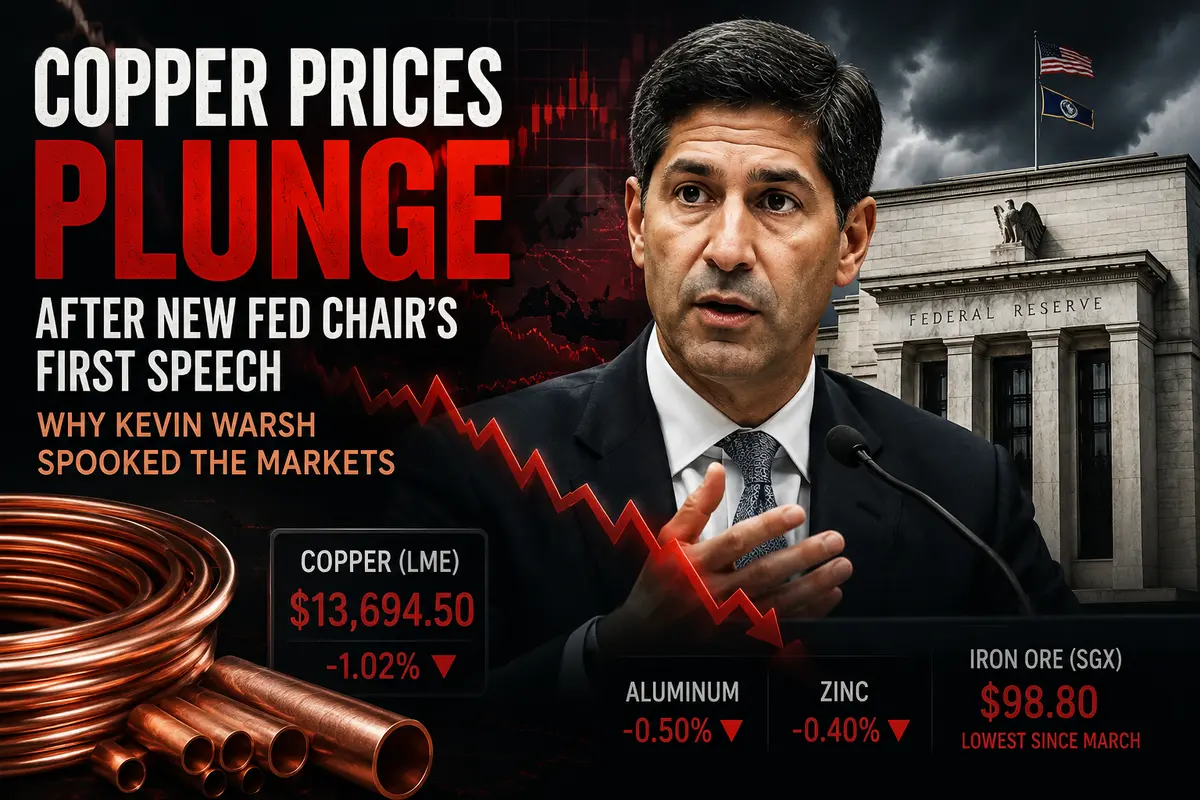
Copper on the London Metal Exchange fell to $13,694.50 per metric ton. Aluminum lost 0.5%, while zinc dropped 0.4%. Iron ore futures in Singapore touched their lowest level since March at $98.80 per ton before recovering slightly to $99.15.
All because of the words Warsh spoke on his very first day in office.
What exactly did the new Fed Chair say that prompted metal markets to react faster than policymakers could blink? And why did copper—often called the “doctor of the economy” because of its sensitivity to economic cycles—find itself at the center of the storm?
Let’s take a closer look.
Kevin Warsh: A New Face for an Old Policy
A Hawkish Debut Nobody Expected
Kevin Warsh did not arrive at the Fed as a newcomer. He previously served at the Federal Reserve during the 2008 financial crisis as a member of the Board of Governors before moving into the private sector.
Many viewed his appointment as the return of a veteran—someone who had “seen it all.” Yet even seasoned traders were surprised by what he said during his debut press conference.
Warsh did more than repeat the usual talking points about inflation. He emphasized them with such conviction and persistence that markets interpreted his remarks as a direct policy signal.
He repeatedly stressed that inflation remains the greatest threat and that the Federal Reserve is prepared to use every available tool to bring it under control.
Futures traders, who normally spend days dissecting every word from Fed officials, reacted immediately. Expectations for higher borrowing costs as early as next month surged.
Before Warsh’s speech, markets viewed the probability of a near-term rate increase as moderate. Afterward, those odds jumped sharply, forcing many investors to rethink their positions.
Most importantly, Warsh did not speak about rate hikes at some vague point in the future. Markets interpreted his comments as a hint that action could come as soon as the next Federal Open Market Committee meeting.
This was not merely hawkish rhetoric—it was hawkish rhetoric with a clear timeline attached. And when a Fed Chair signals intentions that explicitly, markets tend to listen.
Why Metal Markets React So Strongly to the Fed
To understand why copper fell on Warsh’s comments, it is important to remember one thing: copper is not just a metal.
It is a fundamental building block of the modern economy.
Copper is used in electrical wiring, plumbing, electronics, electric vehicles, and renewable energy infrastructure. Demand for copper is a direct indicator of industrial activity and, more broadly, the health of the global economy.
When the Federal Reserve signals higher interest rates, it is effectively saying:
“We are willing to slow economic growth in order to reduce inflation.”
Higher interest rates make borrowing more expensive, discouraging investment in construction, manufacturing, and infrastructure. That ultimately reduces demand for copper and other industrial metals.
Investors understand this perfectly well.
The moment Warsh began discussing the possibility of further tightening, traders started closing long copper positions. The optimism generated by the Iran peace agreement was quickly outweighed by fears of stricter monetary policy.
After all, peace in the Middle East is positive—but if the Fed slows the economy through higher rates, stronger metal demand may never materialize.
Copper’s decline was therefore not a market overreaction. It was a classic response to a signal that the central bank may be willing to sacrifice growth in order to restore price stability.
The only question is how large and how prolonged that sacrifice might become.
The Iran Factor: How Peace Became a Bearish Catalyst
Oil Falls, Copper Rises—Except This Time
At first glance, the U.S.–Iran peace agreement should have been bullish for industrial metals.
The logic is straightforward:
Lower geopolitical risks reduce upward pressure on oil prices. Cheaper energy lowers production costs across industry, potentially boosting demand for raw materials, including copper.
Indeed, copper initially rallied on this optimism.
Investors viewed the agreement as a positive development for global economic stability and increased their exposure to industrial commodities.
Then Warsh arrived and erased that narrative in a single press conference.
Ironically, the same decline in oil prices that should have supported copper may now be working against it.
Lower energy prices reduce inflationary pressure. Lower inflation gives the Fed greater confidence to tighten policy further in order to finish the job.
The result is a paradox:
-
Peace with Iran supports economic activity.
-
Lower oil prices reduce inflation.
-
Lower inflation gives the Fed more room to tighten.
-
Tighter monetary policy hurts copper demand.
Markets recognized this chain reaction almost immediately.
As soon as Warsh emphasized his commitment to fighting inflation, investors shifted their focus from geopolitical optimism to monetary pessimism.
And copper, as the most sensitive barometer of industrial expectations, responded first.
Copper as a Barometer of Global Anxiety
Copper is often referred to as the “doctor of the economy” because its price reflects not only current demand but also expectations about future industrial production.
When investors fear recession, they sell copper.
When they expect growth, they buy it.
Moments like this reveal how much confidence markets have in the economy’s ability to withstand tighter monetary policy.
If investors believe the Fed can reduce inflation without causing a recession, copper tends to remain stable or even rise.
If they fear higher rates will choke off growth, copper falls.
The more-than-1% decline following Warsh’s speech suggests that markets increasingly favor the second scenario.
Investors appear skeptical that the Fed can engineer a painless tightening cycle.
Instead, they see a risk that elevated rates could suppress industrial activity for an extended period, weakening demand for metals.
The behavior of iron ore was particularly telling.
Iron ore touched its lowest level since March. Since iron ore underpins steel production—and steel is essential for construction, infrastructure, and heavy industry—its decline suggests markets are anticipating weakness in those sectors.
And that drop occurred on the same day Warsh discussed interest rates.
Coincidence?
Markets generally do not believe in coincidences.
The Mongolian Mine: A Local Event With Global Impact
Oyu Tolgoi: The Giant That Stopped and Started Again
While traders were analyzing Warsh’s remarks and recalculating rate expectations, another story emerged from Mongolia.
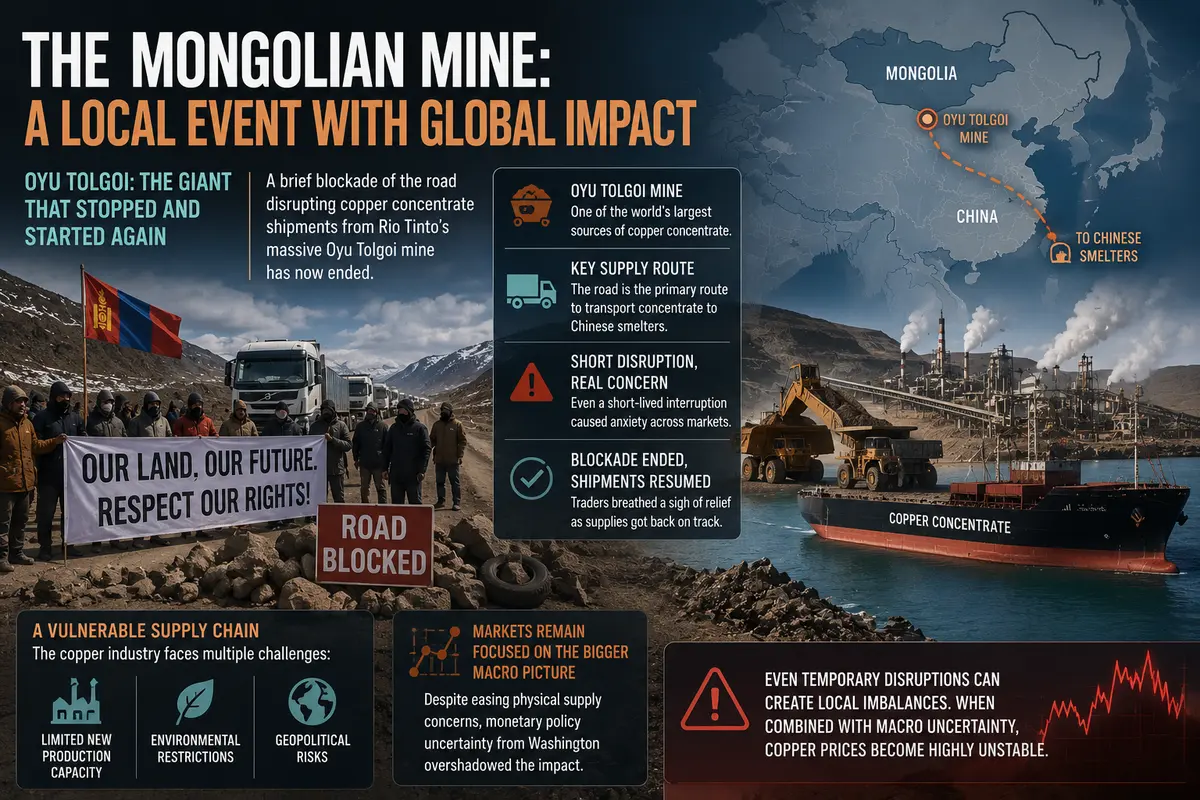
A brief blockade affecting copper shipments from Rio Tinto’s massive Oyu Tolgoi mine came to an end.
Oyu Tolgoi is not just another mine.
It is one of the world’s largest sources of copper concentrate.
The road blocked by protesters serves as the primary route for transporting concentrate to Chinese smelters. Even though the disruption was short-lived, the interruption generated concern across the market.
When the blockade ended and shipments resumed, traders breathed a sigh of relief.
Yet the impact of this development was overshadowed by the much stronger macroeconomic signal coming from Washington.
Even though physical supply concerns eased, investors remained focused on monetary policy risks.
Still, the episode highlighted an important reality: global supply chains remain vulnerable.
The copper industry already faces challenges including limited new production capacity, environmental restrictions, and geopolitical risks.
Even a temporary disruption can create localized imbalances.
When such disruptions coincide with macroeconomic uncertainty, prices can become highly unstable.
The China Factor: What’s Happening in the World’s Largest Market?
China remains the world’s largest consumer of copper.
Its economy, construction sector, and electric vehicle industry are major drivers of global copper demand.
As a result, any change in Chinese economic conditions immediately affects copper prices.
So far, China has not sent any dramatic new signals.
However, investors remain highly sensitive to signs of slowing growth.
Weakness in property markets, slower export growth, and ongoing challenges in the construction sector could all reduce copper demand.
Against this backdrop, a hawkish Federal Reserve represents a double threat.
First, tighter policy tends to strengthen the U.S. dollar, making copper more expensive for buyers using other currencies.
Second, it may slow global economic activity—including China, which remains heavily dependent on exports to the United States and Europe.
The Oyu Tolgoi disruption reminded markets of supply-chain fragility.
But the primary concern today is not logistics.
It is macroeconomics.
And Warsh’s message proved far more powerful than any temporary disruption in Mongolia.
What Comes Next? Forecasts and Scenarios for Copper Prices
The Next Few Weeks: Volatility and Nervous Trading
Copper is likely to remain highly volatile in the coming weeks.
Investors will scrutinize every statement made by Warsh and other Fed officials.
Any hint of a softer tone could trigger a rebound.
Any confirmation of a hawkish policy path could spark another wave of selling.
The next Fed meeting will be critical.
If policymakers raise rates, copper could face additional downside pressure.
If the Fed pauses, markets may breathe easier and copper could recover some of its recent losses.
Inflation data will also be crucial.
Lower-than-expected inflation could encourage Warsh to moderate his rhetoric.
Stronger inflation readings would reinforce his commitment to tightening policy.
The oil market remains another important variable.
The Iran agreement continues to influence energy prices.
If oil remains cheap, inflation pressures may ease—but, as we have seen, that could simultaneously give the Fed more room to tighten.
It is a contradictory dynamic that markets are still trying to digest.
Long-Term Trends: What Will Shape Copper’s Future?
Over the long term, copper’s fundamentals remain highly supportive.
The transition to clean energy, rapid growth in electric vehicle production, and expansion of renewable power infrastructure all require enormous quantities of copper.
Some forecasts suggest copper demand could increase by 30–40% over the next decade.
However, short-term macroeconomic shocks tied to Federal Reserve policy will continue to create headwinds.
Kevin Warsh is widely viewed as a supporter of tighter monetary policy, and as long as he remains at the helm of the Fed, markets will continue pricing in the risk of further tightening.
Investors must therefore navigate a market caught between:
-
Long-term structural demand growth.
-
Short-term monetary-policy risks.
Copper will continue oscillating between these opposing forces.
Whichever factor dominates at a given moment will determine price direction.
Today, the Fed won.
Copper fell, and investors began wondering how long this hawkish cycle might last.
The answer remains uncertain, but it could determine the trajectory of metal markets for months to come.
Conclusion: One Man, One Speech, One Market Selloff
The story of copper falling 1% after the new Fed Chair’s first public appearance is more than just another market headline.
It illustrates how fragile and sensitive the global economy has become after years of inflation shocks and geopolitical uncertainty.
Kevin Warsh stepped onto the stage and said what any responsible central banker would be expected to say:
He would fight inflation.
But the tone, emphasis, and timing of his message triggered a cascading reaction across financial markets.
Copper fell.
Aluminum fell.
Zinc fell.
Iron ore touched its lowest level since March.
All because investors reassessed the likely path of interest rates.
The Iran peace agreement—which had seemed transformative just one day earlier—faded into the background.
The Oyu Tolgoi blockade—which might otherwise have dominated headlines—barely registered.
Markets delivered a clear verdict:
The Federal Reserve matters more than Iran.
Interest rates matter more than geopolitics.
Macroeconomics matters more than everything else.
And as long as Kevin Warsh remains in charge, that logic is likely to dominate market thinking.
The question now is how many more commodities will come under pressure from the Fed’s hawkish stance before markets discover a new equilibrium.
Copper is merely the first—and perhaps the most sensitive—indicator.
If Warsh continues along his current path, other commodity markets may soon follow.
And if the Fed does raise rates next month, this week’s turmoil may prove to be only the beginning.
For now, however, one lesson stands out:
The words of a central bank chair can move markets faster than almost any geopolitical event.
And copper—the faithful barometer of the global economy—demonstrated that reality more clearly than any chart or forecast could.

Comments
No comments yet. Be the first to share your thoughts!
Authentication Required
You must be logged in to post a comment.