

Bar Pipa
We pay for a post of 10$

Bank of England

End of an Era: Mastercard Returns Vocalink to British Banks

End of an Era: Mastercard Returns Vocalink to British Banks

Introduction: A Strategic Asset Too Costly for American Ownership

The story unfolding around payment operator Vocalink could easily serve as the plot of a political thriller. American giant Mastercard, which acquired the British company in 2016 for £701 million, is now considering selling a controlling stake back to British banks. The reason is growing concern over foreign ownership of a strategic national asset.

This is more than a simple business decision. It is an acknowledgment that some assets are too sensitive to remain in the hands of a foreign company, even when that company is as reputable as Mastercard. Vocalink is not merely a payment operator. It is the infrastructure supporting the entire UK retail payments system.

The Financial Times, citing people familiar with the matter, reports that negotiations are still at an early stage. No formal proposals have been submitted yet, but one potential buyer has already been identified. It is DeliveryCo, an organization established with the support of the banking industry to manage procurement for the UK’s new payments platform. If completed, the deal is expected to value a 51% stake at approximately £400 million.

Vocalink: More Than Just a Payment System

The Figures Speak for Themselves

To understand why Vocalink is causing such concern among British authorities, it is enough to look at the figures. The company processes more than 90% of salaries, over 70% of utility bills, and 98% of government benefit payments in the United Kingdom. It is not merely a payment operator; it is the circulatory system of the entire British economy.

When infrastructure of such critical importance is controlled by an American company, it creates potential risks. This is not because Mastercard is unreliable or acts in bad faith. Rather, in a world of geopolitical confrontation and economic warfare, control over such assets...
Continue reading...
0
0

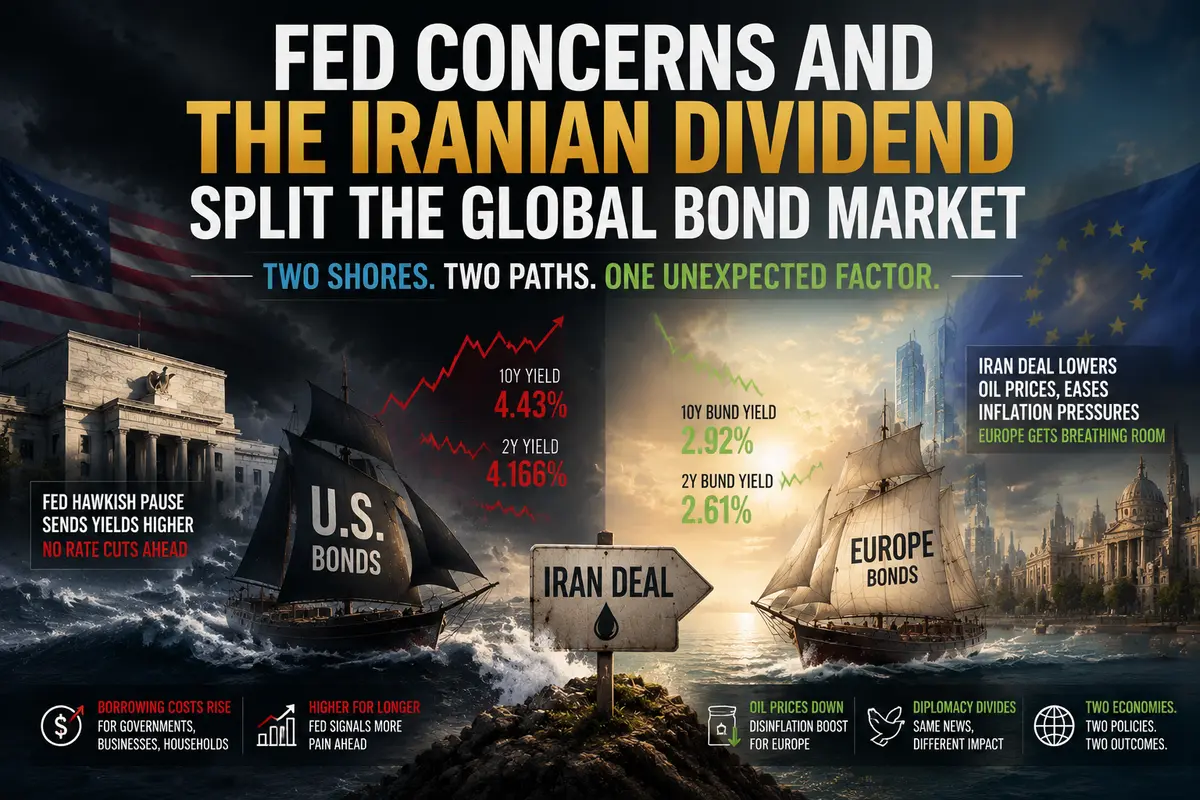
Fed concerns and the Iranian dividend split the global bond market

Fed concerns and the Iranian dividend split the global bond market

Introduction: two shores of the same Atlantic

Imagine two ships sailing in the same ocean but caught in completely different currents. One is racing forward with a tailwind, its crew confident in its course and ready to tighten the sails. The second is barely moving, its holds underfilled, and its captain anxiously scanning the horizon. That is roughly what the government bond markets on both sides of the Atlantic look like today.

What we are seeing in recent days is not just ordinary yield fluctuations. It is a tectonic rupture exposing fundamental differences in the economic trajectories of the United States and Europe. On one side is the Federal Reserve’s aggressive rhetoric, signaling that the era of cheap money has not ended, only paused. On the other is Europe, where every new price signal from the Middle East is perceived as a potential escape from inflationary suffocation.

And at the center of this storm sits an unexpected factor that would normally seem secondary in any other year — a temporary agreement between the United States and Iran. What diplomats discussed in negotiation rooms, bond traders instantly translated into numbers and charts. And those numbers began speaking different languages on opposite sides of the ocean.

Let’s unpack what is really happening in the bond market, why the Fed and the ECB are looking in different directions, and how a peace initiative with Iran unexpectedly became a point of division for investors.

The Fed said “pause,” markets heard “attack”

A hawkish pause: how unchanged rates became a tightening signal

Thursday, Federal Reserve meeting. Everyone expected a rate decision. And it came — no change. But if you think markets breathed a sigh of relief, you are very wrong. In the world of central banking, it is often not the decision itself that...

Continue reading...
0
0
Tim Drening

Rand Fights Back: How South Africa Challenged the Global Storm

Rand Fights Back: How South Africa Challenged the Global Storm

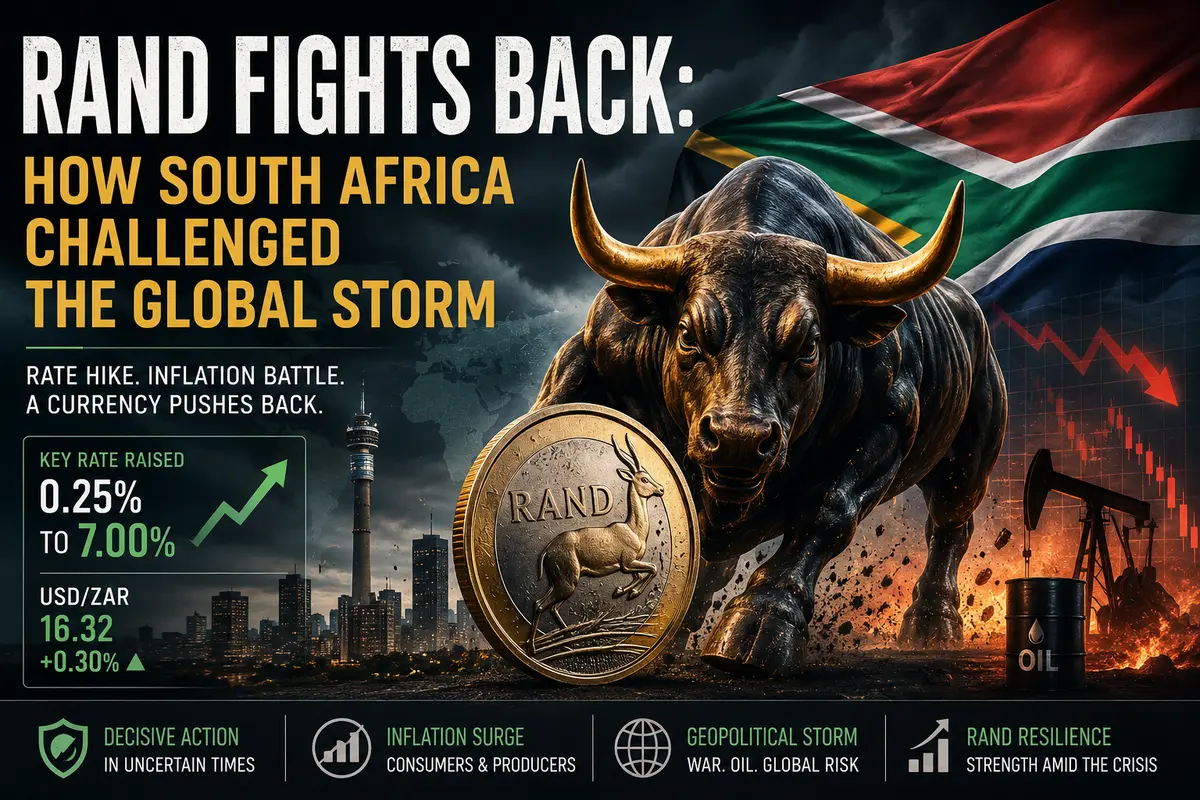
In a world where most emerging markets prefer to hunker down and hope that geopolitical turmoil passes them by, South Africa has done something almost audacious. The South African Reserve Bank raised its benchmark interest rate by a quarter percentage point to 7% per annum—the first rate hike in three years. The market responded not with panic or capital flight, but with strength. The rand gained 0.3%, reaching 16.32 per U.S. dollar. At a time when currencies across the developing world are falling under the pressure of the Iran conflict and a hawkish Federal Reserve, the rand has emerged as one of the few currencies capable of pushing back.

Interest Rates as a Weapon: Why South Africa Tightened Policy

The South African Reserve Bank’s decision was anything but spontaneous. It was driven by economic data that could no longer be ignored. Inflation in South Africa is accelerating. Consumer prices rose 4% year-over-year in April, exceeding the central bank’s 3% target. That alone would be concerning. But the real shock came from producer inflation.

Data released on Thursday showed producer price inflation surging to 4.8% year-over-year. For comparison, the figure stood at just 2.3% in March. That represents more than a doubling in a single month. Producer prices are rising at an alarming pace, and those costs are likely to be passed on to consumers in the months ahead. The central bank saw the warning signs and chose to act before the problem intensified.

Raising interest rates is the traditional central-bank response to inflation. Higher borrowing costs cool demand, restrain price growth, and attract foreign capital. But the remedy comes with side effects: it can also suppress economic growth. At a time when South Africa is already grappling with high energy prices, supply-chain disruptions, and weak domestic demand, the rate hike...

Continue reading...
0
0
Navigation menu
instaforex banner
