Bar Pipa
We pay for a post of 10$

Central Bank

Lin Brings

Goldman Sachs: The U.S. Economy Remains Resilient, but Spending Is Set to Slow
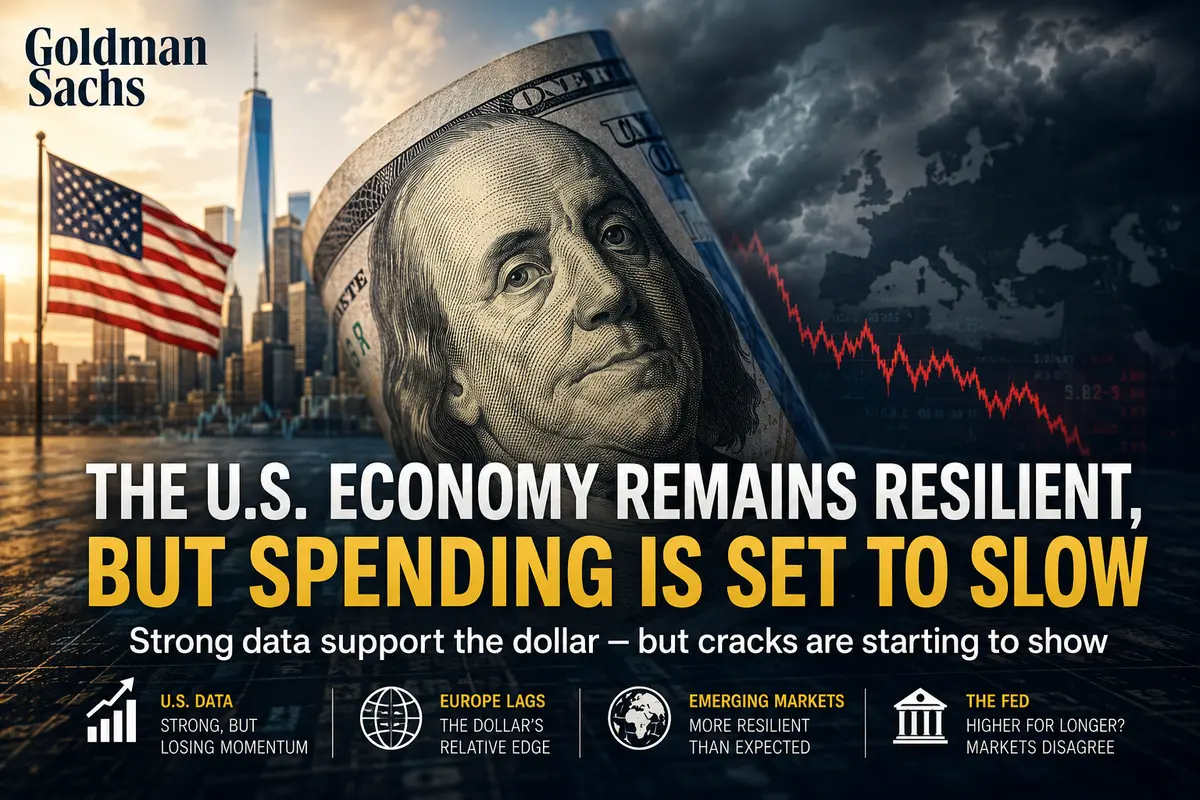
Goldman Sachs: The U.S. Economy Remains Resilient, but Spending Is Set to Slow

America Is Holding Up — But It’s Not Bulletproof

Goldman Sachs, one of the most influential voices in global finance, recently released a detailed assessment of the U.S. dollar and the American economy. The bank’s conclusions are both encouraging and cautionary. On one hand, the U.S. economy continues to demonstrate remarkable resilience. On the other, there are growing signs that this resilience is beginning to show cracks—not fatal or catastrophic cracks, but noticeable ones for those who know how to read between the lines of economic reports and data.

According to Goldman Sachs, the U.S. dollar remains supported by strong economic fundamentals and rising interest-rate expectations. This has been the foundation underpinning the currency for the past eighteen months. However, the bank’s analysts warn that improving global risk sentiment and the resilience of foreign currencies could limit further dollar gains. In other words, the dollar is no longer as attractive as it once was. It remains strong, but its advantage over other currencies is gradually narrowing.

Goldman’s assessment of the latest U.S. economic data is particularly noteworthy. Friday’s employment report exceeded expectations, while resilient ISM business activity indexes pointed to continued economic expansion. Together, these factors support higher Treasury yields and wider interest-rate differentials in favor of the dollar. Europe, Japan, and China continue to lag behind. America remains ahead, and the dollar is reaping the benefits of that leadership.

Yet Goldman also sees the other side of the story. Strong employment and inflation data are positive for the dollar, but they can be negative for equities because they encourage the Federal Reserve to maintain a restrictive monetary stance. And restrictive policy increases recession risk. There is no recession today, but the possibility remains on the horizon—and investors are aware of it.

U.S. Data: Resilience with Signs of Fatigue

What...

Continue reading...
0
0
John Madnes

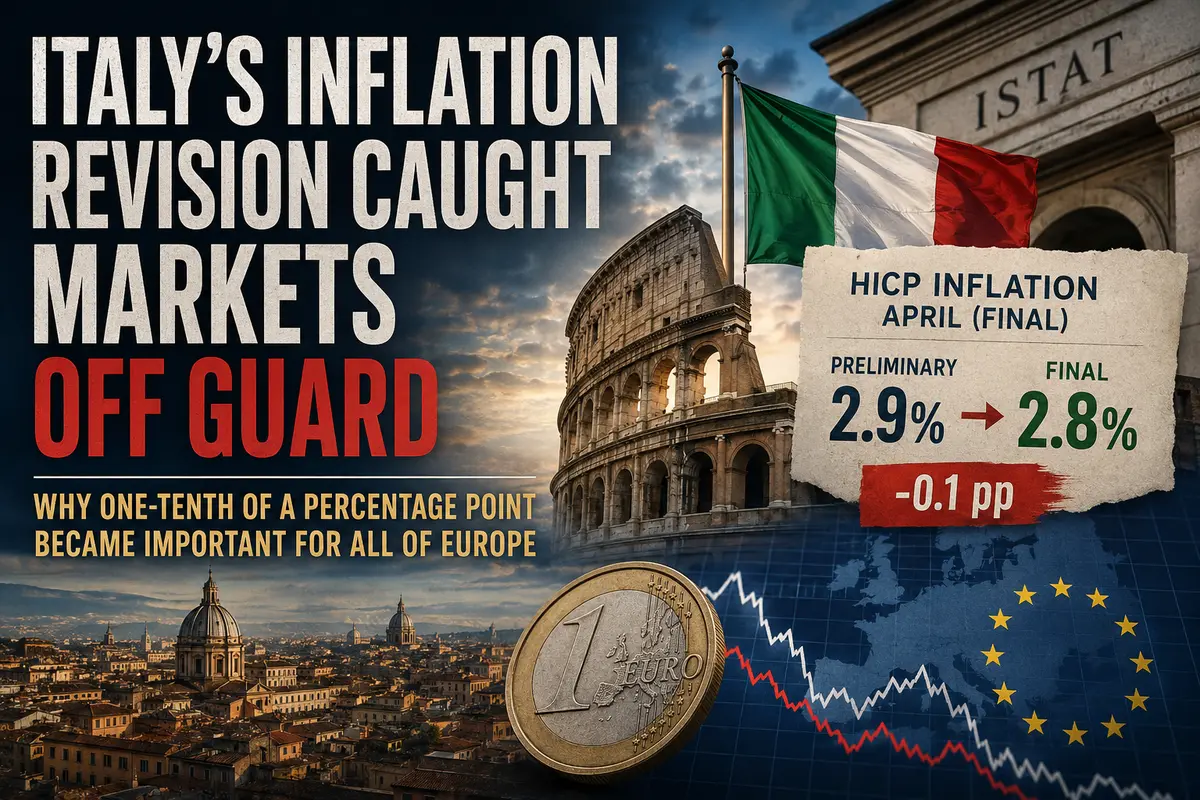
Italy’s Inflation Revision Caught Markets Off Guard

Italy’s Inflation Revision Caught Markets Off Guard

Why One-Tenth of a Percentage Point Became Important for All of Europe

When Italy’s national statistics agency ISTAT released revised inflation data for April on Friday, nothing dramatic seemed to happen at first glance. The preliminary estimate for annual inflation under the harmonized HICP index stood at 2.9 percent, while the final figure came in at 2.8 percent. The difference was just one-tenth of a percentage point. To someone far removed from financial markets, that may look like an accounting detail nobody should care about. But today, it is precisely these “small details” that move bond markets, reshape investor expectations, and force central bankers to study statistical reports line by line.

The modern financial system operates in a state of extreme sensitivity. When the economy is balancing between slowing growth and the threat of a new inflation wave, any deviation from forecasts becomes a signal. Sometimes a single number is enough to sharply alter expectations for interest rates, government bond yields, or the euro exchange rate. That is why the revision of Italy’s inflation data turned out to be far more significant than it initially appeared.

April’s Inflation Surge Looked Too Sharp

The dynamics of April itself look troubling. As recently as March, Italy’s HICP inflation stood at 1.6 percent year-over-year. One month later, it had jumped to 2.8 percent. An increase of 1.2 percentage points in such a short period is not a normal fluctuation — it is a sharp acceleration. And the issue goes beyond the numbers themselves. For Italy, inflation is almost a painful topic because the country’s economy is especially vulnerable to external shocks.

Italy has been living in a state of chronic economic fatigue for years. Formally, it is the eurozone’s third-largest economy, a country with a powerful industrial base, famous global brands, a massive...

Continue reading...
0
0
Navigation menu
instaforex banner