

The Canadian Dollar Holds Near a Multi-Week Low
Where the Loonie Has Stalled
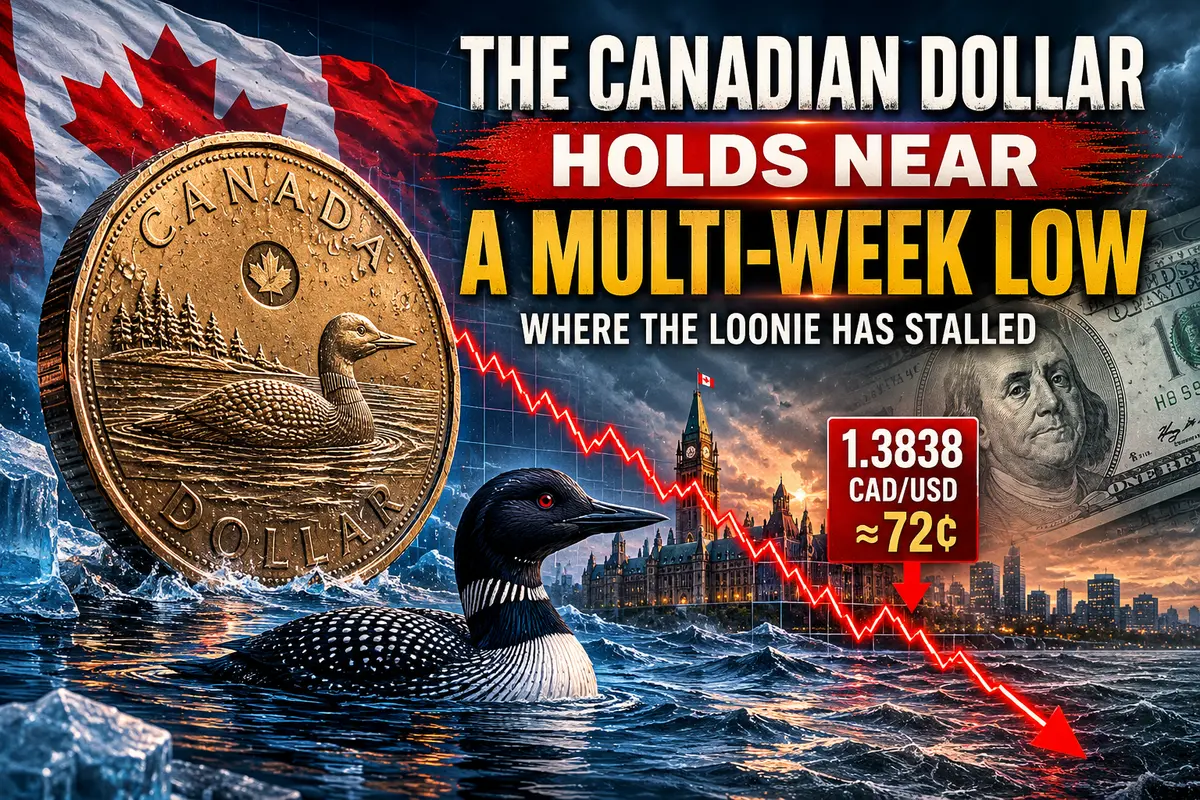
Wednesday was not a particularly good day for the Canadian currency. Then again, neither were the previous several weeks. The Canadian dollar, affectionately known as the “loonie” after the solitary loon depicted on the one-dollar coin, remained dangerously close to its multi-month lows against its American counterpart.
It did not plunge. It did not collapse. It did not crash. It simply stood still. And that stillness — that stubborn pause at a level that pleases no one — speaks more loudly about the challenges facing the currency than any dramatic selloff could.
During trading, the Canadian dollar was virtually unchanged at 1.3838 per U.S. dollar. Converted into U.S. cents, that works out to roughly 72¼ cents for one Canadian dollar — a level that would have seemed insultingly low to many Canadians just a few years ago. Today, it has become an uncomfortable reality to which people are gradually adapting.
Throughout the session, the currency traded within a narrow range between 1.3816 and 1.3854. By foreign-exchange standards, that range is almost laughably small. This is not volatility; it is indecision. Traders do not know which direction to run, so they remain frozen in place, clinging tightly to their positions.
The most troubling moment came last Thursday, when the Canadian dollar slipped to a six-week low of 1.3869. Since then, conditions have not improved, but at least they have not deteriorated dramatically. Whether this calm is the quiet before a storm or merely the beginning of a long and tedious period of stagnation remains to be seen.
What Is Pressuring the Loonie?
Trying to explain the Canadian dollar’s weakness with a single factor would be impossible. As always, it is a cocktail of problems — a bitter blend that financial markets swallow reluctantly because they have little choice.
A Weak Domestic Economy
The first and most obvious factor is Canada’s economy.
The data released on Friday did more than disappoint; they alarmed investors. Canada’s gross domestic product contracted by 0.1% on an annualized basis in the first quarter. At first glance, that number appears insignificant. Minus one-tenth of a percent hardly sounds like a crisis.
But the devil, as always, is in the details.
First, this decline followed another decline. The previous quarter also ended in negative territory, and revised figures revealed that the contraction was deeper than initially estimated — not 0.6%, but a full 1.0%.
Two consecutive quarters of economic contraction constitute a technical recession. Canadian officials prefer softer terms such as “slowdown” or “adjustment,” but the numbers tell a different story. When an economy shrinks for two quarters in a row, it is in recession — regardless of what label policymakers choose to apply.
Even more concerning than the GDP figures themselves was the sharp decline in business investment.
Companies are not spending. Construction cranes stand idle. Factories are not purchasing new equipment. Startups are struggling to secure funding. The reason is stated plainly in economic reports: trade uncertainty.
Canadian businesses simply do not know what tomorrow’s trading relationship with their largest partner, the United States, will look like. And when the rules of the game are unclear, the safest strategy is to sit on cash and wait. That may be rational for individual companies, but it is disastrous for the economy as a whole.
The American Cousin Applies Pressure with a Smile
A second factor keeping the Canadian dollar pinned near its lows is the strength of the U.S. dollar.
The greenback currently resembles a heavily built bodybuilder who walks into a bar and immediately dominates the room. Despite its own challenges, the U.S. economy continues to demonstrate resilience. Interest rates remain relatively high. Inflation has not been fully defeated, but it has been brought under control. Unemployment remains historically low.
Against that backdrop, the U.S. dollar continues to serve as the world’s preferred safe-haven currency.
The Canadian dollar, for all its strengths, has never been a safe-haven asset. It is a commodity currency. Its fortunes are tied to oil, natural gas, lumber, copper, and other raw materials.
In recent weeks, West Texas Intermediate crude prices have moved sideways, giving the loonie neither a reason to rally nor a reason to panic. Ironically, this calm in commodity markets works against Canada. With no support from rising resource prices, the strength of the U.S. dollar simply dominates the equation.
Trade negotiations between Ottawa and Washington have become a saga of their own. The story has dragged on for years, changing themes repeatedly without reaching a final resolution.
Whenever optimism emerges, a new obstacle appears — tariffs on Canadian lumber, disputes over dairy products, or demands related to the automotive sector. Canadian negotiators return from Washington alternately hopeful and empty-handed.
Businesses are tired of waiting. Markets are tired of guessing. And in that environment, the Canadian dollar remains the primary hostage.

The Bank of Canada Watches from the Sidelines
The third ingredient in this unpleasant cocktail is monetary policy.
The Bank of Canada, once known for its predictability and discipline, increasingly resembles someone standing at a crossroads, unsure which direction to take.
Swap-market pricing — one of the clearest indicators of professional investor expectations — suggests that the Bank of Canada will leave its benchmark interest rate unchanged at 2.25% at next week’s policy meeting.
If that happens, it will mark the fifth consecutive meeting without a change.
Five times in a row, policymakers have reviewed the data, weighed the risks, and chosen to stand still.
Why not cut rates?
Because inflation, while lower than before, has not been fully defeated. Premature easing could reignite inflationary pressures and undo much of the progress achieved over the past eighteen months.
Why not raise rates?
Because the economy is already struggling. Two consecutive quarters of GDP contraction are hardly an invitation for tighter monetary policy. Raising rates now could crush what remains of business activity and push Canada into a deeper recession marked by bankruptcies and rising unemployment.
The Bank of Canada is trapped.
In this environment, any action appears riskier than inaction. So policymakers choose inaction, meeting after meeting. Markets have grown accustomed to this stance, but familiarity does not necessarily inspire confidence.
Investors are beginning to wonder whether the central bank has a clear strategy at all, or whether it is simply drifting with the current and hoping the wind changes direction on its own.
What the GDP Data Really Reveal
A closer look at the GDP report paints an even more troubling picture.
Consumer spending — traditionally one of the main engines of the Canadian economy — barely increased.
Many Canadians accumulated significant debt during the era of ultra-low interest rates. Today, they are devoting large portions of their income to mortgage payments and credit-card debt. As a result, fewer people are dining out, buying furniture, or replacing their vehicles.
Demand weakens.
And when demand weakens, production follows.
Exports present another challenge.
Canada relies heavily on selling what it extracts and produces: oil, gas, wheat, canola, lumber, and other commodities. Yet global demand for raw materials is not growing rapidly. China, a major Asian consumer of Canadian resources, faces its own economic difficulties. Europe remains sluggish.
That leaves the United States as the only consistently important market — one that periodically opens opportunities and then closes them with tariffs or threats of new restrictions.
Meanwhile, investment continues to fall.
This may be the most troubling line in the GDP report. Businesses are not building factories, expanding operations, or hiring workers. Some manufacturers have even frozen investment programs that were already on hold last year.
Everyone is waiting.
And that waiting may be more damaging than an actual crisis. In a crisis, at least companies know what they must do: survive. In the current environment, they cannot decide whether they should prepare for growth or brace for decline.
Why 72 Cents Is Bad — But Not a Disaster
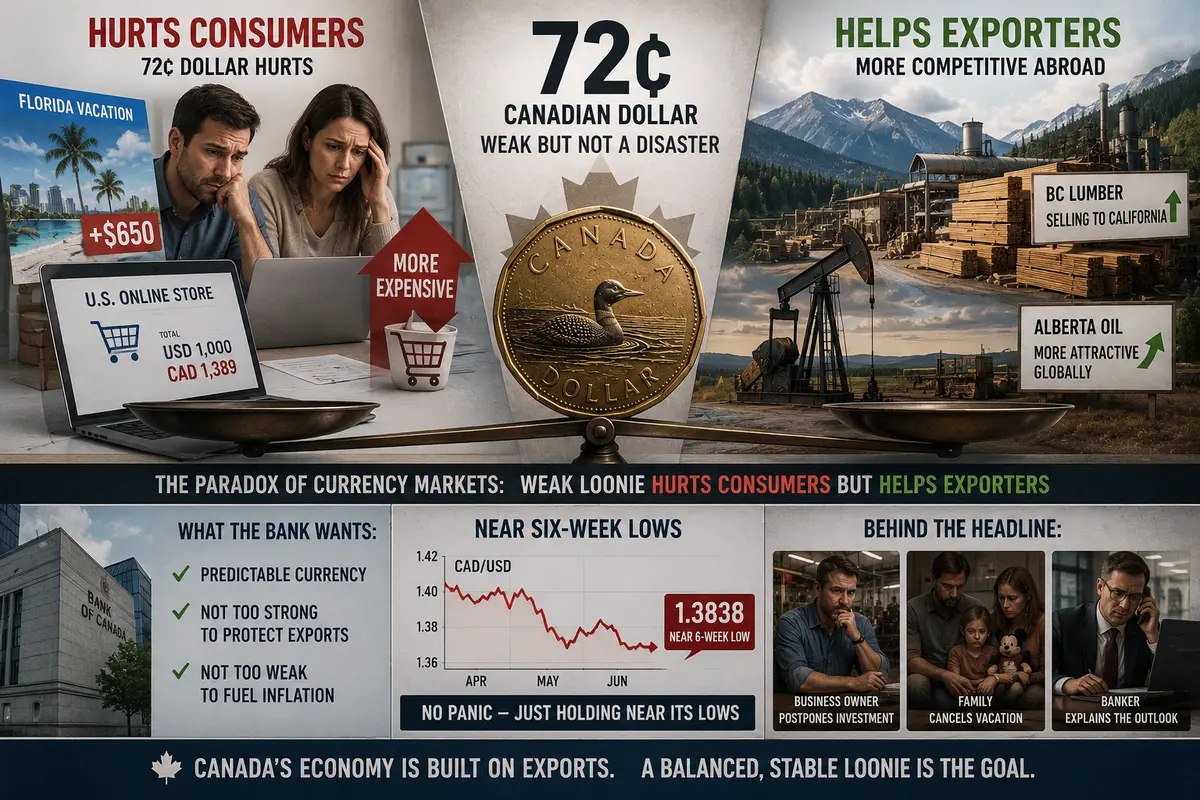
For a Canadian planning a vacation in Florida or shopping from a U.S. online retailer, a 72-cent dollar hurts.
Every U.S. dollar becomes significantly more expensive.
For exporters, however, a weak Canadian dollar can be a blessing.
A lumber mill in British Columbia can sell products into California more competitively than some local producers. An oil producer in Alberta becomes more attractive on the global market.
This is one of the great paradoxes of currency markets: a weak currency hurts consumers but often helps exporters.
Canada’s economy has historically been built around exports. For that reason, the Bank of Canada has never dreamed of an exceptionally strong currency. What policymakers really want is a predictable currency — not so expensive that it undermines exports, and not so cheap that it fuels inflation through higher import prices.
Today, the loonie is cheap and hovering near six-week lows.
But it has not collapsed.
There is no panic — at least not yet.
For now, it is simply “holding near its lows,” a routine phrase in financial headlines that conceals countless personal stories: a business owner postponing the purchase of new equipment, a family canceling a trip to Disney World, a banker struggling to explain the outlook to clients.
Looking Ahead: What Could Change the Situation?
The next major event is the Bank of Canada’s policy meeting.
If rates remain unchanged, as markets expect, the reaction will likely be muted because that outcome is already priced in.
A surprise, however — such as a signal that rate cuts may be coming sooner than expected — could push the Canadian dollar even lower. Ironically, any news that reinforces perceptions of economic weakness is likely to weigh further on the currency.
The second key factor is oil.
Summer travel season in North America typically boosts fuel demand. If oil prices rise, the loonie could follow. If crude remains stuck in place, the Canadian dollar may continue drifting near its lows.
The third — and arguably most important — factor is the outcome of trade negotiations with the United States.
In the long run, almost any certainty is better than the current uncertainty.
If an agreement is reached, businesses may regain confidence and resume investing. If negotiations fail, markets will continue guessing, and the Canadian dollar will remain vulnerable to decisions made elsewhere.
For now, however, the loonie simply holds on.
Neither rising nor falling.
Hovering near a multi-week low.
Like a swimmer clinging to the edge of an ice floe in freezing water, uncertain whether there is enough strength left to pull himself out — or whether all he can do is keep holding on.
The Bank of Canada, the government, exporters, and investors all watch this weary currency and wait.
For what exactly, no one seems to know.
But waiting, for the moment, is the only option they have.

Comments
No comments yet. Be the first to share your thoughts!
Authentication Required
You must be logged in to post a comment.