

Asia Defends Its Currencies Amid a Strong Dollar and Expensive Oil
A Storm That Won’t Let Up
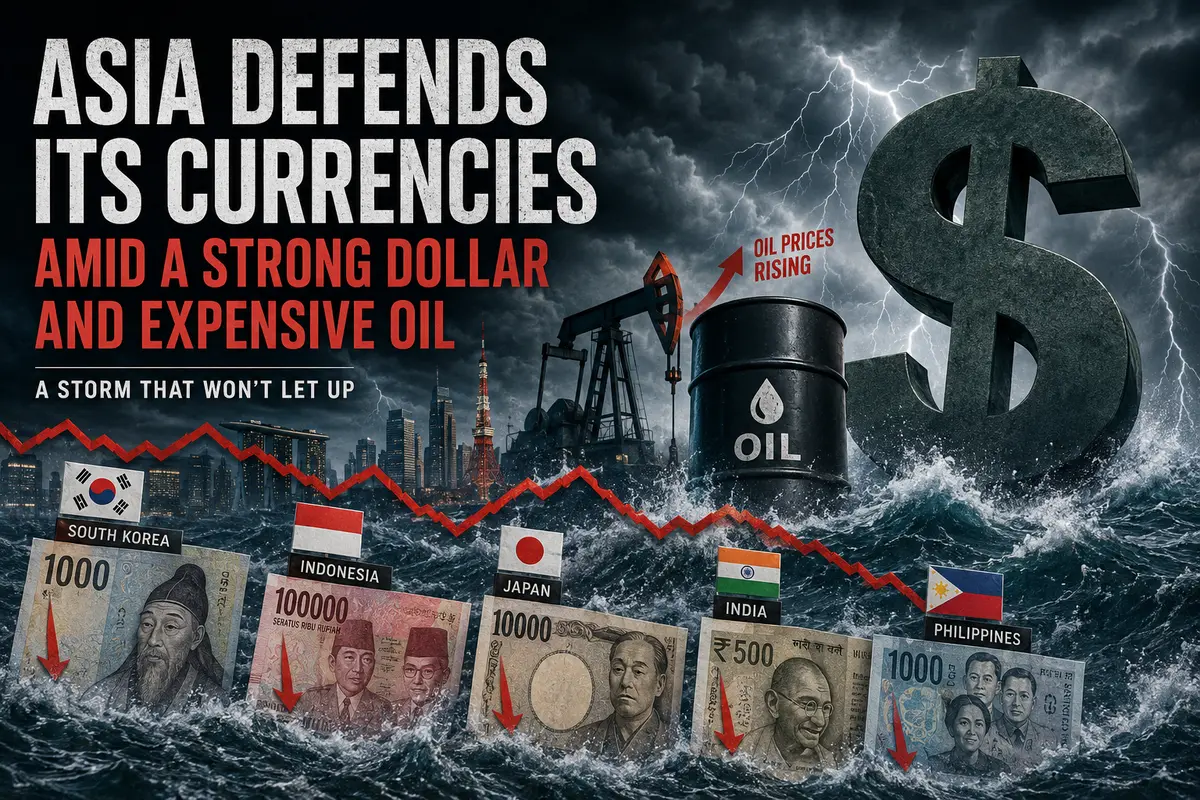
Asia wakes up on Thursday, and the first thing traders see on their screens is red once again. Regional currencies have fallen for a fourth consecutive day. Bloomberg’s Asian currency index—a barometer of the financial health of hundreds of millions of people across the region—continues its relentless slide. The biggest losers are the South Korean won and the Indonesian rupiah, but few others are faring much better.
Behind these numbers lies a simple and uncomfortable story. The dollar is strong. Oil is expensive. Capital is flowing out of Asia and into the United States. Meanwhile, local central banks are trying to preserve what they can. Interventions, warnings, interest-rate hikes—every tool is being deployed. So far, however, the results have been limited.
Asian countries have found themselves in a perfect storm. Two powerful forces are putting simultaneous pressure on their currencies. The first is the policy stance of the U.S. Federal Reserve. The American economy has remained stronger than expected, inflation remains stubborn, and the Fed is not only delaying rate cuts but is even considering further hikes. The second factor is the Middle East. Rising tensions between the United States and Iran are pushing oil prices higher. For Asia, which imports most of the oil it consumes, expensive oil delivers a triple blow: higher inflation, worsening trade balances, and weaker currencies.
Regional authorities are fighting back. Some are intervening directly, selling dollars from their reserves and buying local currencies. Others are raising interest rates to make their currencies more attractive to investors. Some are imposing administrative measures to limit capital outflows. Yet the U.S. dollar remains a formidable opponent. It is difficult to fight when domestic economies are slowing and inflation is rising.
South Korea: Words and Actions
South Korea, Asia’s fourth-largest economy and one of the world’s technology powerhouses, is on the front line of the currency battle. On Thursday, authorities once again declared their readiness to curb excessive market volatility. The statement sounded firm. Markets, however, remained unimpressed.
The won fell to its weakest level against the dollar since 2009. Sixteen years. This is not merely a psychological threshold—it is a historic low. In a single day, the currency lost around 1.5%.
Why is the won so vulnerable? Because South Korea is an export-driven economy deeply integrated into global supply chains. Semiconductors, automobiles, ships, and electronics are shipped worldwide. A stronger dollar makes Korean goods cheaper for foreign buyers, which appears beneficial for exporters. But there is another side to the story.
South Korea imports nearly all the oil it consumes. As oil prices rise, import bills increase. The trade balance deteriorates. Demand for dollars to pay for imports grows. The won weakens. And when the won weakens, imported inflation accelerates. The cycle feeds on itself.
The Bank of Korea faces a difficult dilemma. Raising rates to support the won could choke an already fragile economic recovery. Leaving rates unchanged could allow the currency to weaken further. For now, policymakers have chosen a third option: verbal intervention. Experience suggests that words alone rarely stop a currency’s decline.
Authorities have stated that they are prepared to use all available tools, including currency swap arrangements with other countries. But when the won hit its weakest level since 2009, markets concluded that concrete action was not imminent—and continued selling.
Indonesia: Intervention and Rate Hikes
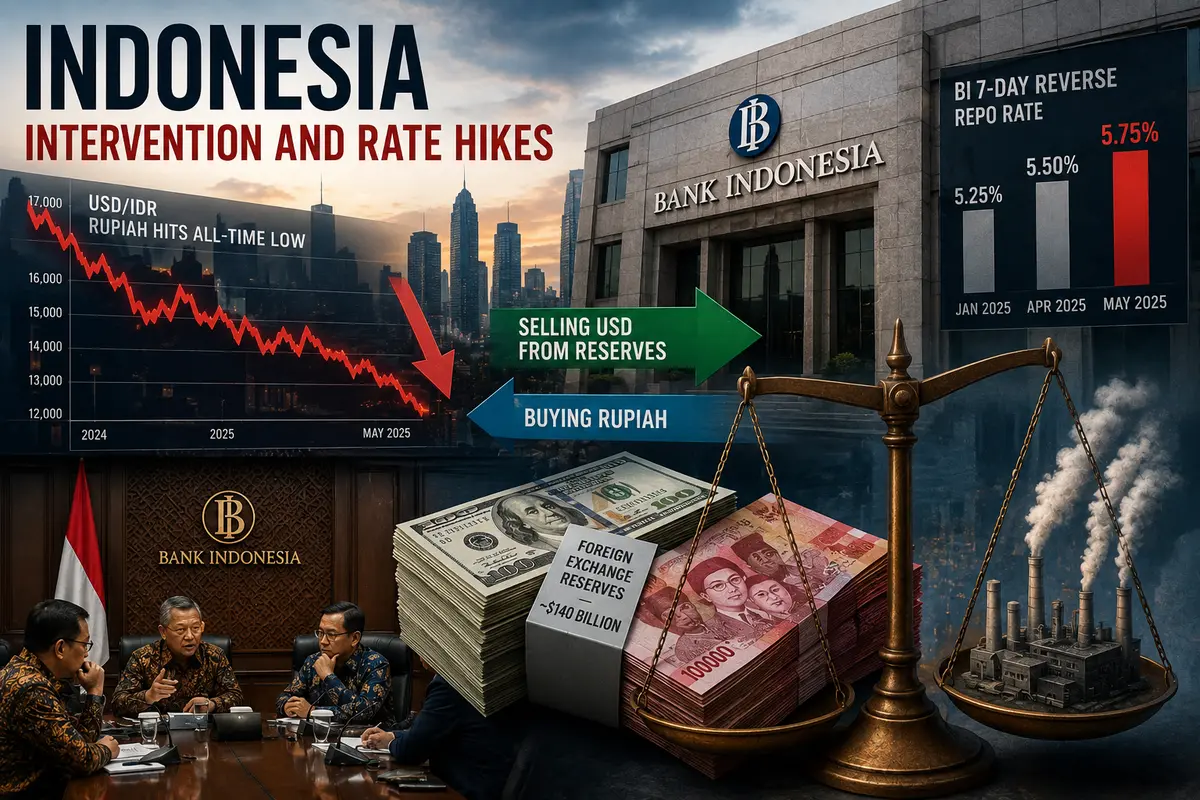
Indonesia, Southeast Asia’s largest economy, is facing an even more serious challenge. The rupiah has fallen to an all-time low. Not merely a sixteen-year low, but the weakest level in its history—a figure that gives policymakers sleepless nights.
Bank Indonesia has gone beyond verbal warnings. It has intensified intervention in the foreign-exchange market, selling dollars from its reserves and buying rupiah in an effort to slow the decline and reduce volatility.
Yet intervention is only a temporary remedy. Indonesia’s foreign-exchange reserves stand at roughly $140 billion. That is substantial, but not unlimited. If pressure on the rupiah persists, reserves will gradually erode. Policymakers need those reserves in case of a more severe crisis.
That is why Bank Indonesia has also adopted more aggressive measures. Last month, it raised its benchmark interest rate by 25 basis points—the third increase this year. Rates are now at their highest level in years.
Higher rates make the rupiah more attractive to foreign investors seeking yield. If U.S. rates are 5% and Indonesian rates are 6%, that extra percentage point can compensate for some of the risks. But there is a tradeoff. Higher rates also slow economic activity. Borrowing becomes more expensive, businesses cut investment plans, and consumers spend less.
Bank Indonesia is trying to balance between two difficult choices. Results have been mixed. The rupiah recovered slightly following intervention announcements but remains near historic lows.
Japan: Back at the Red Line
The Japanese yen is a story of its own. The situation continues to deteriorate. On Thursday, USD/JPY traded near the 160 level—160 yen per dollar—the same threshold that triggered a major intervention in April.
On Wednesday, Japanese officials again warned that they were prepared to respond to excessive currency movements. The language was unusually firm. Finance Minister Satsuki Katayama stated that “appropriate measures” would be taken if volatility became excessive. Traders took notice.
Then new information emerged that changed the market narrative. Sources familiar with the matter reported that the Bank of Japan may consider raising rates by 25 basis points at its meeting later this month.
Twenty-five basis points is significant for a central bank that spent decades keeping rates near zero. Moving from 0% to 0.1% was one step. Moving from 0.1% to 0.35% would represent a much more confident move.
A rate increase would likely strengthen the yen by narrowing the yield gap between Japan and the United States. The currency would become more attractive to global investors. However, higher rates would also challenge an economy that has grown accustomed to ultra-cheap money. Prime Minister Sanae Takaichi’s government is already spending trillions of yen on subsidies to offset the rising cost of living. Higher rates would add another layer of difficulty.
For now, markets remain skeptical that the Bank of Japan will actually deliver a 25-basis-point hike. The risks are considerable, and domestic opposition remains strong. Nevertheless, the fact that such discussions are taking place at senior levels sends an important signal: Tokyo’s patience is wearing thin.
India: Taxes, Bonds, and Hope
The Indian rupee, like many of its regional peers, remains under pressure and is trading near record lows. But India possesses several advantages that others lack.
First, Prime Minister Narendra Modi’s government is not standing still. It is preparing a package of measures aimed at attracting foreign capital. Plans reportedly include tax reductions for foreign investors and the removal of ownership restrictions on certain categories of bonds.
The idea is straightforward: make Indian assets attractive enough that investors willingly buy into the rupee. If foreigners purchase Indian bonds, demand for the currency rises—and higher demand supports its value.
Second, India offers relatively high real interest rates. Inflation is higher than in the United States, but nominal interest rates are also substantially higher. As a result, the real yield on Indian assets remains appealing for patient investors.
Third, India benefits from global diversification trends. Investors are increasingly seeking alternatives to China, and India is a natural candidate thanks to its population, economic growth, and reform agenda. Yet capital inflows have not arrived quickly enough because investors remain concerned about rupee volatility. It is a self-reinforcing cycle.
The government hopes to break that cycle through tax and regulatory reforms. Whether it succeeds remains uncertain. The rupee continues to hover near historic lows.
The Philippines and Others: Who Else Is at Risk?
The Philippines is another country that has raised rates to support its currency, the peso. The central bank has increased rates twice in the past two months. The peso has stabilized somewhat but remains weak by historical standards.
The country faces the same challenge as many of its neighbors: oil. The Philippines imports nearly all of its fuel. High oil prices worsen the balance of payments and fuel inflation. Higher interest rates help contain inflation but do little to address the country’s structural dependence on imported energy.
Thailand’s baht is also under pressure. The Bank of Thailand has so far refrained from raising rates, fearing damage to the tourism sector—the primary engine of growth since the pandemic. But the baht continues to weaken, and pressure is mounting.
Malaysia’s ringgit is the only regional currency showing relative resilience. The reason is simple: Malaysia is a net exporter of energy. It produces oil and gas. Higher energy prices support government revenues and improve the balance of payments. As a result, the ringgit has declined less than many of its peers.
The Singapore dollar, as usual, remains one of the region’s strongest performers. The Monetary Authority of Singapore uses the exchange rate—not interest rates—as its primary policy tool, providing greater flexibility. Even so, the Singapore dollar has also weakened against the U.S. dollar.
Why Is This Happening? Two Main Reasons
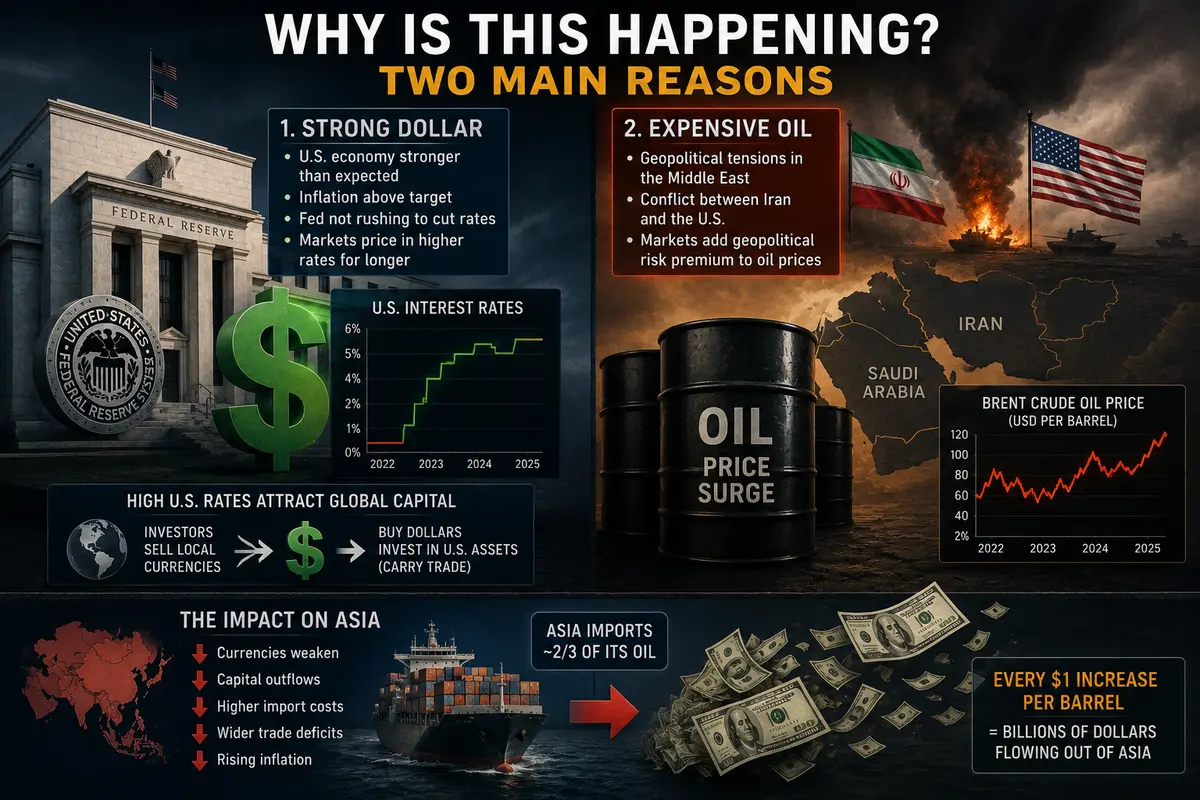
At the root of the problem are two forces: a strong dollar and expensive oil.
The dollar is strong because the Federal Reserve is in no rush to cut rates. The U.S. economy continues to surprise on the upside. Employment, consumer spending, and business activity data have generally exceeded expectations. Inflation, while lower than before, remains above target. Consequently, the Fed has avoided giving clear signals about imminent rate cuts, and markets are pricing in higher rates for longer.
When U.S. interest rates are high, investors around the world sell local currencies and buy dollars in order to invest in U.S. assets that offer attractive and relatively secure returns. This dynamic is often associated with carry-trade strategies. For many Asian currencies, it is a painful environment.
Oil remains expensive because of geopolitical tensions in the Middle East. Conflict involving Iran and the United States has increased uncertainty, and markets have built a geopolitical risk premium into crude prices. For Asia, which imports roughly two-thirds of the oil it consumes, every additional dollar per barrel translates into billions of dollars flowing out of the region.
What Can Authorities Do?
Asian policymakers have several tools at their disposal.
First: Foreign-exchange intervention.
Sell dollars from reserves and buy local currencies. Effective in the short term, but costly. Reserves are finite, and markets know it. If interventions become predictable, speculators may increase their bets against the central bank.
Second: Interest-rate hikes.
Higher rates make currencies more attractive. But they also slow economic growth and increase debt-servicing costs. In highly leveraged economies, aggressive tightening can trigger financial stress.
Third: Capital controls.
Authorities can restrict short-selling, limit capital outflows, or impose taxes on speculative transactions. These are emergency measures that can stabilize markets temporarily but often discourage the foreign investment countries desperately need.
Fourth: Diplomacy.
Currency swap agreements, coordinated interventions with neighboring countries, and international efforts to stabilize exchange markets can all help. Such measures require time and political coordination but can be effective.
Indonesia and the Philippines have chosen rate hikes. South Korea and India are relying more on verbal intervention and administrative measures. Japan is balancing between intervention and possible monetary tightening. There is no single solution.
Looking Ahead
How long will Asian currencies remain under pressure? The answer depends largely on two factors: the Federal Reserve and the Middle East.
If the Federal Reserve begins signaling rate cuts in June or July, the dollar would likely weaken, providing relief for Asian currencies. If not, the pressure may continue.
If ceasefire negotiations gain traction in the Middle East, oil prices could fall. Asia’s import costs would decline, trade deficits would narrow, and currencies would strengthen. If the conflict escalates, oil could rise further, putting additional downward pressure on regional currencies.
For now, both forces are working against Asia. The Fed is not rushing to cut rates. The Middle East is not moving toward peace. Traders in forward and options markets continue to price in further weakness across the region’s currencies.
Asian authorities are doing everything they can: interventions, rate hikes, warnings, and policy adjustments. Yet markets appear to be listening more closely to the dollar and oil than to policymakers. That is why the won is at its weakest level since 2009, the rupiah is near record lows, and the yen is hovering around 160 per dollar.
Who ultimately wins this battle remains to be seen. One thing is certain: Asia is not prepared to surrender. Too much is at stake. Too many people depend on stable currencies. And as long as reserves remain available, interest-rate tools exist, and political will endures, the fight will continue.

Comments
No comments yet. Be the first to share your thoughts!
Authentication Required
You must be logged in to post a comment.