

Fed concerns and the Iranian dividend split the global bond market
Introduction: two shores of the same Atlantic
Imagine two ships sailing in the same ocean but caught in completely different currents. One is racing forward with a tailwind, its crew confident in its course and ready to tighten the sails. The second is barely moving, its holds underfilled, and its captain anxiously scanning the horizon. That is roughly what the government bond markets on both sides of the Atlantic look like today.
What we are seeing in recent days is not just ordinary yield fluctuations. It is a tectonic rupture exposing fundamental differences in the economic trajectories of the United States and Europe. On one side is the Federal Reserve’s aggressive rhetoric, signaling that the era of cheap money has not ended, only paused. On the other is Europe, where every new price signal from the Middle East is perceived as a potential escape from inflationary suffocation.
And at the center of this storm sits an unexpected factor that would normally seem secondary in any other year — a temporary agreement between the United States and Iran. What diplomats discussed in negotiation rooms, bond traders instantly translated into numbers and charts. And those numbers began speaking different languages on opposite sides of the ocean.
Let’s unpack what is really happening in the bond market, why the Fed and the ECB are looking in different directions, and how a peace initiative with Iran unexpectedly became a point of division for investors.
The Fed said “pause,” markets heard “attack”
A hawkish pause: how unchanged rates became a tightening signal
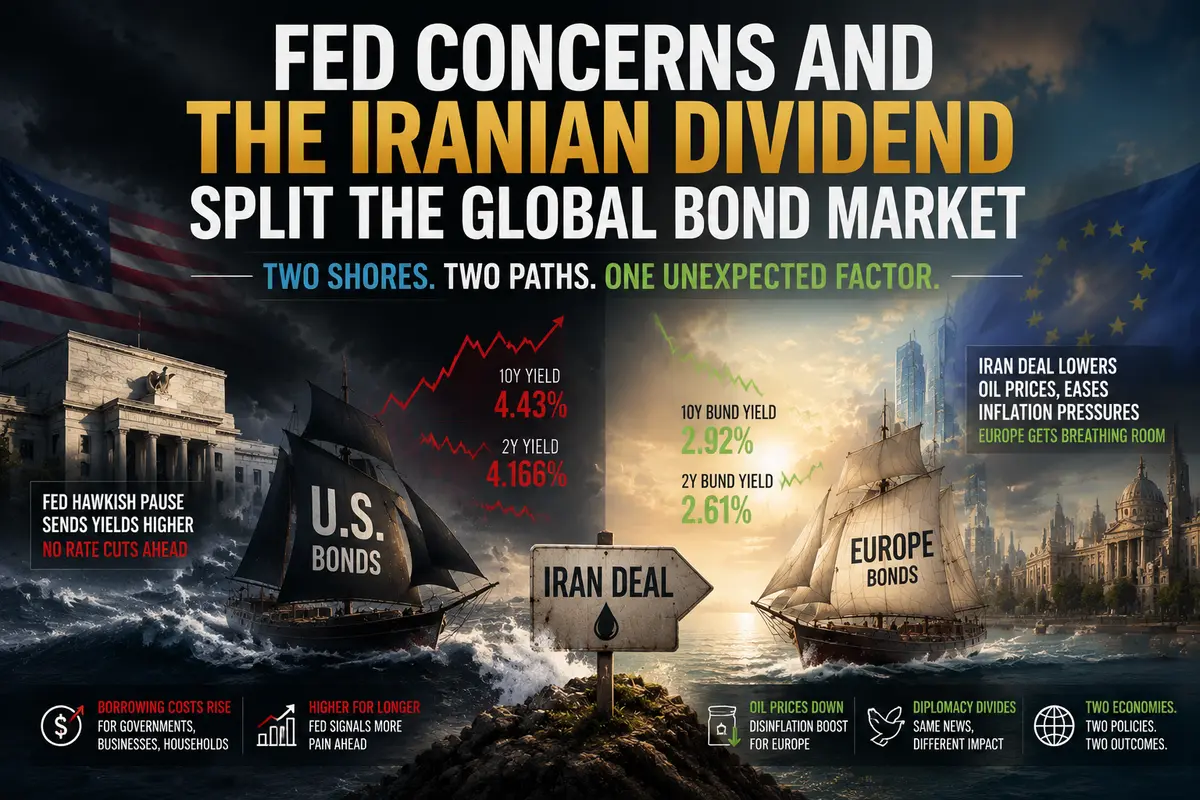
Thursday, Federal Reserve meeting. Everyone expected a rate decision. And it came — no change. But if you think markets breathed a sigh of relief, you are very wrong. In the world of central banking, it is often not the decision itself that matters, but how it is communicated. And the Fed delivered it with such a hawkish tone that investors rushed to recalculate their portfolios.
The key phrase that caused turmoil was the signal that the tightening cycle is far from over. It was not a direct promise of a rate hike, but a clear warning: do not relax, rate cuts are not coming anytime soon. On the contrary, if inflation does not retreat, another hike — or even more than one — is on the table.
Swap markets reacted instantly. The probability of a December rate hike jumped from 42% to 85% within hours. 42% was basically a coin toss. 85% is almost certainty. Investors who just yesterday were planning for monetary easing were suddenly unwinding positions and rotating into defensive assets.
What does this mean for the average bondholder? Old low-yield bonds become less attractive because new ones will offer higher returns. Bond prices fall, yields rise. And so the sensitive US 2-year note jumped to 4.166% — the highest level in more than a year. Benchmark 10-year yields reached 4.43%.
These are not just numbers on a screen. They signal that borrowing costs for the US government are rising. And along with them, credit becomes more expensive for businesses, mortgages for households, and financing for startups. The Fed is telling the market: “We are not done yet — prepare for expensive money for a long time.” And the market, like an obedient student, does its homework.
Two years of expectations vs two years of reality
Interestingly, just a few months ago most analysts expected the Fed to begin cutting rates by the end of 2025. Inflation defeated, labor market cooling, time to breathe. Turns out — no. Inflation is stuck around 3–3.5% and refuses to return to the 2% target. The labor market remains surprisingly resilient, and consumer spending is stronger than even optimists expected.
Now the Fed is forced to admit: “We got the timing wrong.” The market is now reassessing not only December expectations but the entire 2026 outlook. Instead of a quick shift toward easing, we may get a prolonged period of high rates — the famous “higher for longer.”
And the most painful factor for markets is uncertainty. When the Fed says the next move could be up or down, investors hedge in every direction. The cost of hedging rises, liquidity falls, spreads widen. The bond market becomes more nervous than it has been in years.
Europe: the Iranian wind in the sails
Middle East peace as a disinflationary driver
While the Fed was escalating tension in Washington, on the other side of the Atlantic — in Geneva, Vienna, or wherever negotiations took place — the US and Iran signed a temporary peace agreement. And here things get interesting for markets.
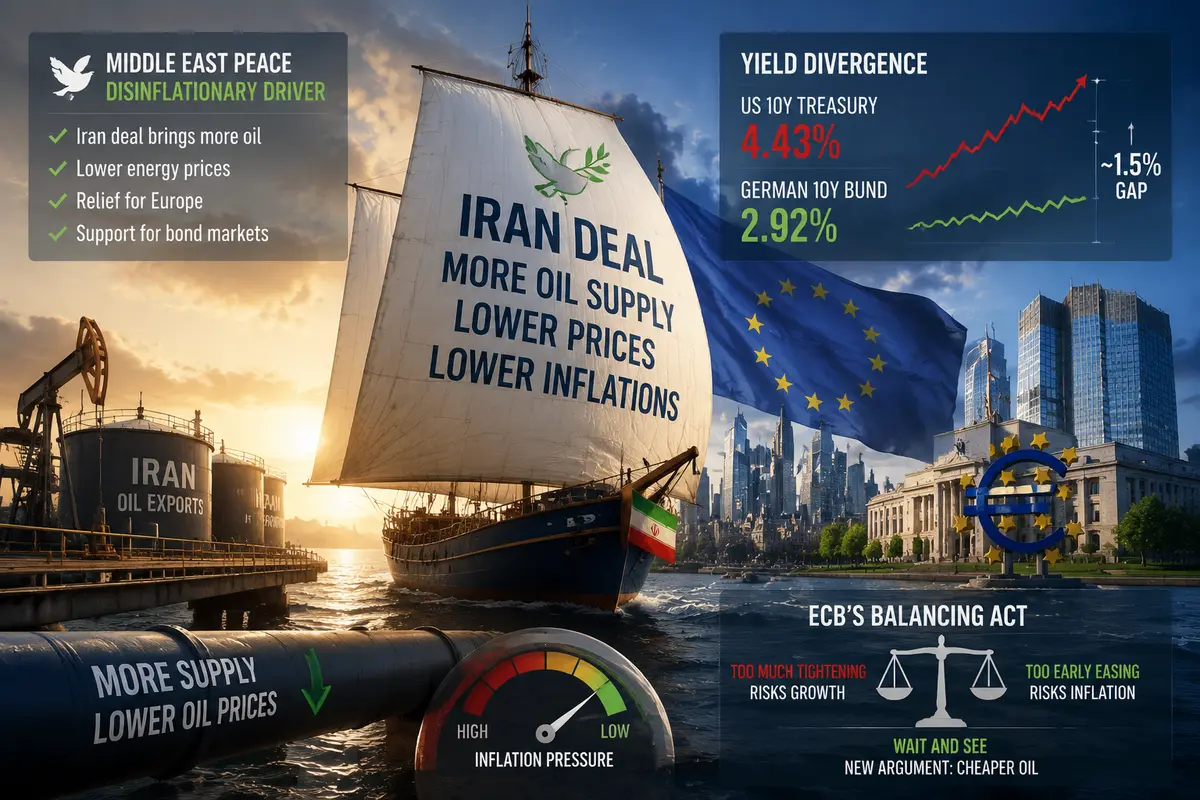
Europe is an economy suffocating from expensive energy imports. Oil, gas, electricity — all of it is embedded in European goods and services. So anything that can reduce energy prices is like a breath of fresh air for European bond markets. And the Iran agreement implies a potential return of significant Iranian oil supply. More oil means lower prices, even with logistical complications.
The irony is that the Fed justifies its hawkish stance with inflation control, while Europe could receive a disinflationary impulse from the Iran deal that the Fed can only dream of. Falling oil prices act as a natural cap on inflation without requiring rate hikes or economic slowdown.
German 10-year Bund yields rose to 2.92% on Thursday, but context matters. Yes, they rose — but they remain far below US yields of 4.43%. That nearly 1.5 percentage point gap is the key signal of divergence. Investors are willing to pay that premium to hold US Treasuries instead of German bonds. This is not just a rate difference — it is a difference in risk perception and economic outlook.
Why the ECB may go its own way
Four European Central Bank officials are set to speak, including chief economist Philip Lane. Each will be under intense scrutiny. Europe is in a dual situation: inflation is still above target, but growth is significantly weaker than in the US.
The ECB is in a difficult position. If it follows the Fed and continues tightening, it risks crushing fragile recovery. If it stops too early or signals easing, the euro could weaken and import inflation.
But now the ECB has a new argument: cheaper oil thanks to the Iran deal. This allows it to say, if not victory over inflation, then at least: “We see positive signals and can afford to wait.”
Given that German 2-year yields are near weekly highs around 2.61% and equity markets are improving, traders are pricing in stabilization rather than further tightening — very different from the US, where markets still expect additional tightening.
Britain: the island exception
The Bank of England at a crossroads
The UK remains on its own path. British 2-year yields sit near mid-April lows around 4.188%, despite expectations that the Bank of England will hold rates steady.
At first glance, UK bonds behave more like European than American assets. Inflation remains high, growth mixed, and fiscal deficits persistent. But the UK is more dependent on energy imports than continental Europe.
So falling oil prices from the Iran deal are even more powerful for Britain. This could allow the Bank of England to pause tightening and take a breath. Everything depends on Governor Andrew Bailey’s tone.
Traders will dissect every word. Any hint that the peak rate has been reached could trigger a sharp rally in gilts. Any mention of persistent inflation risks will push yields higher.
Why the UK is decoupled from the US boom
Three reasons explain the divergence:
First, expectations. Markets already priced in BoE tightening earlier this year. Now that inflation is cooling, there is less need for further hikes.
Second, external orientation. The UK is more tied to Europe and Asia than the US, so American rate moves have less direct impact.
Third, politics. The UK government emphasizes fiscal discipline, reducing risk premiums, while US debt ceiling debates add volatility.
Economic divergence: why the US and Europe are moving apart
US strength becomes a problem
The US economy is growing faster than any other developed economy. Labor markets are strong, consumer spending exceeds expectations. But strength brings inflation pressure.
Higher rates mean higher debt servicing costs. US 10-year yields at 4.43% translate into tens of billions in extra government expenses per percentage point.
Investors are now asking uncomfortable questions: is the US economy overheating? Is there a debt trap forming? Is the Fed becoming hostage to its own policy?
European fragility becomes protection
Europe is the opposite: weak growth, stagnant industry, soft demand.
But weakness reduces inflation pressure naturally. Firms cannot raise prices easily, so the ECB has less need to tighten.
And Europe is highly sensitive to energy prices. The Iran deal is therefore a direct disinflationary force.
What to expect in coming weeks
Three key drivers:
-
Implementation of the Iran deal and oil prices
-
Central bank rhetoric (ECB and BoE)
-
US inflation data
Investors are split into two camps:
-
US bond buyers: attractive yields around 4.43%
-
European bond buyers: potential price upside if yields fall
-
Hedgers: holding both to balance risk
Conclusion: a world no longer unified
The bond market has always been a barometer of the global economy. But today it shows not just “storm” or “calm” — it shows different weather systems across regions.
The US and Europe are no longer moving in sync. Their cycles diverge, their policies diverge, and their bond markets react differently to the same news.
The Fed fights inflation in a strong economy, pushing US yields higher. Europe, softened by weak growth and potential energy relief from Iran, can afford patience.
Britain sits in between, leaning toward Europe.
And at the center of this geopolitical-economic shift is something few expected to matter for bond markets — a temporary US–Iran agreement, which has become a key driver of global yield divergence.
The bond world is no longer one. And we are likely only at the beginning of this path. Investors will have to adapt to a new reality: the US market is one story, Europe another, and Britain a third — and sometimes, news from Tehran matters more than reports from Washington.

Comments
No comments yet. Be the first to share your thoughts!
Authentication Required
You must be logged in to post a comment.