

Eurozone Bonds Breathe a Sigh of Relief: Peace with Iran Appears Within Reach, Yields Fall
Friday: A Day of Hope for Diplomacy
On Friday morning, European markets woke up with the feeling that the heavy burden weighing on them for months had suddenly become a little lighter. It had not disappeared or melted away—it simply stopped suffocating them. Eurozone government bonds rallied, which means their yields declined.
That may sound counterintuitive to those accustomed to thinking that “up” is good and “down” is bad. In the bond market, however, the opposite is true: when bond prices rise, yields fall. And on Friday, the yield on benchmark 10-year German Bunds dropped below 3% for the first time since early June.
Three percent is a psychological threshold. Above it lies a zone of pain, where borrowers—governments, corporations, and mortgage holders—feel the rising cost of money. Below it lies a zone of relief, even if that relief proves temporary.
What happened? Geopolitics.
Donald Trump, who rarely delights markets with predictability, delivered a statement that bond traders would almost be willing to build him a monument for. He said that a historic peace agreement between the United States and Iran could be signed in Europe as early as this weekend.
If true—and Trump is known for presenting wishes as realities—the conflict in the Middle East, which has flared on and off since spring, could finally come to an end. Iran would stop threatening to close the Strait of Hormuz. Israel would halt strikes on the outskirts of Beirut. Oil prices, already at two-month lows, could fall even further. Eurozone inflation, fueled by expensive energy, would begin to slow. And the European Central Bank (ECB), which has been forced to raise interest rates to combat inflation, could at least afford to pause.
All of this is music to the ears of bondholders.
Bonds thrive on low inflation and low interest rates. They suffer when rates rise. And they flourish when rates fall—or even stop rising.
On Friday, they flourished.
German, French, Italian, and Spanish bonds all gained. British gilts rose as well, although they had their own drama unfolding around GDP data.
German Bonds: Bunds Are Back in Fashion
Let’s begin with Germany, because German government bonds—Bunds—are the gold standard of the European debt market. When German yields fall, the entire eurozone takes notice.
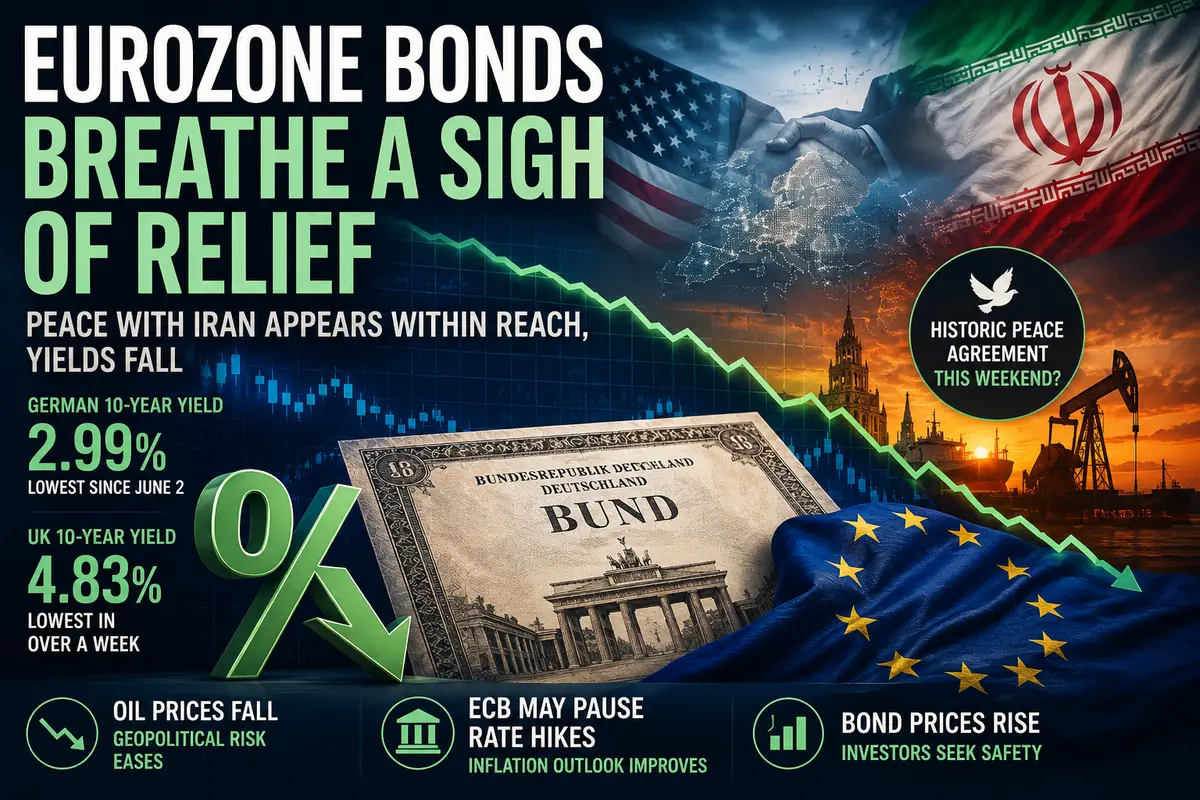
The yield on 10-year German bonds fell to 2.99% on Friday, its lowest level since June 2. For nearly two weeks, yields had remained above 3%, and now they had finally broken lower. The catalyst was news surrounding talks with Iran, which reduced inflation expectations. If oil becomes cheaper, inflation in the eurozone—which remains highly sensitive to energy prices—tends to follow.
Even more revealing was the move in shorter-dated bonds. Two-year German yields, which are highly sensitive to ECB policy expectations, fell to 2.62%, also a more-than-one-week low. They are now on track for their largest two-week decline since late May.
This suggests that markets are pricing in a more dovish ECB. Investors who previously expected another rate hike at the July or September meeting are now becoming less convinced.
Why?
Because the ECB, like every central bank, focuses on inflation. In recent months, eurozone inflation has been driven largely by energy costs—oil, natural gas, and electricity. If peace with Iran leads to lower oil prices, and early signs already point in that direction, then inflation could prove lower than previously expected. As a result, the ECB may no longer feel compelled to tighten policy further.
Bond investors who had endured losses from rising yields over recent months finally enjoyed a moment of relief. Their portfolios appreciated in value.
The only question is how long that relief will last.
Iran Negotiations: What We Know and What Markets Believe
The key question on Friday was simple: what is actually happening behind closed doors?
Trump stated that a “historic peace agreement” could be signed in Europe as early as this weekend. Which weekend? This one—June 13–14—or the next? He did not specify. Nor did he identify the participants, the venue, or the precise terms under discussion.
Yet the mere fact that a U.S. president is publicly discussing the possibility of peace marks a significant shift.
Just a month ago, Trump was promising “total victory” over Iran. A week ago, U.S. forces were striking Iranian-linked targets in Syria and Iraq. Only yesterday, Iran was threatening to close the Strait of Hormuz.
Now, suddenly, there is talk of peace negotiations.
Markets believe it—not because they are naïve, but because they want to believe it.
Too much money has been lost to geopolitical uncertainty. The stakes are too high. If peace is genuinely achieved, it would reshape everything: oil prices, central bank policy, exchange rates, and equity markets.
Skeptics, however, remain.
They point out that Trump has a history of making sweeping statements without binding commitments. Negotiations could collapse at the last minute. Even if an agreement is signed, implementation could take years, and hardline factions on both sides may attempt to sabotage it.
Nevertheless, on Friday the markets chose optimism.
Yields fell. Bond prices rose. And investors headed into the weekend watching every headline with anticipation.

The ECB: A Pause or Just the Calm Before the Next Move?
Until recently, European government bonds had been trapped in a painful downward trend.
Inflation, fueled by instability in the Middle East, refused to retreat. The ECB, which initially dismissed inflation as “transitory,” was ultimately forced to raise borrowing costs. Every rate hike hurts bondholders because newly issued bonds offer higher coupons, making older bonds less attractive.
Now, however, there is hope that the tightening cycle may be nearing its end.
If peace with Iran leads to a sustained decline in oil prices, headline inflation across the eurozone could fall rapidly. Core inflation could follow as second-round effects—where higher energy costs drive broader price increases—begin to fade.
The ECB, having already raised rates several times this year, may decide to pause at its July meeting. If inflation continues to decline, some investors even speculate that the next move could eventually be a rate cut.
That may sound far-fetched today, but markets always look ahead.
And increasingly, they see the possibility that peak rates are already behind us.
Of course, there is a caveat. The ECB has traditionally been more hawkish than the Federal Reserve when it comes to inflation. German policymakers, particularly those associated with the Bundesbank tradition, have historically opposed overly accommodative policy.
But if inflation data continue to improve, even they may soften their stance.
British Bonds: A Different Story Driven by GDP
The United Kingdom, while no longer part of the European Union, still trades within the same broader bond ecosystem.
British government bonds also rallied on Friday, but for a different reason.
April GDP data showed that the UK economy contracted by 0.1% compared with March. It was the first monthly decline since August of last year.
The drop was modest, but it interrupted several months of growth.
For bond markets, weaker economic growth is generally positive news because it reduces pressure on the Bank of England to raise rates.
As a result, yields declined.
The benchmark 10-year gilt yield fell to 4.83%, its lowest level in more than a week. Two-year yields dropped to 4.26%, while five-year yields fell to 4.38%.
This occurred despite UK inflation remaining higher than in either the eurozone or the United States.
Karim Henein, a strategist at Lloyds Bank, summed up the situation with typical analytical caution:
“It does not appear to be a significant enough surprise to alter Monetary Policy Committee voting patterns; inflation data remain far more important in the near term. There is also clearly some volatility in the GDP figures.”
In other words: don’t get carried away.
One weak month does not constitute a trend. The Bank of England will continue focusing on inflation.
Markets, however, are already looking ahead. They see a weaker economy and conclude that rates may stop rising sooner than expected—or perhaps even begin falling earlier than anticipated.
And so they buy bonds.
Oil and Inflation: The Real Drivers Behind the Rally
At the center of this entire story lies one commodity: oil.
Brent crude, which traded near $95 per barrel just a month ago, has fallen toward $91–92 and briefly dipped even lower on Friday.
The reason is straightforward: expectations of peace in the Middle East and a reduced risk of disruption in the Strait of Hormuz.
Why does oil matter so much for bonds?
Because Europe is a net importer of energy. When oil becomes more expensive, companies and consumers spend more on fuel. Inflation rises. Central banks respond by raising rates. And higher rates hurt bond prices.
The chain reaction is long but direct:
Cheaper oil → lower inflation → lower interest rates → higher bond prices.
And vice versa.
That is why bond markets reacted immediately when Trump spoke of peace with Iran.
They do not require guarantees.
Hope is enough.
Hope that oil prices will continue falling.
Hope that inflation will slow.
Hope that the ECB will not need to raise rates further.
Will Peace Hold? Traders Remain Cautious
Of course, all of this optimism could evaporate quickly.
If negotiations fail, if Iran presents unacceptable conditions, or if military action resumes, the hope currently supporting markets could disappear overnight.
Bond yields would rise again. Prices would fall. Investors would once more face losses.
Traders understand this.
That is why Friday’s rally was not euphoric—it was cautious.
Yields declined, but not dramatically. Yield spreads between German and Italian bonds remained elevated, reflecting Italy’s greater vulnerability to energy-price shocks. Investors did not abandon their hedges; they merely reduced them somewhat.
As one London-based trader reportedly put it:
“We believe in peace—but not enough to sell all our safe-haven assets. We’ve simply shifted from equities into bonds because bonds feel safer right now.”
What Comes Next? The Weekend Will Be Decisive
The coming days—Saturday and Sunday—could prove critical.
If Trump genuinely succeeds in securing a peace agreement with Iran, Monday could bring a continuation of the bond rally. German yields might fall toward 2.8–2.9%, while British yields could decline to 4.6–4.7%. The euro would likely strengthen, the dollar weaken, and equity markets—particularly airlines and tourism stocks—could rise.
If negotiations collapse, or if Trump’s statements prove exaggerated, markets should expect a reversal. German 10-year yields could return to the 3.1–3.2% range, while British yields could move back toward 4.9–5.0%. Volatility would increase sharply.
There is also a third possibility: a partial agreement.
Perhaps a temporary ceasefire, a prisoner exchange, or limited sanctions relief. Such an outcome would fall short of a “historic peace agreement,” but it would still represent progress. Markets would likely react positively, though without the enthusiasm that a comprehensive peace deal would generate.
For now, however, eurozone bonds are rising.
Yields are falling.
Investors are smiling—but they are keeping a finger close to the sell button.
Because in the Middle East, peace has rarely been permanent. Even when it arrives, the next conflict is often only a few years away.
Yet for bond markets, even a few months of calm would be a gift.
A few years would be something closer to happiness.
Let us hope the weekend brings peace—or at least a ceasefire. Enough to keep oil prices moving lower, inflation slowing, and bonds advancing.
After several difficult years, bondholders have earned a little relief.

Comments
No comments yet. Be the first to share your thoughts!
Authentication Required
You must be logged in to post a comment.