Bar Pipa
We pay for a post of 10$

Yen Tests the 160-per-Dollar Level Amid Intervention Threats
Yen Tests the 160-per-Dollar Level Amid Intervention Threats
The line that must not be crossed

The silence during Wednesday’s Asian trading session was tense. Not the kind of silence where nothing happens, but the kind where everyone holds their breath and stares at a single number on their screens: 160. Three digits that, for the Japanese yen, matter more than any economic forecast or government report.

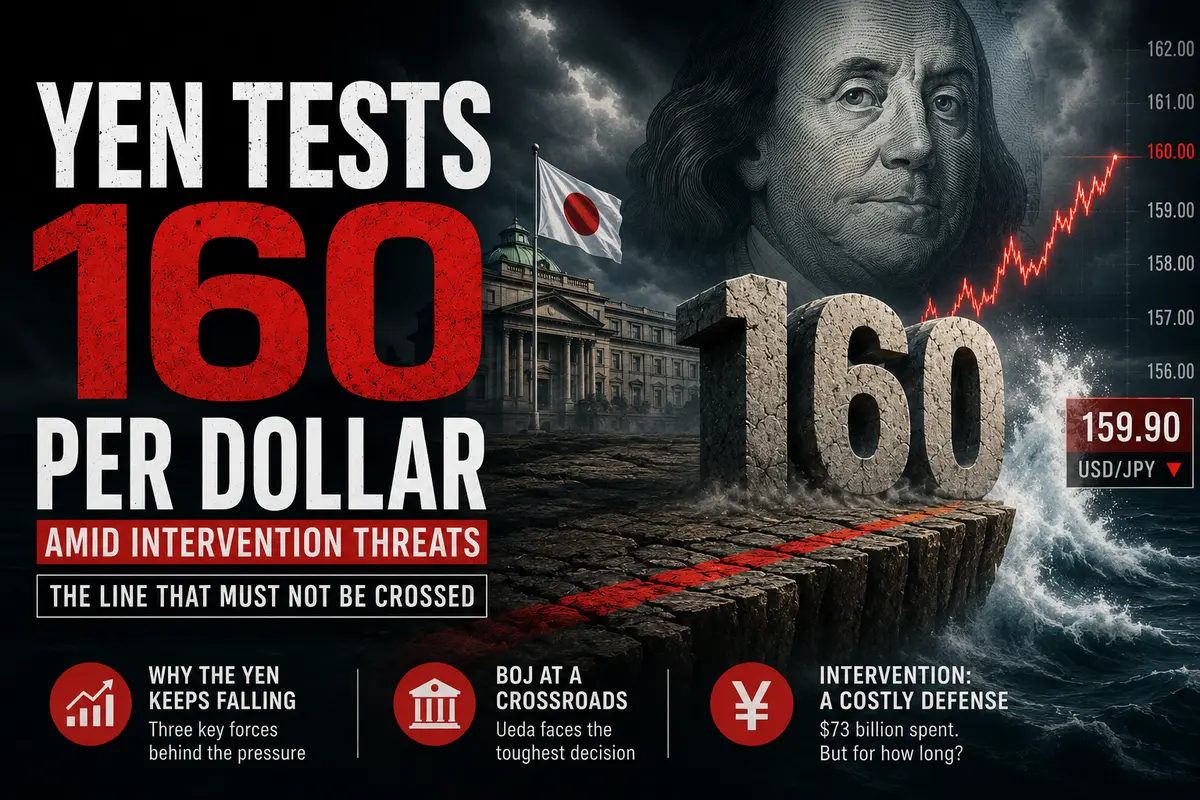
The dollar-yen exchange rate hovered around 159.9. It was like standing at the edge of a cliff and looking down. One step forward, and you're at 160 — precisely the level Japanese authorities deemed unacceptable back in April.

Four months ago, Japan’s Ministry of Finance woke up to a yen trading at 160 and launched a currency intervention on a scale the country had not seen in decades. Officials spent a record ¥11.5 trillion — nearly $73 billion — defending the currency. It was the largest single-round intervention in modern Japanese history.

But markets are notoriously stubborn. The impact proved short-lived. As soon as Japanese officials breathed a sigh of relief and congratulated themselves, the dollar resumed its slow, relentless advance. And today, the 160 level was briefly touched again. Only for a few minutes — but those few minutes were enough to make thousands of traders around the world forget about their coffee and everything else.

Why the Yen Is Falling Again: Three Pillars of Weakness

There are several explanations, rooted not in emotion but in the hard realities of global finance.

1. U.S. Interest Rates

The most obvious factor is U.S. monetary policy. The Federal Reserve has made it clear that it is in no rush to cut interest rates. Contrary to gloomy predictions, the U.S. economy continues to show remarkable resilience.

Labor market data surprised analysts with stronger-than-expected job openings, while consumer spending has softened only modestly...


Continue reading...
0
0
Lin Brings

Gold Falls Despite Rising Tensions in the Middle East

Gold Falls Despite Rising Tensions in the Middle East
The Safe-Haven Paradox: When War Fails to Support Gold

In finance, there are a few principles that rarely get questioned. One of them is simple: geopolitical tensions push gold prices higher. Wars, conflicts, and threats typically drive investors away from fragile paper currencies and toward the timeless, yellow, dependable metal. Gold is a safe haven. And safe havens are supposed to rise in value when bullets start flying.

Wednesday's Asian trading session politely—but firmly—challenged that assumption.

Because the Middle East was on fire. Not figuratively, but literally. Missiles were flying. Troops were moving. Negotiations were starting and stalling in equal measure. Yet against this backdrop, gold actually fell. Only slightly—about half a percent—but it fell nonetheless. Spot gold slipped to around $4,462 per ounce, while futures mirrored the move.

Was this a market mistake? A temporary lapse of judgment among traders? Or has the old safe-haven rule stopped working in today's increasingly chaotic world?

Neither.

The reality is that the world has become more complicated. A single conflict can now push gold both higher and lower at the same time. Every coin has two sides—and in the Middle East, it often has ten.

What's Happening in the Middle East?

To understand gold's behavior, we first need to understand the situation in a region that gave humanity writing but has yet to discover lasting peace.

On Wednesday, the picture was far from calm.

Israel, which in recent months has operated under the principle that "the best defense is a strong offense," continued military operations in southern Lebanon. This is an area where Hezbollah traditionally maintains significant influence—a place Israeli forces often describe as a hornet's nest, where every move provokes a response. These were not isolated retaliatory strikes but a systematic campaign aimed at degrading hostile infrastructure.

Meanwhile, Iran—widely regarded as...

Continue reading...
0
0
Tom Maffin

The Canadian Dollar Holds Near a Multi-Week Low

The Canadian Dollar Holds Near a Multi-Week Low
Where the Loonie Has Stalled

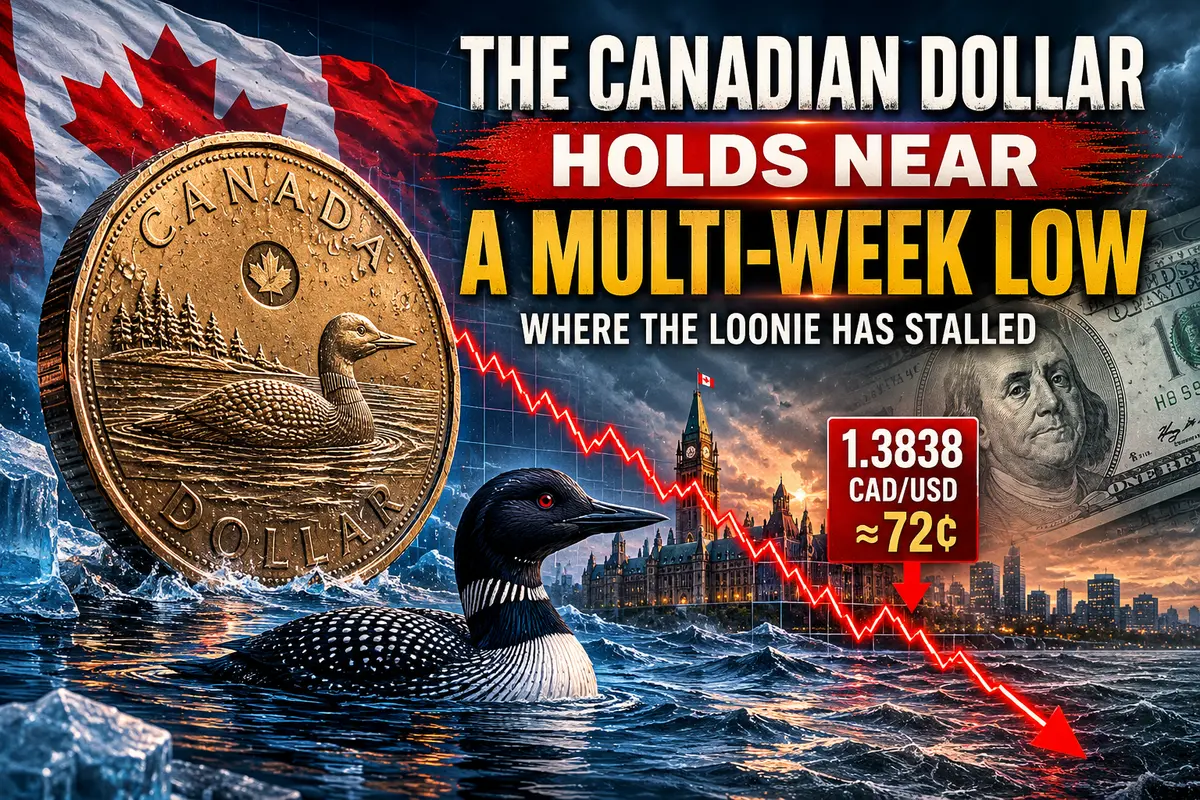
Wednesday was not a particularly good day for the Canadian currency. Then again, neither were the previous several weeks. The Canadian dollar, affectionately known as the “loonie” after the solitary loon depicted on the one-dollar coin, remained dangerously close to its multi-month lows against its American counterpart.

It did not plunge. It did not collapse. It did not crash. It simply stood still. And that stillness — that stubborn pause at a level that pleases no one — speaks more loudly about the challenges facing the currency than any dramatic selloff could.

During trading, the Canadian dollar was virtually unchanged at 1.3838 per U.S. dollar. Converted into U.S. cents, that works out to roughly 72¼ cents for one Canadian dollar — a level that would have seemed insultingly low to many Canadians just a few years ago. Today, it has become an uncomfortable reality to which people are gradually adapting.

Throughout the session, the currency traded within a narrow range between 1.3816 and 1.3854. By foreign-exchange standards, that range is almost laughably small. This is not volatility; it is indecision. Traders do not know which direction to run, so they remain frozen in place, clinging tightly to their positions.

The most troubling moment came last Thursday, when the Canadian dollar slipped to a six-week low of 1.3869. Since then, conditions have not improved, but at least they have not deteriorated dramatically. Whether this calm is the quiet before a storm or merely the beginning of a long and tedious period of stagnation remains to be seen.

What Is Pressuring the Loonie?

Trying to explain the Canadian dollar’s weakness with a single factor would be impossible. As always, it is a cocktail of problems — a bitter blend that financial markets swallow reluctantly because they have...

Continue reading...
0
0

The Euro’s Role in the World Remains Stable Despite Uncertainty

The Euro’s Role in the World Remains Stable Despite Uncertainty
The Alternative That Never Became an Alternative

There was something almost tragicomic about it. Throughout 2024, analysts, economists, and geopolitical observers kept wondering: surely this is the moment when the euro finally makes its move.

The United States pursued such an unpredictable economic policy that even its own allies were left bewildered. Trade wars, abrupt policy reversals, public disputes within the administration—a perfect storm that should have pushed the world to look for an alternative to the dollar.

And that alternative already had a name: the euro. The world’s second-largest reserve currency. The natural contender for the throne.

But the world, as it often does, refused to behave as experts expected. It did not rush into the arms of the euro. In fact, it did not rush toward any single currency at all. Instead, investors, central banks, and major funds cast their votes for something else entirely: gold—and the currencies of small, often overlooked countries.

The euro remained roughly where it had always been, holding a share of about 20% of the global market.

These are not rumors or speculation. The figures were published on Tuesday by the European Central Bank (ECB) in its latest report. And, frankly, the numbers make for rather disappointing reading from a European policymaker’s perspective.

Because 20% is not bad. But it is not progress either. It is stagnation. And perhaps most frustrating of all, the euro’s current share remains below the level it enjoyed twenty years ago, in the early years of its existence.

Numbers That Don’t Lie

Let’s dispense with euphemisms. Twenty percent is not a commanding second place. It is a frozen picture.

The euro is neither growing nor shrinking. It is holding the line.

At first glance, given reports that the dollar is also losing ground, this could be framed as...

Continue reading...
0
0
NorthRay

The Trend Is My Friend

The Trend Is My Friend

As long as I traded against the trend, I kept losing. The moment I made friends with it, everything changed.

Hi, this is NorthRay.💪

There was a time when I opened trades simply because “the price is too high, it has to fall now” or “the price is too low, it has to rise now.”

I wasn’t paying attention to the trend. I was trading my feelings.

And do you know what happened?

During an uptrend, I would open Sell positions (because “it can’t keep going up forever”). The price kept rising. My losses kept growing. I held on, hoping for a reversal. Eventually, I either closed at a loss or got stopped out.

Then I read a phrase that every experienced trader repeats:

“The trend is your friend.”

I decided to test it. And surprisingly, once I started trading with the trend, my trades began closing in profit much more often. Not always, but noticeably more often.

Today I’ll explain what trends are, how to identify them, and why trading against them is like swimming upstream in a mountain river.

What Is a Trend? (The Simplest Explanation)

A trend is the direction of price movement.

If the price is moving up, it’s an uptrend (bullish trend).

If the price is moving down, it’s a downtrend (bearish trend).

If the price is moving sideways within a range, it’s a sideways trend (range or consolidation).

Think of it this way:

Imagine you’re standing on an escalator.

An uptrend is an escalator moving upward. You can stand still and it will carry you up. You can walk up and get there faster. But if you try to walk down, you’ll struggle.

A downtrend is an escalator moving downward. Walking up is difficult and risky.

A sideways market is an...

Continue reading...
0
0
BCR

Daily Analysis 3 June 2026 | Markets Brace for NFP as Geopolitical Risks Drive Volatility

Daily Analysis 3 June 2026 | Markets Brace for NFP as Geopolitical Risks Drive Volatility

Currency & Commodity Analysis:


US Dollar Index


The US dollar index remained above 99 on Tuesday, after rising in the previous session, as stalled US-Iran peace talks increased safe-haven demand, while inflation risks and interest rate expectations came into focus. On Monday, Iranian media reported that Tehran had suspended communication with Washington in response to Israeli attacks in Lebanon. Meanwhile, President Trump stated that discussions are ongoing and hinted that a memorandum of understanding with Iran on reopening the Strait of Hormuz could be reached next week. However, rising energy-driven inflation has led markets to anticipate a possible Federal Reserve rate hike before the end of the year. Investors are now awaiting Tuesday's Jolts job openings report, followed by Friday's closely watched US monthly employment data, for further insight into the Fed's policy outlook.


The US dollar index will be under pressure. The dollar index faces greater downside risk, with 98.79 (the Bollinger Band middle line) and 98.58 (the 200-day moving average) serving as key short-term support levels. A break below these levels could lead to a move towards 97.62 for support. From a cross-market technical perspective, the dollar index and US Treasury yields are currently showing some divergence. On the 240-minute chart of the dollar index, the price has fallen from the mid-May high of 99.55, currently trading at 99.20. The MACD histogram is -0.0169, with both the DIFF and DEA lines below the zero line and in a bearish divergence, indicating the downtrend has not yet reversed. Support levels to watch are the psychological level of 99.00 and the previous pullback low of 98.75; a break below these levels would target the next support zone at the recent low of 97.62.


Consider shorting the US Dollar Index at 99.30 today, with a stop-loss at...

Continue reading...
0
0

THE SILENT ORATOR: HOW US TREASURY BONDS AND THE YIELD CURVE DICTATE THE DIRECTION OF EVERY FINANCIAL MARKET — AND WHAT THEY ARE SAYING RIGHT NOW | CAPITAL STREET FX

US 30Y Treasury Yield: 5.025% — first close above 5% since 2007

US 10Y Treasury Yield: 4.463% — elevated on fiscal concerns

US 2Y Treasury Yield: 3.992% — pricing near-term cuts ahead

2Y/10Y Spread: +47bps — re-steepened from record -108bps inversion

10Y TIPS Real Yield: ~2.1% — highest sustained level since 2008

30Y TIPS Real Yield: 2.70% — historically restrictive

DXY Dollar Index: 98.97 — weakening despite elevated rates

USD/JPY: 159.26 — JGB yield approaching 2.70%, 30-year high

EUR/USD: 1.1654 — near 1-year high

GBP/USD: 1.3458 — near 3-day highs

XAU/USD Gold: $4,542 — off all-time high of $5,595, stabilised above $4,500

PCE Inflation: 3.8% YoY, Core 3.3% — fifth year above target

Fed Funds Rate: 4.25-4.50% — zero cuts priced for 2026

Fed Chair: Kevin Warsh — sworn in 22 May 2026, 11th Chair

US National Debt: $36.2 trillion — growing at $1 trillion every ~100 days

Japan Treasury Holdings: ~$1.1 trillion — $220 billion at repatriation risk

Inversion Duration: 803 days — longest ever recorded, now re-steepened

Historical Parallels: 1994 Bond Massacre, 2007 Re-Steepening Trap, 1981 Volcker Peak

INTRODUCTION: A MARKET THAT SPEAKS WITHOUT WORDS

On the afternoon of 29 May 2026, nobody made a speech. Nobody needed to. The US Treasury sold $25 billion in 30-year bonds and the auction cleared at 5.025% — a number that appeared on trading terminals in Tokyo, London, and New York within milliseconds of the hammer falling. No finance minister issued a statement. No central banker stepped to a podium. A single number crossed the wire, and the largest financial market on earth began, without discussion or ceremony, to rearrange itself around it.

The bond market does not hold press conferences. It...

Continue reading...
0
0

Double Trouble Today: BOE’s Bailey Speaks & JOLTS Job Openings! (+ Gold Strategy)

Double Trouble Today: BOE’s Bailey Speaks & JOLTS Job Openings! (+ Gold Strategy)

Hey Traders,

Today is packing some serious macroeconomic heat. If you're trading the Pound, the Dollar, or Gold, you need to have your alerts set and your risk management dialed in. Here is the no-nonsense breakdown of what to expect today and how to position yourself.

🇬🇧 BOE Gov Bailey Speaks: Is the Pound Losing its Edge?

The Context: Governor Andrew Bailey has recently shifted to a surprisingly dovish stance. He explicitly noted that the Bank of England (BoE) might tolerate inflation staying above their 2% target temporarily to support the weak real economy, especially given the ongoing uncertainties and supply shocks from the conflict in the Middle East.

What to Watch: He is in the spotlight again today. If he doubles down on this dovish rhetoric and signals that the BoE is in "no rush" to tighten policy or hike rates despite sticky prices, expect the Pound to face selling pressure.

Key Pairs: Watch $GBPUSD and $EURGBP. If Bailey sounds cautious about UK growth and confirms that summer rate hikes are effectively off the table, $GBPUSD could aggressively test immediate support levels.

🇺🇸 USD JOLTS Job Openings: The Prelude to NFP

The Numbers: Dropping exactly at 10:00 AM ET / 14:00 GMT. The forecast is sitting around 6.82M to 6.87M openings, which is slightly below or roughly in line with March's print of 6.866M.

Why it Matters: The Federal Reserve is laser-focused on the labor market right now to determine its next monetary policy move. This report is our first major clue of the week, setting the stage before Friday’s massive Nonfarm Payrolls (NFP) release.

The Play:

Hot Print (>6.87M): A higher-than-expected number means the labor market is still too tight, reinforcing the "higher for longer" interest rate narrative. This is bullish for the USD.

Cold Print...

Continue reading...
0
0

Strategy Shares Fall After First Bitcoin Sale Since 2022

Strategy Shares Fall After First Bitcoin Sale Since 2022
From an ironclad “never” to the first step back

The cryptocurrency market is used to surprises, but the news that emerged this past Monday caught even the most seasoned Bitcoin enthusiasts off guard. Strategy Inc. — a company that for years has served as a living symbol of unwavering faith in Bitcoin — has sold part of its Bitcoin holdings. For the first time since 2022. The amount was modest, around $2.5 million. Yet the mere fact of the sale sent the company’s stock down nearly 5% in premarket trading.

For those who have followed the story of Strategy (formerly known as MicroStrategy), this move looks like a crack in the foundation. Michael Saylor, the company’s co-founder and chief evangelist, spent years repeating the same mantra: “We do not sell Bitcoin. Ever.” His strategy was brilliantly simple — borrow money, issue bonds, raise capital by any available means, and convert it into Bitcoin. Accumulate at all costs. Hold indefinitely. And now, that narrative has begun to soften.

What Happened

Investors and analysts immediately turned to the regulatory filings submitted after the transaction. What they found was intriguing: the sale was not a panic move or a forced liquidation during a market downturn. Strategy remains the world’s largest corporate holder of Bitcoin, with approximately $61 billion worth of the cryptocurrency still on its balance sheet. The sale was largely symbolic and does not alter the broader picture.

But this is not really about the money. It is about the signal.

When someone who has spent years pledging eternal commitment suddenly takes a step back, the market starts asking questions. The stock did not fall because the company lost $2.5 million. It fell because traders realized that the principle of “buy only, never sell” is no longer absolute.

Saylor himself hinted at...

Continue reading...
0
0

Huang at Computex: How Nvidia Plans to Feed the AI-Hungry World

Huang at Computex: How Nvidia Plans to Feed the AI-Hungry World

Taipei, Computex 2026. The hall is packed to capacity as journalists and analysts from around the world hang on every word of a man who, over the past few years, has transformed from the head of a gaming graphics card manufacturer into one of the most influential figures on the planet. Jensen Huang, Nvidia’s founder and longtime CEO, steps up to the microphone. He is wearing his trademark leather jacket—a signature look that has become as recognizable as Steve Jobs’ black turtleneck. But today, he is not talking about new products; he covered those the day before. Today, he is addressing what concerns markets most: supply. Specifically, whether Nvidia can physically manufacture enough chips to satisfy a world obsessed with artificial intelligence.

“We Can Handle It”: Three Words the Market Was Waiting to Hear

Huang did not mince words. He acknowledged what the market has been whispering about for months: supply constraints remain a real issue. Nvidia, the company powering data centers around the globe with its semiconductor technology, is facing an enormous imbalance between supply and demand. Every new data center, every new large language model, and every AI startup wants Nvidia accelerators. Demand is growing exponentially, outpacing the production capacity of even a giant like Nvidia.

Yet Huang stated that the company has secured sufficient supply to support continued production growth. This was more than just an optimistic remark. It was a signal to investors who had become increasingly anxious about reports of chip shortages and shipment delays. Nvidia’s CEO was effectively saying: we see the problem, we are working on it, and we have addressed it to the extent necessary to keep growing.

Behind those words lies an immense effort. Nvidia does not manufacture chips itself—it designs them and relies on Taiwan’s TSMC and, to a lesser...

Continue reading...
0
0
Navigation menu
instaforex banner