

Gold Falls Despite Rising Tensions in the Middle East
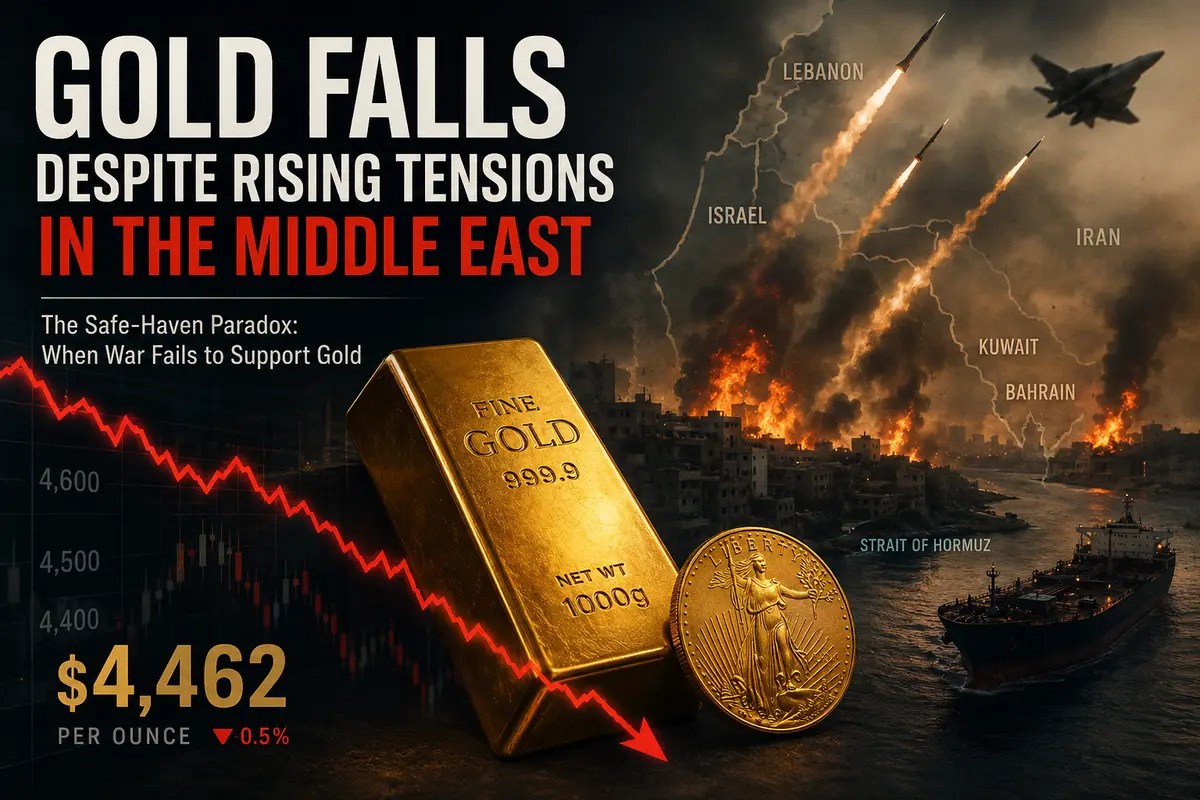
The Safe-Haven Paradox: When War Fails to Support Gold
In finance, there are a few principles that rarely get questioned. One of them is simple: geopolitical tensions push gold prices higher. Wars, conflicts, and threats typically drive investors away from fragile paper currencies and toward the timeless, yellow, dependable metal. Gold is a safe haven. And safe havens are supposed to rise in value when bullets start flying.
Wednesday’s Asian trading session politely—but firmly—challenged that assumption.
Because the Middle East was on fire. Not figuratively, but literally. Missiles were flying. Troops were moving. Negotiations were starting and stalling in equal measure. Yet against this backdrop, gold actually fell. Only slightly—about half a percent—but it fell nonetheless. Spot gold slipped to around $4,462 per ounce, while futures mirrored the move.
Was this a market mistake? A temporary lapse of judgment among traders? Or has the old safe-haven rule stopped working in today’s increasingly chaotic world?
Neither.
The reality is that the world has become more complicated. A single conflict can now push gold both higher and lower at the same time. Every coin has two sides—and in the Middle East, it often has ten.
What’s Happening in the Middle East?
To understand gold’s behavior, we first need to understand the situation in a region that gave humanity writing but has yet to discover lasting peace.
On Wednesday, the picture was far from calm.
Israel, which in recent months has operated under the principle that “the best defense is a strong offense,” continued military operations in southern Lebanon. This is an area where Hezbollah traditionally maintains significant influence—a place Israeli forces often describe as a hornet’s nest, where every move provokes a response. These were not isolated retaliatory strikes but a systematic campaign aimed at degrading hostile infrastructure.
Meanwhile, Iran—widely regarded as a key regional power broker—launched ballistic missiles toward Kuwait and Bahrain. Not at Israel, which might have seemed the obvious target in a direct confrontation, but at neighboring Gulf monarchies.
Why?
Official explanations vary. Unofficially, it appears to be a demonstration of capability. Iran is signaling that it can reach virtually any target in the region. Its message is simple: our missiles can go wherever we want them to.
At the same time, U.S. forces reportedly struck Iran’s Qeshm Island. Qeshm is not just another island. It sits near the Strait of Hormuz, one of the world’s most strategically important maritime chokepoints, through which roughly one-fifth of global oil consumption passes. Tankers carrying crude oil from across the Persian Gulf transit these waters daily. Control of Qeshm means influence over the strait. A strike there is effectively a strike against Iran’s ability to threaten global energy supplies.
Iranian media, to their credit, reacted without sensationalism. Reports indicated that Tehran had not been in contact with Washington for several days. Negotiations that recently appeared promising have become stalled.
At the same time, political figures continued sending mixed signals. Some insisted talks were progressing and that an agreement remained possible. For markets, however, conflicting statements have become little more than background noise.
Wednesday also featured another round of talks between Israel and Lebanon. Lebanon, burdened by economic crisis and political dysfunction, once again attempted to mediate or at least negotiate a ceasefire on its territory. Few observers expected a breakthrough.
Why Isn’t Gold Rising When Everything Is Burning?
This is where things become interesting.
Despite missiles, military strikes, diplomatic deadlock, and regional escalation, gold declined by roughly 0.5%.
Why?
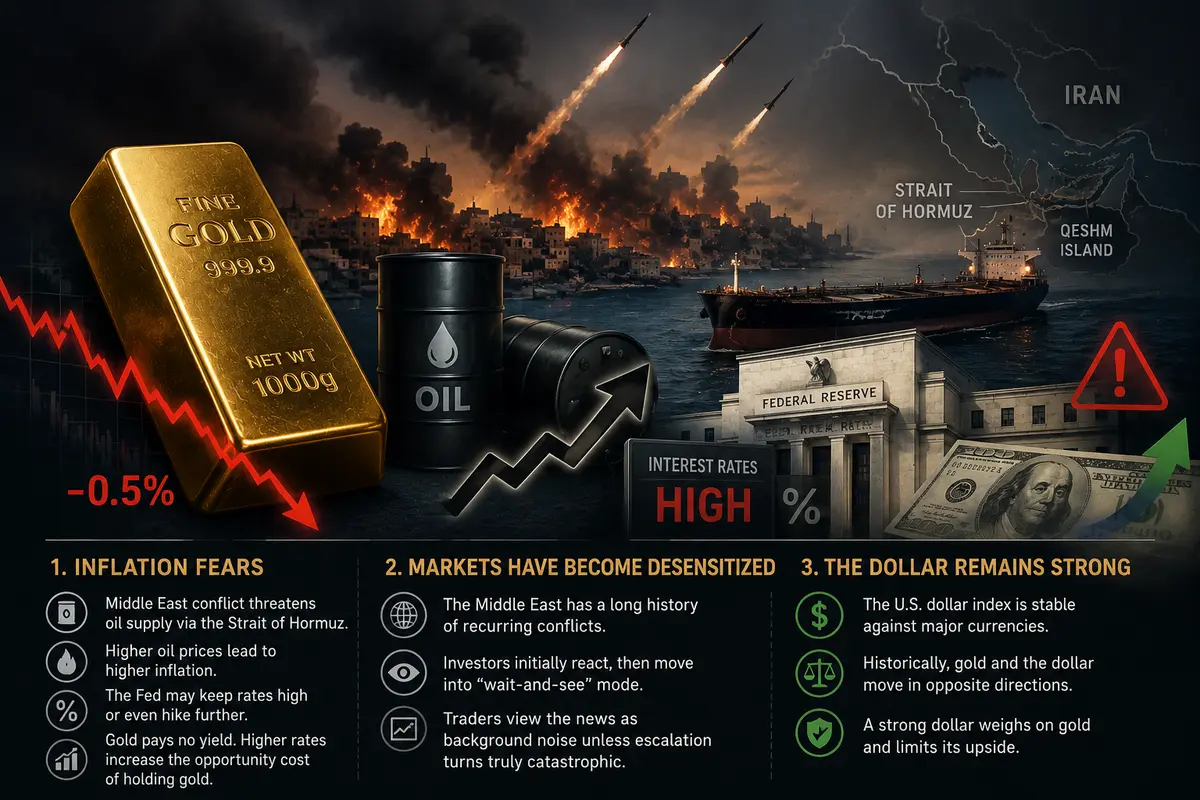
1. Inflation Fears
Ironically, the primary economic consequence of Middle East conflict is often not fear itself—but oil.
The Strait of Hormuz remains vulnerable. Military action around Qeshm raises the possibility of further escalation. Iran could attempt to disrupt shipping routes—or at least threaten to do so.
If that happens, oil prices could surge.
Markets understand this. They also understand what it means for the Federal Reserve.
Higher oil prices translate into higher inflation. And if inflation remains elevated, the Fed will struggle to cut interest rates. In fact, the possibility of further rate hikes cannot be ruled out.
That matters because gold pays no yield. It simply sits in a vault and shines.
When interest rates are high, investors can earn attractive returns from bonds and other income-producing assets. The opportunity cost of holding gold increases significantly.
2. Markets Have Become Desensitized
It sounds cynical, but markets adapt.
The Middle East has experienced recurring conflicts for decades. Each new flare-up initially sparks safe-haven buying, but if the conflict does not evolve into something truly catastrophic, markets gradually move on.
Investors switch into “wait-and-see” mode.
For traders in London, New York, and Singapore, events that are tragic for residents of Gaza, Beirut, or Tehran can eventually become background noise.
3. The Dollar Remains Strong
The U.S. dollar index was largely unchanged against major currencies.
Historically, gold and the dollar tend to move in opposite directions.
A strong dollar generally weighs on gold.
As long as the greenback remains resilient despite geopolitical turmoil, gold struggles to find the momentum needed for a major rally.
U.S. Economic Data Added More Pressure
Perhaps the most important factor came not from the Middle East, but from Washington.
Economic data released Tuesday showed that U.S. job openings increased in April rather than declining as analysts had expected.
The labor market remains tight.
Companies are still hiring. Workers are still changing jobs. Wage pressures remain present.
Why is that bad for gold?
Because a strong labor market gives the Federal Reserve little reason to ease monetary policy.
In fact, it strengthens the case for keeping rates elevated for longer.
Just a month ago, many traders were pricing in three or four rate cuts this year. Now those expectations are being revised downward. The probability of a near-term rate cut has diminished substantially.
More importantly, some investors have begun factoring in the possibility—however small—of another rate increase.
Not the base case.
But no longer impossible.
And whenever that possibility emerges, gold becomes nervous.
What Happens Next? Three Possible Scenarios
Investors are now focused on a series of key U.S. economic reports.
These include:
-
The ADP employment report, often viewed as a preview of Friday’s payroll data.
-
The ISM Services PMI, a crucial indicator for the sector that accounts for the majority of U.S. GDP.
-
Durable goods orders, covering everything from vehicles and appliances to industrial equipment.
Each report has the potential to shift market expectations.
If the data come in weak, the Fed may eventually move closer to rate cuts, providing support for gold.
If the data remain strong, markets may price in a more hawkish Fed stance, putting additional pressure on precious metals.
Friday’s Non-Farm Payrolls report remains the week’s headline event.
Historically, payroll data have moved markets more than almost any other economic release.
A significantly stronger-than-expected jobs number could push gold toward new lows.
The Middle East Still Matters
Despite the focus on U.S. rates, geopolitical risk cannot be ignored.
If talks between Israel and Lebanon collapse entirely, regional tensions could escalate further.
If negotiations involving Iran and the United States prove to be little more than rumors, the geopolitical risk premium could quickly return to gold prices.
Yet even in that scenario, markets will focus on two critical questions:
Will Oil Flows Through Hormuz Be Disrupted?
If yes, oil prices could spike, inflation expectations would rise, and the Fed might become even more hawkish—ironically creating a negative environment for gold.
If not, the conflict may remain localized, allowing gold to benefit from traditional safe-haven demand.
What Happens to the Dollar?
As long as the dollar remains strong, gold faces an uphill battle.
And the dollar remains strong because the U.S. economy continues to show resilience, while the Federal Reserve is not yet ready to surrender its fight against inflation.
Silver, Platinum, and the Rest
Other precious metals were also under pressure.
Silver fell about 1.1%, while platinum lost roughly 0.6%.
Silver occupies a unique position: part precious metal, part industrial commodity.
Investors view it both as a safe haven and as a bet on global economic growth.
Right now, concerns about slowing industrial activity appear to be outweighing its defensive appeal.
Platinum is even more dependent on industrial demand, particularly in automotive catalysts, chemical production, and electronics.
Its decline reinforces the idea that markets are currently focused less on “stores of value” and more on interest rates, monetary policy, and capital preservation.
What Should Investors Prepare For?
The current environment is a classic trap for retail investors who rely on simple formulas.
Middle East conflict? Buy gold.
Higher interest rates? Sell gold.
But what happens when war and rising rates occur simultaneously?
The textbooks offer no easy answer.
Many strategists recommend avoiding dramatic moves.
Gold remains trapped in a broad trading range between roughly $4,400 and $4,600 per ounce. Bulls and bears continue testing each other’s resolve without committing to a decisive breakout.
Until there is greater clarity on Iran, Federal Reserve policy, and regional diplomacy, that range may persist.
But ranges never last forever.
Eventually, one force will prevail.
Geopolitical risks may overpower monetary policy and send gold sharply higher.
Interest rates may dominate and push gold lower.
Or, as often happens, an entirely unexpected black swan event could emerge and invalidate everyone’s forecasts.
For now, however, it is simply Wednesday.
Asia is trading.
The Middle East is burning.
America is releasing economic data.
Gold is down half a percent.
And within that decline there is neither panic nor relief—only the weary recognition that the old rules no longer seem to apply, while the new ones have yet to be written.

Comments
No comments yet. Be the first to share your thoughts!
Authentication Required
You must be logged in to post a comment.