Bar Pipa
We pay for a post of 10$

SK Hynix

Lin Brings

SK hynix’s American Dream: How the Korean Giant Could Take Over Intel’s Ohio Fab
SK hynix’s American Dream: How the Korean Giant Could Take Over Intel’s Ohio Fab

Ohio Emerges as a New Hub for Korean Chips

When Intel began construction of its massive campus in New Albany, Ohio, in 2022, the project looked like the return of an iconic American manufacturer to its home soil after decades of expanding production overseas. Four hundred hectares of land, enough space for eight semiconductor fabrication plants, and promises of hundreds of billions of dollars in investment were all supposed to symbolize the revival of the American semiconductor industry. However, as often happens, reality introduced some harsh adjustments.

Today, four years later, this ambitious project is hanging by a thread, and its future may end up in the hands of a competitor: South Korea’s SK hynix. Negotiations over a possible acquisition of the Ohio campus are reportedly taking place behind closed doors. Although the potential purchase price remains closely guarded, the very possibility of such a transaction has shaken the markets and prompted analysts to reconsider the balance of power within the global semiconductor industry.

For SK hynix, this would not simply be another deal aimed at increasing production capacity. It would be a strategic move capable of completely transforming the company’s position in the US market while also satisfying growing political pressure from Washington. For several years, the US administration has urged semiconductor manufacturers to move production facilities to American soil and reduce their dependence on Asian manufacturing. SK hynix appears ready to answer that call—not by building an entirely new factory from scratch, but by purchasing infrastructure that is already close to completion.

Interestingly, the Korean company already has experience working with former Intel assets. In 2020, SK hynix agreed to acquire Intel’s NAND flash memory business for $9 billion, making it the largest transaction in the company’s history. Now, another piece of Intel’s former empire may be up...


Continue reading...
0
0

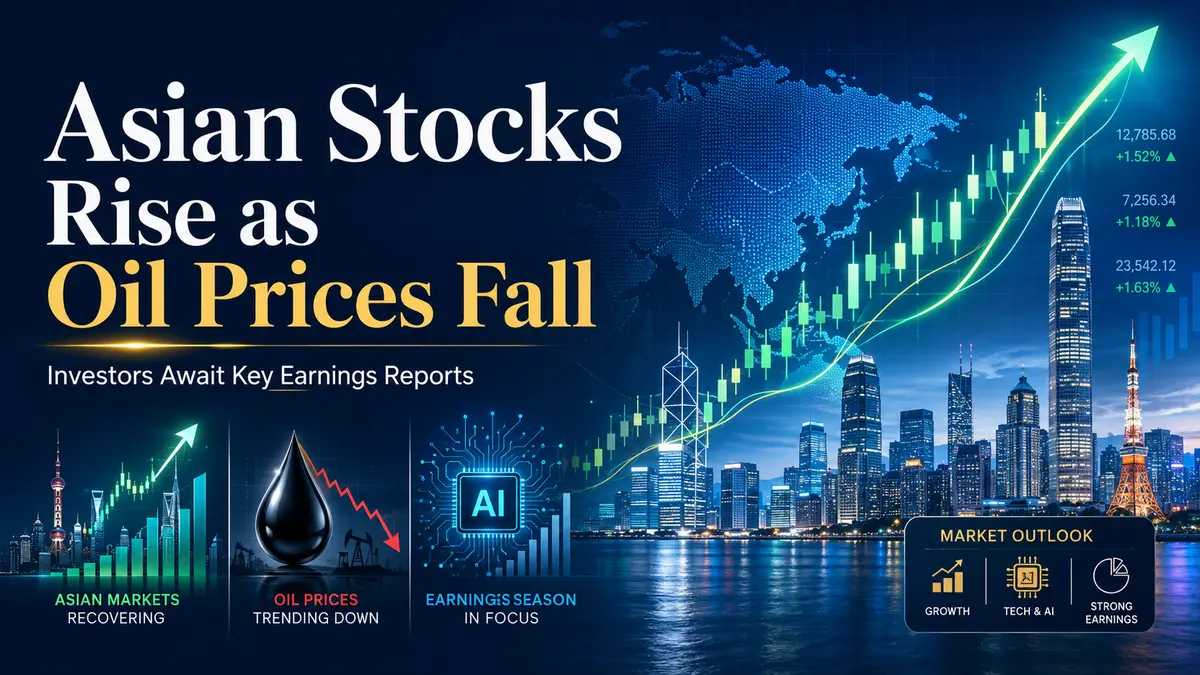
Asian Stocks Rise as Oil Prices Fall and Investors Await Earnings

Asian Stocks Rise as Oil Prices Fall and Investors Await Earnings

Tuesday: Markets Recoup Their Losses

Tuesday 21.07.2026 became a day of recovery for Asian stock markets. After several days of volatility and selling pressure driven by geopolitical risks, investors returned to buying. The main catalysts behind the rebound were lower oil prices and hopes for a diplomatic resolution in the Middle East.

Wall Street ended Monday with moderate losses, but U.S. stock futures pointed to a stronger opening on Tuesday. The technology-heavy NASDAQ, which is particularly sensitive to shifts in investor sentiment, led the advance.

Japan was one of the main beneficiaries of the positive momentum across Asian markets. The ^N225 ... rose by more than 2% after the market was closed on Monday for a public holiday. Investors actively purchased technology stocks, while overall market sentiment remained positive.

However, South Korea’s KOSPI delivered perhaps the most impressive performance. The index rebounded by almost 4% after falling approximately 5% during the previous session. This is a classic example of a “dead cat bounce,” as investors return to oversold stocks, particularly in the technology sector.

Technology Sector Leads the Recovery

Technology companies were the primary drivers of growth across Asian markets. BC94.L ... Electronics shares surged by 6%, while SK Hynix gained 4.5%. This represented a powerful recovery following several days of declines, during which concerns about inflated valuations and geopolitical risks weighed heavily on the sector.

For investors, the rebound may indicate that the fundamental positions of these companies remain strong. Samsung recently forecast a nineteenfold increase in operating profit for the second quarter, and the markets appear ready to believe these projections. Like Samsung, SK Hynix is a major supplier of memory chips used in artificial intelligence applications, and demand for these products remains high.

However, the recovery of Asia’s technology sector is taking place against a backdrop of continued uncertainty....

Continue reading...
0
0

SK Hynix Enters a New Era: How AI Memory Is Changing the Rules of the Game

SK Hynix Enters a New Era: How AI Memory Is Changing the Rules of the Game

Introduction: A 13 Percent Surge in a Single Day

Wednesday became a day of triumph for shareholders of South Korean memory-chip manufacturer SK Hynix. The company’s shares jumped 13.4 percent to 2,170,000 won KRWUSD ... , helping the benchmark KOSPI index gain 8 percent. This impressive surge was driven by a rally in U.S. technology stocks and optimistic analyst forecasts regarding artificial intelligence-driven demand for memory chips.

What is behind this growth? Barclays initiated coverage of SK Hynix’s American Depositary Receipts, or ADRs, with an “Overweight” rating and a price target of $330. Analysts believe that a worsening industry supply shortage through 2027, limited near-term competitive risks from China, and the company’s leadership in high-bandwidth memory chips should support substantial earnings growth.

In this article, we will examine the key drivers behind SK Hynix’s growth, assess the company’s prospects, and consider how long this bullish trend may continue.

Rebound After the Decline: Investors Return

Record-Breaking Drop on Monday

On Monday, SK Hynix shares experienced a record decline as investors took profits following the company’s successful Nasdaq listing. The 9.3 percent drop dealt a serious blow to shareholders, but the situation began to change as early as Tuesday.

The company’s American Depositary Receipts rebounded sharply, rising by approximately 27 percent. Investors returned to AI-related semiconductor stocks amid a broad rally in U.S. technology shares.

Optimistic Market Sentiment

The rebound was driven by optimism regarding the company’s long-term prospects. Despite short-term volatility, investors identified significant opportunities for future growth.

The rise in U.S. technology stocks also played an important role, creating a favorable market environment for SK Hynix.

Barclays Forecast: Overweight

“Overweight” Rating

Barclays initiated coverage of SK Hynix’s U.S.-listed ADRs with an “Overweight” rating and a price target of $330. This represents a strong signal for investors and reflects analysts’ confidence in...

Continue reading...
0
0
Tom Maffin

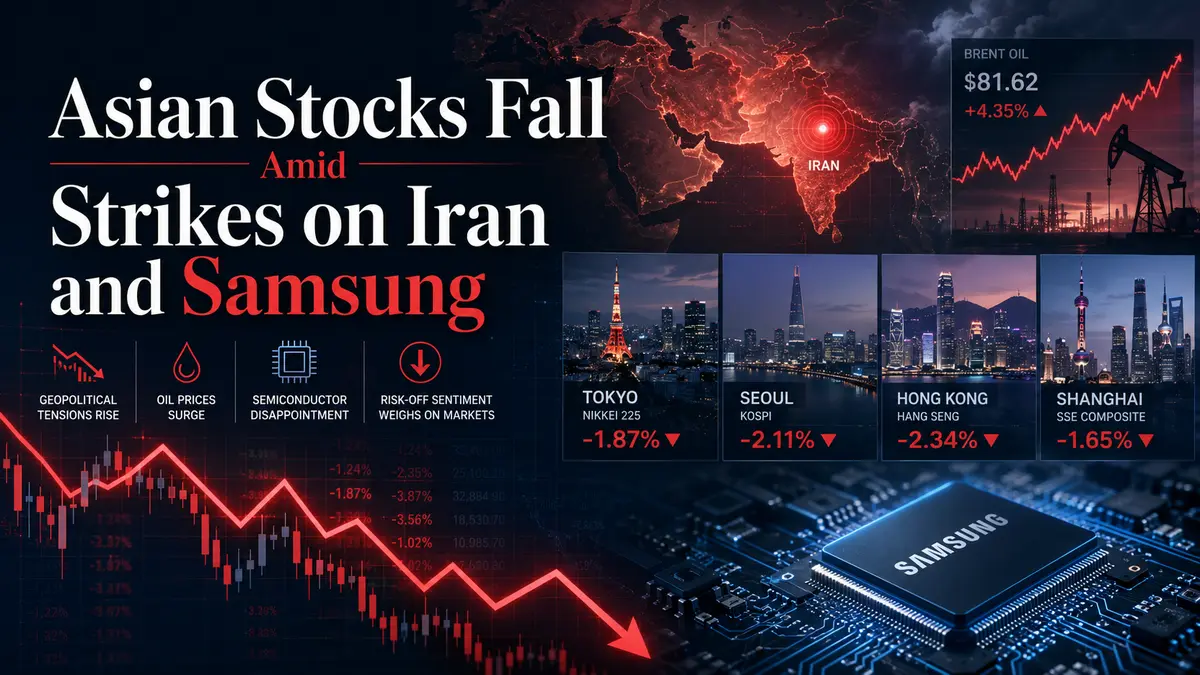
Asian Stocks Fall Amid Strikes on Iran and Samsung

Asian Stocks Fall Amid Strikes on Iran and Samsung

Introduction: A Thursday When Geopolitics and Corporate News Hit Markets

Thursday, Asian trading session. Investors in Tokyo, Seoul, Shanghai, and Hong Kong open their terminals and see red numbers. Most Asian stock markets are declining amid new U.S. military strikes on Iran and rising oil prices, which have suppressed risk appetite. An additional negative factor was investor disappointment with Samsung Electronics’ results, which continues to weigh on South Korean stocks.

Wall Street closed mixed overnight after the minutes of the Federal Reserve’s June meeting confirmed a cautious monetary policy stance. Nasdaq 100 and S&P 500 futures were trading unchanged on Thursday, giving the market no clear direction.

The latest wave of selling followed a volatile week for semiconductor stocks. Profit-taking last week accelerated on Tuesday after Samsung Electronics’ 19-fold increase in quarterly operating profit failed to meet investors’ elevated expectations.

South Korea remained under pressure. Samsung fell 2.5% after dropping nearly 7% in the previous session, while LG Innotek lost more than 5%. However, SK Hynix rebounded 3.5% after demand for the company’s planned $28 billion U.S. market offering exceeded the available shares by seven times.

The KOSPI fell nearly 1.8%, extending its decline after officially entering a bear market this week — the index has dropped more than 20% from the record high reached last month.

Japan became the regional growth leader. The Nikkei 225 gained about 1.5%, while the TOPIX rose 0.5% thanks to renewed buying in chip supplier stocks. Murata Manufacturing climbed nearly 5%, while TDK rose more than 2%. Kioxia Holdings gained as much as 11% after Bain Capital confirmed its exit from its investment in the flash memory manufacturer.

In other markets, Australia’s S&P/ASX 200 fell 0.8%, the Shanghai Composite lost 0.6%, the Shanghai Shenzhen CSI 300 declined 0.3%, and Hong Kong’s Hang Seng weakened...

Continue reading...
0
0

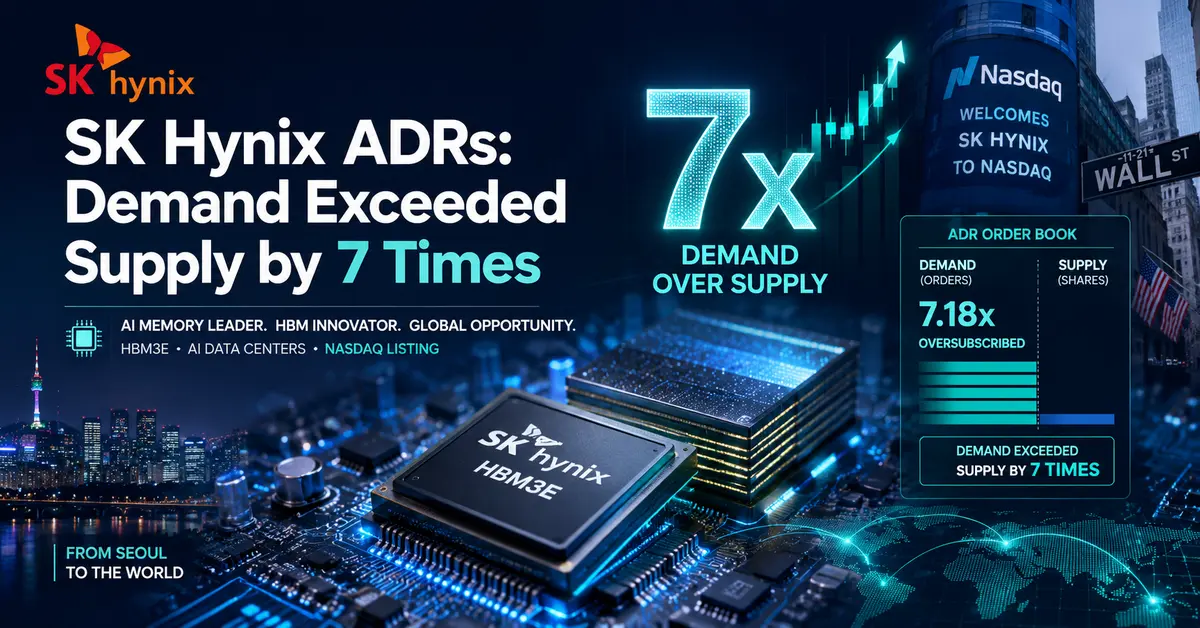
SK Hynix ADRs: Demand Exceeded Supply by 7 Times

SK Hynix ADRs: Demand Exceeded Supply by 7 Times

Introduction: The Thursday When the Korean Giant Conquered Wall Street

Thursday. Seoul, SK Hynix headquarters. News of the planned $28 billion American Depositary Receipt (ADR) offering spreads across global markets at lightning speed. Demand exceeded supply by more than seven times even before the price was announced. This is not just a successful placement — it is a triumph for the Korean semiconductor industry.

SK Hynix shares rose by 6% during trading in Seoul, outpacing the 2.4% gain in the broader KOSPI index. Over the past two weeks, the stock has fallen by around 25% amid large-scale profit-taking in the technology sector, yet over the past 12 months it is still up by about 680%.

The offering is expected to become the second-largest in the world, behind SpaceX’s $85.7 billion initial public offering last month. The funds raised will be used to build new factories and purchase equipment as part of the company’s production expansion aimed at meeting growing demand for memory chips used in artificial intelligence.

Underwriters are expected to provide pricing guidance after the South Korean stock market closes on Thursday, while the allocation of securities among investors will be completed later during the U.S. trading session. The ADRs are scheduled to begin trading on the Nasdaq Global Select Market on Friday.

Despite the recent decline in global semiconductor stocks, SK Hynix remains one of the main beneficiaries of the AI investment boom. The company has become a leading supplier of high-bandwidth memory (HBM) chips for Nvidia, strengthening its position at the center of the AI infrastructure supply chain amid continued growth in demand for advanced memory for AI servers.

Let’s take a closer look at why demand for SK Hynix ADRs turned out to be so high, what it means for the company, and what it means...

Continue reading...
0
0

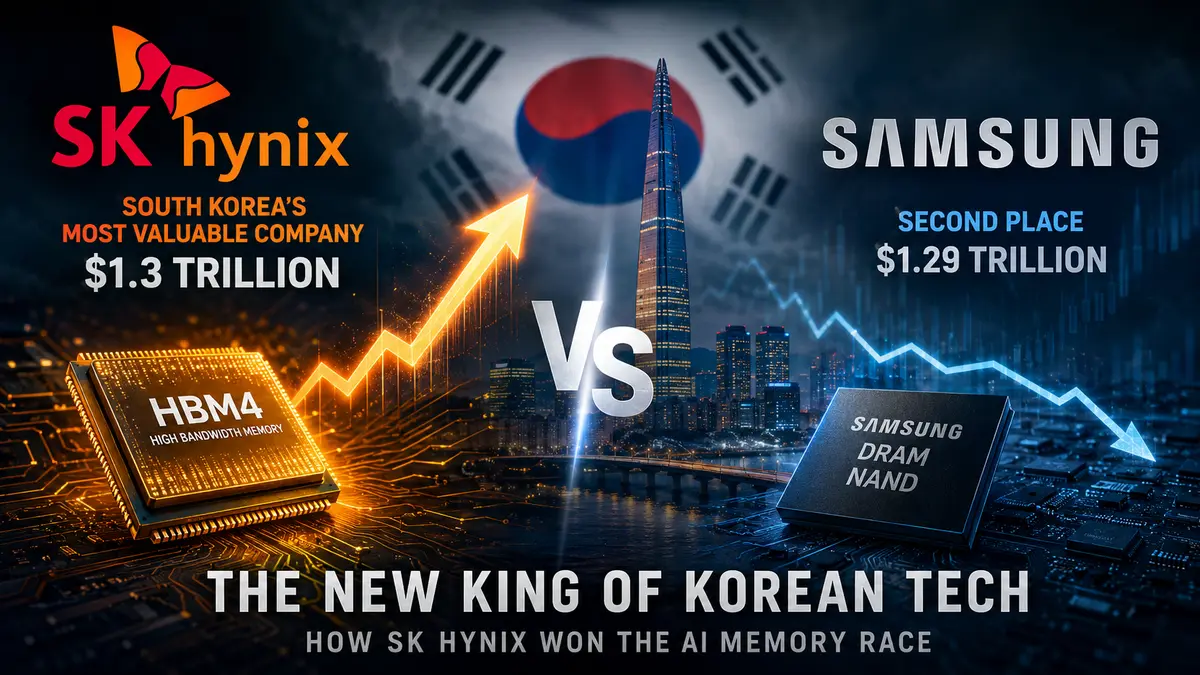
SK Hynix Surpasses Samsung: How a Modest Chipmaker Became South Korea’s Most Valuable Company

SK Hynix Surpasses Samsung: How a Modest Chipmaker Became South Korea’s Most Valuable Company

Introduction: The Day the Crown Fell

Monday morning in Seoul began like any other—people grabbing coffee, traffic filling the roads, office workers hurrying to work. But on the stock exchange, something historic was unfolding. SK Hynix shares surged 3.7%, reaching 2.8 million won per share. At the moment the stock crossed that threshold, South Korea crowned a new market king.

SK Hynix, a company many had written off two decades ago, became the most valuable company in the country. Its market capitalization reached 2,082 trillion won, or approximately $1.3 trillion. Samsung, the longtime champion that had held the title for so long that many investors could scarcely remember another leader, slipped into second place with a valuation of 2,081 trillion won.

The gap between them is only one trillion won. Yet that trillion is more than just a number. It symbolizes a tectonic shift in the global semiconductor industry. It reflects the reality that artificial intelligence is redrawing the map of the technology world, rewarding those who made the right bets at the right time while leaving others struggling to catch up.

How did SK Hynix—a company that once stood on the brink of bankruptcy and desperately searched for a buyer—manage to overtake Samsung, one of the most powerful and resilient technology giants on the planet? And what does this mean for the semiconductor industry as a whole?

Let's take a closer look.

The Rise of SK Hynix: From Bankruptcy to a Trillion-Dollar Empire

2005: The Company Nobody Wanted to Buy

To appreciate SK Hynix's triumph today, we need to go back about twenty years.

In 2005, the company was not merely the second-largest player in the memory market—it was a struggling one. Burdened by debt, saddled with outdated manufacturing facilities, and steadily losing market share, Hynix (as it was...

Continue reading...
0
0

Asian Markets at a Crossroads: Japan and Australia Await Central Bank Signals

Asian Markets at a Crossroads: Japan and Australia Await Central Bank Signals

Tuesday — the day when decisions matter more than news

Tuesday began on Asian stock markets with a tense silence. There was none of Monday’s euphoria, when investors celebrated the peace agreement with Iran. Nor was there the panic of last week, when stocks plunged as much as 10% in a single day. Instead, markets found themselves somewhere in between: mixed performance, caution, and anticipation.

Japan’s Nikkei 225 slipped 0.2%. Australia’s ASX 200 lost 0.4%. Chinese indices were largely unchanged. Hong Kong’s Hang Seng fell more than 1%. Only South Korea’s KOSPI posted a strong gain, rising 1.5% on the back of strength in the technology sector.

Why such divergence? Because each market has its own catalyst. In Japan, investors are focused on the Bank of Japan, which is expected to raise interest rates to their highest level in 31 years. In Australia, attention is on the Reserve Bank of Australia, which is widely expected to keep rates unchanged. In China, weak economic data disappointed investors. In South Korea, a rally in semiconductor stocks continues following a recent rebound.

Yet what unites all these markets is anticipation—anticipation of decisions, signals, and greater clarity.

And that anticipation defines Tuesday.

Japan: Bank of Japan Expected to Raise Rates to 1%

The Bank of Japan meets today, June 16. The central bank is expected to raise its short-term policy rate by 25 basis points to 1.0%, the highest level in 31 years. The last time rates were at this level was in 1995.

Why is the BOJ taking this step? Inflation remains above its 2% target. Consumer spending has been resilient. Energy prices, while easing following the peace agreement with Iran, remain higher than a year ago. Meanwhile, the yen remains weak at around ¥160 per U.S. dollar, increasing import costs and adding...

Continue reading...
0
0

Korean Chipmakers Rise from the Ashes: SK Hynix and Samsung Recover After a Bloody Monday

Korean Chipmakers Rise from the Ashes: SK Hynix and Samsung Recover After a Bloody Monday

The Day That Nearly Broke the Market

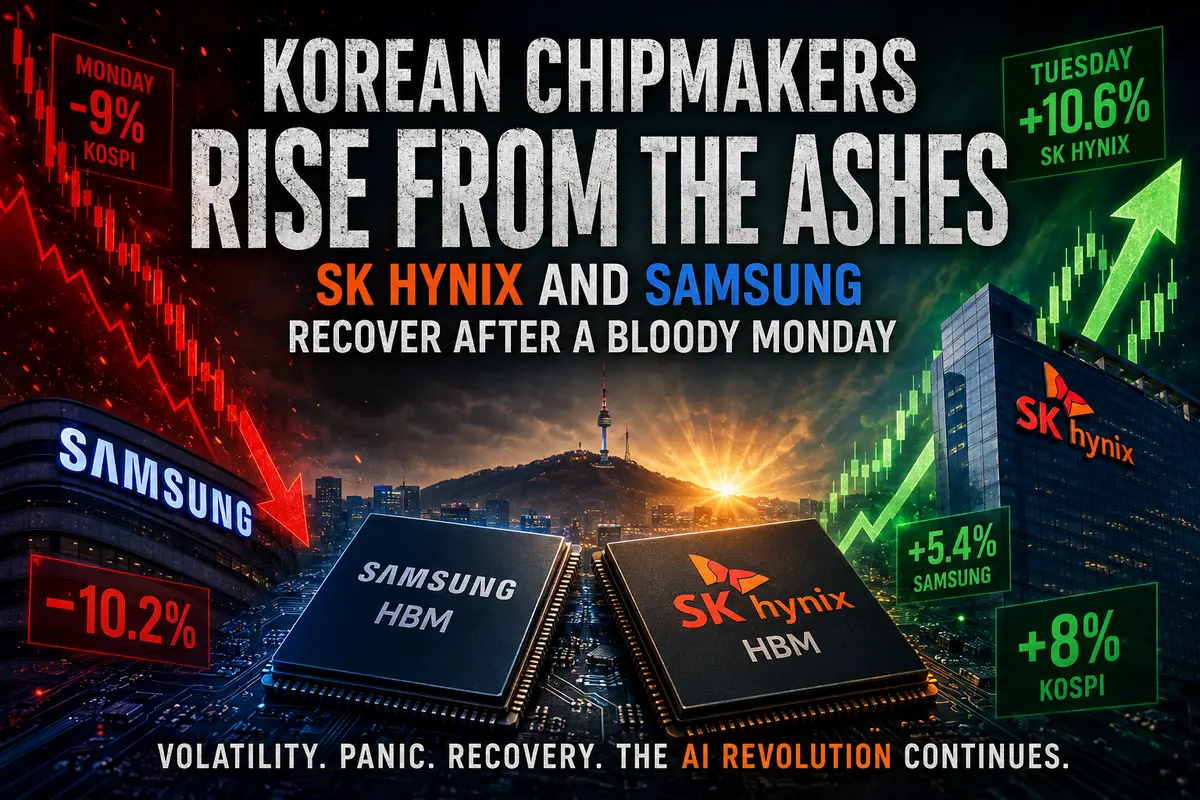
Monday was a nightmare for South Korea. The KOSPI, the country’s benchmark stock index, plunged nearly 9%. Nine percent in a single day. That’s not a correction—it’s a market collapse that happens once every few years, if not once a decade. Samsung Electronics shares fell 10.2%, while SK Hynix lost 8%. Traders in Seoul struggled to recall anything like it since the pandemic-driven market chaos of March 2020.

What caused it? Several factors converged at once. The overheated artificial intelligence sector, which had been soaring for the past eighteen months, finally cracked. Investors who had made hundreds of percent in gains from semiconductor stocks decided it was time to take profits. Add geopolitics to the mix—weekend missile exchanges between Iran and Israel pushed oil prices higher and fueled panic. Then came macroeconomics: strong U.S. employment data reinforced expectations that interest rates would remain elevated.

All of these ingredients combined into a toxic cocktail. And because South Korea had benefited more than almost anyone from the AI boom, it suffered more than most when sentiment turned.

But Tuesday brought a dramatic reversal. SK Hynix surged 10.6%. Samsung gained 5.4%. The KOSPI itself jumped 8%. An 8% rise in one day is almost as extraordinary as a 9% decline the day before. The market is clearly rattled. Traders who felt like they had a heart attack on Monday were celebrating on Tuesday. As for tomorrow—nobody knows.

SK Hynix: Nvidia Partnership Becomes a Lifeline

The story of SK Hynix deserves special attention.

On Monday, while the market was burning, the company received an unexpected boost. Right in the middle of the panic, SK Hynix announced a long-term technology partnership with Nvidia—the very company that currently dominates the AI landscape and whose chips power virtually every major...

Continue reading...
0
0

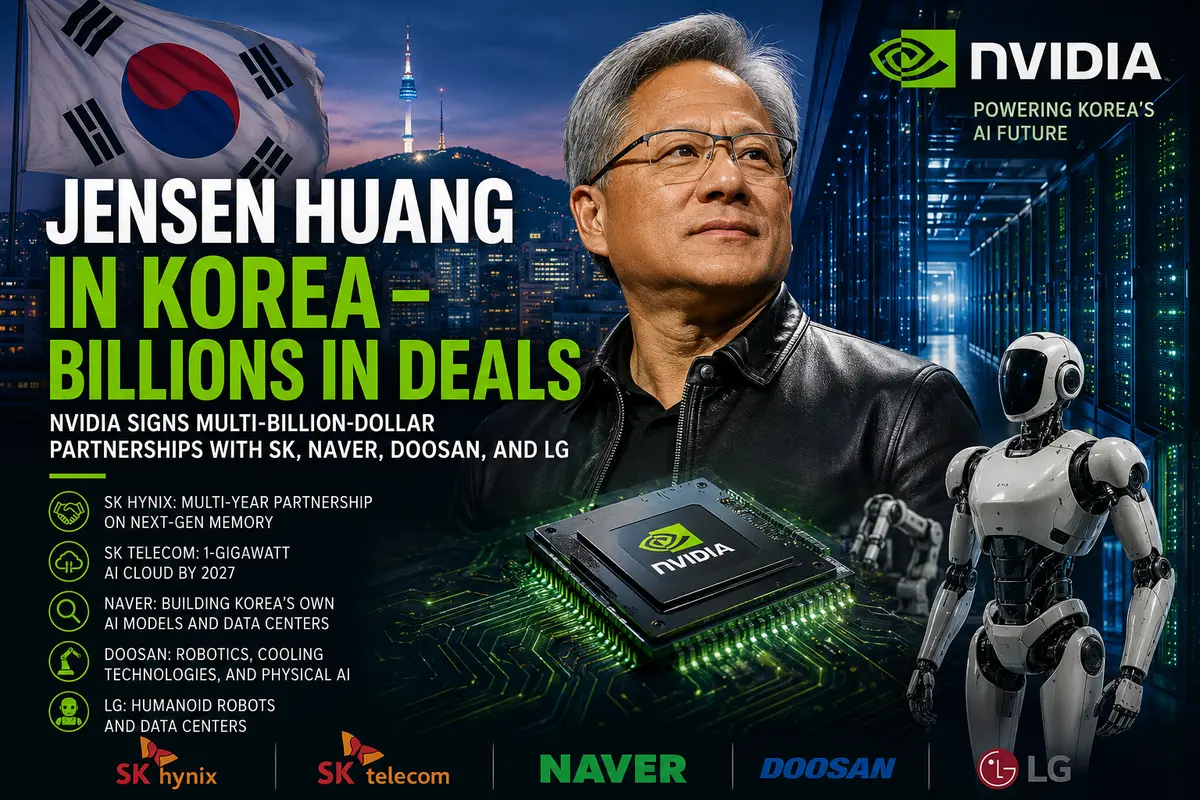
Jensen Huang Arrived in Korea — and for Good Reason: Nvidia Signs Multi-Billion-Dollar Deals with SK, Naver, Doosan, and LG

Jensen Huang Arrived in Korea — and for Good Reason: Nvidia Signs Multi-Billion-Dollar Deals with SK, Naver, Doosan, and LG

A Visit Six Months in the Making

When Nvidia CEO Jensen Huang lands in a country, local technology companies line up to meet him. Not because he's handing out gifts, but because in today's AI world, almost no major decision gets made without Nvidia. Huang arrived in South Korea on Friday, and by Monday, announcements of new partnerships were pouring in one after another.

These are not the typical memorandum-of-understanding photo opportunities that often accompany executive visits. These are real technology partnerships, multi-year agreements, and strategic alliances that could reshape the global AI infrastructure landscape.

Nvidia needs Korea because the country produces some of the world's most advanced memory chips. Korea needs Nvidia because without its AI accelerators, even the most sophisticated data center is just an expensive room full of servers.

The main players in this Korean tour are SK Group, Naver, Doosan, and, as it became clear later, LG. Each company received its own dose of Nvidia's influence. And each is now building its AI strategy around technologies from the American giant.

SK Hynix: A Multi-Year Partnership That Has Competitors Nervous

Let's start with the most obvious—and arguably the most important—announcement.

SK Hynix is the world's second-largest memory chip manufacturer after Samsung. More importantly, it has become one of the biggest beneficiaries of the AI boom thanks to its leadership in HBM (High Bandwidth Memory), the advanced memory technology essential for AI workloads.

HBM is not the kind of memory found in your laptop. It enables data transfers measured in terabytes per second between processors and memory, making it indispensable for training and running modern AI models.

Now SK Hynix and Nvidia have entered into a multi-year technology partnership. This is more than a supply agreement—it involves joint development of future generations of memory and AI accelerators.

In...

Continue reading...
0
0
Tim Drening

Silence on the Airwaves: Why Bitcoin Fell Asleep While the AI Sector Went Crazy

Silence on the Airwaves: Why Bitcoin Fell Asleep While the AI Sector Went Crazy

Nine months. That’s how long it has been since Bitcoin was last this boring. The Bitcoin Volmex implied volatility index — the market’s thermometer of excitement — has dropped to 36.11, its lowest level since last September. The price is stuck around seventy-seven thousand dollars, nearly forty percent below the all-time high above one hundred twenty-six thousand reached in October. And while traders in the worlds of equities and semiconductors are losing their minds over massive rallies, the crypto market has sunk into a lethargic sleep. This is not a crash, not a collapse, not capitulation. It is something more insidious — a slow fading of interest.

Hot Money Moved Into AI

To understand where the speculative capital went, you only need to look at the headlines of recent weeks. South Korea’s KOSPI is hitting record highs. Japan’s Nikkei is storming historical peaks. SK Hynix has just entered the trillion-dollar company club. Samsung is celebrating the resolution of its labor dispute and climbing higher as well. This entire fireworks show is happening in one sector — manufacturers of memory chips, AI accelerators, and related hardware. That is where the “hot money” has gone: into AI and semiconductor stocks, absorbing the same speculative capital that once fueled crypto rallies.

Orbit Markets co-founder Caroline Mauron puts it with brutal clarity: “Retail interest is flowing into other sectors in search of new trading opportunities, as confirmed by ETF outflows.” And the numbers do not lie. In May, around one billion dollars was withdrawn from U.S. spot Bitcoin ETFs, breaking a two-month streak of inflows. Institutional investors who had enthusiastically entered crypto through regulated products are now taking profits or cutting positions.

The logic behind this exodus is simple and ruthless. Bitcoin is trapped in a range. It cannot break resistance and move to...

Continue reading...
0
0
Navigation menu
instaforex banner