

Korean Chipmakers Rise from the Ashes: SK Hynix and Samsung Recover After a Bloody Monday
The Day That Nearly Broke the Market
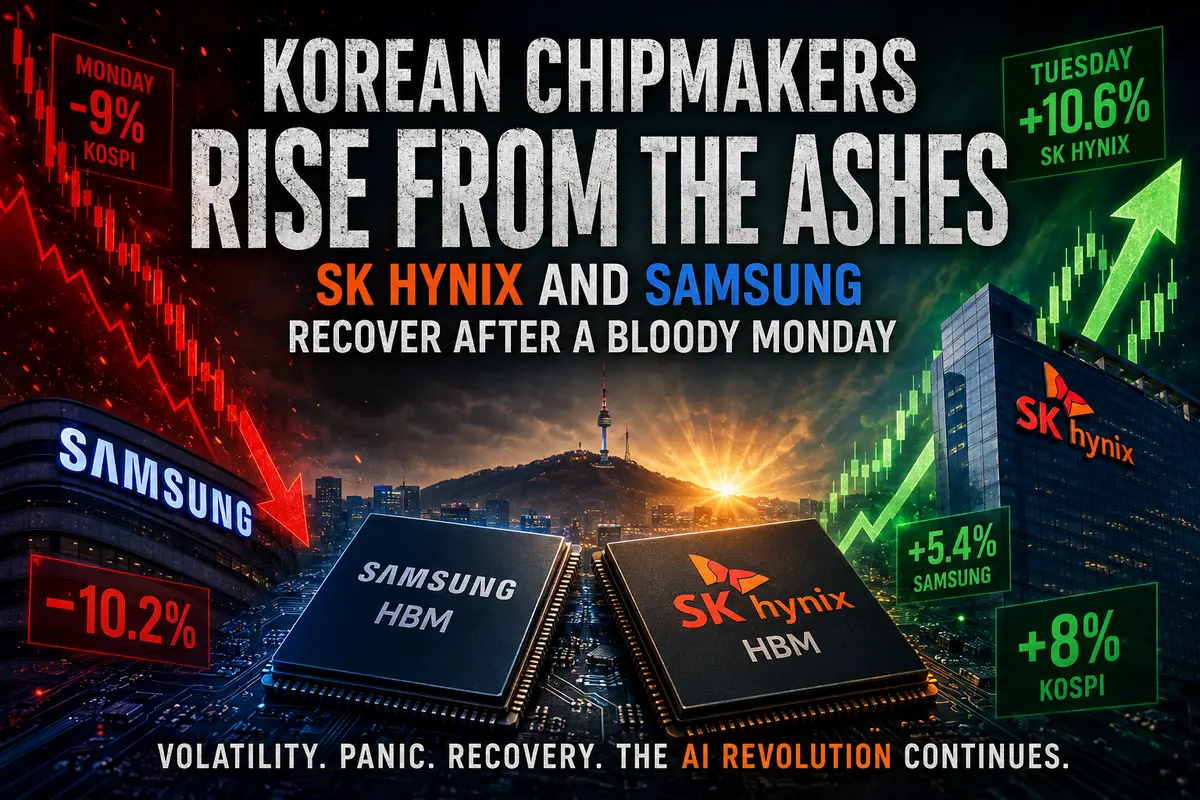
Monday was a nightmare for South Korea. The KOSPI, the country’s benchmark stock index, plunged nearly 9%. Nine percent in a single day. That’s not a correction—it’s a market collapse that happens once every few years, if not once a decade. Samsung Electronics shares fell 10.2%, while SK Hynix lost 8%. Traders in Seoul struggled to recall anything like it since the pandemic-driven market chaos of March 2020.
What caused it? Several factors converged at once. The overheated artificial intelligence sector, which had been soaring for the past eighteen months, finally cracked. Investors who had made hundreds of percent in gains from semiconductor stocks decided it was time to take profits. Add geopolitics to the mix—weekend missile exchanges between Iran and Israel pushed oil prices higher and fueled panic. Then came macroeconomics: strong U.S. employment data reinforced expectations that interest rates would remain elevated.
All of these ingredients combined into a toxic cocktail. And because South Korea had benefited more than almost anyone from the AI boom, it suffered more than most when sentiment turned.
But Tuesday brought a dramatic reversal. SK Hynix surged 10.6%. Samsung gained 5.4%. The KOSPI itself jumped 8%. An 8% rise in one day is almost as extraordinary as a 9% decline the day before. The market is clearly rattled. Traders who felt like they had a heart attack on Monday were celebrating on Tuesday. As for tomorrow—nobody knows.
SK Hynix: Nvidia Partnership Becomes a Lifeline
The story of SK Hynix deserves special attention.
On Monday, while the market was burning, the company received an unexpected boost. Right in the middle of the panic, SK Hynix announced a long-term technology partnership with Nvidia—the very company that currently dominates the AI landscape and whose chips power virtually every major data center.
What does this partnership involve?
SK Hynix will supply Nvidia with advanced HBM (High Bandwidth Memory) for AI accelerators. More importantly, the two companies will jointly develop future generations of memory technology. This means exclusive access to future chip specifications and the ability to begin development one or even two years ahead of competitors. It is a strategic advantage that is difficult to overstate.
As a result, SK Hynix held up better than Samsung during Monday’s selloff, losing 8% compared to Samsung’s 10.2%. The partnership news helped contain the panic. Some investors reasoned that if Nvidia had chosen SK Hynix as a strategic partner, the company must be doing something right. Instead of selling into weakness, they bought the dip.
On Tuesday, the full effect became apparent. SK Hynix shares jumped 10.6%—the strongest performance among South Korea’s major technology companies. Investors clearly liked the deal. The stock now trades only a few percentage points below its pre-crash level.
Samsung: A Giant That Stumbled but Didn’t Fall
Samsung’s situation is somewhat more complicated.
Samsung also produces HBM memory and supplies Nvidia. However, it has not secured the same type of exclusive partnership. Its HBM products are generally viewed as slightly less advanced than those of SK Hynix, and over recent quarters SK Hynix has outpaced Samsung in AI-memory growth.
That is why Samsung fell harder on Monday. Investors interpreted the Nvidia-SK Hynix announcement as a potential threat to Samsung’s market share. The selling intensified, and the stock dropped 10.2%.
Yet Samsung also rebounded on Tuesday, gaining 5.4%.
Fundamentally, Samsung remains a giant. The company produces not only AI memory but also smartphone chips, displays, processors, and semiconductor manufacturing equipment. Few companies in the world are as diversified. After Monday’s selloff, many investors concluded that Samsung’s valuation had become too attractive to ignore.
Those who had panic-sold on Monday returned as buyers on Tuesday. The old market saying—“buy when others are fearful, sell when others are greedy”—proved relevant once again.
KOSPI: A Roller Coaster Ride
The KOSPI experienced two days that many markets would normally experience over an entire year.
-
Monday: -9%
-
Tuesday: +8%
Such volatility has not been seen since March 2020, when the world entered COVID lockdowns, or even since the 2008 collapse of Lehman Brothers.
What does this tell us?
It means investors are deeply uncertain. They fear higher U.S. interest rates. They fear conflict in the Middle East. They fear an AI bubble. They fear further weakness in China’s economy.
At the same time, they recognize that technology remains one of the most compelling investment themes available. If not AI and semiconductors, then what? Oil? Gold? Bonds? Every alternative appears either low-yielding or risky in its own way.
As a result, the Korean market has become hostage to headlines. Good news triggers an 8% rally. Bad news causes a 9% crash. No news leaves investors frozen in uncertainty.
For long-term investors, this volatility creates opportunities. For traders, it creates endless stress. For South Korea’s economy, it presents a challenge, because unstable markets tend to discourage foreign capital.
Three Factors Behind Last Week’s AI Selloff
To understand Monday’s decline, we need to examine three factors that built up throughout the previous week and exploded over the weekend.
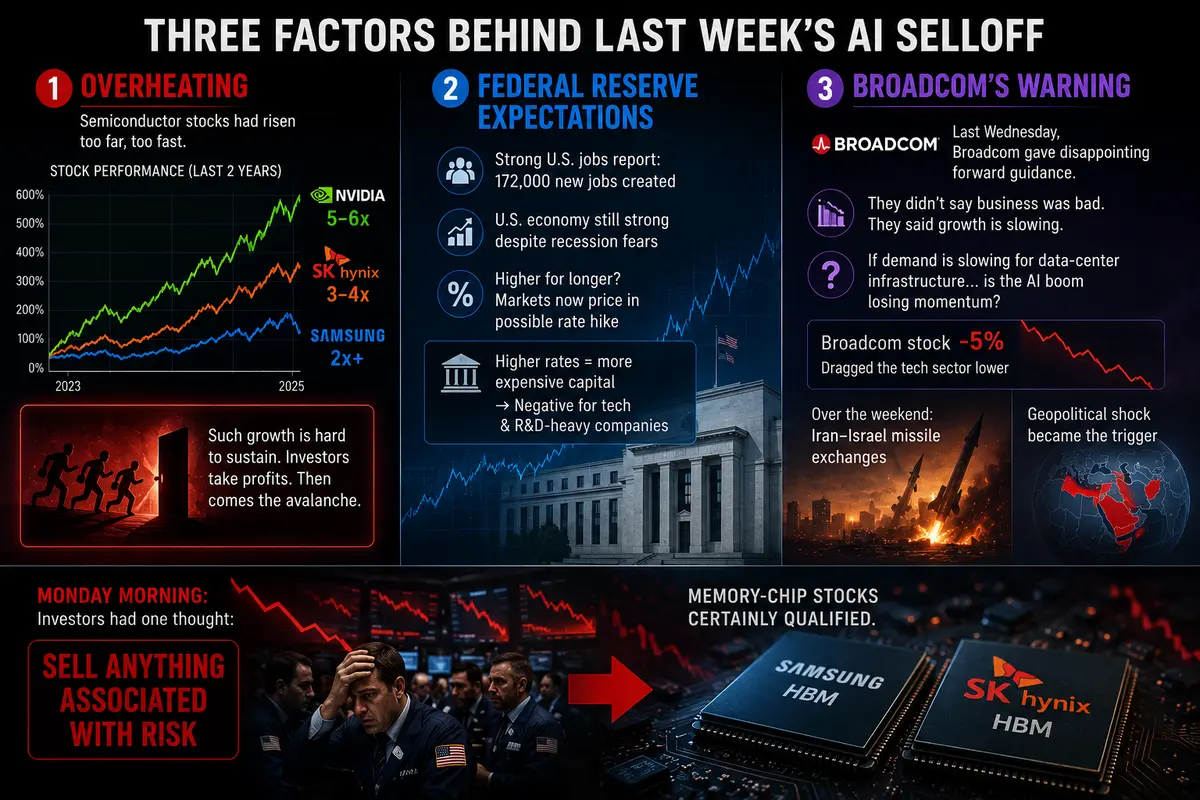
1. Overheating
Semiconductor stocks had risen too far, too fast.
-
Nvidia had gained roughly 5–6 times over the previous two years.
-
SK Hynix had risen 3–4 times.
-
Samsung had more than doubled.
Such growth rates are difficult to sustain indefinitely. Eventually investors begin taking profits. Once that process starts, it often turns into an avalanche as everyone heads for the exit at the same time.
2. Federal Reserve Expectations
Strong U.S. labor market data showed 172,000 new jobs created.
The American economy continues to expand despite repeated recession predictions. This suggests that the Federal Reserve can keep interest rates elevated for longer. Some investors are even beginning to price in the possibility of another rate increase.
Higher rates mean more expensive capital, which is generally negative for technology companies that rely heavily on research and development spending.
3. Broadcom’s Warning
Last Wednesday, Broadcom released guidance that disappointed investors.
The company did not say business was weak. It said growth was slowing.
Markets reacted immediately. If a major supplier of data-center infrastructure sees slowing demand growth, perhaps the broader AI boom is losing momentum.
Broadcom shares fell about 5%, dragging the wider technology sector lower.
Then came the Iran-Israel missile exchanges over the weekend. That geopolitical shock became the trigger.
By Monday morning, investors arrived with a simple mindset:
“Sell anything associated with risk.”
Memory-chip stocks certainly qualified.
Why the AI Bubble Hasn’t Burst Yet
There is an important nuance that many panic-driven investors overlook.
The AI bubble has not burst.
What we are witnessing looks more like a correction than a collapse.
The distinction matters.
In a true crash, stocks fall 30%, 50%, or even 70%, and remain depressed for years. In a correction, they fall 10–20% before rebounding.
SK Hynix fell 8% on Monday and rose 10.6% on Tuesday, nearly recovering all its losses. Samsung lost 10.2% and quickly regained roughly half of that decline.
That is not the behavior of a market in permanent collapse.
The fundamental drivers of the AI boom remain intact:
-
Companies continue building data centers.
-
Demand for AI training chips remains strong.
-
Nvidia continues selling accelerators faster than it can manufacture them.
-
SK Hynix and Samsung still struggle to meet demand for HBM memory.
Yes, interest rates remain high. Yes, geopolitics remains tense.
But the long-term demand for AI computing power is unlikely to disappear because of a single Broadcom forecast or one weekend of military escalation.
Investors who understand this used the selloff as a buying opportunity.
Trillion-Dollar Valuations: Are They Justified?
Earlier this year, Samsung and SK Hynix reached extraordinary valuations.
Samsung’s market capitalization exceeded $400 billion, while SK Hynix approached $150 billion. Together with Micron, valued at roughly $200 billion, they control most of the advanced memory market that powers AI applications.
Many analysts question whether such valuations are justified.
After all, memory manufacturing has historically been a cyclical business. Prices can rise sharply, but they can also fall 50–70% during downturns.
Supporters of current valuations argue that AI represents something different: a structural shift rather than a traditional cycle.
Demand for AI computing power could grow for years, perhaps decades. And memory manufacturers occupy a critical bottleneck in the supply chain. Without HBM memory, modern AI accelerators simply cannot function.
Who is right remains to be seen.
If AI transforms the world as optimists predict, current valuations may appear cheap five years from now. If AI proves to be another overhyped bubble like the dot-com era, many companies could suffer severe declines.
However, between those extremes lies a middle ground. Given their dominant positions, Samsung and SK Hynix are likely to remain industry leaders under almost any scenario.
The real question is how much they can grow.
Micron and the Global Context
No discussion of Korean chipmakers would be complete without mentioning Micron, their major American competitor.
Micron shares also declined during the selloff, though less dramatically—around 5–7%. Like its Korean rivals, the stock rebounded on Tuesday.
Micron is the third major player in the memory market behind Samsung and SK Hynix. It possesses its own HBM technologies and maintains relationships with Nvidia and AMD.
Yet in terms of manufacturing scale and technological leadership, it still trails the Korean giants.
Interestingly, the selloff affected the entire AI ecosystem:
-
Nvidia fell roughly 5–6%.
-
AMD dropped about 4%.
-
Intel declined around 3%.
All rebounded the following day.
This suggests that the problem was not company fundamentals. The issue was investor sentiment.
The market is nervous.
At the slightest sign of danger, investors run for the exits. When fear subsides, they rush back in.
What Comes Next?
Several upcoming events could influence Samsung, SK Hynix, and the broader semiconductor sector.
-
Wednesday: U.S. inflation data.
-
Thursday: U.S. producer price index data.
-
Friday: Bank of Japan policy meeting.
Higher-than-expected inflation could revive fears of tighter monetary policy and pressure technology stocks. Lower inflation could trigger another rally.
Meanwhile, the situation in the Middle East remains fragile. Any breakdown in diplomatic efforts could send oil prices higher and trigger another flight from risk assets.
For Korean chipmakers, the biggest threats currently come not from their own businesses but from external factors—macroeconomics and geopolitics.
Until those forces stabilize, volatility is likely to remain elevated.
A Long-Term Perspective: Is It Time to Buy?
For investors with a three-to-five-year horizon, Monday’s selloff may have presented an attractive entry point.
After the correction, Samsung and SK Hynix trade at valuation multiples below some historical averages. Their dividend yields are modest—around 1–2%—but provide some downside support. And if the AI boom continues, the long-term upside could be substantial.
There are risks, of course:
-
China’s economy could slow more than expected.
-
New U.S. restrictions on China could affect Korean semiconductor firms.
-
AI enthusiasm could eventually prove excessive.
Personally, after weighing all the factors, I find current levels attractive for long-term investors. Not because stocks must rise tomorrow, but because they are likely to be worth more in one or two years than they are today.
That said, this is not investment advice—just an analytical perspective.
The Bottom Line
Monday and Tuesday served as a reminder that even the strongest stocks can lose 10% in a single day—and that panic is rarely a good adviser.
Those who sold at Monday’s lows likely regretted it by Tuesday.
Those who bought were rewarded almost immediately.
SK Hynix nearly recovered all of its losses thanks to its Nvidia partnership announcement. Samsung regained roughly half of its decline. The KOSPI surged 8%, marking one of the strongest single-day moves in its history.
The underlying concerns have not disappeared. U.S. interest rates remain high. Middle East tensions remain unresolved. The AI sector still appears overheated in places.
But the market has demonstrated that it can rebound just as quickly as it falls.
Life goes on. Stocks rise and fall. Traders win and lose.
And Samsung and SK Hynix continue producing the chips that power our digital world—a fact worth remembering whenever panic takes over the market.

Comments
No comments yet. Be the first to share your thoughts!
Comments only for logged-in users.